p.11 #1 · Canon video thread for hybrid shooters...
Art, your post, and my experience in the past when I didn't have my VND with me, got me to wonder "why don't we just crank up our shutter speed when it's really bright" like we would when shooting stills and didn't want to adjust ISO or aperture. I know that having too slow of a shutter speed (less than 2X your frame rate) results in having too much motion blur. Turns out, having your shutter speed too high leads to the opposite effect. This person's video does a good job of illustrating it:
p.11 #2 · Canon video thread for hybrid shooters...
Quicksetter1 wrote:
I feel like I've discovered the Treasure of the Sierra Madre. The information and discussions have been extremely valuable and thorough to another R5 user transitioning from stills to video. Thank you all.
The subjects that I intend to video are surfing, and costal birds and landscapes.
Due to glare off of the ocean water, I generally use a polarizer to calm this issue when shooting stills. But with the mention of using ND's I have a question.
Does using a polarizer filter shooting video have any drawbacks?
Tom
On bigger motion shoots, it’s typical to combine a polarizer and a ND, but we rarely use them with a variable ND. Variable NDs are very convenient, but fixed NDs are typically better if you don’t mind the hassle(and expense) of picking one and sticking with it for a scene. We often shoot in full sun, wide open, so it’s certainly doable. Most of the higher end cameras have internal NDs that you can dial in, so it’s a bit easier. Variable NDs are very popular in the mirrorless/dslr space though, and for good reason. If I was going to use one, I’d probably want to use a higher fixed ND and then combine it with a lighter (lesser setting) variable ND to touch up exposure. I’m not sure you’d want to then stack another filter though, to get your polarizer.
As far as drawbacks to a polarizer, the main drawback is that we typically keep an eye on skin tones to make sure we aren’t removing so much glare that people start to look too plastic like. With nature and surf videos, I doubt this is something that you will run into.
p.11 #3 · Canon video thread for hybrid shooters...
Adult Bald Eagles flying close by, sticking the landing in a tree, and several eagles in a tree.
These four clips were captured in 6 minutes of different eagles to make a 2 minute video.
Below L&D 21 on Mississippi River near Quincy,Il.
Canon R5 MKII, RF200-800 4k 119.88 fps super slow motion.
p.11 #4 · Canon video thread for hybrid shooters...
dj63401 wrote:
Adult Bald Eagles flying close by, sticking the landing in a tree, and several eagles in a tree.
These four clips were captured in 6 minutes of different eagles to make a 2 minute video.
Below L&D 21 on Mississippi River near Quincy,Il.
Canon R5 MKII, RF200-800 4k 119.88 fps super slow motion.
&ab_channel=DaveJohnson
Nice tracking work. This video quality looks great on a large hi res monitor. Are you 100% hand holding or are you using a monopod or tripod?
p.11 #5 · Canon video thread for hybrid shooters...
artsupreme wrote:
Nice tracking work. This video quality looks great on a large hi res monitor. Are you 100% hand holding or are you using a monopod or tripod?
Thank You.
On a tripod.
I do handhold some with not very good results.
I do use a monopod some with so-so results.
Edit: I do use post-processing stabilization in Resolve 19. This one did not require a lot.
Dave
p.11 #7 · Canon video thread for hybrid shooters...
dj63401 wrote:
Adult Bald Eagles flying close by, sticking the landing in a tree, and several eagles in a tree.
These four clips were captured in 6 minutes of different eagles to make a 2 minute video.
Below L&D 21 on Mississippi River near Quincy,Il.
Canon R5 MKII, RF200-800 4k 119.88 fps super slow motion.
Another fabulous video, Dave! You've really got your tracking technique down to a fine art now. Wonderful!
p.11 #8 · Canon video thread for hybrid shooters...
On this day I used a gimbal. I was not real happy with my panning, these last 2 videos excepted. The next trip out, I used my video head, a Manfrotto Fluid MVH502AH. I had a handle on, but mostly panned with hands on camera. Have not processed those yet. I'm going again in the morning and plan to use the video head.
p.11 #10 · Canon video thread for hybrid shooters...
Carlo_M wrote:
It's a little bit of a complex question, and one I don't have all the answers to, but here are some things I've run across while researching NDs and PFs for use on video.
Now you don't explicitly ask this, but I'm inferring this based on your post that you normally use a polarizer for stills, and are looking to get into video. Are you asking if you can just use your polarizer instead of an ND filter?
The answer is: that depends. So a polarizer will usually only cut off a fixed amount of light, say 2 stops. Many of us here use variable ND filters at least in the 1-5 stop range, and I use the NISI system which also has an add on +4 filter so if needed I can stop down 1 - 9 stops. Why is this important? If you're shooting in a place with a lot of ambient light (daytime, outdoors) or a lot of reflected light (you say you shoot some ocean/water scenes) you're going to want to be able to stop down especially if you want to keep a certain aperture. ...Show more →
You nailed it. Shooting ocean/surfing scenes I generally use a Circ Polarizer to knock down the sun's glare off the water, which can be seen in the two examples in the pictures below. Although I can easily find 77mm filters for my RF 100-500L, the challenge is trying various ND gels for my EF 400/ 2.8, that requires "drop-in" filters. I do have a circ polarizer drop-in for that lens, but given the lighting challenges below, I'm curious if there is any benefit to purchase additional ND drop-in filters.
On the other hand, I could MacGyver a ND gel sheet on the end of my EF 400.
Thanks again for being patient with us video nuubs.
Tom
Example #1
Canon EOS R3EF400mm f/2.8L IS II USM lens400mmf/4.01/3200s160 ISO-0.3 EV
Example #2
Canon EOS R3RF100-500mm F4.5-7.1 L IS USM lens100mmf/8.01/1000s160 ISO+0.3 EV
p.11 #11 · Canon video thread for hybrid shooters...
Carlo_M wrote:
Art, your post, and my experience in the past when I didn't have my VND with me, got me to wonder "why don't we just crank up our shutter speed when it's really bright" like we would when shooting stills and didn't want to adjust ISO or aperture. I know that having too slow of a shutter speed (less than 2X your frame rate) results in having too much motion blur. Turns out, having your shutter speed too high leads to the opposite effect. This person's video does a good job of illustrating it:
So now I always have my VNDs in my camera bag. ...Show more →
No offense intended, but as someone who doesn't own a TV and can't remember the last time I went to a movie theater (I prefer reading the book to watching the movie every time) and who is a complete rookie at shooting video, that video comes across to me as complete BS. Watching the "naturally blurry" footage he shows makes me nauseous, and I prefer 1/240 hand waving over the 1/48. Not to mention, how many times does he need to say "cinematic" in 6.5 minutes.
I shoot wildlife and maybe a tiny bit of sports to view myself and share with family and friends on YouTube. My videos are never going to be viewed in a theater, and I'm not interested in being "cinematic". I'm still working on comparing the still images I took with a rental R1 and R5II last week to decide which one I want, and once I purchase one or the other I'll be able to do my own shutter speed experiments.
p.11 #12 · Canon video thread for hybrid shooters...
vbnut wrote:
No offense intended, but as someone who doesn't own a TV and can't remember the last time I went to a movie theater (I prefer reading the book to watching the movie every time) and who is a complete rookie at shooting video, that video comes across to me as complete BS. Watching the "naturally blurry" footage he shows makes me nauseous, and I prefer 1/240 hand waving over the 1/48. Not to mention, how many times does he need to say "cinematic" in 6.5 minutes.
I shoot wildlife and maybe a tiny bit of sports to view myself and share with family and friends on YouTube. My videos are never going to be viewed in a theater, and I'm not interested in being "cinematic". I'm still working on comparing the still images I took with a rental R1 and R5II last week to decide which one I want, and once I purchase one or the other I'll be able to do my own shutter speed experiments....Show more →
I agree his examples are very bad because they are very shaky and can make you sick watching it. But there are many other examples out there that show why the motion blur is natural to the human eye. Once you see it you'll likely not want to break the 180 degree rule unless you are shooting a scene without much movement.
If you are just watching on small devices it probably won't make as much of a difference but if you are watching on a large TV or nice big hi resolution display then the "cinematic" look is ideal IMO. I refuse to break the 180 degree shutter rule but I'm sure there are situations where it's okay to do.
p.11 #13 · Canon video thread for hybrid shooters...
I think the mistake here is speaking in absolutes, from either end. Sure, the shutter = 1/2xFPS formula is a “standard” in film, but is it an absolute must or else your video is totally ruined, like the YouTuber implies? No. Is it a wrong formula to follow? Also, no. It is a standard for a reason. But in the end it’s all about personal preference and need.
I personally prefer the look and motion blur from shooting 24 fps and following the formula, as opposed to the “soap opera” look that can result from higher frame rates + faster shutters - but again that’s me. Do I shoot in 24 fps and follow the formula 100% of the time? No. But I do most of the time, unless the need calls for something else.
p.11 #14 · Canon video thread for hybrid shooters...
I'm a hobbyist hybrid wildlife shooter in Ottawa Ontario so I'm out in all kinds of weather during four seasons of the year. I shoot with 3 different lenses ranging in filter size from 43mm to 95mm. In often changing settings while following frequently moving wildlife subjects having to deal with ND filters is a major pain in the petootie. I just don't do it and my videos still look fine.
I typically don't break the 180 rule regarding shutter speed and instead usually use the aperture to get proper exposure. Under extreme conditions and if there's not too much action, i.e. slow swimming ducks, perched birds, lounging foxes, I'll increase the shutter speed a bit plus use the aperture.
I'll probably continue to use this approach until hybrid cameras come with built-in NDs like my Canon FX100 had back in the day.
p.11 #15 · Canon video thread for hybrid shooters...
Quicksetter1 wrote:
You nailed it. Shooting ocean/surfing scenes I generally use a Circ Polarizer to knock down the sun's glare off the water, which can be seen in the two examples in the pictures below. Although I can easily find 77mm filters for my RF 100-500L, the challenge is trying various ND gels for my EF 400/ 2.8, that requires "drop-in" filters. I do have a circ polarizer drop-in for that lens, but given the lighting challenges below, I'm curious if there is any benefit to purchase additional ND drop-in filters.
On the other hand, I could MacGyver a ND gel sheet on the end of my EF 400.
Thanks again for being patient with us video nuubs.
As post above I gave up with VND the X pattern is just killing the image especially at or close to full strength.
I have now a few sets of NDs 82mm, 95mm and 112mm (100-300) but I'm really considering switching to the clip in ones so one set and I'm done.
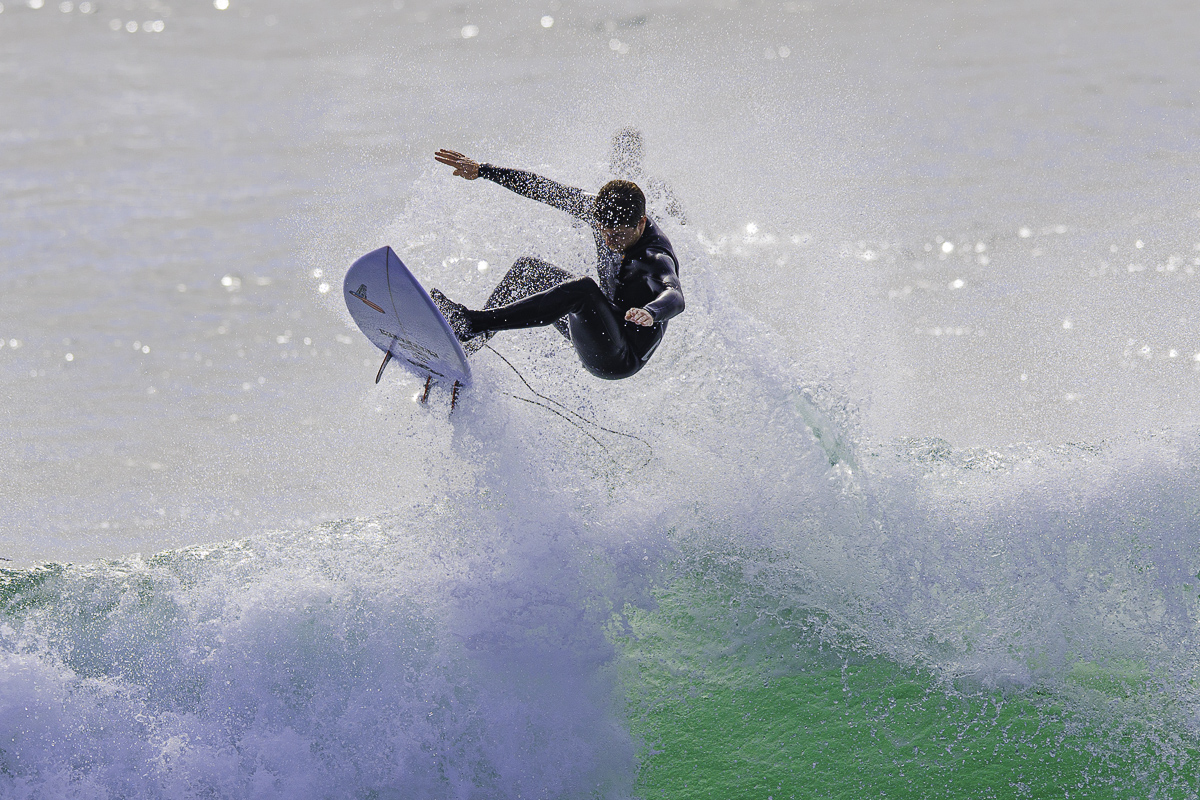
I think for sports looks good also with really high shutter speed, here me running with a gimbal at a surf wave pool probaly 1/2000
The only sports that I shoot with NDs are the one that I would photograph while panning, MTB, Cycling and Car racing, Ice hockey, ski, horse show jumping, basketball I do all at high shutter speed.
When I had the 200-400 I did find a few 52mm ND that worked in the filter holder, but many do not fit.
As post above I gave up with VND the X pattern is just killing the image especially at or close to full strength.
I have now a few sets of NDs 82mm, 95mm and 112mm (100-300) but I'm really considering switching to the clip in ones so one set and I'm done.
I think for sports looks good also with really high shutter speed, here me running with a gimbal at a surf wave pool probaly 1/2000
The only sports that I shoot with NDs are the one that I would photograph while panning, MTB, Cycling and Car racing, Ice hockey, ski, horse show jumping, basketball I do all at high shutter speed.
When I had the 200-400 I did find a few 52mm ND that worked in the filter holder, but many do not fit. ...Show more →
Fabulous video of this surfer! You really nailed it!
And no one could ever know that the shutter speed on this was 1/2000 if you didn't tell us.
Rudy
p.11 #17 · Canon video thread for hybrid shooters...
vbnut wrote:
No offense intended, but as someone who doesn't own a TV and can't remember the last time I went to a movie theater (I prefer reading the book to watching the movie every time) and who is a complete rookie at shooting video, that video comes across to me as complete BS. Watching the "naturally blurry" footage he shows makes me nauseous, and I prefer 1/240 hand waving over the 1/48. Not to mention, how many times does he need to say "cinematic" in 6.5 minutes.
I shoot wildlife and maybe a tiny bit of sports to view myself and share with family and friends on YouTube. My videos are never going to be viewed in a theater, and I'm not interested in being "cinematic". I'm still working on comparing the still images I took with a rental R1 and R5II last week to decide which one I want, and once I purchase one or the other I'll be able to do my own shutter speed experiments....Show more →
While this video does a decent job of showing how shutter angle affects the look and feel of footage, it’s doesn’t probably apply to someone like you, where cinematic just isn’t the goal, and that’s okay. Sports and wildlife are two styles where pros frequently break the 180 rule, for better or worse. People often want that extra crispness for sports, so cranking the shutter is pretty common, especially when you are looking for that effect.
Back when big movies (and music videos and commercials) were shot on film, and video was seen as being for home/news/low budget movies, people avoided cranking the shutter because it immediately exaggerated the video look, and made everything look cheap. There was an association of video with “bad/cheap” and film with “good/expensive.” You can also look back on this time as the root of people who work in film (especially DPs), hating to be called “videographers.”
Now we are so used to seeing content shot on phones and such, most people aren’t really offended by the look, though it’s still seen as less “cinematic.” Not everyone wants cinematic though, so if you like your footage, than that’s all that probably matters. There are a lot things that I avoid in my photography and motion work that most people wouldn’t care about, because we have different goals and different aesthetics.
As post above I gave up with VND the X pattern is just killing the image especially at or close to full strength.
I have now a few sets of NDs 82mm, 95mm and 112mm (100-300) but I'm really considering switching to the clip in ones so one set and I'm done.
I think for sports looks good also with really high shutter speed, here me running with a gimbal at a surf wave pool probaly 1/2000
The only sports that I shoot with NDs are the one that I would photograph while panning, MTB, Cycling and Car racing, Ice hockey, ski, horse show jumping, basketball I do all at high shutter speed.
When I had the 200-400 I did find a few 52mm ND that worked in the filter holder, but many do not fit.
...Show more →
Surf video looks great! Appreciate the example!
Dave
p.11 #19 · Canon video thread for hybrid shooters...
Oof didn't realize that guy's video was going to touch such a nerve! It was simply one of the first Google results for "what happens if shutter speed is high for mirrorless video shooting" or something like that. But it's also a good reminder that if someone starts a reply with "No offense intended"...there's probably a little offense intended
I linked to that video because I thought it did a good job in showing what happens when shutter speed is above or below 2X the frame rate of the video. Something which I think the creator of that video demonstrated to good effect. Now as others have opined, whether you like the result at very high (or very low) shutter speed, that's completely up to you as the videographer. It's your project, your shooting style, your choice. But I don't think that renders that video "complete BS" as I think someone called it.
Personally speaking I found it gave valuable insight as to why the 180 degree rule exists, and now I understand why it is desirable (but not required) for a lot of video shooting. To me, it's not about trying to be "film-like" as I'm old enough to remember when movies were projected on film, and that medium had more than its share of motion artifacts (like judder/stutter during some horizontal panning shots).
That video demonstrated to me why intuitively, my eye seems to appreciate the 180 degree rule results. Not because it's more film-like, but rather because the amount of motion blur captured with the shutter speed being 2X frame rate is very close to what my eye sees in real life. So when I watch the motion on a video I have recorded following the 180 degree rule, my brain thinks "yeah that's pretty much what motion looks like to my eyes". If the shutter speed is below the rule, my brain registers the additional blur. If the shutter speed is increased greatly, similarly my brain notices that there's much less blur and thinks of the results as appearing "hyper-realistic".
Now if you like either of those results, cool.
I'm one of those who, upon buying a new TV, the first thing I do is turn of "motion smoothing" (called by different names by different makers) so that I don't get that hyper-realistic look (or as someone earlier in the thread referred to it as: the Soap Opera Effect). I just want the film, TV show, etc. played back to me at the same frame rate (or as close as possible) that it was recorded at, not up-sped to 120hz or 240hz. I reserve those for my gaming sessions (RTX 4090 letting me get 4K 160hz ftw!). But I have friends who never turn those settings off (not sure they actually prefer the SOE, I think they just got their TV with it turned on by default and never bothered to experiment with settings).
p.11 #20 · Canon video thread for hybrid shooters...
I was surprised that, nearly a full day after your post, nobody had commented about it, so I started my response with "No offense intended" because I really didn't want to offend anyone. I really did find the blurry footage hard to watch. Headache-causing is probably a better description than nauseating. You're right that "complete BS" probably isn't fair, but, especially given how poor the footage seemed to me, the author's categorical statements came across as egoistical and condescending, which rubbed me the wrong way.
Maybe my eyes work different (better?) than other folks, so I don't see as much blur in real life, or maybe my brain works different (worse?) than other folks, so I don't realized how much blur there is in real life, but either way, as I said, his 1/240 hand waving looked better to me than the 1/48.