Do a search on eBay for "EF-D".
The guy's ID is "yoshiki_kyo". I had no issues with my purchase and shipping was pretty quick considering it came from Japan.
It came boxed in Canon packaging just as if I bought it from a camera shop.
Instructions included were in English and it came with the custom tool for switching the screens out.
Thanks, It looks like it maps the AF sensors. This may help get to know the AF characteristics under varying conditions.
On the EF-D, wouldn't the grid pattern be distracting? I can see a use if you needed strict alignment in an application, but for normal shooting would it be useful in any way?
UCSB wrote:
On the EF-D, wouldn't the grid pattern be distracting? I can see a use if you needed strict alignment in an application, but for normal shooting would it be useful in any way?
Personally I don't find them distracting, the lines are very thin and precise.
Edited by stevenas on Sep 11, 2007 at 02:16 PM GMT
Just got my 40D today. Wow, what a big upgrade from a Rebel XT. VF is nice, and blackout time is so quick, the picture shows up instantly. The shutter sound is somewhat awkward? But it is quiet, which is nice. It sounds like a goofy *clunk* to me.
What surprised me the most is when mounting my Tamron 28-75. I used to have trouble locking focus with the XT in low light. On the 40D, it locks 100% of the time! (so far), even at close distances. The Canon 17-55 IS focuses even faster with this thing.
I have the Ee-D grid screen on my 5D and the lines aren't distracting at all. You tend to look past them just like you do with the focusing points and I've found the grids to be very helpful in lining up horizons.
therock wrote:
How is the EF-D different? Or any of them? I read some are brighter than others?
The cost?
Glad to hear its not hard to install. I will be trying to track one down too. From what I've seen at the online stores its only about $35 (Au$) which is very reasonable!
I wonder if we will see any 3rd party screens hitting the market?
Thanks for the feedback on the EF-D ... I think I will pick one up. After thinking about it, it does sound useful for the countless product shots I have been doing lately.
stevenas wrote:
I found a EF-D screen and it takes all of 3 minutes to install in the 40D, very nice indeed.
I'm going to try and track one down tomorrow at a couple of the local camera stores, I have seen it at a few online stores but after factoring shipping I will rather buy locally.
The EF-D screen is something I've wanted on my other cameras, Shame Canon don't offer the on demand grid like the one found on Nikon cameras.
Hi all,
Got my 40D four days ago.Shutter sound is noisy but reassuringly solid.Light has not been good in UK so it has been difficult to evaluate the autofocus but first impressions are good.The ISO range is fantastic and noise is pleasantly low at1600.The camera is built like a tank and with BG-2 is quite heavy.
I had hoped to take the camera on holiday to Greece in two days time and give it a real workout-unfortunately it has a couple of faults and will have to go back to Jessops. The multifunction switch doesnt work and neither does the live view function.
Pete.
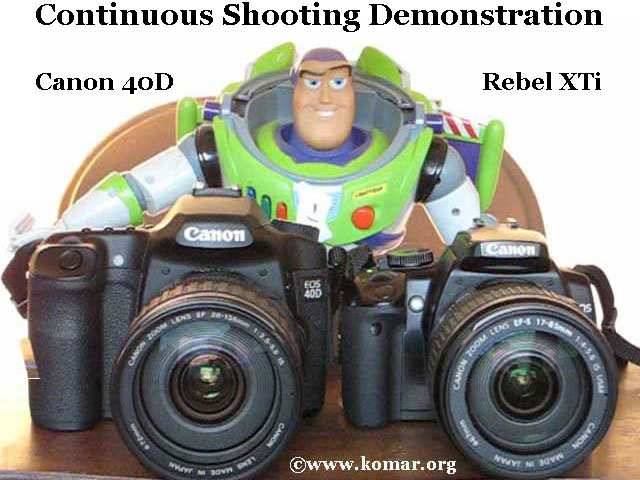
I haven't seen this mentioned much, but turns out that the 40D burst depth is quite sensitive to the ISO setting when shooting JPEG's. When I shot my video of the 40D and XTi (see picture below - heh, heh!), I only got 50 frames ... but that was ISO 3200 - I was able to get 89 at ISO 100.
You can see this for youself (without firing off a buncha shots) since the Canon 40D shows the burst depth in the viewfinder window before you even get started. Presumably, this is how much the in-camera buffer can store before it has to write to the memory card. The faster the memory card, the more frames above that number you'll be able to fire. Specifically, the number of shots available are 75 (ISO100), 74(200), 63(400), 60(800), 57(1600), and 49(3200). Page 57 of the manual says that burst depth varies with "subject, CF card brand, ISO Speed, Picture Style, etc" ... but I didn't think it would be that significant.
I would hope even with 50 frame burst depth that you would have gotten your shot by then ... but just thought I'd pass on this tidbit that confused me for a bit.
Peter twohey wrote:
Hi all,
Got my 40D four days ago.Shutter sound is noisy but reassuringly solid.Light has not been good in UK so it has been difficult to evaluate the autofocus but first impressions are good.The ISO range is fantastic and noise is pleasantly low at1600.The camera is built like a tank and with BG-2 is quite heavy.
I had hoped to take the camera on holiday to Greece in two days time and give it a real workout-unfortunately it has a couple of faults and will have to go back to Jessops. The multifunction switch doesnt work and neither does the live view function.
Pete....Show more →
I don't know if you have already tried this but;
Did you make sure you switched the On/Off switch to the second click (One click disables the switches and the second enables full control) which is there so you can leave the camera on without changing settings accidentally.
Also with the liveview feature you need to enable it in the custom function settings.
Alek Komarnits wrote:
... 40D burst depth is quite sensitive to the ISO setting when shooting JPEG's. ...
All the Canons I've had will shoot less pictures at higher ISOs than lower. You can see it on the "frames remaining" on the top of the camera. I don't know if the 40D is more sensitive in this regard.
I played with the 40D today at a local Best Buy. I was a little shocked when I saw it.
I'm not used to the buttons on the bottom and I'm not sure that I like the new position. The screen is HUGE!! Going back to my 20D made me feel a little claustrophobic. I don't mind the redesigned menu but I wish that the Custom Functions would be grouped together rather than split up like the rest of the menu. I love the favorites menu. All my favorite setting under one screen just where I like them - cool. Live view is pretty cool but forget focusing handheld at 10x or even 5x with anything long. Though I look forward to using it for star gazing and other tripod shots. The shutter is an improvement over the 20D but could be quieter still. I'm not complaining however as any improvement over the 20D is welcome. Doesn't sound like such a clunker anymore. ISO in viewfinder is an awesome addition.
I checked out the pictures I took in the store and while they were quick-and-dirty shots, I'm quite happy with them. Can't really tell much of a difference in high ISO between the 20D and the 40D. I look at this as a plus as I was always happy with the high ISO the 20D put out. I will have to admit that with NR on, the ISO 3200 file looked cleaner than the 20D.
Alek Komarnits wrote:
I haven't seen this mentioned much, but turns out that the 40D burst depth is quite sensitive to the ISO setting when shooting JPEG's. When I shot my video of the 40D and XTi (see picture below - heh, heh!), I only got 50 frames ... but that was ISO 3200 - I was able to get 89 at ISO 100.
You can see this for youself (without firing off a buncha shots) since the Canon 40D shows the burst depth in the viewfinder window before you even get started. Presumably, this is how much the in-camera buffer can store before it has to write to the memory card. The faster the memory card, the more frames above that number you'll be able to fire. Specifically, the number of shots available are 75 (ISO100), 74(200), 63(400), 60(800), 57(1600), and 49(3200). Page 57 of the manual says that burst depth varies with "subject, CF card brand, ISO Speed, Picture Style, etc" ... but I didn't think it would be that significant.
I would hope even with 50 frame burst depth that you would have gotten your shot by then ... but just thought I'd pass on this tidbit that confused me for a bit.
All files get compressed. Even RAW, they are just lossless. Compression works by grouping like adjoining pixels and replacing a say 10 black pixels with a small code that says "10 black pixels go here" (very simplified explanation). The higher the ISO the more noise and more pixel neighbors differ. Leave your lens cap on and see how many frames you can get. Should be a lot more since the whole thing is black. compare this with a busy shot of say bunches of small different colored flowers.
Kenny Donahue wrote:
All files get compressed. Even RAW, they are just lossless. Compression works by grouping like adjoining pixels and replacing a say 10 black pixels with a small code that says "10 black pixels go here" (very simplified explanation). The higher the ISO the more noise and more pixel neighbors differ. Leave your lens cap on and see how many frames you can get. Should be a lot more since the whole thing is black. compare this with a busy shot of say bunches of small different colored flowers.
Thanks,
-Kenny
Got that and have some understanding of JPEG compression ... I just didn't think it would be that major of a difference for the same scene, but different ISO's ... although now I remember that the data from my ISO shootout, showed the size of the (no-noise reduction) JPEG going from 3.7 MBytes at ISO100 to 5.8 MBytes at ISO3200.
Yea, shooting with lens cap on would probably yield very long bursts ... and HEY, there would have to be at least one good image in there - right! ;-)
Edited by Alek Komarnits on Sep 14, 2007 at 01:33 PM GMT
Sep 11, 2007 at 11:28 PM
Allen Maestas Offline • • • • • • Upload & Sell: Off
The Live view function gives just another awesome tool to landscape photographers, it worked great on my 1st processed shot. The zoom function to focus workes awesome.