arbitrage wrote:
People often bring up hummingbirds but almost every hummingbird image I've ever selected to post process has the wings either fully extended to the back or the front where you don't get distortion even with slower scanning sensors.
Or you get both in the same image, like with the A7R V...
dclark wrote:
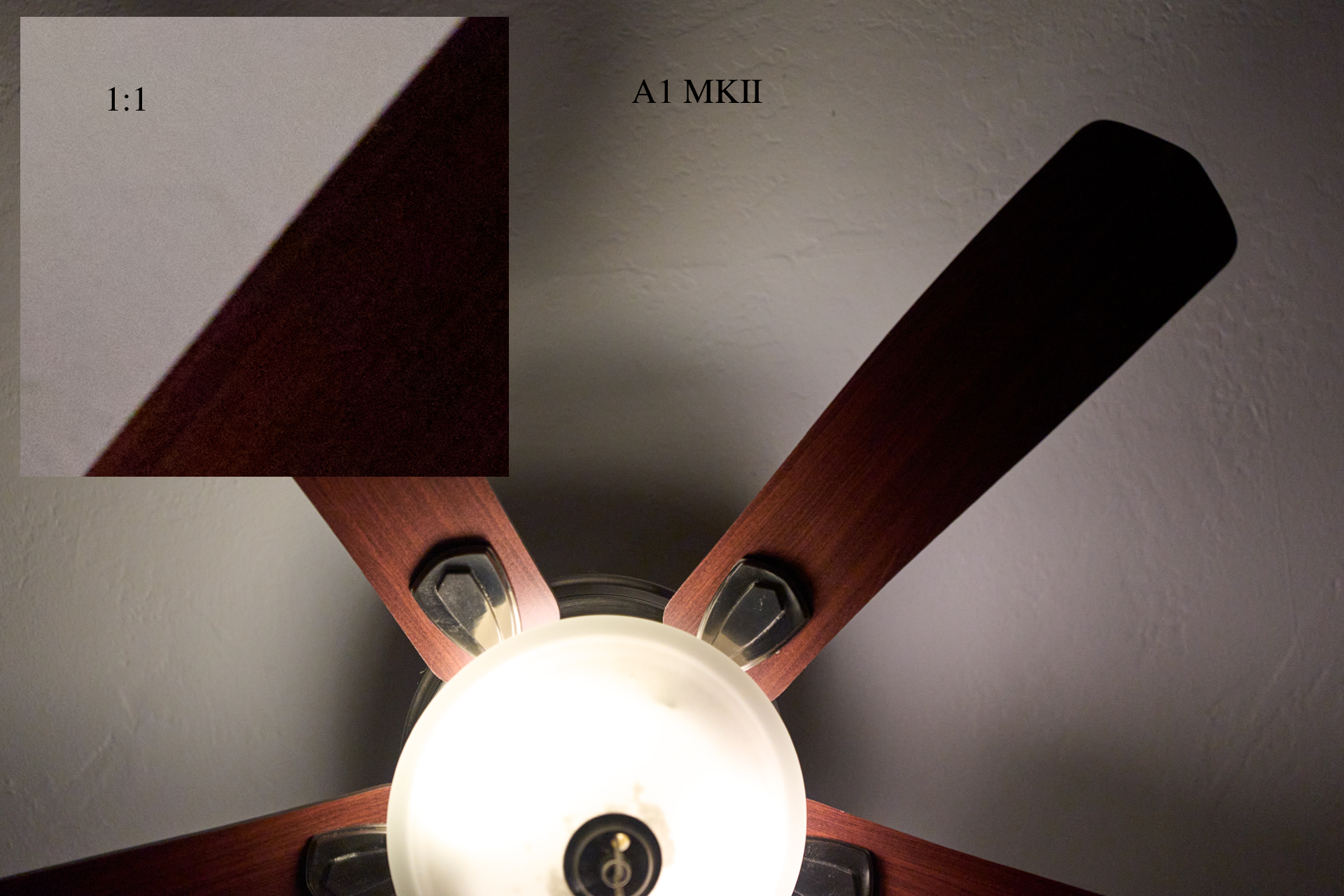
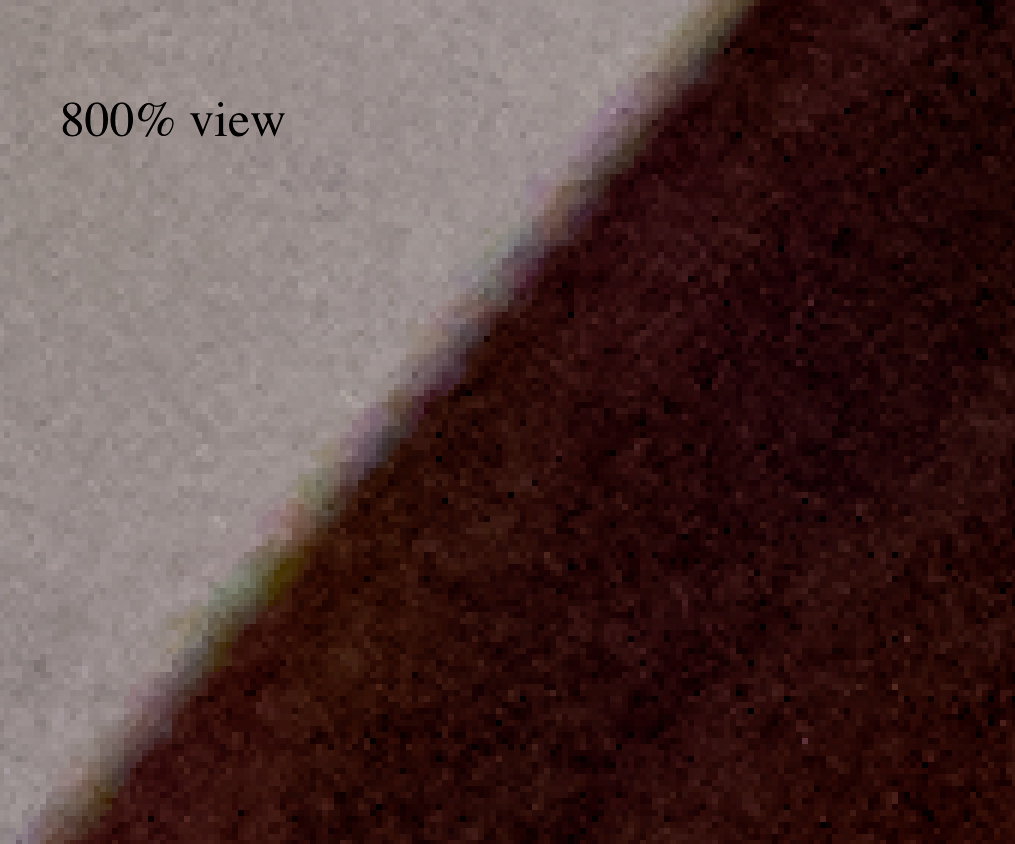
Your 1:1 photos show that the readout is 1 row at a time. If there were 12 rows it would show up clearly. Even the guessed and speculated 4 or more would be easily seen.
Agreed, that's what his ceiling fan photos indicate. Something doesn't seem right though...
If the a7rVI full-sensor readout rate is 19.7ms, that puts its per-row readout rate at 2,959 ns/row (19.7ms / 6,656 rows) if we assume a single-row readout.
The a7rV full-sensor readout rate is 100.4896ms, for a per-row readout rate of 15,860 ns/row (100.4896ms / 6,336 rows), which means the a7rVI's per-row readout rate is 5.35x faster than the a7rV (15,860 ns/2,959 ns), with no reduction in dynamic range from that much faster per-row readout.
The A1's full-sensor readout rate is 3.9117ms, for a per-row readout rate of 8,149 ns/row (3.9117ms / 5,760 rows / 12 parallel rows per readout), which implies the a7rVI is 2.75x faster than the A1 on a per-row basis (8,149ns / 2,959ns), with no reduction in dynamic range from that much faster readout.
This strikes me as highly unlikely.
Reviewing Sony's patent on novel rolling-shutter readout techniques, they describe several methods for reducing skew, some of which would obscure the telltale row-to-row staircase artifacts in a test like the ceiling fan. Specifically, an interlaced readout scheme where alternate rows are read in succession rather than each row in succession - for example, reading rows 8-1 in reverse order, followed by rows 16-9, etc.. (figure 12-B in the patent link below). This method could be combined with a parallel-row readout.
snapsy wrote:
Agreed, that's what his ceiling fan photos indicate. Something doesn't seem right though...
If the a7rVI full-sensor readout rate is 19.7ms, that puts its per-row readout rate at 2,959 ns/row (19.7ms / 6,656 rows) if we assume a single-row readout.
The a7rV full-sensor readout rate is 100.4896ms, for a per-row readout rate of 15,860 ns/row (100.4896ms / 6,336 rows), which means the a7rVI's per-row readout rate is 5.35x faster than the a7rV (15,860 ns/2,959 ns), with no reduction in dynamic range from that much faster per-row readout.
The A1's full-sensor readout rate is 3.9117ms, for a per-row readout rate of 8,149 ns/row (3.9117ms / 5,760 rows / 12 parallel rows per readout), which implies the a7rVI is 2.75x faster than the A1 on a per-row basis (8,149ns / 2,959ns), with no reduction in dynamic range from that much faster readout.
This strikes me as highly unlikely.
Reviewing Sony's patent on novel rolling-shutter readout techniques, they describe several methods for reducing skew, some of which would obscure the telltale row-to-row staircase artifacts in a test like the ceiling fan. Specifically, an interlaced readout scheme where alternate rows are read in succession rather than each row in succession - for example, reading rows 8-1 in reverse order, followed by rows 16-9, etc.. (figure 12-B in the patent link below). This method could be combined with a parallel-row readout.
You're confusing conversion times and read sequences. Reading single rows sequentially does not mean each row needs to be digitized before the next row is read. If there is a bank of sense nodes and ADC's the conversions can overlap even though the row readouts are sequential. The patent you cite discusses a few ways the sequencing can be managed. This is an example of how it is often impossible to determine from external measurements the details of how a system may be working internally. There are usually multiple ways a system could be working internally and be consistent with external observations and measurements. Without insider information it's all guess work and speculation. What we can measure is the total time aliasing in the image and whether there is a staircase pattern to the time aliasing.
Could someone please do the ceiling-fan test on an A1 or A1 II, or provide a link to a post that has already done it? Please use a shutter of1/4000 or faster, with as much light as you can throw to minimize noise. Extra credit if you can do the test at multiple fan speeds, including the fan's fastest speed
I'd like to both confirm the A1's 12-row readout and that the ceiling-fan methodology readily discovers it. I know from Jim Kasson's Z9 test that the Z9 sensor has 12-row readouts, and I know from my Z9 and A1 measurements that the two core sensors IP are the same based on their identical readout times per row (after normalizing for their slight resolution differences), so I'm expecting the A1 ceiling fan test to show the staircase pattern as well, provided again the methodology is apt.
dclark wrote:
You're confusing conversion times and read sequences. Reading single rows sequentially does not mean each row needs to be digitized before the next row is read. If there is a bank of sense nodes and ADC's the conversions can overlap even though the row readouts are sequential. The patent you cite discusses a few ways the sequencing can be managed. This is an example of how it is often impossible to determine from external measurements the details of how a system may be working internally. There are usually multiple ways a system could be working internally and be consistent with external observations and measurements. Without insider information it's all guess work and speculation. What we can measure is the total time aliasing in the image and whether there is a staircase pattern to the time aliasing. ...Show more →
Sony's Exmor column-parallel architecture performs concurrent ADCs on every column, so the digitization happens as part of the row readout. I agree there is possibly some measure of parallelization / pipelining in the process, either separately or in addition to a multi-row readout scheme.
I also agree that it may be ultimately be impossible to divine the a7rVI's readout method from observation alone, but I'd like to endeavor some experiments before concluding this is one of those instances.
duncangr wrote:
But if you have the same FOV in APS-C mode as in FF mode then the slope will be quite a bit less. As you rightly point out cropping alone will make no difference.
the slope does not change in APS-C mode, it's the same. Slope is limited by sensor electronics not FoV or anything like that.
if you want to get same FoV in APS-C as FF you have to walk quite a bit back from the bird that will reduce the rotational speed as you pan from much farther away and makes the distortion less .... but no one would switch to APS-C and the walk back from the bird to end up with a low resolution image of a far bird.... doesn't makes sense really
dclark wrote:
Your 1:1 photos show that the readout is 1 row at a time. If there were 12 rows it would show up clearly. Even the guessed and speculated 4 or more would be easily seen.
I think so, or let say most likely.... but even when the rows are grouped they are still scanned in staggered fashion, the stagger delay can be micro second range, the groups on the other hand can have large offset which would create the kind of staircase you mention ( which this test rules out obviously ) but they can also have very small offset that is not visible.... there are commercial examples of each....so I am not certain 100% but as far as effect in the photos are concerned I am with you to call it rolling.
speedmaster20d wrote:
the slope does not change in APS-C mode, it's the same. Slope is limited by sensor electronics not FoV or anything like that.
if you want to get same FoV in APS-C as FF you have to walk quite a bit back from the bird that will reduce the rotational speed as you pan from much farther away and makes the distortion less .... but no one would switch to APS-C and the walk back from the bird to end up with a low resolution image of a far bird.... doesn't makes sense really
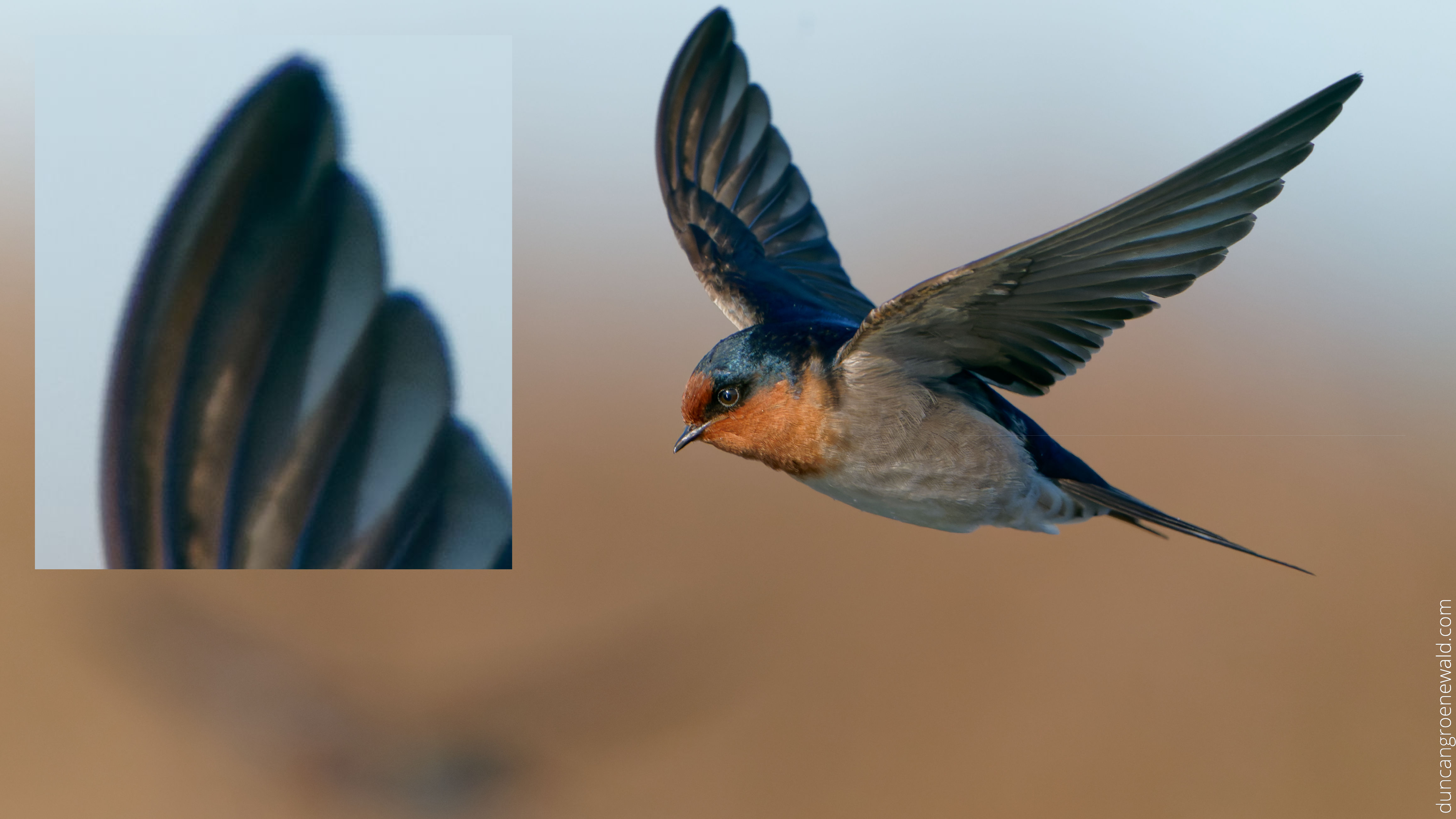
If you fill the frame with a swallow flying towards you in FF mode the distortion will be greater than if you fill the frame on the same bird in APS-C mode.
Why would you do that in FF mode - more pixels = more detail.
Why would you do that in APS-C mode rather than just cropping - potentially better camera performance and less distortion, longer buffer, better AF, EVF etc. assuming of course those do realise a benefit in APS-C mode.
speedmaster20d wrote:
I think so, or let say most likely.... but even when the rows are grouped they are still scanned in staggered fashion, the stagger delay can be micro second range, the groups on the other hand can have large offset which would create the kind of staircase you mention ( which this test rules out obviously ) but they can also have very small offset that is not visible.... there are commercial examples of each....so I am not certain 100% but as far as effect in the photos are concerned I am with you to call it rolling.
It does not matter if they are digitized at different times, it only matters when charge transfer to the sense node is triggered. I suppose there may be some variation by row that is difficult to detect in the image, but if it's difficult to detect in measurements like this, it is unimportant so far as rolling shutter distortion is concerned. If we can't see it in test images meant to show it, who cares? BTW, the appearance of the staircase in the A9 is shown in my post from a few years ago that is linked earlier in this thread.
dclark wrote:
It does not matter if they are digitized at different times, it only matters when charge transfer to the sense node is triggered. I suppose there may be some variation by row that is difficult to detect in the image, but if it's difficult to detect in measurements like this, it is unimportant so far as rolling shutter distortion is concerned. If we can't see it in test images meant to show it, who cares? BTW, the appearance of the staircase in the A9 is shown in my post from a few years ago that is linked earlier in this thread....Show more →
yes the conversion (digitization) time does not matter , it is decoupled from charge transfer from the photo cells.
in a generic image sensor ( I don't claim to know any specific details about Sony and even if I knew I wouldn't disclose here )
- the row to row rolling stagger delay is to let each (long) row's voltage initialize and settle before the charge transfer gates can open. after the gate opens , charge is shared and we have to wait again for the critical voltages to settle before we move on to the next row.
- sometimes these rows are grouped together so that they can share initialization and settle time, but it requires stronger source drivers and can increase power. if you zoom into the group there is a little bit of staggering of rows still but could be small.
- There could be time offset between these groups, the offset can be large or small depending on how many source drivers you have and other design details....
measuring this detail timing require disassembling the camera and probing certain traces with an oscilloscope while still driving the image sensor with an FPGA copying the camera's logic. There could be some creative ways to guesstimate it by an optical setup .... but honestly who has the time and motivation to do it and as you say if it doesn't show up in a photograph why care ?
I have no clue what exactly Sony does but it could be that in their current cameras they use mostly a rolling scheme and it could be that in the A9 that had a different scheme that resulted in those staircases artifacts.
----------
sorry bit of tangent above - we can focus back on the photographic aspect.
I think we can say for photographic purposes all these cameras are using rolling scan with no such thing as `4 or 8 or 12' rows and I also measured the readout times so we got all that we really care about already
what I plan to do with these readout times is make a table and estimate what panning conditions are problematic and then give this camera a final verdict.
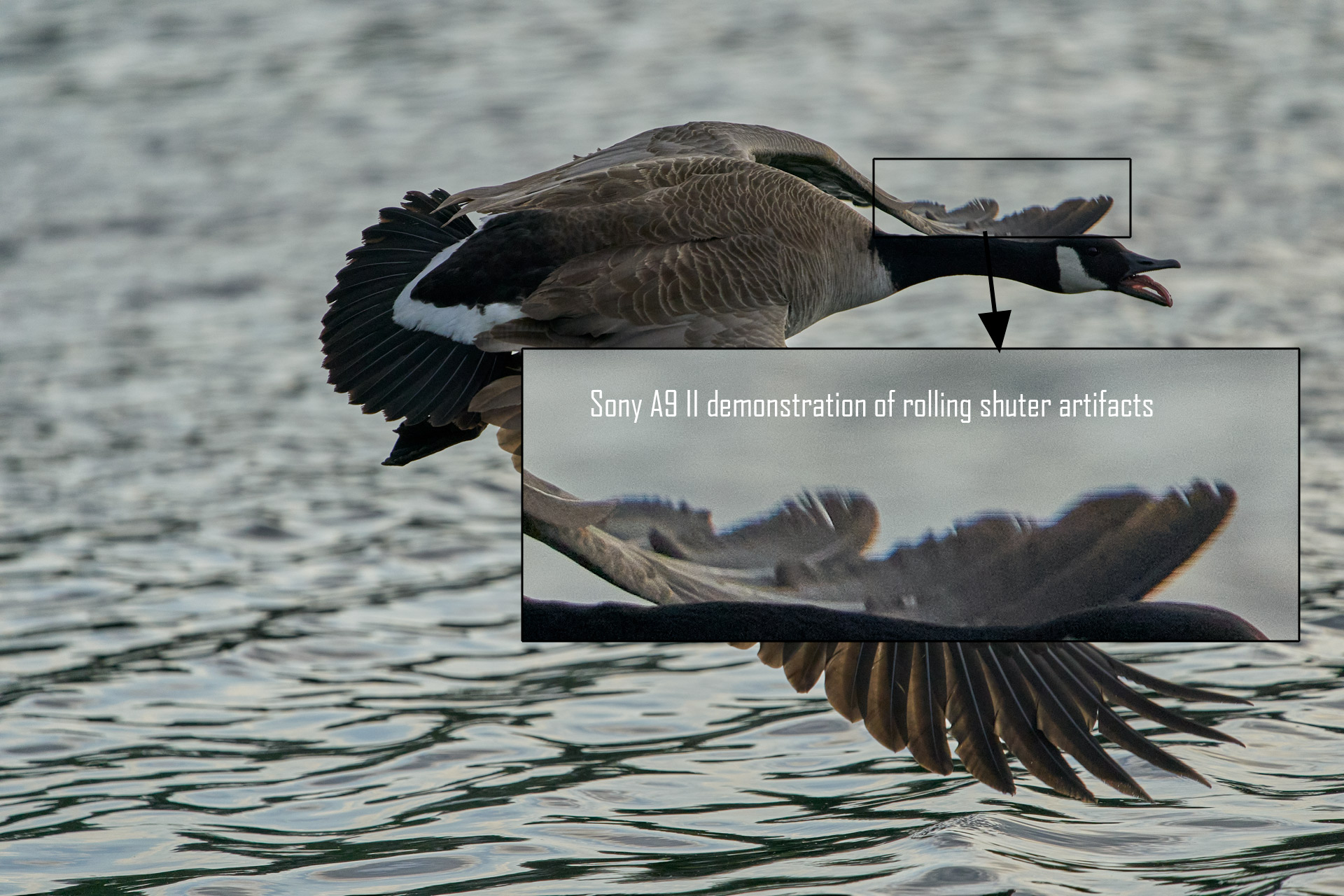
Edit : I went back and looked at my A9 II files, I can see the same kind of artifact Dave had found... never seen this on 300K worth of A1 and A1 II files. so there was something different for that camera but it's hard to tell exactly what beyond a guess just by looking at this image
it also appears that the A7RVI focus distance record and recall feature does not work with zoom lenses, whereas the A1 does..... I have contact Sony to confirm.
- the choppy / stuttering image in the EVF when AF is engaged actually changes with RAW compression setting, it is unbearable for lossless compressed RAW and pretty bad for HQ compressed RAW, it only becomes tolerable for me with lossy compressed RAW
edit: this happens when the pre-capture is set to ON
speedmaster20d wrote:
this should debunk the claim / speculation about A1 II is reading in 12 or 8 rows.
I think it's best to refrain from framing speculations / rumors as facts without solid proof.
Thanks for performing this test! While I said it was unlikely the a7rVI was reading only a single row at a time, it's even more unlikely for the A1. It's implausible the A1 is achieving its readout speeds with a single row readout - that would represent almost half an order of magnitude improvement in sensor technology, over just a single sensor generation. The fact the Z9 sensor has 12-row readouts makes it A1 not having exceedingly unlikely - the Z9 sensor has identical readout speeds as the A1 when normalized for their slight row count differences, indicating they're share the same core sensor IP.
I'm much more apt to believe the absence of the stair-case artifact in your A1 test indicates this particular ceiling fan / speed / arrangement / image noise is failing to manifest it or, more unlikely, that Sony is using one of the alternate, novel readout schemes I referenced from their patent and that this changed for the A1 II vs A1 I sensor.
snapsy wrote:
Thanks for performing this test! While I said it was unlikely the a7rVI was reading only a single row at a time, it's even more unlikely for the A1. It's implausible the A1 is achieving its readout speeds with a single row readout - that would represent almost half an order of magnitude improvement in sensor technology, over just a single sensor generation. The fact the Z9 sensor has 12-row readouts makes it A1 not having exceedingly unlikely - the Z9 sensor has identical readout speeds as the A1 when normalized for their slight row count differences, indicating they're share the same core sensor IP.
I'm much more apt to believe the absence of the stair-case artifact in your A1 test indicates this particular ceiling fan / speed / arrangement / image noise is failing to manifest it or, more unlikely, that Sony is using one of the alternate, novel readout schemes I referenced from their patent and that this changed for the A1 II vs A1 I sensor....Show more →
I am sorry but all of the above is nothing but speculation. There is zero evidence for all of these claims. Maybe you should be aware that just because a company files a patent, it doesn't mean they execute every single product like that and it can be totally irrelevant. If you ever work for a big tech company then you would know that the critical stuff is rarely if ever patented. patents are public and expire, trade secrets don't.
snapsy wrote:
Thanks for performing this test! While I said it was unlikely the a7rVI was reading only a single row at a time, it's even more unlikely for the A1. It's implausible the A1 is achieving its readout speeds with a single row readout - that would represent almost half an order of magnitude improvement in sensor technology, over just a single sensor generation. The fact the Z9 sensor has 12-row readouts makes it A1 not having exceedingly unlikely - the Z9 sensor has identical readout speeds as the A1 when normalized for their slight row count differences, indicating they're share the same core sensor IP.
I'm much more apt to believe the absence of the stair-case artifact in your A1 test indicates this particular ceiling fan / speed / arrangement / image noise is failing to manifest it or, more unlikely, that Sony is using one of the alternate, novel readout schemes I referenced from their patent and that this changed for the A1 II vs A1 I sensor....Show more →
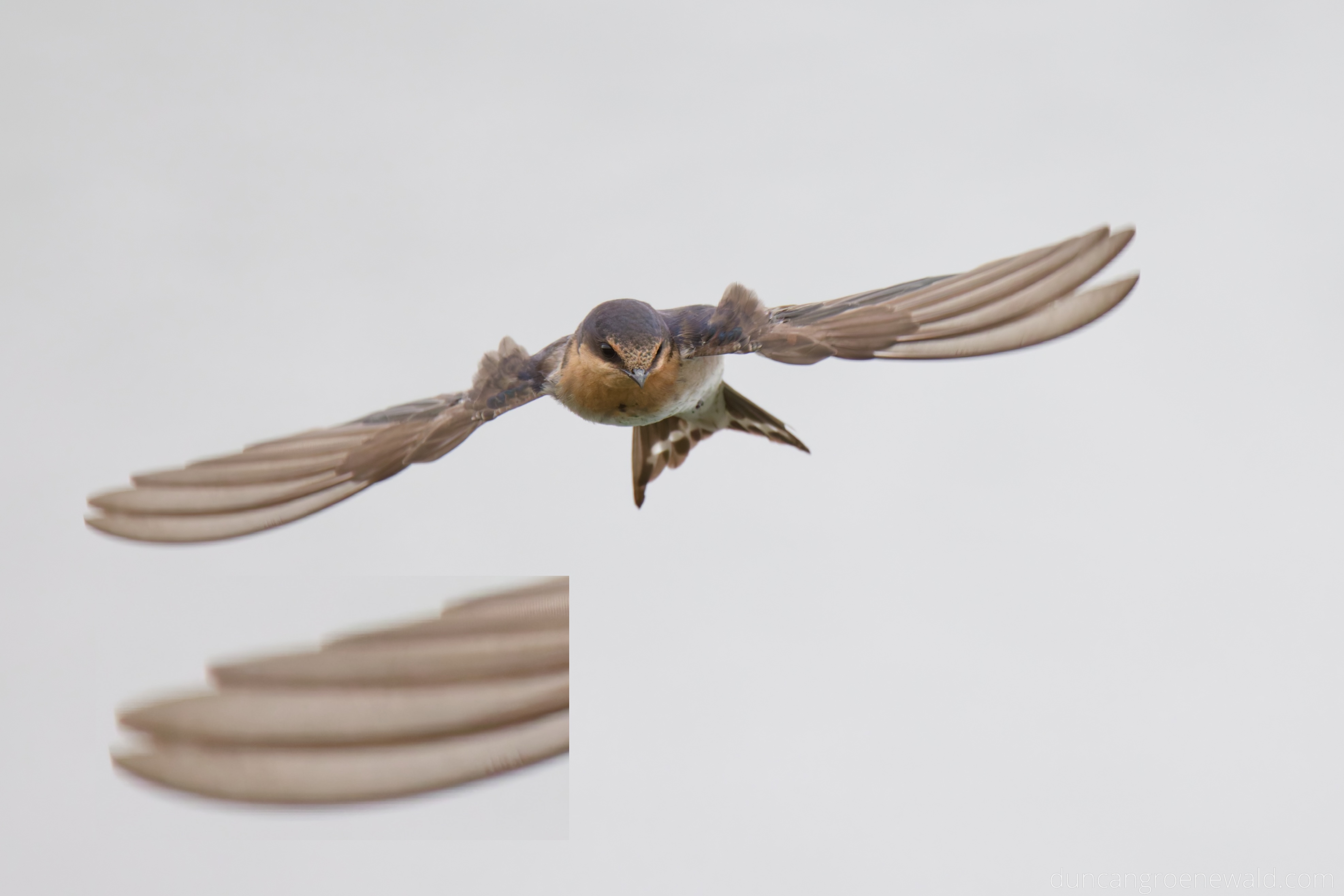
I recently used an R5m2 shooting swallows and the jagis on the wings were clearly visible and awful.
I have seen this on the A9 where they are barely visible but have never seen this on any A1/A1ii or A9iii images - and I have many thousands from the A1 - the edges all appear to be consistently smooth like the edges in the fan images above.
A9 Jaggies
R5M2 Jaggies
EDIT:
Couldn't find any evidence of these artifacts in the Z9 swallow images either.
I did some digging in the facts, that means Sony's publications in peer reviewed journal, not internet rumors.
It turns out that Sony actually published the A1 sensor design and featured at ISSCC 2021 titled
ISSCC 2021: Sony 50.1MP Full-Frame Sensor with Sigma-Delta ADC and kTC Noise Reduction
Sony's technical paper reveals the facts and repeals fiction, rumors and speculations.
I attached the PDF down below,
what the paper reveals are several feature for the A1 sensor (to ones skilled in the art)
* column-parallel ΔΣ ADC
* pipelined S&H + kTC cancellation
* simultaneous multi-row pipeline stages with heavy parallel processing to achieve high FPS
However one not skilled in the art would easily confuse these two fundamental concepts as Dave Clark also pointed out earlier in this thread.
(1) charge transfer / pixel read (physical rolling shutter mechanism)
vs
(2) downstream conversion / ADC / processing pipeline
That distinction is crucial. The rolling shutter is result of (1) not (2)
what the paper reveals in horizontal scan diagram is consistent with row-by-row (or line-by-line) charge transfer with heavy downstream pipelining that was novel.
The converted photons are locked into electrical charge, and the charge transfer is row by row. but in parallel we have digital operation that can happen like below.
So while row N is being converted:
* row N+1 is being sampled
* row N−1 is in ADC stage
* row N−2 is in digital readout
the row N does not have to wait for row N-1 digital stages to finish, it just rolls on....
So as far as Sony A1 is concerned facts align and sensor architecture is consistent with the simple fan test, because of course there are no "alternative facts".
There is no evidence whatsoever to hint at multiple physically separated rows transferring charge simultaneously as a unit for A1 . That would require:
* multi-row global transfer gates
* or charge-domain batching memory per row group
and would be very unique. There is ZERO evidence of this and from a technical point of view it makes no sense (again to the skilled in the art).
and to understand what is really happening in cameras that show a certain different signature we need this kind of technical document to look at and should refrain from presenting speculations as facts.
good observations and data are facts, but hypothesis are not facts until proven beyond a reasonable doubt




 but as far as effect in the photos are concerned I am with you to call it rolling.