arbitrage wrote:
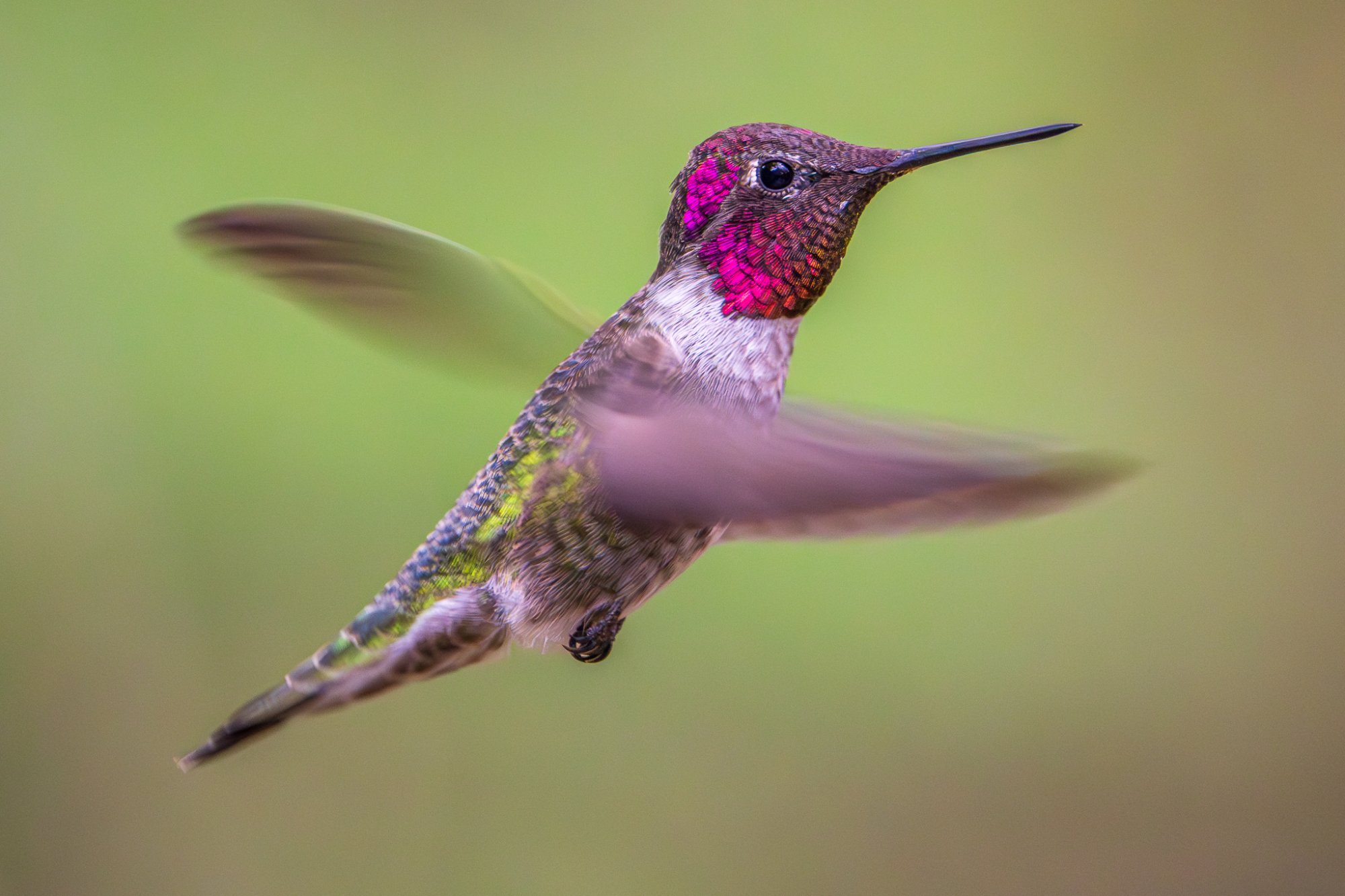
People often bring up hummingbirds but almost every hummingbird image I've ever selected to post process has the wings either fully extended to the back or the front where you don't get distortion even with slower scanning sensors.
Or you get both in the same image, like with the A7R V...
dclark wrote:
Your 1:1 photos show that the readout is 1 row at a time. If there were 12 rows it would show up clearly. Even the guessed and speculated 4 or more would be easily seen.
Agreed, that's what his ceiling fan photos indicate. Something doesn't seem right though...
If the a7rVI full-sensor readout rate is 19.7ms, that puts its per-row readout rate at 2,959 ns/row (19.7ms / 6,656 rows) if we assume a single-row readout.
The a7rV full-sensor readout rate is 100.4896ms, for a per-row readout rate of 15,860 ns/row (100.4896ms / 6,336 rows), which means the a7rVI's per-row readout rate is 5.35x faster than the a7rV (15,860 ns/2,959 ns), with no reduction in dynamic range from that much faster per-row readout.
The A1's full-sensor readout rate is 3.9117ms, for a per-row readout rate of 8,149 ns/row (3.9117ms / 5,760 rows / 12 parallel rows per readout), which implies the a7rVI is 2.75x faster than the A1 on a per-row basis (8,149ns / 2,959ns), with no reduction in dynamic range from that much faster readout.
This strikes me as highly unlikely.
Reviewing Sony's patent on novel rolling-shutter readout techniques, they describe several methods for reducing skew, some of which would obscure the telltale row-to-row staircase artifacts in a test like the ceiling fan. Specifically, an interlaced readout scheme where alternate rows are read in succession rather than each row in succession - for example, reading rows 8-1 in reverse order, followed by rows 16-9, etc.. (figure 12-B in the patent link below). This method could be combined with a parallel-row readout.
snapsy wrote:
Agreed, that's what his ceiling fan photos indicate. Something doesn't seem right though...
If the a7rVI full-sensor readout rate is 19.7ms, that puts its per-row readout rate at 2,959 ns/row (19.7ms / 6,656 rows) if we assume a single-row readout.
The a7rV full-sensor readout rate is 100.4896ms, for a per-row readout rate of 15,860 ns/row (100.4896ms / 6,336 rows), which means the a7rVI's per-row readout rate is 5.35x faster than the a7rV (15,860 ns/2,959 ns), with no reduction in dynamic range from that much faster per-row readout.
The A1's full-sensor readout rate is 3.9117ms, for a per-row readout rate of 8,149 ns/row (3.9117ms / 5,760 rows / 12 parallel rows per readout), which implies the a7rVI is 2.75x faster than the A1 on a per-row basis (8,149ns / 2,959ns), with no reduction in dynamic range from that much faster readout.
This strikes me as highly unlikely.
Reviewing Sony's patent on novel rolling-shutter readout techniques, they describe several methods for reducing skew, some of which would obscure the telltale row-to-row staircase artifacts in a test like the ceiling fan. Specifically, an interlaced readout scheme where alternate rows are read in succession rather than each row in succession - for example, reading rows 8-1 in reverse order, followed by rows 16-9, etc.. (figure 12-B in the patent link below). This method could be combined with a parallel-row readout.
You're confusing conversion times and read sequences. Reading single rows sequentially does not mean each row needs to be digitized before the next row is read. If there is a bank of sense nodes and ADC's the conversions can overlap even though the row readouts are sequential. The patent you cite discusses a few ways the sequencing can be managed. This is an example of how it is often impossible to determine from external measurements the details of how a system may be working internally. There are usually multiple ways a system could be working internally and be consistent with external observations and measurements. Without insider information it's all guess work and speculation. What we can measure is the total time aliasing in the image and whether there is a staircase pattern to the time aliasing.
Could someone please do the ceiling-fan test on an A1 or A1 II, or provide a link to a post that has already done it? Please use a shutter of1/4000 or faster, with as much light as you can throw to minimize noise. Extra credit if you can do the test at multiple fan speeds, including the fan's fastest speed
I'd like to both confirm the A1's 12-row readout and that the ceiling-fan methodology readily discovers it. I know from Jim Kasson's Z9 test that the Z9 sensor has 12-row readouts, and I know from my Z9 and A1 measurements that the two core sensors IP are the same based on their identical readout times per row (after normalizing for their slight resolution differences), so I'm expecting the A1 ceiling fan test to show the staircase pattern as well, provided again the methodology is apt.
dclark wrote:
You're confusing conversion times and read sequences. Reading single rows sequentially does not mean each row needs to be digitized before the next row is read. If there is a bank of sense nodes and ADC's the conversions can overlap even though the row readouts are sequential. The patent you cite discusses a few ways the sequencing can be managed. This is an example of how it is often impossible to determine from external measurements the details of how a system may be working internally. There are usually multiple ways a system could be working internally and be consistent with external observations and measurements. Without insider information it's all guess work and speculation. What we can measure is the total time aliasing in the image and whether there is a staircase pattern to the time aliasing. ...Show more →
Sony's Exmor column-parallel architecture performs concurrent ADCs on every column, so the digitization happens as part of the row readout. I agree there is possibly some measure of parallelization / pipelining in the process, either separately or in addition to a multi-row readout scheme.
I also agree that it may be ultimately be impossible to divine the a7rVI's readout method from observation alone, but I'd like to endeavor some experiments before concluding this is one of those instances.