This topic is in the 2024 archive. You can read it and like its posts here. It is read only.
Archive 2024New Cosina Voigtländer 50/3.5 APO & 50/2.2 VM announcement
p.19 #1New Cosina Voigtländer 50/3.5 APO & 50/2.2 VM announcement
It suggests there are trade-offs in lens design that have an effect on the 'diffraction profile' (we can call it). And that using the same methodology, these profiles vary considerably, making them even more important.
While looking at this matter, I noticed the MTF graphs for the Leica 50mm SL lenses (f1.4 and f2) indicate almost no fall-off from wide apertures to f8. It's doubtful you can cheat diffraction so easily. It raises questions about their methodology, but at least they report f8 data.
Like focus breathing (which tends to get waved away as 'it doesn't matter for stills photographers' (!)), it's a blind spot for you to figure out - after you buy a lens and compare it with others at that FL.
But aperture-related image quality is very important to photographers using mid-apertures frequently. Zeiss used to give Lloyd Chambers the entire MTF by aperture series, but he craftily put them behind his $$ wall. Zeiss gave them to him but not their users! He hides it to make subscription money. It's enough reason to not pay him, IMO. Example:
'Aperture series 1.8,2,2.8,4,5.6,8,11,16 available in full article
MTF for Zeiss Batis 85mm f/1.8 Sonnar from f/1.8 through f/16'
Aug 07, 2024 at 03:22 PM
p.19 #2New Cosina Voigtländer 50/3.5 APO & 50/2.2 VM announcement
philip_pj wrote:
It suggests there are trade-offs in lens design that have an effect on the 'diffraction profile' (we can call it). And that using the same methodology, these profiles vary considerably, making them even more important.
While looking at this matter, I noticed the MTF graphs for the Leica 50mm SL lenses (f1.4 and f2) indicate almost no fall-off from wide apertures to f8. It's doubtful you can cheat diffraction so easily. It raises questions about their methodology, but at least they report f8 data.
Like focus breathing (which tends to get waved away as 'it doesn't matter for stills photographers'...Show more →
Lloyd's aperture series are just him taking a given scene and providing high res shots taken at all apertures. I don't think he had any special MTF charts, but it's been years since I subscribed to his Zeiss classic lens section, so I don't recall exactly.
Aug 07, 2024 at 03:42 PM
p.19 #3New Cosina Voigtländer 50/3.5 APO & 50/2.2 VM announcement
The reference Philip provided did include MTF charts from f/1.8 to f/16 for the Batis 85, and they did reasonably look like the Zeiss ones, so I think he's probably correct on that.
highdesertmesa wrote:
While looking at this matter, I noticed the MTF graphs for the Leica 50mm SL lenses (f1.4 and f2) indicate almost no fall-off from wide apertures to f8. It's doubtful you can cheat diffraction so easily. It raises questions about their methodology, but at least they report f8 data.
Like focus breathing (which tends to get waved away as 'it doesn't matter for stills photographers' (!)), it's a blind spot for you to figure out - after you buy a lens and compare it with others at that FL.
But aperture-related image quality is very important to photographers using mid-apertures frequently. Zeiss used to give Lloyd Chambers the entire MTF by aperture series, but he craftily put them behind his $$ wall. Zeiss gave them to him but not their users! He hides it to make subscription money. It's enough reason to not pay him, IMO. Example:
'Aperture series 1.8,2,2.8,4,5.6,8,11,16 available in full article
MTF for Zeiss Batis 85mm f/1.8 Sonnar from f/1.8 through f/16'Lloyd's aperture series are just him taking a given scene and providing high res shots taken at all apertures. I don't think he had any special MTF charts, but it's been years since I subscribed to his Zeiss classic lens section, so I don't recall exactly.
highdesertmesa wrote:
philip_pj wrote
It suggests there are trade-offs in lens design that have an effect on the 'diffraction profile' (we can call it). And that using the same methodology, these profiles vary considerably, making them even more important.While looking at this matter, I noticed the MTF graphs for the Leica 50mm SL lenses (f1.4 and f2) indicate almost no fall-off from wide apertures to f8. It's doubtful you can cheat diffraction so easily. It raises questions about their methodology, but at least they report f8 data.
Like focus breathing (which tends to get waved away as 'it doesn't matter for stills photographers' (!)), it's a blind spot for you to figure out - after you buy a lens and compare it with others at that FL.
But aperture-related image quality is very important to photographers using mid-apertures frequently. Zeiss used to give Lloyd Chambers the entire MTF by aperture series, but he craftily put them behind his $$ wall. Zeiss gave them to him but not their users! He hides it to make subscription money. It's enough reason to not pay him, IMO. Example:
'Aperture series 1.8,2,2.8,4,5.6,8,11,16 available in full article
MTF for Zeiss Batis 85mm f/1.8 Sonnar from f/1.8 through f/16'
Aug 07, 2024 at 04:20 PM
p.19 #4New Cosina Voigtländer 50/3.5 APO & 50/2.2 VM announcement
(Before putting on the Sherlock Holmes hat, it's important to recognise the technical efforts of all reviewers, particularly the doyen of them: FM. It was much worse in the bad old days.)
Now I can see what has happened: Zeiss gave Lloyd (LC) an early copy with the full aperture range. He published it (page is dated 2022) and I just found it:
https://diglloyd.com/blog/2015/20150429_1044-ZeissBatis-85f1_8-MTF.html
LC made a new page (dated 2024-08-07) with just the f1.8 MTF:
https://diglloyd.com/prem/s/ML/ZeissBatis/ZeissBatis85f1_8-MTF.html
The graph (for just f1.8) on this page is an excerpt from his earlier page.
Zeiss made some changes which show up at f1.8 and f4 (maybe (probably) other apertures too, unpublished). Both apertures are different to LC's pages - it's subtle but it's there, a bit worse in the outer frame:
https://www.zeiss.com/content/dam/consumer-products/downloads/photography/datasheets/en/batis-lenses/datasheet-zeiss-batis-1885. pdf (remove the space before 'pdf' in case it might load)
Now to: 'Lloyd's aperture series are just him taking a given scene and providing high res shots taken at all apertures.'
On LC's original 'full apertures' page, in small italicised font at the bottom we see the text: "Graphs courtesy of Carl Zeiss". LC doesn't have a K8.
Aug 07, 2024 at 06:02 PM
p.19 #5New Cosina Voigtländer 50/3.5 APO & 50/2.2 VM announcement
Using the Batis 85/1.8 Zeiss aperture series linked above, the on axis 40lpmm measures are very different to the Lenstip data for the CV 35/50 APO, in that they stay high even at f11. Here they are: f1.8: 66%; f2: 69%; f2.8: 76%; f4: 78%; f5,6 79%; f8: 75%; f11: 70%.
Then I saw Leica's SL 50/2 MTF - they claim the same (very high: 80%) image quality at f8 as at f2, with just a percentage point or two in it. The 35/2 SL is similar. Could it be the Imatest methodology showing incorrect data for the CV lenses?
Then I saw Leica's SL 50/2 MTF - they claim the same (very high: 80%) image quality at f8 as at f2, with just a percentage point or two in it. The 35/2 SL is similar. Could it be the Imatest methodology showing incorrect data for the CV lenses?
Aug 07, 2024 at 06:37 PM

p.19 #6New Cosina Voigtländer 50/3.5 APO & 50/2.2 VM announcement
philip_pj wrote:
Using the Batis 85/1.8 Zeiss aperture series linked above, the on axis 40lpmm measures are very different to the Lenstip data for the CV 35/50 APO, in that they stay high even at f11. Here they are: f1.8: 66%; f2: 69%; f2.8: 76%; f4: 78%; f5,6 79%; f8: 75%; f11: 70%.
Then I saw Leica's SL 50/2 MTF - they claim the same (very high: 80%) image quality at f8 as at f2, with just a percentage point or two in it. The 35/2 SL is similar. Could it be the Imatest methodology showing incorrect data for the CV lenses?...Show more →
I think you have raised an important issue, but it is one on which it is hard to get good data. I am not a huge fan of Imatest results especially for testing one lens at a time that isn't even necessarily selected to be a good copy. And sometimes you get very different results. For example, the Voigtlander 50 f/2 APO when tested by ephotozine has excellent MTF50 at what they call both the centre and the edge all the way through f/11 with very little drop in performance as you stop down. In fact, f/11 is basically the same performance as f/2. See their results here:
https://www.ephotozine.com/article/voigtlander-50mm-f-2-apo-lanthar-e-lens-review-35712/performance
In contrast Lenstip gets very different results. They report big drops in MTF50 at f/8 and f/11 at the center, APS-C edge, and edge that are well below how the lens performs at f/2. See their results here:
https://www.lenstip.com/613.4-Lens_review-Voigtlander_Apo_Lanthar_50_mm_f_2_Aspherical_Image_resolution.html
Perhaps the difference is the camera used as that does affect MTF50 results, but still those two tests look nothing alike and especially on the issue of whether the lens loses performance at narrower apertures. The ephotozine results suggests it doesn't the Lenstip review suggests it does. How do we resolve such discrepant results?
I think there is a pretty easy answer and that is looking at Fred's reviews which thoroughly test how lenses perform stopped down and tests lenses compared to several other lenses in the same conditions and he makes sure he gets a good copy.
On this particular lens with Fred's test we see that the lens does decrease in performance when stopped down to f/8 and f/11 but still performs at least as well as the several other lenses to which he compared it. I think for that bottom line the decreased performance of the Voigtlander 50 f/2 APO at narrower apertures is not an issue. The lens does well at those apertures and at least as well as the alternatives. Now will it beat the new Voigtlander 50 f/3.5 APO? We will have to wait to see and there is little doubt Fred will actually do that test so we will see. My prediction is that the lenses will be virtually indistinguishable at f/8 and f/11 and probably f/5.6 as well. At f/3.5 and f/4 the f/2 lens will probably be a tiny bit better and of course it does have the wider apertures, but we will have to wait for those tests to know if these predictions are accurate.
Aug 08, 2024 at 06:05 AM
p.19 #7New Cosina Voigtländer 50/3.5 APO & 50/2.2 VM announcement
Steve Spencer wrote:
How do we resolve such discrepant results?
just stop trusting/reading testers/websites/youtubers who don't know what diffraction is (not to mention the Airy disk ...)
Steve Spencer wrote:
On this particular lens with Fred's test we see that the lens does decrease in performance when stopped down to f/8 and f/11...
Aug 08, 2024 at 06:40 AM
p.19 #8New Cosina Voigtländer 50/3.5 APO & 50/2.2 VM announcement
Steve Spencer wrote:
For example, the Voigtlander 50 f/2 APO when tested by ephotozine has excellent MTF50 at what they call both the centre and the edge all the way through f/11 with very little drop in performance as you stop down. In fact, f/11 is basically the same performance as f/2. See their results here:
https://www.ephotozine.com/article/voigtlander-50mm-f-2-apo-lanthar-e-lens-review-35712/performance.
Yeah, well the Sigma 50 f/2 seems to do at least as well:
https://www.ephotozine.com/article/sigma-50mm-f2-dg-dn-contemporary-lens-review-36474/performance
I don't know what to make of such results. The VC 35mm and 50mm APO-Lanthars are far and away my most-used lenses. I do know that I enjoy using them, and they're certainly sharp enough for me.
Aug 08, 2024 at 10:33 AM
p.19 #9New Cosina Voigtländer 50/3.5 APO & 50/2.2 VM announcement
It's a sad situation, isn't it? It raises more questions than answers, probably because we all have different notions of acceptable sharpness, reviewers as well. Are lens designers getting better at making lenses that hold on to their wide aperture results at f8? Thinking of the Leica SL data.
But most very good lenses should rise from wide open to their peak then decline slowly at first, as shown in Fred's 50/2.2 tests:
Centres: 'At every aperture, there are minor improvements, with f/5.6 showing the most noticeable difference from wide open.' 'At f/8, there are signs of diffraction, and the image quality degrades slightly.' and 'f/5.6 is the optimal aperture for the mid-field' 'Extreme Corner: f/5.6 - f/8: Not much changes in this area.'
You can picture a relatively flat curve rising steadily from wide open to the inflection point of f5.6, to then turn downwards. If you use slow lenses - even old ones - that peak at f5.6, the designers understand that they are producing a lens bound for use in landscapes, where performance simply must be sound at, and around, f8.
It's their raison d'etre. It's a big help with close focusing lenses like the new APO (0.45m or 18 inches). How will the new APO go against the 50/2.2? We may soon have the answers with respect to this highly unusual APO 50/3.5 from Cosina.
Aug 08, 2024 at 03:55 PM
p.19 #10New Cosina Voigtländer 50/3.5 APO & 50/2.2 VM announcement
philip_pj wrote:
It's their raison d'etre. It's a big help with close focusing lenses like the new APO (0.45m or 18 inches). How will the new APO go against the 50/2.2? We may soon have the answers with respect to this highly unusual APO 50/3.5 from Cosina.
We will know more soon. I'm getting the Voigtlander 50mm f/3.5 APO Type II (Silver) tomorrow.
Aug 08, 2024 at 04:13 PM
p.19 #11New Cosina Voigtländer 50/3.5 APO & 50/2.2 VM announcement
Cosina announced the official (Japan) release date for APO-Lanthar 50/3.5 just now. It is 8/29:
https://www.cosina.co.jp/news/%e3%83%95%e3%82%a9%e3%82%af%e3%83%88%e3%83%ac%e3%83%b3%e3%83%80%e3%83%bcapo-lanthar-50mm-f3-5-type-i-ii-vm-%e7%99%ba%e5%a3%b2%e6%97%a5%e3%81%ae%e3%81%8a%e7%9f%a5%e3%82%89%e3%81%9b/
https://www.cosina.co.jp/news/%e3%83%95%e3%82%a9%e3%82%af%e3%83%88%e3%83%ac%e3%83%b3%e3%83%80%e3%83%bcapo-lanthar-50mm-f3-5-type-i-ii-vm-%e7%99%ba%e5%a3%b2%e6%97%a5%e3%81%ae%e3%81%8a%e7%9f%a5%e3%82%89%e3%81%9b/
Aug 09, 2024 at 12:01 AM
p.19 #12New Cosina Voigtländer 50/3.5 APO & 50/2.2 VM announcement
50/3.5 APO ergonomics: for those wanting light lenses, the strange T1 looked to be the choice, at 150g in black finish. But the T2 in the same finish is just 175g, and it focuses down to 0.35m or a little over 13 inches (T1 is 0.45m).
T2 also has a more user-friendly focus ring IMO (broader and easier to find for a gloved hand), the T1 rings look a little narrow and toy-like with strange indentations scratched in at an angle on the focus ring; a thin lip hangs over it at the front, indicating they wanted a more generous width - fingers may still fall into the front/rear gap. There is also a non-functional knurled ring at the very front of the T1 - it will make removing a filter much harder (two adjacent knurled surfaces -vs- a smooth surface in T2). It can be mistaken by fingers for the aperture ring too.
The T2 has some odd post affair which can only lead to trouble. Can it be removed? The aperture and focus ring marks (small dots) on both silver lenses will be very hard to see in field conditions. The black types are much better for this. The T2 will be easier to mount on the camera body.
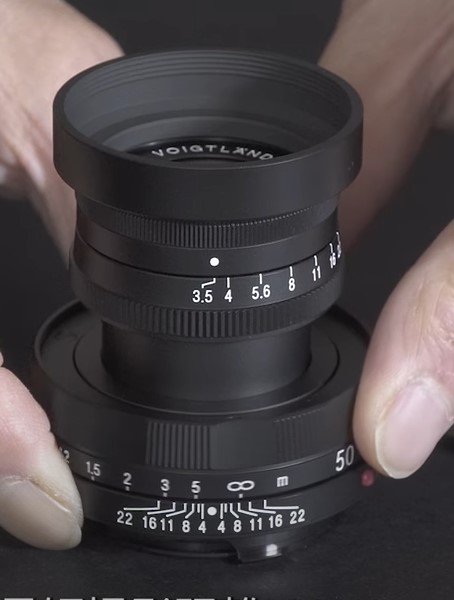
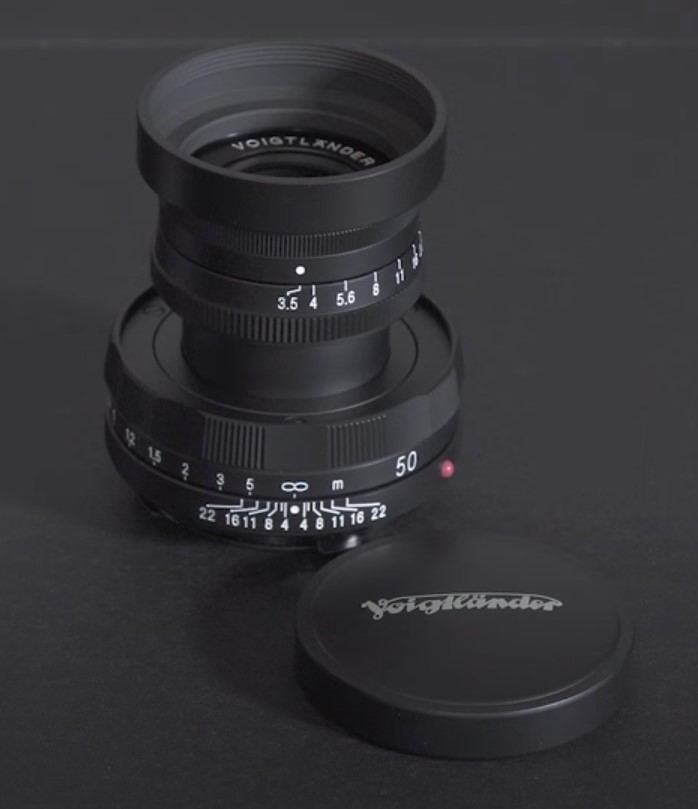
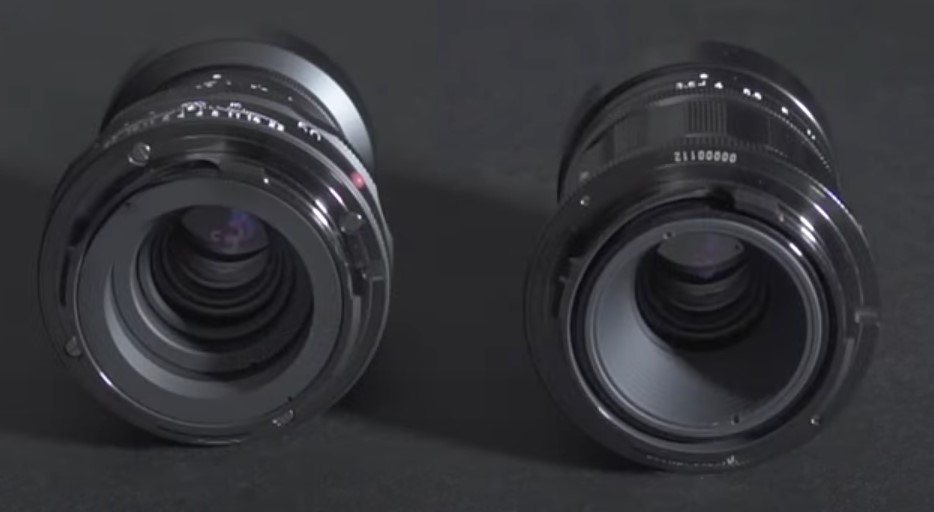
Filters are 34mm (T1) and 39mm (T2). The 39mm Heliopans are around $40 (UV) and $75 (Pol), Helio 34mm are in the $40-$45 range for both. The hoods for both are very functional and protective, helped by the generous filter thread and slightly retracted small front element. The front caps look like CV hood caps, going by their size. The rear end of each lens is different, the T1 has some ramped steps to catch dust; the T2 is a clean cone. Some images from the Cosina PR video:
T1 hood and lens front, at infinity
T1 hood and cap lens front, at infinity
rear internals of T1 (left) and T2 (right)
T2 also has a more user-friendly focus ring IMO (broader and easier to find for a gloved hand), the T1 rings look a little narrow and toy-like with strange indentations scratched in at an angle on the focus ring; a thin lip hangs over it at the front, indicating they wanted a more generous width - fingers may still fall into the front/rear gap. There is also a non-functional knurled ring at the very front of the T1 - it will make removing a filter much harder (two adjacent knurled surfaces -vs- a smooth surface in T2). It can be mistaken by fingers for the aperture ring too.
The T2 has some odd post affair which can only lead to trouble. Can it be removed? The aperture and focus ring marks (small dots) on both silver lenses will be very hard to see in field conditions. The black types are much better for this. The T2 will be easier to mount on the camera body.
Filters are 34mm (T1) and 39mm (T2). The 39mm Heliopans are around $40 (UV) and $75 (Pol), Helio 34mm are in the $40-$45 range for both. The hoods for both are very functional and protective, helped by the generous filter thread and slightly retracted small front element. The front caps look like CV hood caps, going by their size. The rear end of each lens is different, the T1 has some ramped steps to catch dust; the T2 is a clean cone. Some images from the Cosina PR video:
 |
||
 |
||
|
T1 hood and lens front, at infinity
|
||
 |
||
|
T1 hood and cap lens front, at infinity
|
||
 |
||
|
rear internals of T1 (left) and T2 (right)
Aug 09, 2024 at 12:32 AM
p.19 #13New Cosina Voigtländer 50/3.5 APO & 50/2.2 VM announcement
philip_pj wrote:
50/3.5 APO ergonomics: for those wanting light lenses, the strange T1 looked to be the choice, at 150g in black finish. But the T2 in the same finish is just 175g, and it focuses down to 0.35m or a little over 13 inches (T1 is 0.45m).
T2 also has a more user-friendly focus ring IMO (broader and easier to find for a gloved hand), the T1 rings look a little narrow and toy-like with strange indentations scratched in at an angle on the focus ring; a thin lip hangs over it at the front, indicating they wanted a more generous...Show more →
The two "posts" on T2 (second post is at the opposite side of the lens and can't be seen on the product pics) are for the purpose of helping to mount and "demount" the lens as there's basically nothing to grab onto on the T2 lens that doesn't rotate (the non-rotating parts are too narrow to grab), and the focus ring's throw is very long so it would be troublesome to always rotate it to one or the other end to help mounting and demounting. Heliar 40/2.8 lens designed for VM-E close adapter use has similar posts for the same purpose and those are very helpful for mounting/demounting the lens.
Additionally T1 has the benefit that the lens barrel and aperture ring don't rotate at all when focusing, whereas on T2 both of them rotate together (like Heliar 50/3.5).
I liked the T1 better from handling perspective when I tried prototypes of both types at CP+, but on the other hand I'd still prefer the closer MFD of T2.
Aug 09, 2024 at 12:46 AM
p.19 #14New Cosina Voigtländer 50/3.5 APO & 50/2.2 VM announcement
philip_pj wrote:
50/3.5 APO ergonomics: for those wanting light lenses, the strange T1 looked to be the choice, at 150g in black finish. But the T2 in the same finish is just 175g, and it focuses down to 0.35m or a little over 13 inches (T1 is 0.45m).
Although both are painted black, I think the finishes on Type 1 and Type 2 differ. Type 1 has a matte black finish, while Type 2 features a glossy black paint finish.
T2 also has a more user-friendly focus ring IMO (broader and easier to find for a gloved hand), the T1 rings look a little narrow and toy-like with strange indentations scratched in at an angle on the focus ring; a thin lip hangs over it at the front, indicating they wanted a more generous width - fingers may still fall into the front/rear gap. There is also a non-functional knurled ring at the very front of the T1 - it will make removing a filter much harder (two adjacent knurled surfaces -vs- a smooth surface in T2). It can be mistaken...Show more →
The T2 has some odd post affair which can only lead to trouble. Can it be removed? The aperture and focus ring marks (small dots) on both silver lenses will be very hard to see in field conditions. The black types are much better for this. The T2 will be easier to mount on the camera body.
Cosina is sending the Silver Brass Type 2 prototype for an initial review, so I won't have the Type 1 for comparison just yet. However, I'm intrigued by the ergonomic design of the Type 2. The poles appear to aid in mounting and dismounting, though the close minimum focusing distance results in a longer throw and aperture/focus linkage to accommodate the same optical design.
Aug 09, 2024 at 09:27 AM
p.19 #15New Cosina Voigtländer 50/3.5 APO & 50/2.2 VM announcement
Just received the 50/3.5 APO Type II "Silver." It’s smaller than I anticipated. The tactical minimum focus distance rangefinder limit works well, but I wish it were closer to 0.62m, where the rangefinder remains engaged starting with the M10 series. It appears Cosina designed it to be compatible with older Leica M models, including film cameras, where the rangefinder disengages closer to 0.7m.
This version is compact yet dense (brass), feeling about the same weight as my CV 50/2 APO but in reality it's around 40 grams lighter.
The metal poles make mounting and unmounting the lens very easy. I’ll share my initial thoughts in a review along with some sample images soon. This is a prototype so I may not be able to conduct detail tests with it.
Aug 09, 2024 at 02:46 PM
p.19 #16New Cosina Voigtländer 50/3.5 APO & 50/2.2 VM announcement
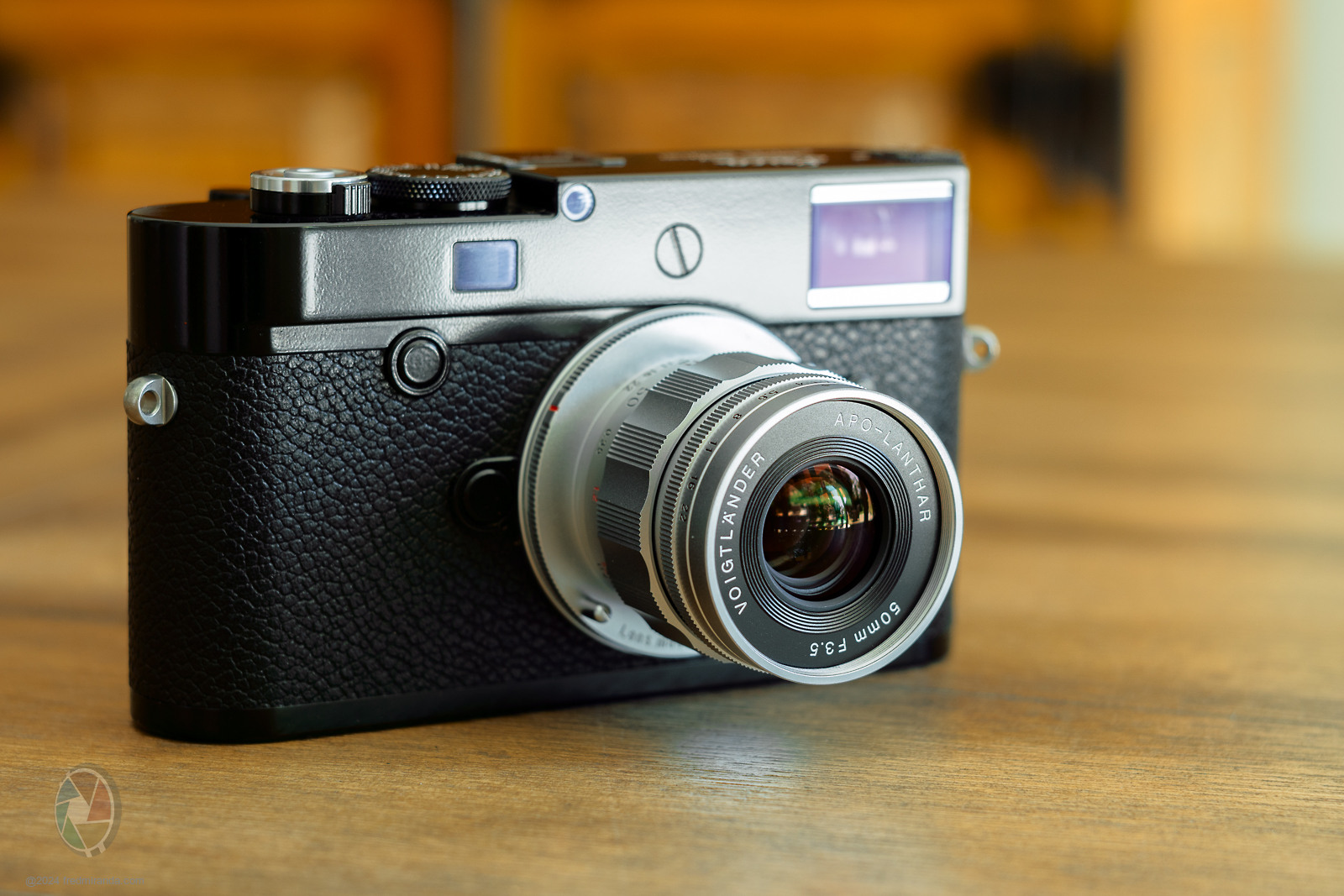
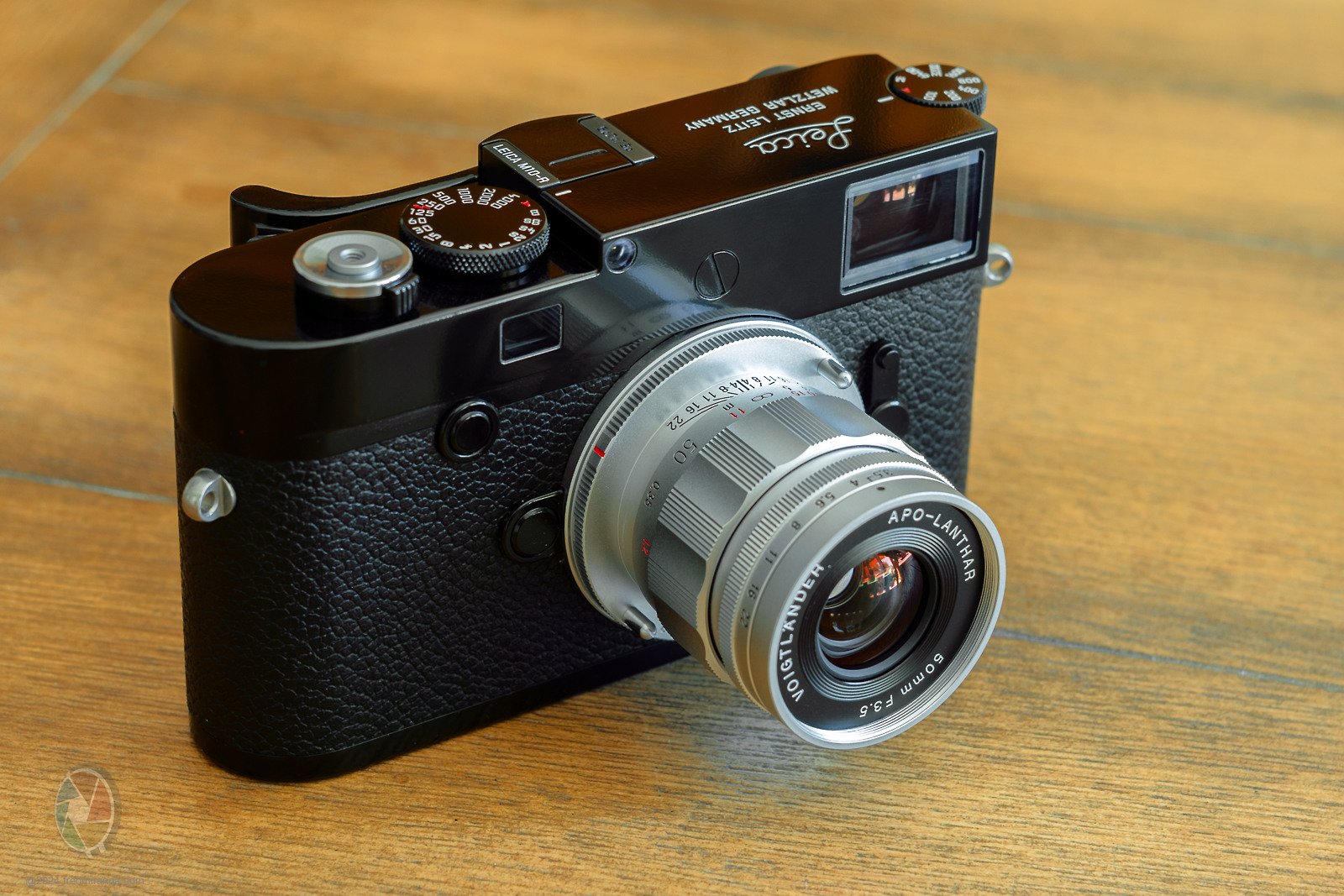
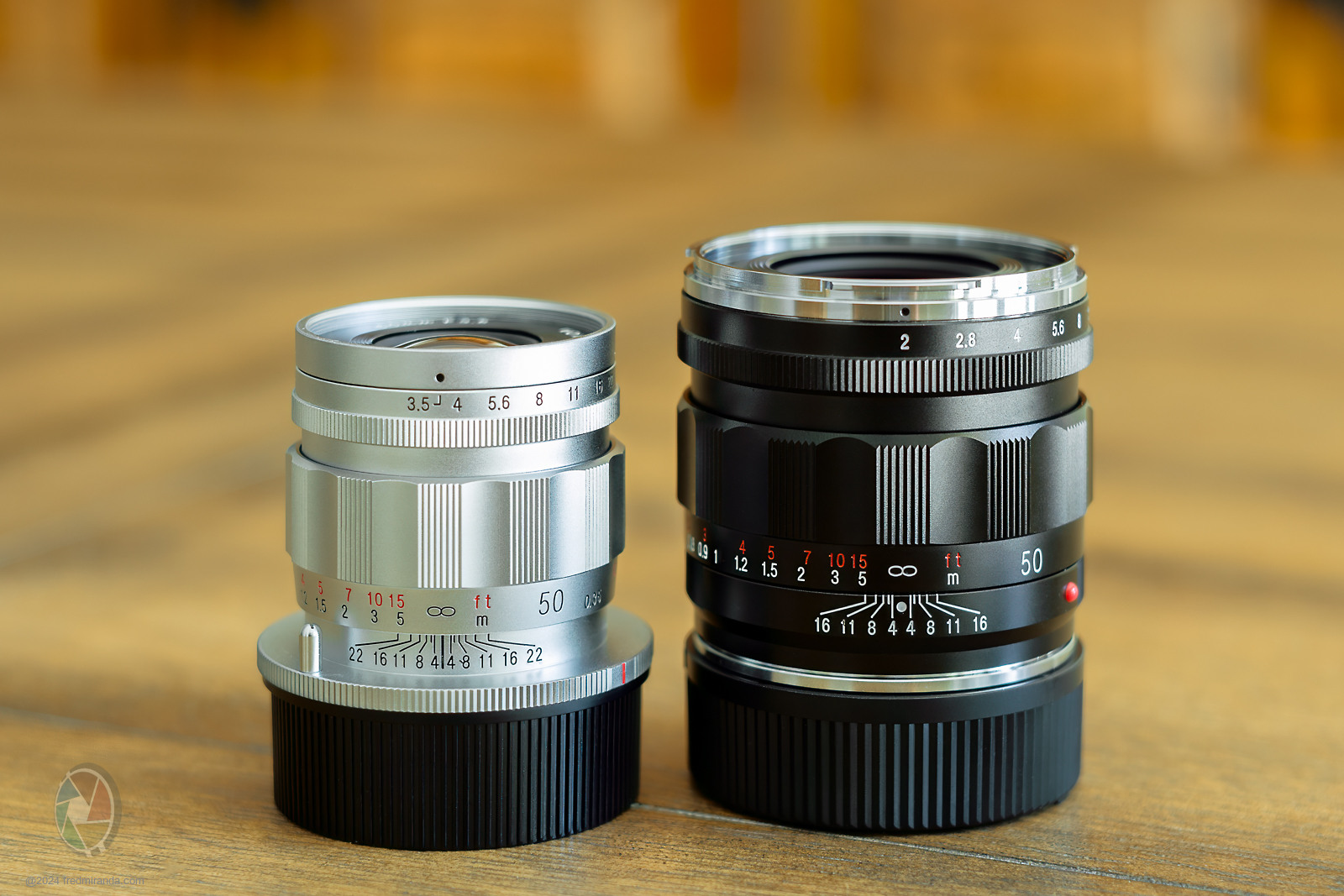
Here are a few quick shots showcasing the Voigtlander 50mm f/3.5 APO-Lanthar on my M10-R:
Voigtlander 50mm f/3.5 APO-Lanthar vs Voigtlander 50/2 APO-Lanthar
 |
||
 |
||
|
|
||
 |
||
|
|
||
 |
||
|
Voigtlander 50mm f/3.5 APO-Lanthar vs Voigtlander 50/2 APO-Lanthar
Aug 09, 2024 at 03:21 PM
p.19 #17New Cosina Voigtländer 50/3.5 APO & 50/2.2 VM announcement
edit: I see both rings rotate together from earlier posts.
Aug 09, 2024 at 04:18 PM
p.19 #18New Cosina Voigtländer 50/3.5 APO & 50/2.2 VM announcement
Well, it doesn't have that sexy 2.2 skopar appeal. From a purely aesthetic stand point, that is.
Aug 09, 2024 at 08:37 PM
p.19 #19New Cosina Voigtländer 50/3.5 APO & 50/2.2 VM announcement
In my maybe unpopular opinion both types of 50/3.5 have design choices that could have been easily avoided. That being so, many will look at the 50/2.2 as a small jewel. It's much more versatile and offers very solid performance.
For those wanting a small, light and well constructed lens that can do most anything with efficiency with appealing minimalism, it's maybe the leading contender of the CV 50mm lenses. It looks like different design departments are at work inside Cosina - one moving forward, the other looking backwards.
For those wanting a small, light and well constructed lens that can do most anything with efficiency with appealing minimalism, it's maybe the leading contender of the CV 50mm lenses. It looks like different design departments are at work inside Cosina - one moving forward, the other looking backwards.
Aug 09, 2024 at 11:56 PM
p.19 #20New Cosina Voigtländer 50/3.5 APO & 50/2.2 VM announcement
Paul.S wrote:
Well, it doesn't have that sexy 2.2 skopar appeal. From a purely aesthetic stand point, that is.
Maybe, but what if I told you that the new CV 50/3.5 APO performs equally to the CV 50/2 APO when both are compared at f/3.5? Despite their completely different optical designs -- with the new f/3.5 APO-Lanthar featuring a formula close to a planar design -- it’s capable of producing smooth rendering similar to that of the f/2 APO-Lanthar.
Besides being much smaller and lighter, it has the significant advantage of much less optical vignetting when both are compared wide open. This lens offers exceptional performance in a compact size, though I agree that f/3.5 may not be very exciting.
I've also found that its angle of view is significantly narrower than that of the CV 50/2 APO. However, with a minimum focusing distance of 0.35 meters, it offers much more versatility for live view shooting compared to the standard 0.7 meters.
Aug 10, 2024 at 05:05 PM