snapsy
Offline
• • • • • •
Upload & Sell: On
|
 p.21 #14 · Nikon unveils the highly anticipated Z8 camera! p.21 #14 · Nikon unveils the highly anticipated Z8 camera! | |
snapsy wrote:
Started a thread on Dpreview regarding battery life and CIPA. Here's what I came up with:
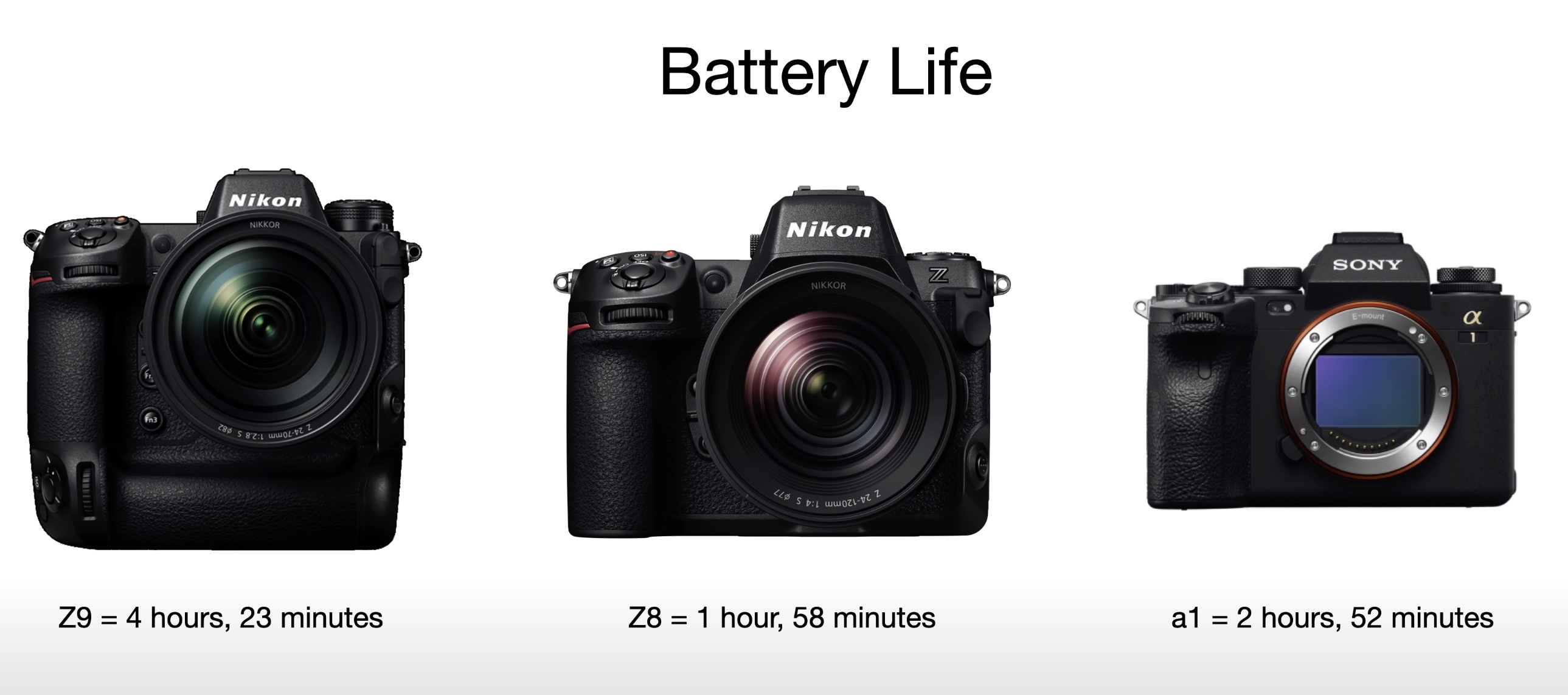
The Nikon's Z8 specs for battery life are 330 shots w/EVF and energy saving mode off. This is based on CIPA's Battery Test Methodology, which takes a photo every 30 seconds, with the camera and display on between each photo, cycling camera power after every 10 shots. Since MILCs run their sensors and Live View continuously, this DSLR-era test amounts to a power-on endurance test because sensor reading and display-driving consume significant power.
Nikon has started quoting an additional battery life measurement, based on an internal methodology they call "burst photography". Here is the methodology as described in the Z9 manual:
In-house measurements. Image quality set to JPEG normal, image size to “Large”, shutter speed to 1/250 s, shutter-release button pressed halfway for 3 s and focus cycled from infinity to minimum range three times before a burst of six shots, after which the viewfinder is turned on for 5 s and then turned off and the standby timer allowed to expire. This process is then repeated. Measured with a NIKKOR Z 70–200mm f/2.8 VR S lens. [Viewfinder only] was selected for monitor mode.
In this test the Z8 is rated at 2,280 photos vs CIPA's 330 shots.
We can calculate the power-on endurance time from these ratings by reversing the shot calculation. For CIPA, it's 330 * 30 (seconds per shot) = 9,900 seconds, or 2 hours 45 seconds. For Nikon's burst test it's 2,280 / 6 (shots per burst) * 10 (10 = default power-off standby delay), or 3,800 seconds, or 1 hour 3 minutes.
From these reverse calculations it's clear that taking 6 photos per burst vs 1 yields more photos per charge, while at the same time reducing total running time:
* CIPA: 340 shots and 2:45 runtime
* Nikon burst test: 2,280 shots and 01:03 runtime
Taking 6 photos vs 1 every 30 seconds yields 6.7x more total photos per charge but with 38% of the camera runtime, translating to 2.5x more energy efficiency per photo on a runtime-weighted basis.
Power consumption for taking photos is the sum of the parts. It's running the camera's embedded CPU, imaging ASIC, CMOS image sensor, EVF or LCD, lens elections including AF and aperture motors, powering the CFE card for both idle and write operations, etc...
It would be helpful to try and isolate which of these parts consume the most power. To this end I have done some preliminary measurements using my Z6, which is rated for 310 shots per CIPA (Nikon specs), which works out to 2 hours 35 seconds of power-on time.
Here are some of my initial measurements:
1. Camera idle in shooting mode, EVF off, LCD off, top LCD on, airplane mode, Nikon 70-200 f/4G lens on FTZ, Sony 64GB XQD 400MB/s card: 3 hours 31 minutes power-on time
2. Same as #1 but with EVF on (18% grey target TTL): 2 hours 32 minutes power-on time
3. Same as #1 but with intervalometer taking raw photo every 5 seconds (12 per minute), MF mode, aperture locked to wide-open: 2,264 photos, 3 hours 8 minutes power-on time.
Initial observations:
* Using CIPA's methodology, the additional energy consumed taking/processing photos vs baseline camera energy consumption running idle is rather small. Note that my initial measurement excludes AF motor and aperture operation, which will add to photo-taking energy consumption
*The EVF is a significant consumer of energy
* Note: Even with the EVF/LCD off during idle operation the camera still continuously samples the image sensor, as evidenced by continuously-updating metering values on the top LCD
More tests planned......Show more →
I previously posted the following three battery measurements on my Z6:
1. Camera idle in shooting mode, EVF off, LCD off, top LCD on, airplane mode, Nikon 70-200 f/4G lens on FTZ, Sony 64GB XQD 400MB/s card: 3 hours 31 minutes power-on time
2. Same as #1 but with EVF on (18% grey target TTL): 2 hours 32 minutes power-on time
3. Same as #1 but with intervalometer taking raw photo every 5 seconds (12 per minute), MF mode, aperture locked to wide-open: 2,264 photos, 3 hours 8 minutes power-on time
I have a new measurement to add: Same as #1 but camera in menu mode instead of shooting mode. This ran for 6 hours 31 minutes. To test this I set the display to EVF only, the c3 dle time for menus to 10 minutes (maximum), entered the menu, then pressed a button every 9 minutes to prevent the camera from entering power-off standby. I pressed my eye to the EVF every so often to monitor when the camera exhausted the battery; the EVF off otherwise.
In menu mode the camera is presumed to stop reading the sensor continuously, since it no longer displays metering on the top panel while in a menu. Also, if IBIS was on the camera locks IBIS when switching from shooting -> menu mode (audible click), a further indication the camera transitions to a sensor-idle state when entering a menu. Provided this assumption is true we can isolate the power draw of reading the sensor continuously and the Expeed power to process that feed (plus any small additional power required while idle in shooting mode, including metering calcs). Power-on time drops from 6:31 (menu mode) to 3:31 (shooting mode), which means the camera consumes 46% more power to read the sensor continuously while idle.
It's interesting to step back and compare these Z6 values to the closest equivalent DSLR, the D750. Using the same EN-EL15 7V 1900mAh battery, the D750's CIPA rating is 1,230 shots, which translates to a runtime of 10:15. The Z's longest runtime is 6:31 (full idle in menu).
Some notes:
* It's presumed that playback mode would yield the same idle times as menu mode, since both involve the camera idle with sensor reads stopped (IBIS lock click when entering playback mode, same as when entering menu mode)
* The camera doesn't stop sensor reads during image review mode - power draw is the same as idle shooting mode and no IBIS locking click. Note you can transition from image review to playback mode by scrolling to the next/previous photo before the image review ends.
* I checked if turning off the top LCD would encourage the camera to stop its continuous sensor reads while idle in shooting mode, since with the EVF/LCD already off and now the top panel off (no exposure reading display) the camera has no reason to be reading the sensor continuously. It still does however.
Based on these observations Nikon could measurably improve shooting-mode runtime battery life by turning off sensor reads whenever the camera is configured for EVF only and EVF eye's sensor shows no use (EVF off). The only exceptions would be background use, like HDMI. This would bridge some of the gap to a DSLR's runtime.
You could manually achieve the same result by always entering menu or playback mode in idle time between shots, although that would grow tedious. Another alternative is to use an aggressive power-off standby value, but that incurs a moderate wakeup delay whenever you want to return to shooting.
|