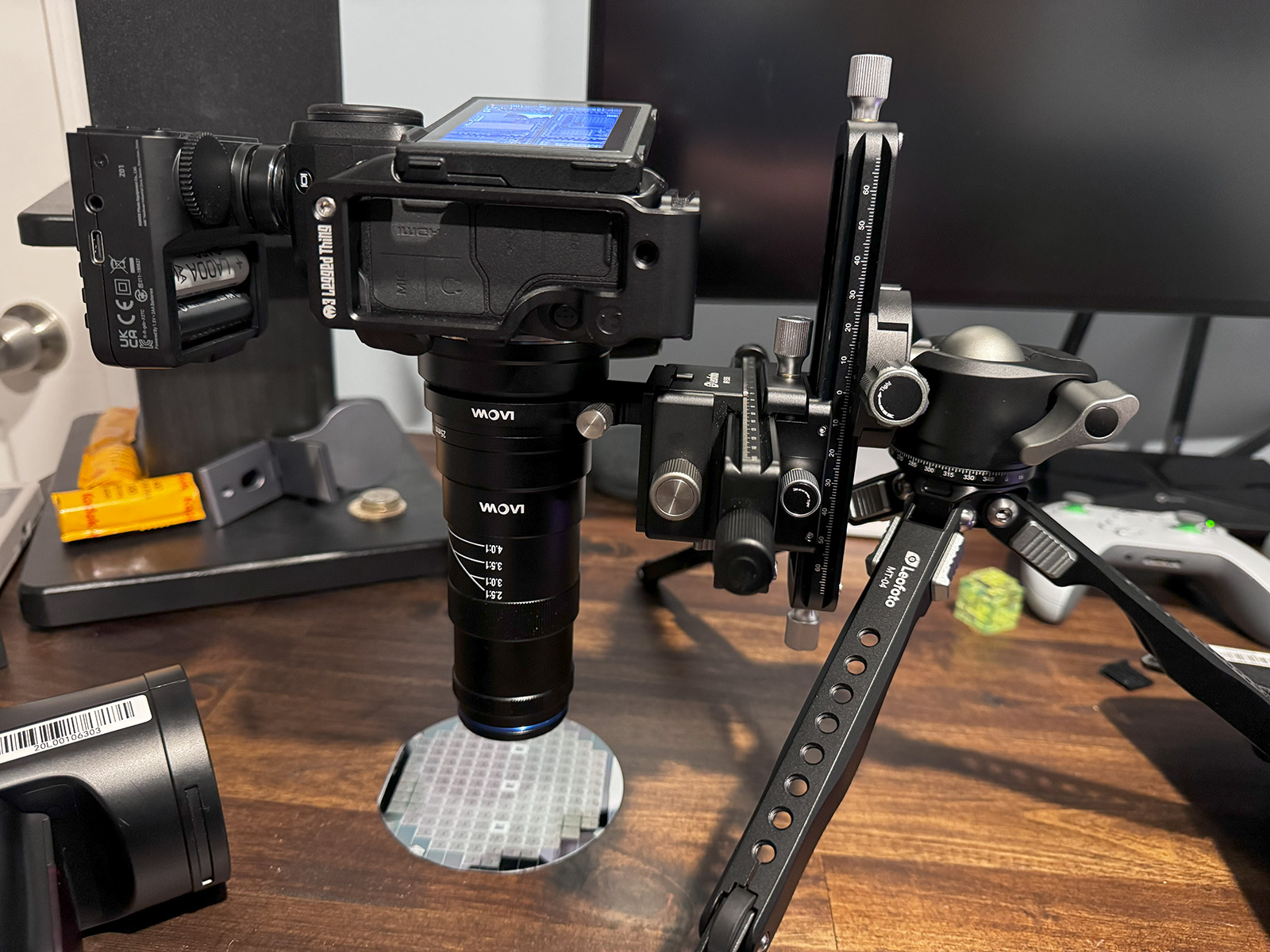
So more photos of technology. I picked up a silicon wafer that contains 145 Rockwell 5300 Series microprocessors from 1986 (plus 3...somethings..perhaps test circuits?). The wafer is 4" in diameter.
Here's a shot at 1:1 with the Z8 and the Z 105mm f/2.8 Macro:
With the Laowa 25mm, here's a shot of one of the processors - this is at about 3.8x magnification. An individual processor is 6.82mm (according to my best measurement with a micrometer) in width. Measuring pixels, the "Rockwell International Corp" lettering is approximately 27 microns in height.
And a nice easter egg left by the designers in the center of the chip: "Aloha"! The text is about 40 microns tall, but the lines that make up the letters are about 2 microns thick. From the research I did on this chip, apparently, the Aloha text was put there because the chip designers were promised trips to Hawaii if they met the aggressive deadline to finish the design. Also, in the full image above you can see the initials of the chip designers. (you can also see here that at 100%, all the etched features on the CPU are discernible)
Z9 with Tamron 35-150 f2-2.8 in the studio
When I am bored I tend to use objects laying around my studio for what I call practice work.
I visualize a final image of the object and then create it. This exercise has always helped me
to think out of the box when I am doing commercial work.
So I reshot the sensor this morning using my Z8 at 3.7x, slightly different lighting - this is a 25 image focus stack, though only about 8 were needed for the main part of the sensor (the rest are for the back of the package, which has mostly been cropped out). There's so much detail available here at such a tiny scale.
This is a 100% crop of a closer shot at 5x on the Z8 just to see how much detail it can resolve with a little better technique than the first time I posted. At this magnification the sensor photosites are very clear, which is just crazy to me.
Just to get a comparison of the size - here's the sensor assembly next to that Swiss coin I also photographed earlier - again, it's about the size of a nickel.
I have a wafer of 1980s computer chips coming tomorrow, so I'll shoot that, and then I need to find more tiny things to shoot. Really incredible how different things look at super high magnification. Take this Danish 2 Kroner coin - this is 'just' at 2.5x magnification. If you look at this coin with your eyes, it looks very clean, bright and shiny with no obvious defects at all...it isn't a particularly worn coin...I chose it because it looked fairly new. And yet, side light it and go to high magnification, and you can see every imperfection, every scratch, the mottling of the metal after striking, the beginnings of oxidation. And I'm just figuring out how to use this lens. Essentially everything requires focus stacks, as at these scales, the raised portions of a coin and the background of the coin are not in focus in the same shot. Depth of field is in the neighborhood of 0.1mm or less.
AdaptedLenses wrote:
Would you consider this micro-LoCA
It’s not LoCa because this is all in focus. However, the lens does have a small amount of fringing on bright specular highlights, and it’s possible that’s some of what you see here, but it’s also important to note that this is etched polished silicon, which is iridescent, with different colors appearing depending on the angle of light and reflection, which I think is also a large part of what this look is.
RoamingScott wrote:
Still have a Z9, Ross, or just older edits?
No longer have that cam but still processing Z9 files, have a backlog of those plus unprocessed files from Z7 and D850 also. I put office tasks off for years sometimes because I’d much rather be outdoors!
Still coming to grips with the insanely shallow depth of field at high magnifications. Tried this focus stack today, which took quite a lot of time to do, since I have to do it manually on a rail. This is 127 images. Turns out I needed to do at least twice as many images, as the banding you see is due to gaps in focus coverage..this was about 40 shots per rotation of the macro rail screw, which means I was moving about 25-35 microns per shot...and it wasn't enough. Looks like I will need to do about 10 micron shifts...so a shot like this will probably take me about 15 minutes just to shoot the images. Good to know.
Jman13 wrote:
Still coming to grips with the insanely shallow depth of field at high magnifications. Tried this focus stack today, which took quite a lot of time to do, since I have to do it manually on a rail. This is 127 images. Turns out I needed to do at least twice as many images, as the banding you see is due to gaps in focus coverage..this was about 40 shots per rotation of the macro rail screw, which means I was moving about 25-35 microns per shot...and it wasn't enough. Looks like I will need to do about 10 micron shifts...so a shot like this will probably take me about 15 minutes just to shoot the images. Good to know.
Alas, even if they existed, I would imagine the degree of tilt needed to get this in 1-2 shots would be incredibly extreme since the plane of focus is only about 10 microns deep, so I think there'd be a pretty major loss of quality.
How would one shoot this for a living? I honestly don't know.
If T/S is an option, maybe not in this format. Or are there other tricks to simplify image taking in such an extreme use case?
In another thread somebody mentioned that, even RAW, these can be taken by a workaround shooting 60 fps video. Would it be possible to do so while changing focus (aka camera to object distance)? Maybe not... or not smooth enough.
But it would take 300 RAWs in 5sec. Smooth focusing is the problem.
At 1:1 or thereabouts, it's pretty easy, because it can be done in camera with focus stacking and autofocus. However, extreme magnifications can't really use autofocus..at least all macro lenses greater than 2x have been manual focus so far, and I don't see AF as being useful in this area, so you set a magnification, and focus by moving the camera, on a macro focusing rail. My rail is manually operated.
The easy way to do this is by buying an automated macro rail system, which uses a motor to drive the focus rail, and has an interface to connect to your remote shutter release on the camera - it then will automatically move the rail forward by a specified amount, take the picture, move, take another, and so on.
The cheapest automated systems start at around $350, and I might pick one up eventually if I find myself doing these often. The expensive ones can run several thousand dollars.
You don't want to constantly be taking photos because you want to let the camera settle for a second or so after every move (even small vibrations are massively magnified at this level of macro), and in my case, probably even slightly more since I'm using flash, so I'd need to make sure the flash can fully recycle and not overheat. In this arrangement, it's simple, since I was at 1/128 flash power, but some of the other images I've taken were through diffusion, or not arranged to be so reflective, and were as high as half power.
This wasn't for the angled shot above, but here's my current fully manual setup, with two rails mated (gives me the ability to also do fine movements left and right if desired for framing..I don't always use that, but it's nice).
I know focusing has to be done by moving the camera, not by focusing the lens. But still, the idea of moving the camera slowly while high-speed video-taking under constant ligthing was obviously a stupid one: one will never get the camera moving smoothly enough, I think you are right.
Speaking of a tilt lens or a view camera: That might be helpful if it was possible to move (the rail / the camera / the subject even) perpendicular to the focus plane, not the line of sight. So you will end up with less shots.
Yeah, tilt can be great for a lot of applications, but as mentioned earlier, the depth of field is so thin here that for anything except fairly gentle angles to subject, it's not going to help much...not to mention aligning the plane of focus would also be a nightmare. I have to generally focus stack even when shooting square to subject on a flat subject, because it's almost impossible to get the camera 100% perfectly square to the subject. Even using a level, it takes 3-4 shots to cover a completely flat subject at these magnifications.
As an aside, I actually just went ahead and ordered the WeMacro motorized rail system...at $320, it's a steal for being able to automate this process.