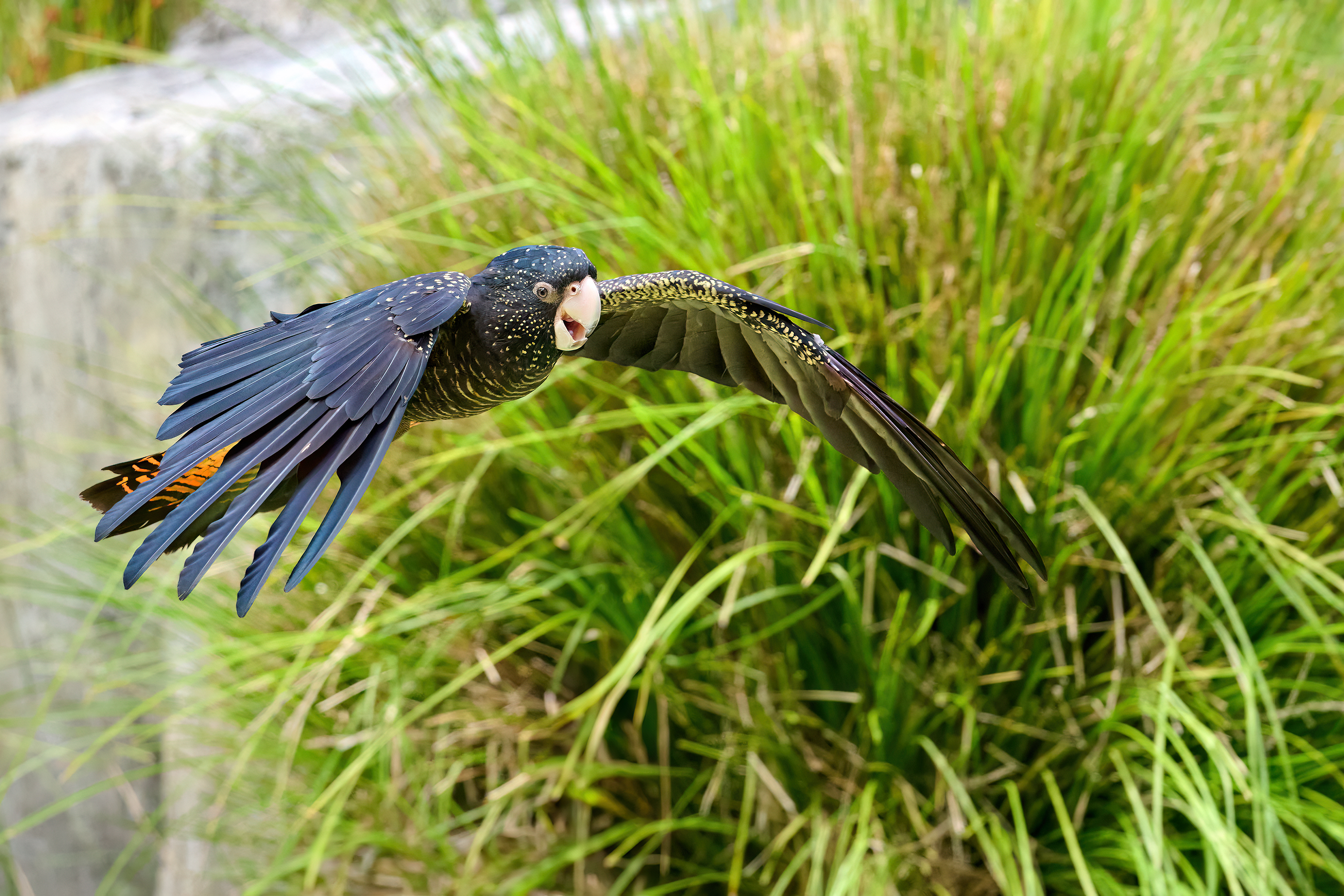
4) Powerful Owl. Found only in a coastal area of South Eastern Australia rarely further than 200kms (120miles) inland from the sea. Whilst not endangered, they are rare to see and are listed as vulnerable. It is a large owl, the largest owl of Australia, the male can measure up to 65cms (26 inches) in height with a wingspan of up to 135cms (53 inches). The male has been known to reach up to 2.2kg (4.9 lbs) in weight.
Some quick test shots trying my hand at ultra-macro. This is the Zf with the Laowa 25mm f/2.8 2.5-5x Macro. All are focus stacks (depth of field is insanely thin at these magnifications, and f/4 is about the most you can stop down before diffraction destroys the image at 5x)
A 1/1.7" digital camera sensor from my first digital camera - the Kodak DC3400 (at about 3.5x magnification):
The edge of a well-worn quarter, at 5x magnification.
And the face and edge of a Swiss 20 Rappen coin (full coin is the size of a US Nickel), at 5x:
So some interesting (to me) stuff. I've photographed this sensor in the first image before, at 2x magnification, and saw those numbers, and I'll share some info in a second. With this, I also took a single shot at 5x, and then this is cropped as well. Because it's not focus stacked and I wasn't 100% square to the sensor, the right side of the image has gone out of the depth of field a bit, but I want to draw your attention to a couple things.
So if you look at the top left corner, you'll see etched into the sensor package, the code "MN39570" which reference the internal code of the actual sensor. The "MEC" below this code stands for Matsushita Electronics Company...better known as Panasonic. There's one hit only regarding this code - the development announcement for this sensor :https://www.dempa.co.jp/productnews/kobetu/981005/1005_02.htm
Google translate shows it as saying, among other things: “Digital still cameras are rapidly increasing in pixel count, but with the adoption of this new CCD, 300dpi is possible with L size (A6 size) printing, and image quality equivalent to that of single-lens reflex still cameras is possible.” Needless to say, knowing the output of my DC3400, this was not the case. Still...super cool. Those code numbers are 52 microns tall, so about the width of a thin human hair. With the extra magnification from this lens, I was also able to see that each wire to the sensor is also numbered - the little numbers 20 and 19 are approximately 20 microns tall.
And finally, if you look at the left side of the sensor itself, you can see the individual sensor photosites, which are 4.2 microns in size. I find it incredible to see this level of detail, since none of these features are even visible as existing to the naked eye. The whole sensor is roughly the size of my pinky fingernail.
Jman13 wrote:
Some quick test shots trying my hand at ultra-macro. This is the Zf with the Laowa 25mm f/2.8 2.5-5x Macro. All are focus stacks (depth of field is insanely thin at these magnifications, and f/4 is about the most you can stop down before diffraction destroys the image at 5x)
So I reshot the sensor this morning using my Z8 at 3.7x, slightly different lighting - this is a 25 image focus stack, though only about 8 were needed for the main part of the sensor (the rest are for the back of the package, which has mostly been cropped out). There's so much detail available here at such a tiny scale.
This is a 100% crop of a closer shot at 5x on the Z8 just to see how much detail it can resolve with a little better technique than the first time I posted. At this magnification the sensor photosites are very clear, which is just crazy to me.
Just to get a comparison of the size - here's the sensor assembly next to that Swiss coin I also photographed earlier - again, it's about the size of a nickel.
I have a wafer of 1980s computer chips coming tomorrow, so I'll shoot that, and then I need to find more tiny things to shoot. Really incredible how different things look at super high magnification. Take this Danish 2 Kroner coin - this is 'just' at 2.5x magnification. If you look at this coin with your eyes, it looks very clean, bright and shiny with no obvious defects at all...it isn't a particularly worn coin...I chose it because it looked fairly new. And yet, side light it and go to high magnification, and you can see every imperfection, every scratch, the mottling of the metal after striking, the beginnings of oxidation. And I'm just figuring out how to use this lens. Essentially everything requires focus stacks, as at these scales, the raised portions of a coin and the background of the coin are not in focus in the same shot. Depth of field is in the neighborhood of 0.1mm or less.
Two shots of an older computer motherboard - one of the CPU socket and the other of, well, I don't know what. It's a very tiny cylinder with two very, very thin leads coming off it (barely visible when looking at it). at 3x and 3.7x respectively. Stacking images that have this much depth always creates some issues, though, since the highest items (pins in the first image, hoop in the second) are massively out of focus by the time you get to the bottom of the stack.