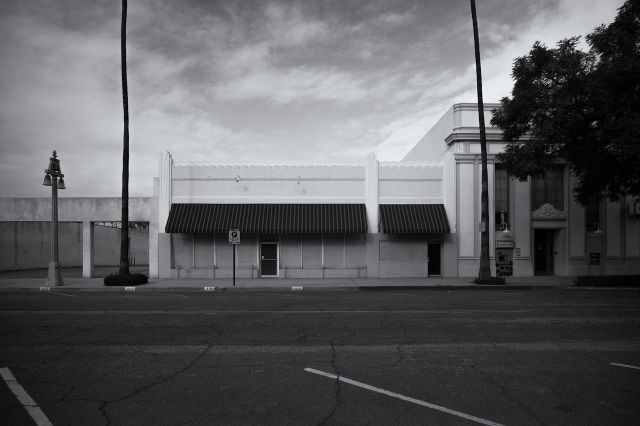
Just a quick and dirty test of my new-to-me Biogon ZM 25 2.8... Just a resized JPG (in mspaint no less, lol..) straight from my M240. Really pleased w/ the lack of distortion and the overall look and feel of the lens.
Allen, Superb series, very much enjoyed and congratulation for exhibition
shujert, I really love this portrait. Feel it deserves much more 'like'
Werner, Enjoy your works over past several pgs.
Edward, pure magic.
Ron, decisive moment!
Charlie, you are very consistent with your images look, I like them.
Gary, got your M8.2? Based on what I see from S2, I have to wonder if M8 has even more special sensor than M9
@Fast Shadow: C-biogon looks great, love that shot
@Michael: kind words very much appreciated, if undeserved Love that great DOF!
@Edward Wow! Really superb portrait with incredible rendering by 85/2 WO. Here is your "other" lens, the incomparable Kaaragon:
this one is accidentally clever: my favorite masonic temple with steeple from church across the way reflecting in window L1026928 by unoh7, ZM 35/2 5.6
Thank you very much for the kind words Allen, Michael, Charlie!
Allen, congrats on the exhibition and press article. Wish I could visit though I'm on the other side of the planet
Fast shadow, I'm sure you will love the 25 biogon. It's an outstanding lens.
Michael, really like the stormy weather and the darkish mood.
Charlie, good stuff with the karaagon as usual. My favorite is the Masonic temple.
Question : sending my Leica in for service tomorrow and wondering about insurance... Plan to ship usps priority. Should I buy insurance for the replacement value?
Katie, not sure what I would do about insurance. However, if you are anywhere near a Leica dealer, it's better to have the dealer ship the camera for you. Last June or so I shipped my M9-P to Leica NJ for vertical rangefinder alignment using UPS. The rangefinder work was done under warranty, but Leica Customer Service found that my sensor needed alignment because of an impact shock that the camera had received, which they attributed to a tiny dent where my Thumbs Up is that I had not noticed. I maintained that the damage happened during shipment for which Leica CS provide a prepaid air bill, so that their insurance should pay — considering that none of my shots taken in the days before I shipped the camera showed any signs of sensor mis-alignment. I was forced to pay $450 for the sensor alignment.
Had I sent the camera through the Washington DC Leica Shop (15 miles away from where I was), the camera would have been inspected before shipment and Leica would have taken responsibility.
On page 1112, I posted two photos from a 16-shot essay that I have just completed — and below are four more. You can view the complete essay by clicking here. [Press “L” to see the pictures at their full size, and then navigate through the essay.]
The essay is on "Sam Roi Yod”, which means “three hundred peaks" and applies to a range of dramatic limestone hills that rise up from the coastal plain at the edge of the Gulf of Thailand, about 250 km south of Bangkok. The area is a national park, whose wet-land ecology has been devastated by years of illegal shrimp farming, cattle raising and poaching.
A traveler driving across the national park — two bitumen-paved roads cut through it — will see the natural beauty but only some indications of the environmental damage: plastic bags littering the ponds and beaches, and shrimp farms along the periphery as well as within the boundaries of the park. But the extent of the damage — poisoning of the ponds and soil by the effluents from shrimp farms — will not be visible. What is not there cannot be seen: the former richness of the waterfowl and of the flowering lotus ponds.
When I stopped at a coffee shop on the way to a pond famous for its lotus blossoms, a woman asked me whether I was going to worship at the temple that had been built there because, if I was going to drive 30 km to see the lotus blossoms, she didn’t want me to be disappointed. At the pond, a park official told me that he had been trying to plant lotus there for the last 10 years without success.
I am struggling very much with the jpeg export. It seems the quality of the picture is reduced quite a lot when I export it as jpeg and it appears sh...ty and smudgy as if you sucked the life out of it. Someone please shed some light on it. I know there was a script to use in PS for web sharpening etc and if I am not wrong (Ron), it was denoir who had talked about it.
Yes, Luka (denoir) was one of the advocates of this resizing method and there were a number of discussions about it, as well as some examples, IIRC. I just don't remember where in the thread it is.
It might help if you were to outline the steps and apps you use from start to finish in your post production. Looking at your image here and on Flickr, I can see the fine details are quite jagged looking. It seems like a combination of coarse resizing and sharpening. Sharpening is generally a localized contrast enhancement, which means the reduction of intermediate tonality, which can very much skew the look of the 'native' rendering of the equipment used for the image. Multi-stage resizing will probably help minimize at least the look of over sharpening. But there's probably only so much you can do to retain very fine detail in a 1024px wide image. From my newspaper prepress experience, final output was sharpened very strongly (super crunchy) and it always resulted in a loss of color nuance and overall tonality. While there is only so much you can do to retain tonality when printing on paper one grade above toilet tissue, I found a zap of additional saturation after sharpening helped a lot. Not sure how that directly relates to here, but bottom line is that sharpening can and will influence the look of the final image. It's a bit of a juggling game to find the combination of settings or steps that will look pleasing to your eyes. That's about the extent I can help as far as multi-step resizing is concerned - I try to completely avoid any post in Photoshop and just do single step resizing for web display with Photo Mechanic. I'm sure it's not ideal and can result in crispy results at times, but I'm just not motivated to try anything more complex.
A variation on the earlier scene:
M240 & 28 Lux.
This area of the gallery was being set up for a wedding that evening, with some 'moody' orange lighting to enhance the dozens of candles set up in what would be the altar area (out of view here, but why people were stopping here on the stairs to look). The blue was from indirect late afternoon daylight filtering through skylights.
I also came to a realization from the images produced that day, having shot a fair mix at ISO 1000 and 1600. As I've noted in the past, I shoot at 1000 to retain 3fps (or at least much more immediate shot-to-shot capability) and a ~13 frame buffer. Yet, I think I like the look from ISO 1600 better. The crossover point with the M240 where it's no longer afflicted with the green shadow problem is 1000/1250 and even if I run ISO 1000 images through the green shadows Lightroom plug-in, there is still something lingering in darker values that I don't see at 1250 and higher. I did a reception last night at 1600 and found the files were pretty robust, and that often I could live with ~1fps, though at times it was a bit painful.