fredmiranda.com
Login

Moderated by: Fred Miranda
  

FM Forums | Sony Forum | Join Upload & Sell

1       2       3              7              9              11       12       end
  

Utility of dynamic range beyond a certain point


Daran
Offline
• • •
Upload & Sell: Off
p.8 #1 · Utility of dynamic range beyond a certain point


hasenbein wrote:
That's not a problem of the shadow areas, but only your error in editing. Lowering higlights and raising shadows for the whole image is NOT the correct method. The flatness of the rocks is only because of this flawed method.
Correct method: Have masks for sky, rocks, water; edit exposure, white point, black point, contrast etc. for each mask individually.

One mans flaw is another mans feature. By using masks you introduce discontinuities into your processing. Which if overdone (common) is something that makes the result look artificial. A safer and more natural approach (assuming the required DR range isn't too wide) is to limit yourself to monotone continuous transfer curves, where what is brighter consistently remains brighter, just not by as much. The C1 HDR adjustments do just this and tend to work very well for typical scenes with a bright sky. But even there, if you overdo it, the result can look cooked.


Jun 19, 2026 at 06:31 AM
ytwong
Offline
• • • •
Upload & Sell: Off
p.8 #2 · Utility of dynamic range beyond a certain point


I think better dynamic range means better highlight roll off to me.

And for night cityscape, there is never too much DR.


Jun 19, 2026 at 06:43 AM
chez
Offline
• • • • • • •
Upload & Sell: On
p.8 #3 · Utility of dynamic range beyond a certain point


Jack Flesher wrote:
Hmmm. Perhaps you could link to them so we can discuss directly what you see as blown?


Here are a few examples where the white areas have gone to featureless white.

https://www.fredmiranda.com/forum/topic/1925842/0#16944947

https://www.fredmiranda.com/forum/topic/1909132/0#16852120


Jun 19, 2026 at 07:45 AM
chiron
Offline
• • • • •
Upload & Sell: On
p.8 #4 · Utility of dynamic range beyond a certain point


aCuria wrote:
https://live.staticflickr.com/65535/55344407954_40f992d4e2_b.jpg7IV07279-HDR-SDR by acurian, on Flickr

Image A: Multi-image "HDR" stacking, what I intended the shot to look like.

https://live.staticflickr.com/65535/55344191986_23f63662f8_b.jpg7IV07279-SDR by acurian, on Flickr

Image B: Single image "highlight recovery" test. Foreground exposure was correct in camera, and Highlights set to -100 in lightroom (max slider) to "recover highlights" as much as possible. Highlights have been clipped and cannot be fully recovered. Foreground looks correct.

https://live.staticflickr.com/65535/55344357693_3c32ae8154_b.jpg7IV07278-SDR by acurian, on Flickr

Image C: Single image "shadow recovery" test. Scene exposed to as to preserve highlights. Overall exposure raised in POST so the sky looks correct. Highlights set to -100 to undo raised exposure in sun area. Shadows
...Show more

It's an interesting problem. The lighting ratio in the actual scene is vast--I can't even guess it--and is way beyond what any sensor or the human eye can record. For example, if one comes from a dark room into sunlight (as in the old days, from a movie theater into afternoon sun), you can't see for a bit until your eyes adjust to the light. And if you then go back into the darkened room, you again can't see there until your eyes adjust. We can't see bright and dark at the same time.

So, you are trying to render the scene in a way that in fact it is never seen by human eyes, by compressing the lighting ratio after the fact. Painters do this all the time and make it look natural, in part through the varying colors and the varying intensity with which they depict colors in the painting. My own experience is that it is very hard to do this in photography without the result looking artificial and unnatural--because it is artificial and unnatural for our eyes to see it that way.

One solution is to have the dark areas go dark and be intrinsic to the composition as shadows, as in a Rembrandt or a Caravaggio painting. Another solution is not to photograph scenes with such a large lighting ratio. But for some photographers, that may mean giving up too much.


Jun 19, 2026 at 09:04 AM
Jack Flesher
Offline
• • • •
Upload & Sell: On
p.8 #5 · Utility of dynamic range beyond a certain point


chez wrote:
Here are a few examples where the white areas have gone to featureless white.

https://www.fredmiranda.com/forum/topic/1925842/0#16944947

https://www.fredmiranda.com/forum/topic/1909132/0#16852120


Alas I was perhaps baiting you a bit... Keep in mind the images you linked to are all what? Yes, jpegs. Need I be more specific? Perhaps I do for thread posterity. How many stops of DR can you replicate in an 8-bit, sRGB jpeg? That's not a rhetorical question, look it up if you don't already know. You can stretch them to almost 9 stops with a careful reversed curve, but 8 is generally a practical maximum. Beyond that it takes an HDR blend to render more into them. (But yes, we can edit more DR down to the jpeg 8 by carefully choosing what and where we feel we can compress the full image data and in fact this is what we are doing regularly with todays cameras.) Next, I edited these images for this forum knowing I was outputting jpegs. Could I have pulled these highlights down more or even HDR'd them to get the look perhaps you seem to be looking for? Yes. However, I personally find the very look you see here as both pleasing *and believable* -- YMMV...

Now to the specifics of the above sets you linked. Firstly, the Christmas shots are taken here in Northern California, and of course in late December when the Sun is at its furthest South and lowest on the horizon. Also here in coastal NorCal during the winter months, we regularly have full skies of heavy overcast, as was the case this day, so there is zero blue in any part of the sky. Hence the sun is behind overcast and low enough to be directly behind a couple of the windows in my backgrounds. Even the exterior shot the gray sky is not blown if you dropper it; because it was in fact a gray sky. On the interior shots where the Sun though a layer of overcast is the direct light source through the window, that is blown per my earlier comment of realism. Even still, you will note that in many of the windows I did in fact edit back hints of outdoor details to *my* tastes which are perhaps far subtler than yours... Additionally, I did edit these to include a bit of nostalgic "glow" which probably adds to the impression of being blown. I suspect the differences here between you and me is I edit to my standards of believability and/or impressionism where you prefer fuller, more complete total visual information to make your own artistic points? That or possibly you have your monitor set so bright you can't see the highest details in my images, which along with no concept of color management is unfortunately a fairly common issue with participants in this forum -- but I digress as this is a divergent discussion...

Now to the Bodie set. In that, you will also in fact notice similar hints of exterior detail in many of the windows. Not a lot, because again I am editing to *my* tastes specifically for monitor jpeg viewing. Again if you pull them into a good editing program and dropper them, you'll see most of those are not yet fully blown -- unless of course the Sun is hitting them directly. To wit, Bodie windows are literally covered in a thick layer of dust and scum both inside and out, so are for all practical purposes thin scrims to begin with, and if even just slightly side-lit they blow naturally; and here I choose to treat them as I said earlier as I do for any other specular or direct, into-the-camera lighting source as nearly pure white.

Hope this clarifies *my* personal editing pov...


Edited on Jun 19, 2026 at 09:36 AM · View previous versions


Jun 19, 2026 at 09:29 AM
gdanmitchell
Offline
• • • • • • •
Upload & Sell: Off
p.8 #6 · Utility of dynamic range beyond a certain point


chiron wrote:
It's an interesting problem. The lighting ratio in the actual scene is vast--I can't even guess it--and is way beyond what any sensor or the human eye can record. For example, if one comes from a dark room into sunlight (as in the old days, from a movie theater into afternoon sun), you can't see for a bit until your eyes adjust to the light. And if you then go back into the darkened room, you again can't see there until your eyes adjust. We can't see bright and dark at the same time.

So, you are trying to render the
...Show more

I know that a lot of people — including you, clearly — understand this about photographing subjects with very large dynamic ranges. But I’m still surprised by how many photographers and photography enthusiasts don’t get this basic fact about making photographs… and they assume that we can somehow make the kinds of photographs of these subjects that we are used to seeing while avoiding the necessity to make adjustments (sometimes quite large adjustments) in post to deal with the gigantic dynamic ranges.

They seem to think that it is just a matter of using a camera that captures a large dynamic range and… job done.

The trick is that the capture system creates something that looks little at all like what we see when we look at the original subject with our own eyes (and brains). Quite simply, the camera does not see at all like the human visual system sees.

The (wrong) notion seems to be that if you just use the right camera and all of the right settings that you should simply be able to “capture reality” without “manipulating” the image later on. It rarely works that way.

In order to produce a final image that seems authentic to our human vision it turns out that we must essentially simulate what the brain does when we look at subjects with larger dynamic ranges — simply put, we have to make some of the dark stuff lighter and make sure that the bright stuff isn’t so bright that it loses detail.

As with our human vision, it isn’t enough to just make a generic curve adjustment to the whole scene. We generally want to selectively lighten the things that would otherwise be good dark, while controlling the brightness of those that would be too light, all while maintaining tonal relationships among elements in the range in between the extremes.

One solution is to have the dark areas go dark and be intrinsic to the composition as shadows, as in a Rembrandt or a Caravaggio painting. Another solution is not to photograph scenes with such a large lighting ratio. But for some photographers, that may mean giving up too much.

The “Rembrandt/Caraggio” solution can work in some cases, but it is more likely that it won’t because in many cases with photographs (and with paintings more broadly!) things in those dark areas are actually important to the overall image. In fact, if you look at the paintings from those two (and others) and think about what the real world version of the scene would have looked like and what it would have looked like to a camera, you quickly see that they are almost always altering the luminosity relationships among elements of the painting.

In other words, as you wrote, rendering the scene “as… seen by human eyes” and the human visual system.

It is also a matter of individual interpretation. Some photographers’ styles depend on dramatic, higher contrast images and even on flirting with blown highlights and/or black shadows… while others take a different approach and may even mute the highlights and enhance the details in shadows.

To be clear, there ARE some situations in which it is fine, good even, to blow out highlights and block shadows — even though both of those situations are normally approached with a great deal of caution and judgment.

- - -

hasenbein wrote:
That's not a problem of the shadow areas, but only your error in editing. Lowering higlights and raising shadows for the whole image is NOT the correct method. The flatness of the rocks is only because of this flawed method.
Correct method: Have masks for sky, rocks, water; edit exposure, white point, black point, contrast etc. for each mask individually.


Often I tend to agree with your suggested approach, and it is what I most often end up doing. But let’s be a bit cautious about labeling particular approaches as “NOT the correct method” or a “flawed method.”

In fact, a variety of techniques and approaches can be ideal for particular situations. For example, in some cases it can work quite well to do something as simple as lower the “highlights” and raise the “shadows” values, perhaps will increasing contrast to ensure that the midtones don’t get “constipated,” to use a description borrowed from one of my friends. You could also combine this with a simple S-curve to lower contrast at the extremes and add some in the middle.

Is that “the right” approach? Sometimes yes, sometimes no.

The point is that we have a great big bag of tricks that we can call upon to deal with the huge range of challenges presented by different images. No one method is right in all cases, and very few are without value in at least some situations.

- - -

aCuria wrote:
You do have a point, but do note that a standard monitor has less DR than what the eye can see all at once.


The words “at once” are doing a lot of work there, and we need to take a closer look at what that means.

While the human visual system is capable of seeing a huge range of luminosity values — from painfully bright down to the edge of blackness — we can’t actually “see” all of those at once. In order to see at those extremes, our visual system has to do something pretty complicated adjusting and at those range extremes it isn’t instantaneous.

If you were to somehow encounter a real world situation that contained the lowest luminosity levels of that range, which can only be “seen” after minutes of adjustment (and without color!) AND the very brightest that we can see… you would not actually be able to “see” both of those.

Even in a much less extreme situation — for example, looking into dark shadows at twilight while the sky is still rather bright — your “eyes” have to adjust from one subject to the other in order to see them. When you look up at the sky your pulls contract and when you then look into the shadows they dilate, and that change is not quite instant.

The challenge in a photograph, whether printed on paper or displayed on a HDR monitor, is to bring the extremes of that range closer together while maintaining convincing levels of contrast in the middle tones.

Edited on Jun 20, 2026 at 09:43 AM · View previous versions


Jun 19, 2026 at 09:36 AM
sbay
Offline
• •
Upload & Sell: Off
p.8 #7 · Utility of dynamic range beyond a certain point


Jack Flesher wrote:
Yes. While I have occasionally done "Sun in my landscape, I let the Sun blow and go for the Sunstar because that's the only way it looks right to me, YMMV.

I've shot a lot of dimmer indoors with bright outdoor windows. Bodie interiors are a good example for me if you've ever shot there. Here I had no problems with Nikon Z7ii, Z9, Leica SL3 or Fuji XH2 raw files keeping enough detail in a single raw to be able to tune the highlight slider down to recover outside details in the windows, and raise the shadow slider enough
...Show more

I actually feel the same, that when looking at the sun, or a photo of the sun, I think it looks most realistic when that area is blown or gives the appearance of being blown. Sometimes this is just a small area around the sun in my photos, other times it can be a bit broad (depends on the cloud cover and scene conditions). I do also like pure white / sunstar in some compositions.

Regarding shadow noise, I guess we just have a difference of expectations or wants in the noise levels. With ETTR shots, I definitely feel like the shadows could be cleaner and I still blend images to achieve that. Often I'll first process a single shot (for sharing or to see if I even like it) and then redo it as a blend later when I need larger output where the noise would be more visible.


Jun 19, 2026 at 09:52 AM
chiron
Offline
• • • • •
Upload & Sell: On
p.8 #8 · Utility of dynamic range beyond a certain point


gdanmitchell wrote:
[
In order to produce a final image that seems authentic to our human vision it turns out that we must essentially simulate what the brain does when we look at subjects with larger dynamic ranges — simply put, we have to make some of the dark stuff lighter and make sure that the bright stuff isn’t so bright that it loses detail.

As with our human vision, it isn’t enough to just make a generic curve adjustment to the whole scene. We generally want to selectively lighten the things that would otherwise be good dark, while controlling the brightness of those
...Show more

As you know, I don't disagree with you. But I think one has to be very cautious about how much one lightens shadows because there is tendency to overlighten shadows that produces something that is quite artificial. The human eye can see both brights and darks in the same scene, but not at the same time--our pupil changes diameter very quickly as we move from a brighter to a darker area of a scene. We aren't actually seeing both in the same way at the same time, though we may be "remembrering" both in our mind at more or less the same time. But in looking at the scene overall, while not focusing on specific areas, we see highlights that might be blown and shadows that are too dark to see into.

My own preference, which is just my preference, is to let shadows be shadows, perhaps modestly modified, that are used as part of the composition and to use highlights sparingly and to bring them down toward the middle as much as is consistent with their role in the image. To go back to painting, Rembrandt and Caravaggio are extremists with shadows. But the master of light Vermeer has shadows that you can't really see into and that function as shadows and he sparingly uses relatively few highlights, bringing them toward a moderate tone. Probably his most famous highlight, the "pearl" in The Girl with the Pearl Earring, is pure white and has no detail, though of course it is quite small. Most of his tones are variations in the middle range and his light is filled with subtleties of colors.

Ultimately, a photograph renders what the eye cannot see and how we choose to manage the difference between the two is the artist's work and a large part of what make the photograph interesting or not.


Jun 19, 2026 at 10:25 AM
Jack Flesher
Offline
• • • •
Upload & Sell: On
p.8 #9 · Utility of dynamic range beyond a certain point


sbay wrote:
I actually feel the same, that when looking at the sun, or a photo of the sun, I think it looks most realistic when that area is blown or gives the appearance of being blown. Sometimes this is just a small area around the sun in my photos, other times it can be a bit broad (depends on the cloud cover and scene conditions). I do also like pure white / sunstar in some compositions.

Regarding shadow noise, I guess we just have a difference of expectations or wants in the noise levels. With ETTR shots, I definitely feel like the
...Show more

I think we’re generally in agreement here. I too would dual process to improve shadow noise if I felt it were obviously detrimental to the final result I was after 👍


Jun 19, 2026 at 10:55 AM
Jack Flesher
Offline
• • • •
Upload & Sell: On
p.8 #10 · Utility of dynamic range beyond a certain point


chiron wrote:
As you know, I don't disagree with you. But I think one has to be very cautious about how much one lightens shadows because there is tendency to overlighten shadows that produces something that is quite artificial. The human eye can see both brights and darks in the same scene, but not at the same time--our pupil changes diameter very quickly as we move from a brighter to a darker area of a scene. We aren't actually seeing both in the same way at the same time, though we may be "remembrering" both in our mind at more or less
...Show more

So let shadows be shadows, but absolutely pull highlights down so they always have visible detail?


Jun 19, 2026 at 10:56 AM


Search in Used Dept. 

gdanmitchell
Offline
• • • • • • •
Upload & Sell: Off
p.8 #11 · Utility of dynamic range beyond a certain point


chiron wrote:
As you know, I don't disagree with you. But I think one has to be very cautious about how much one lightens shadows because there is tendency to overlighten shadows that produces something that is quite artificial. The human eye can see both brights and darks in the same scene, but not at the same time--our pupil changes diameter very quickly as we move from a brighter to a darker area of a scene. We aren't actually seeing both in the same way at the same time, though we may be "remembrering" both in our mind at more or less
...Show more

I definitely agree with you that lightening shadows is something to be done with care, and that if any of these things are down without some taste (if I can use that term here) the results can be less than wonderful.

Your point about "remembering" at the same time is valid, too. I have a personal example of this that I only received in the past few years due to an issue with my vision due to some retinal damage. I have lost the vision in a small central area in one eye. If I close my other eye and look at something that falls in the area of vision loss I cannot see it. However, if I look at something with both eyes I can see it well enough, though with a loss in depth perception.

Here's the weird part that illustrates your "remembering" point. If I look at something with both eyes and then close the good eye, for a brief moment my brain tells me that I'm seeing what is in the blind spot of the bad eye!

We never literally see everything fully in our entire field of vision. We construct a mental model of what we see that makes some assumptions and also works from what our brain remembers seeing.

All of this illustrates even more how much different our eye/brain "seeing" is vastly different from what our camera "see." A lot of post processing is geared to integrating those two different modes of seeing.

Edited on Jun 19, 2026 at 02:48 PM · View previous versions


Jun 19, 2026 at 11:34 AM
chiron
Offline
• • • • •
Upload & Sell: On
p.8 #12 · Utility of dynamic range beyond a certain point


Jack Flesher wrote:
So let shadows be shadows, but absolutely pull highlights down so they always have visible detail?


Well, that's not quite what I said. What I said was, "My own preference, which is just my preference, is to let shadows be shadows, perhaps modestly modified, that are used as part of the composition and to use highlights sparingly and to bring them down toward the middle as much as is consistent with their role in the image." "Modestly modified" can cover a lot of ground, but I do think shadows should appear as shadows even if you can see into them a little bit.

BTW, modifying shadows modestly while more affirmatively bringing down highlights is exactly what most most standard post-procssing algorithms do. For example, in LRC, if you hit AUTO as a starting point for your editing, the algorithm will reduce highlights much more aggressively than it raises shadows. Pretty much a standard first move.


Jun 19, 2026 at 12:06 PM
chiron
Offline
• • • • •
Upload & Sell: On
p.8 #13 · Utility of dynamic range beyond a certain point


gdanmitchell wrote:
I definitely agree with you that lightening shadows is something to be done with care, and that if any of these things are down without some taste (if I can use that term here) the results can be less than wonderful.

Your point about "remembering" at the same time is valid, too. I have a personal example of this that I only received in the past few years due to an issue with my vision due to some retinal damage. I have lost the vision in a small central area in one eye. If I close my other eye and
...Show more

Yes. And that is really a good and fascinating example regarding your retinal defect in the one eye! Nicely observed.


Jun 19, 2026 at 12:09 PM
Jack Flesher
Offline
• • • •
Upload & Sell: On
p.8 #14 · Utility of dynamic range beyond a certain point


chiron wrote:
Well, that's not quite what I said. What I said was, "My own preference, which is just my preference, is to let shadows be shadows, perhaps modestly modified, that are used as part of the composition and to use highlights sparingly and to bring them down toward the middle as much as is consistent with their role in the image." "Modestly modified" can cover a lot of ground, but I do think shadows should appear as shadows even if you can see into them a little bit.

BTW, modifying shadows modestly while more affirmatively bringing down highlights is exactly what most
...Show more

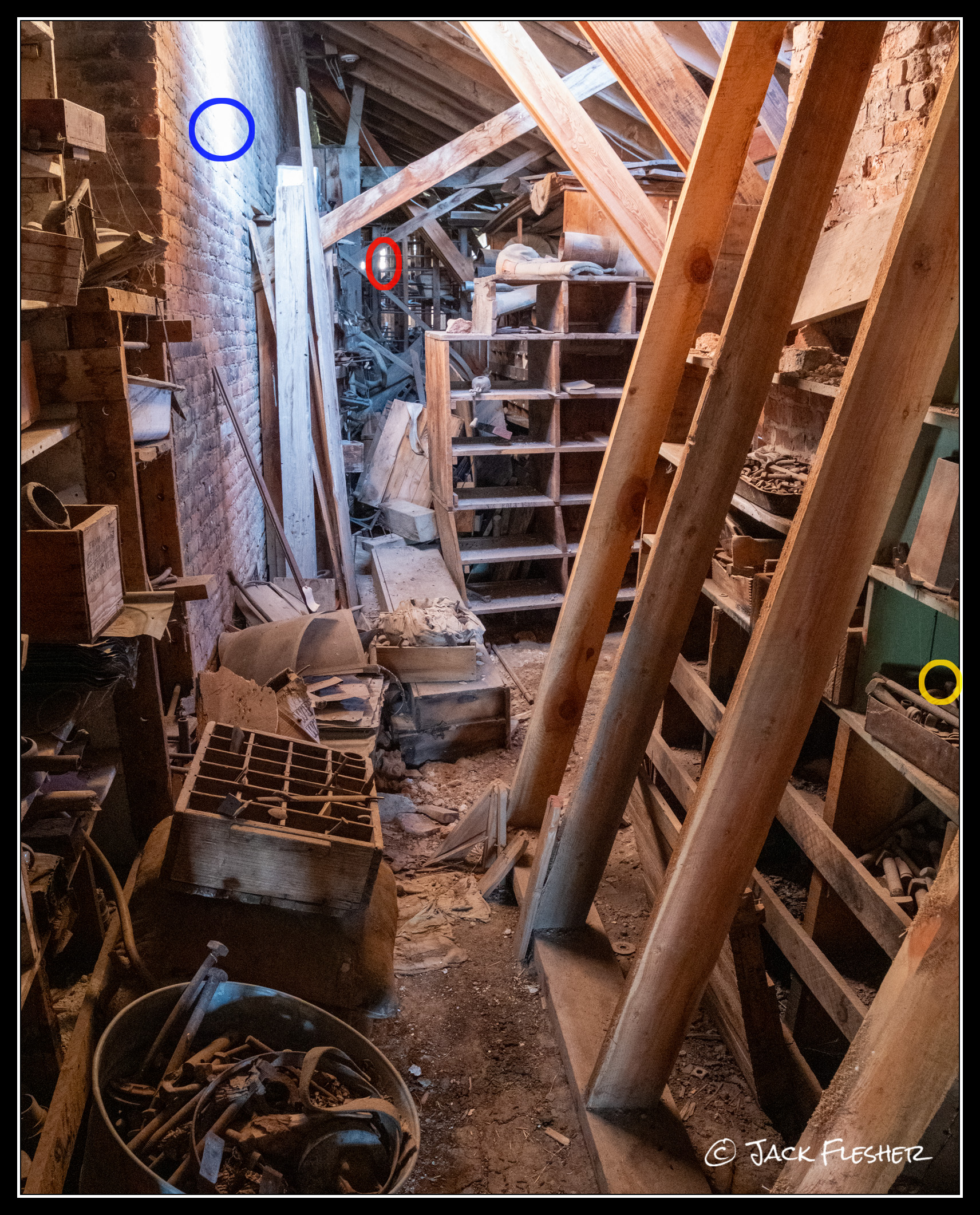
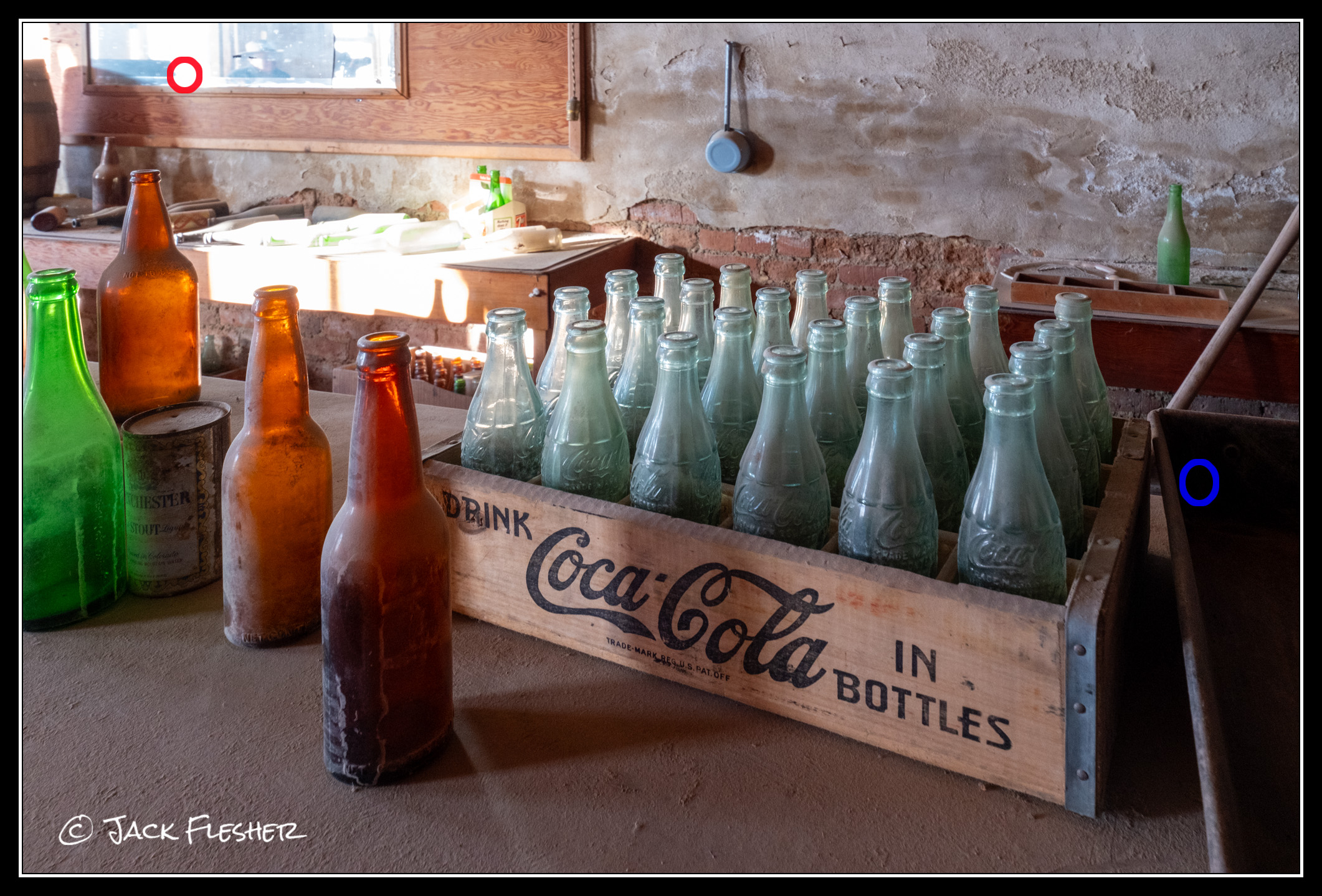
Just to take this one level further. Here are two Bodie images from that same shoot I just edited for this example, both single frame captures from a Fuji XH2 and edited completely in ACR... Not necessarily "artistic," but chosen simply to illustrate my points. In the first, I'm in a very dark back room in the store. There is a bit of light filtering in from an adjacent room behind me that has a door; while the window in the back ground behind the shelves literally has full June Sun streaming through it at about 9:00 in the morning. To my eys at the time, the floor and shelving were basically all shadow, the lit wall appearing bright-normal to my naked eyes. I edited this one so neither the blue hot nor red spectral circled areas are blown, nor is the darkest shadow yellow circled area totally black; though it may definitely appear that way on a given monitor. Likewise, in the second image, the brightest white areas of full Sun through the window and into the mirror area are not blown, however to my eyes at the time it definitely appears as full on Sunlight reflecting at me, while the bottles are medium dim. Here however, there is one tiny region, maybe 2 to 4 pixels total near the center of the blue circled area shadow that I took to full black and are indeed totally black. Everything else in this image has measurable sRGB tonality whether easily discernible or not. Just FWIW to illustrate my earlier point.

Edit: Totally sidebar comment irrelevant to this thread, but I'm getting the hang of ACR and definitely liking Adobe's color, detail and noise raw conversion capabilities. Not as fully controllable as in C1, but the "automated" portions of their approach seem very good and I think ACR is probably going to be adequate for the types of imaging I do now.


Jun 19, 2026 at 01:32 PM
chiron
Offline
• • • • •
Upload & Sell: On
p.8 #15 · Utility of dynamic range beyond a certain point


Jack Flesher wrote:
Just to take this one level further. Here are two Bodie images from that same shoot I just edited for this example, both single frame captures from a Fuji XH2 and edited completely in ACR... Not necessarily "artistic," but chosen simply to illustrate my points. In the first, I'm in a very dark back room in the store. There is a bit of light filtering in from an adjacent room behind me that has a door; while the window in the back ground behind the shelves literally has full June Sun streaming through it at about 9:00 in the
...Show more

I like both images very much, though neither is how I would have edited them. That said, I think they are images well worth spending time with. And obviously it is not for me to say that my tastes should be entertained by you. I personally would have made the light feel more realistic by including more shadows and darkness in both images and perhaps by raising the contrast a bit. I would have made the shadows deeper in the first one and raised the contrast; and I would have lowered the highlights, especially around the sunlight and the highlights in the bottles in the second one. Generally, I would make the light less even in both. All the colors have the same intensity and brightness, which is not how I usually depict color. They are a little too close to a blended exposure HDR image for me. But that is just me. i think they are very nice images.

Can you clarify how these relate to your earlier point and what your "theory" of these pictures is?


Jun 19, 2026 at 02:51 PM
Jack Flesher
Offline
• • • •
Upload & Sell: On
p.8 #16 · Utility of dynamic range beyond a certain point


chiron wrote:


Can you clarify how these relate to your earlier point and what your "theory" of these pictures is?


Simply, these frames contained probably on the order of 20 stops of DR in real life (WAGing here as I did not meter them) yet I am still able to edit them into a believable, un-blown, un-clipped 8 stop DR web image. The little Fuji XH2 sensor has roughly 11 stops of DR at its base ISO where I was shooting. Hence my point is one or two or even three additional stops of sensor DR would have made little difference to these finals as posted. Less so for you given your comment you would slam the shadows even more than I did here.

Where extra DR would have helped is if I had wanted to lift shadows more than about 2 stops more, giving me less noise and more detail if I did so. And to be clear, even a 3 stops darker exposure would not have affected the specular/directly-Sunlit sections in these frames at all. 5 stops down might have aided the brighest non-specular highlights, and then lifting shadows 2-3 stops on a 14-stop DR sensor *might* have generated an image more to your liking, but would make zero positive impact to these images for my tastes.


Jun 19, 2026 at 03:22 PM
snapsy
Offline
• • • • • •
Upload & Sell: On
p.8 #17 · Utility of dynamic range beyond a certain point


When you don't need shadows to be visible (or its detail legible) then by definition you don't need the extra dynamic range which provides that detail in the shadows. You could instead just capture the shadows dark, either accepting them as they are, either clipped or noisy.

The dichotomy between rendered shadows and highlights in this thread is interesting. While many have expressed distaste for visible shadows, hardly anyone has any aversion to excessive highlights, including blown-out highlights, including stating this preference explicitly. Again, if you don't mind blow-own highlights and/or don't need visible detail in the shadows then by definition you don't need additional dynamic range.

I'm not saying this is right or wrong or one preference is better than another- I'm just stating this to level-set the discussion on dynamic range in general.


Jun 19, 2026 at 04:21 PM
chez
Offline
• • • • • • •
Upload & Sell: On
p.8 #18 · Utility of dynamic range beyond a certain point


snapsy wrote:
When you don't need shadows to be visible (or its detail legible) then by definition you don't need the extra dynamic range which provides that detail in the shadows. You could instead just capture the shadows dark, either accepting them as they are, either clipped or noisy.

The dichotomy between rendered shadows and highlights in this thread is interesting. While many have expressed distaste for visible shadows, hardly anyone has any aversion to excessive highlights, including blown-out highlights, including stating this preference explicitly. Again, if you don't mind blow-own highlights and/or don't need visible detail in the shadows then by definition
...Show more

I find blown highlights attracts one’s eyes to the bright light and away from the actual subject. I’d much rather have dark shadows with a glimpse of details with some features in the highlights than details totally revealed in the shadows with pure white featureless highlights. Dark shadows invites further exploration…blown highlights just makes one squint.


Jun 19, 2026 at 05:05 PM
snapsy
Offline
• • • • • •
Upload & Sell: On
p.8 #19 · Utility of dynamic range beyond a certain point


chez wrote:
I find blown highlights attracts one’s eyes to the bright light and away from the actual subject. I’d much rather have dark shadows with a glimpse of details with some features in the highlights than details totally revealed in the shadows with pure white featureless highlights. Dark shadows invites further exploration…blown highlights just makes one squint.


Sure, one of many artistic choices and perfectly reasonable. Again, if details aren't needed in the shadows then the dynamic range yielding those details isn't needed either, which was the thrust of my comment.


Jun 19, 2026 at 05:36 PM
aCuria
Offline
• • •
Upload & Sell: Off
p.8 #20 · Utility of dynamic range beyond a certain point


aCuria wrote:
You do have a point, but do note that a standard monitor has less DR than what the eye can see all at once.


gdanmitchell wrote:
The words “at once” are doing a lot of work there, and we need to take a closer look at what that means.

While the human visual system is capable of seeing a huge range of luminosity values — from painfully bright down to the edge of blackness — we can’t actually “see” all of those at once. In order to see at those extremes, our visual system has to do something pretty complicated adjusting and at those range extremes it isn’t instantaneous.

If you were to somehow encounter a real world situation that contained the lowest luminosity levels of
...Show more


I think when the eye looks at the darker part of scene on screen, its possible for the eye to adapt if the monitor is on the larger side.

When comparing the same raw file on a HDR and SDR monitor, its quite clear to me that I can appreciate dynamic range beyond what the SDR IPS monitor can display. The difference is not small

Either the eye's instantaneous dynamic range exceeds the SDR monitor, or the eye is able to adapt to different parts of the image being bright and dark as the eye moves around the image.

I think the zone system is still relevant for the digital medium. Even if a SDR monitor can display 10 stops, the detail in the dimmest 2 stops is not fantastic. If we put the darkest important detail at zone 3, then the monitor only has 7 stops of DR left for the rest of the image.


Jun 20, 2026 at 01:32 AM
1       2       3              7              9              11       12       end


FM Forums | Sony Forum | Join Upload & Sell

1       2       3              7              9              11       12       end


Welcome back
Log in to your account