fredmiranda.com
Login

Moderated by: Fred Miranda
  

FM Forums | Sony Forum | Join Upload & Sell

1       2       3              8              10       11       12       end
  

Utility of dynamic range beyond a certain point


aCuria
Offline
• • •
Upload & Sell: Off
p.9 #1 · Utility of dynamic range beyond a certain point


chiron wrote:
It's an interesting problem. The lighting ratio in the actual scene is vast--I can't even guess it--and is way beyond what any sensor or the human eye can record. For example, if one comes from a dark room into sunlight (as in the old days, from a movie theater into afternoon sun), you can't see for a bit until your eyes adjust to the light. And if you then go back into the darkened room, you again can't see there until your eyes adjust. We can't see bright and dark at the same time.

So, you are trying to render the
...Show more

I actually have a HDR workflow... Compression was needed because I think few people here have a HDR monitor

The HDR variant is here, copy and paste the link because FM does not handle the link properly. Use a HDR monitor, turn HDR on and use chrome to view. Firefox cant handle HDR.
https://eu.zonerama.com/acuria/Photo/15185111/635719080


Jun 20, 2026 at 01:55 AM
chiron
Offline
• • • • •
Upload & Sell: On
p.9 #2 · Utility of dynamic range beyond a certain point


aCuria wrote:
I actually have a HDR workflow... Compression was needed because I think few people here have a HDR monitor

The HDR variant is here, copy and paste the link because FM does not handle the link properly. Use a HDR monitor, turn HDR on and use chrome to view. Firefox cant handle HDR.
https://eu.zonerama.com/acuria/Photo/15185111/635719080


That is a very good rendering of a very nice image, but for my taste the HDR version still has way over-the-top highlights that hit you in the eye and become the center of attention in a way that distorts the perception of the image, like looking at a lightbulb. It is the same problem that I have with virtually every HDR image that I see. I believe that I would like the processing of your image better if you took the highlights down by 30 or 40 points. Obviously, you may see the image very differently and have different preferences than I do, which is obviously fine.

For me, the final version of a still image is the best version that can be printed. What would you do with this image if you were preparing it for printing? What would your "soft-proof" print version of the image be?


Jun 20, 2026 at 04:18 AM
aCuria
Offline
• • •
Upload & Sell: Off
p.9 #3 · Utility of dynamic range beyond a certain point


chiron wrote:
That is a very good rendering of a very nice image, but for my taste the HDR version still has way over-the-top highlights that hit you in the eye and become the center of attention in a way that distorts the perception of the image, like looking at a lightbulb. It is the same problem that I have with virtually every HDR image that I see. I believe that I would like the processing of your image better if you took the highlights down by 30 or 40 points. Obviously, you may see the image very differently and have different
...Show more
I suspect we may be seeing different things entirely when it comes to the HDR version.

I suspect we may be seeing different things entirely when it comes to the HDR version. Different displays can interpret the PQ EOTF differently, for example, through source-referred rendering, display-adaptive tone mapping, or perceptually optimized tone mapping... which can lead to substantially different image reproduction.

To me the HDR version is not that bright for this image.


Jun 20, 2026 at 06:38 AM
chiron
Offline
• • • • •
Upload & Sell: On
p.9 #4 · Utility of dynamic range beyond a certain point


aCuria wrote:
I suspect we may be seeing different things entirely when it comes to the HDR version.

I suspect we may be seeing different things entirely when it comes to the HDR version. Different displays can interpret the PQ EOTF differently, for example, through source-referred rendering, display-adaptive tone mapping, or perceptually optimized tone mapping... which can lead to substantially different image reproduction.

To me the HDR version is not that bright for this image.


That might well be.


Jun 20, 2026 at 08:26 AM
bwcolor
Offline
• • • •
Upload & Sell: Off
p.9 #5 · Utility of dynamic range beyond a certain point


chiron wrote:
That is a very good rendering of a very nice image, but for my taste the HDR version still has way over-the-top highlights that hit you in the eye and become the center of attention in a way that distorts the perception of the image, like looking at a lightbulb. It is the same problem that I have with virtually every HDR image that I see. I believe that I would like the processing of your image better if you took the highlights down by 30 or 40 points. Obviously, you may see the image very differently and have different
...Show more

This summarizes the reason why members on this board respond poorly to HDR images. Prior to this post, it was stated that few likely had HDR capable monitors and I suggest this is unlikely. Most smartphones and tablets can handle HDR. The older members grew-up with SDR monitors and printing was/is the ultimate resting place of their image. The print is considered at the time of exposure. Decades ago, everyone could recognize that there was something special/different about projected slides, but relatively few photographers owned slide projectors. So, when we look at an HDR image, it demonstrates everything that we have spent decades trying to avoid. I believe that it takes continuous use of an HDR workflow before a person’s personal preferences can be tamed a bit and weened off their preference for what they habitually view. HDR is not appropriate for many images, but for those that are more HDR/SDR agnostic, it can be a great creative component of some images. For most, after many decades of photography, it just doesn’t look right. Maybe this is why color photography as an art form took so many decades to be accepted. BTW.. I liked the HDR rendering of the image being discussed. Smartphone photography and those that view such images will push HDR and it will become the norm. I say this because the printing of images is a much more difficult thing for most of us to accomplish today as compared to a decade past.

Edited on Jun 20, 2026 at 08:59 AM · View previous versions


Jun 20, 2026 at 08:51 AM
fjablo
Offline
• • • •
Upload & Sell: Off
p.9 #6 · Utility of dynamic range beyond a certain point


For me the "good enough" threshold is around 9 stops of PDR according to photonstophotos. We crossed that with the Nikon D700 / Canon 5D Mk II at base ISO (with some caveats concerning banding patterns). For me the main benefit of higher DR sensors now is that a) I can get that kind of DR at higher ISOs (e.g. ISO 800 on my Nikon Zf) and b) I can be a bit sloppy with exposure settings and still get a good file.

There might be some edge cases where this might not hold, but generally I find that if you can't fit the image into those 9 stops then the light is shit anyway. No point in polishing a turd, better to come back another time when the light is better.

I also find images processed with shadows +100 / highlights -100 look horribly unnatural. Capture One is a bit better than LR here as it has separate sliders for the deepest shadows and brightest highlights, lifting the former by +5 to +10 has a nice subtle effect. Otherwise better to use the the exposure and/or midtone (=brightness) sliders to bring back an image that was exposed for the highlights (iirc C1 compresses highlights if you raise exposure, so doesn't blow them as the camera would). Can't recall when I last had to push exposure more than 2-3 stops..

In that sense I personally consider the PDR increase with the new Sony sensors inconsequential. But the technology is nice for APS-C / MFT and I guess also nice-to-have on FF


Jun 20, 2026 at 08:58 AM
fjablo
Offline
• • • •
Upload & Sell: Off
p.9 #7 · Utility of dynamic range beyond a certain point


hasenbein wrote:
For shots with the sun in the frame you can not have enough dynamic range!


Do you though?

3x D700, 1x Zf (could have taken these on any A7 model ever released):

Isar x D700 by Felix, auf Flickr

Staufen II by Felix, auf Flickr

Raisting bw2 by Felix, auf Flickr

Kvalvika II by Felix, auf Flickr


Jun 20, 2026 at 09:27 AM
gdanmitchell
Offline
• • • • • • •
Upload & Sell: Off
p.9 #8 · Utility of dynamic range beyond a certain point


Daran wrote:
By using masks you introduce discontinuities into your processing. Which if overdone …


The words “which if overdone” are pulling a whole lot of weight in that post!

That strikes me as the logical equivalent of saying that some people make espresso poorly, therefore espresso is bad. ;-)

Your point is not an indictment of using masks. It is an indictment of using masks poorly.

Skillfully applied, masks themselves are invisible to most viewers, even many sophisticated cate viewers unless they stop to carefully analyze how an effect was created. In fact, skillfully applied masks have an effect that is quite similar to how our visual system operates.

It is a misconception that extensive use of post processing techniques intrinsically causes poor results. In fact, some of the very best photographs that you/I see result from extensive post-processing work, but work done so skillfully and with such aesthetic sophistication that it doesn’t draw attention to itself.

I am reminded of a conversation I had with a friend who is a pretty highly-regarded landscape photographer and expert printer about HDR some years back. I was complaining about the prevalence of “HDR effect” photographs — which were a “thing” for a while a few years back. He pointed out to me that the problem was not HDR techniques themselves, but lead-footed applications of them in a gross manner… and that we presumed that HDR was bad because bad HDR got our attention… while all of the photographs using the same techniques in subtle, appropriate ways just… looked good.

- - -

aCuria wrote:
I think when the eye looks at the darker part of scene on screen, it’s possible for the eye to adapt if the monitor is on the larger side.

When comparing the same raw file on a HDR and SDR monitor, its quite clear to me that I can appreciate dynamic range beyond what the SDR IPS monitor can display. The difference is not small

Either the eye's instantaneous dynamic range exceeds the SDR monitor, or the eye is able to adapt to different parts of the image being bright and dark as the eye moves around the image.

I think the zone
...Show more

So, if the eye is “adapting as it moves around the image” on the HDR monitor, thus perceptually darkening the lightest tones and lightening the dark areas…

… what is the advantage over a monitor image where your eyes don’t do that?

The concepts underlying the zone system are still relevant (critical even!) while the actual zone system is not particularly so anymore. When we look at a scene and recognize that highlights might be blown out and that decreasing exposure to maintain highlight detail and then bringing up the values in darkest areas in post will get the result we want… we are applying the approach of the zone system.

- - -

About the blown highlights issue… In some of the examples in this thread there are several issues to think about. One, of course, is whether and to what extent details should be retained in the very brightest areas. (I generally want to retain some detail, with the possibly exception of very small specular highlights. I’ll “under-expose” intentionally in order to retain some highlight detail in most cases.)

The other is the composition impact of very bright areas in the frame. Extremely bright areas draw attention to themselves, especially when set against other areas of the image that use much darker tones. That can be a good thing if the highlight areas are the primary subject. But if the primary subject is in the darker areas, a very bright (and especially if large) bright area can take the viewer’s focus away from the primary point of focus and weaken the composition. In general I’d prefer to tone down the highlights in a non-primary area of the frame or even rethink the composition to remove them.

(There are exceptions. For example, you blow our almost the entire frame and have your primary subject be much darker — though not so dark as to lose all detail. I’ve seen this work in, among other things, photographs of darker subjects against glowing, bright fog.)

- - -

Since I’m here, a contribution to the sun-in-the-frame-with-older-camera thread:

Cranes, Sunrise, Winter Sky

This is, obviously, a single exposure. Exposure settings were chosen to a) deal with moving birds, b) avoid blowing out the sun entirely, c) keep barely enough shadow detail to get the effect I wanted in post. And, yes, this photograph required some sophisticated work in post, as I knew it would when I made the exposure. (Single exposure using a Canon 5DsR.)

Edited on Jun 20, 2026 at 10:01 AM · View previous versions


Jun 20, 2026 at 09:36 AM
snapsy
Offline
• • • • • •
Upload & Sell: On
p.9 #9 · Utility of dynamic range beyond a certain point


fjablo wrote:
Do you though?

3x D700, 1x Zf (could have taken these on any A7 model ever released):

https://live.staticflickr.com/65535/54851082817_7011e690c7_h.jpgIsar x D700 by Felix, auf Flickr

https://live.staticflickr.com/65535/53166147968_bf27d4b4aa_h.jpgStaufen II by Felix, auf Flickr

https://live.staticflickr.com/65535/52172617672_e1805348c7_h.jpgRaisting bw2 by Felix, auf Flickr

https://live.staticflickr.com/65535/54110031524_916a629daf_h.jpgKvalvika II by Felix, auf Flickr


Those are great examples of how veiling glare limits the dynamic range of many exposures when the sun is in the frame.


Jun 20, 2026 at 09:51 AM
chiron
Offline
• • • • •
Upload & Sell: On
p.9 #10 · Utility of dynamic range beyond a certain point


gdanmitchell wrote:
The other is the composition impact of very bright areas in the frame. Extremely bright areas draw attention to themselves, especially when set against other areas of the image that use much darker tones. That can be a good thing if the highlight areas are the primary subject. But if the primary subject is in the darker areas, a very bright (and especially if large) bright area can take the viewer’s focus away from the primary point of focus and weaken the composition. In general I’d prefer to tone down the highlights in a non-primary area of the frame or
...Show more

Yes, exactly. In HDR images, there are usually very bright areas that pull the eye and that are minor compositional or semantic elements in the composition. The entire art of composition is to lead the eye in a way that is both meaningful and pleasing. So far, the HDR images that I have seen essentially randomize composition by making whatever is brightest the focus of every image, even if, for example, it is the foot of a saint in a stained-glass window rather than the face of the saint.

I like your pic and the exposure and processing. Very nice, well-balanced image.


Jun 20, 2026 at 10:42 AM


Search in Used Dept. 

chiron
Offline
• • • • •
Upload & Sell: On
p.9 #11 · Utility of dynamic range beyond a certain point


bwcolor wrote:
This summarizes the reason why members on this board respond poorly to HDR images. Prior to this post, it was stated that few likely had HDR capable monitors and I suggest this is unlikely. Most smartphones and tablets can handle HDR. The older members grew-up with SDR monitors and printing was/is the ultimate resting place of their image. The print is considered at the time of exposure. Decades ago, everyone could recognize that there was something special/different about projected slides, but relatively few photographers owned slide projectors. So, when we look at an HDR image, it demonstrates everything that we
...Show more

Maybe, but I think another possibility is that HDR eventually falls by the wayside. Photography has a 200-year history and during that time there have been various innovations that have essentially disappeared, like stereoscopic cameras and other 3D techniques. They eventually became novelties, lost their novelty value, and then disappeared.

What has remained constant over the 200 years is the classic photographic print, improved in various ways around the edges but still essentially the same medium.

As far as the dynamic range or tonal range of an image at the point of display, I am thinking that what works best for the visual beauty and coherence of almost any image is to have the tonal range of an image fall within a limited rather than a wide range. I think this might almost be a natural rule related to the way we see and the need for the parts of an image to be related to each other in a coherent, integrated, comfortable way. All paintings present images in a limited tonal range, and the images created have great beauty and power. If I imagine a Vermeer rendered as an HDR, I want to scream and tear my hair out.

I do think there can be advantages to having a wide dynamic range at capture because it provides options for how parts of the tonal range will be used at display.


Jun 20, 2026 at 11:18 AM
rico
Offline
• • • • •
Upload & Sell: Off
p.9 #12 · Utility of dynamic range beyond a certain point


ytwong wrote:
I think better dynamic range means better highlight roll off to me.

That is also my priority. Having lived through the early era of digital photography (Canon D30, Nikon D300) when DR was in desperately short supply, I find today to be luxurious living. Ever tried to up DR of a Coolpix 900 with image stacking? Not pretty. The D3X had beautiful JPEG highlight rolloff but only at base ISO; the A1 is even better.I just want to expose for the highlights to prevent channel blowout (real loss of chromaticity) except for near-point light sources. I don't ask for any terrestrial exposure to preserve the sun's disk and resolve sunspots!


Jun 20, 2026 at 09:24 PM
tctmp
Offline
• • •
Upload & Sell: Off
p.9 #13 · Utility of dynamic range beyond a certain point


gdanmitchell wrote:
Since I’m here, a contribution to the sun-in-the-frame-with-older-camera thread:

https://live.staticflickr.com/65535/52708021815_3d8b1c9d4f_b.jpgCranes, Sunrise, Winter Sky

This is, obviously, a single exposure. Exposure settings were chosen to a) deal with moving birds, b) avoid blowing out the sun entirely, c) keep barely enough shadow detail to get the effect I wanted in post. And, yes, this photograph required some sophisticated work in post, as I knew it would when I made the exposure. (Single exposure using a Canon 5DsR.)


While I understand it's a personal choice, this picture looks unnatural to me immediately. The upper band of yellow that's as bright as the sun, I don't think it needs to be a photographer who's heavily engaged in post processing to notice this. People who have seen open space sunsets a few times will likely catch that already.


Jun 21, 2026 at 12:10 AM
ruthenium
Offline
• • • •
Upload & Sell: On
p.9 #14 · Utility of dynamic range beyond a certain point


snapsy wrote:
When you don't need shadows to be visible (or its detail legible) then by definition you don't need the extra dynamic range which provides that detail in the shadows. You could instead just capture the shadows dark, either accepting them as they are, either clipped or noisy.

The dichotomy between rendered shadows and highlights in this thread is interesting. While many have expressed distaste for visible shadows, hardly anyone has any aversion to excessive highlights, including blown-out highlights, including stating this preference explicitly. Again, if you don't mind blow-own highlights and/or don't need visible detail in the shadows then by definition
...Show more

This is my favorite post in this thread, that captures the essence of what the "Utility of dynamic range" is about.

1) Preventing or minimizing highlight clipping is achieved by adjusting exposure, not by extending the dynamic range.

2) An extended dynamic range can allow capturing more light. The utility of this is in the shadows, not in the highlights. This is seen in the improved shadow signal-to-read noise ratio, as was nicely demonstrated by @snapsy in post 10 on p. 6 in https://www.fredmiranda.com/forum/topic/1945915/5#17057193
Therefore, indeed "When you don't need shadows to be visible (or its detail legible) then by definition you don't need the extra dynamic range."

3) Also, there is little need to worry (much) about the dynamic range when shooting above the base ISO. Already one step in ISO (e.g., from 100 to 200) means the loss of 1/2 of the light that the camera can capture theoretically. A full-frame camera at ISO 800 captures as much light as a micro-four-thirds camera at ISO 200 (and has a similar dynamic range).

4) I suspect that the extended dynamic range of the A7RVI (and that of A7V) is misleading. Obviously, the A7RVI at ISO 100 captures the same (or practically the same) amount of light as the A7RV at ISO 100. Thus, the shadow signal-to-read noise ratio should be practically the same in both. The way how the A7RVI achieves the "better" dynamic range is by suppressing the shadow signal. The problem is that the read noise is not suppressed selectively. It is suppressed together with the shadow signal. I speculate here. To prove me right or wrong, one should compare the shadows in the same scene captured with the A7RVI and A7RV side-by-side.


Jun 21, 2026 at 03:04 AM
jtra
Offline
• • •
Upload & Sell: Off
p.9 #15 · Utility of dynamic range beyond a certain point


ruthenium wrote:
4) I suspect that the extended dynamic range of the A7RVI (and that of A7V) is misleading. Obviously, the A7RVI at ISO 100 captures the same (or practically the same) amount of light as the A7RV at ISO 100. Thus, the shadow signal-to-read noise ratio should be practically the same in both. The way how the A7RVI achieves the "better" dynamic range is by suppressing the shadow signal. The problem is that the read noise is not suppressed selectively. It is suppressed together with the shadow signal. I speculate here. To prove me right or wrong, one should compare the
...Show more

You can download raws from dpreview for their exposure latitude test (better than using jpgs view they offer in web viewer). They are underexposed on purpose. They have multiple isos available, all same light, same shutter speed, same aperture, varying shutter modes. Push exposure of the ISO 100 set by 5 stops and compare details. I did it. The a7rvi in mechanical shutter is cleaner in these deep shadows and it contains more details there than a7rv. But a7rvi in eshutter is a bit worse than a7rv and much worse in eshutter in Hi+ drive mode.

Once you get to ISO 800 set of images (only brighten by 2 stops since light and shutter did not change), the image quality in shadows will be mostly equal for all shutter modes of a7rvi and for a7rv because all of them are past their second base ISO and also it is just +2EV.

Note that faces in test scene have faded colors nowadays. Older camera tests show them with more reds. It was mentioned by Richard Butler in dpreview discussion under a7rvi review.


Jun 21, 2026 at 05:24 AM
snapsy
Offline
• • • • • •
Upload & Sell: On
p.9 #16 · Utility of dynamic range beyond a certain point


ruthenium wrote:
4) I suspect that the extended dynamic range of the A7RVI (and that of A7V) is misleading. Obviously, the A7RVI at ISO 100 captures the same (or practically the same) amount of light as the A7RV at ISO 100. Thus, the shadow signal-to-read noise ratio should be practically the same in both. The way how the A7RVI achieves the "better" dynamic range is by suppressing the shadow signal. The problem is that the read noise is not suppressed selectively. It is suppressed together with the shadow signal. I speculate here. To prove me right or wrong, one should compare the
...Show more

The a7rVI achieves it's higher DR with the mechanical shutter via a lower-noise readout path - there's no suppression of signal.

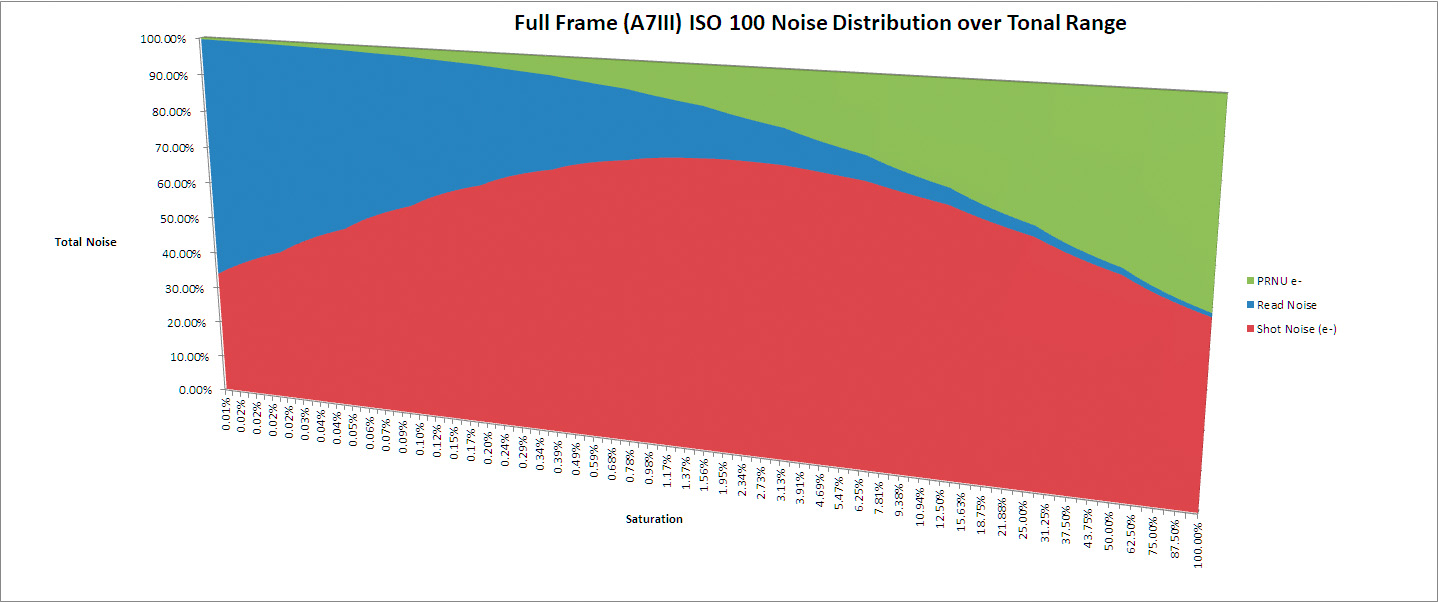
Deep shadow noise is composed primarily of read noise (electronics), not shot noise (light), thus even if the two sensors capture the same amount of light the sensor with the lower read noise will have a higher SNR in the deep shadows near the noise floor. Here's a visualization of a sample Photon Transfer Curve which demonstrates this:

The horizontal axis is the sensor saturation, left is 0% at noise floor, right is 100% at sensor saturation. The vertical axis is the % of noise each color-coded noise component represents in the total noise for that saturation level.


Jun 21, 2026 at 06:28 AM
Daran
Offline
• • •
Upload & Sell: Off
p.9 #17 · Utility of dynamic range beyond a certain point


gdanmitchell wrote:
The words “which if overdone” are pulling a whole lot of weight in that post!
That strikes me as the logical equivalent of saying that some people make espresso poorly, therefore espresso is bad. ;-)

It is not. It may have eluded you, but I did not write that masks make bad images. Not sure why what I meant wasn't obvious to you, but maybe you just wanted to use me as a segway? If so, I'm sorry I responded.


Jun 21, 2026 at 07:02 AM
ruthenium
Offline
• • • •
Upload & Sell: On
p.9 #18 · Utility of dynamic range beyond a certain point


snapsy wrote:
The a7rVI achieves it's higher DR with the mechanical shutter via a lower-noise readout path - there's no suppression of signal.

Deep shadow noise is composed primarily of read noise (electronics), not shot noise (light), thus even if the two sensors capture the same amount of light the sensor with the lower read noise will have a higher SNR in the deep shadows near the noise floor. Here's a visualization of a sample Photon Transfer Curve which demonstrates this:

The horizontal axis is the sensor saturation, left is 0% at noise floor, right is 100% at sensor saturation. The vertical axis is
...Show more

Can you expand on the "lower-noise readout path"?
My thinking is that the A7RVI uses the Dual Gain Output (one optimized for highlights and one optimized for shadows).
Perhaps you mean the same, only use different terminology.
I fully appreciate that "if the two sensors capture the same amount of light the sensor with the lower read noise will have a higher SNR in the deep shadows near the noise floor"
The key question is whether the A7RVI has an intrinsically "lower read noise" when compared to A7RV, or if this "lower read noise" is achieved by applying a lower gain "optimized for shadows". My understanding is that the latter should work to reduce BOTH the read noise and whatever signal that happens to be in those "shadows." It is this latter scenario that I referred to when speculated that the read noise "is suppressed together with the shadow signal". Thus, I expected that the shadow signal-to-read noise ratio shouldn't change in the A7RVI vs A7RV.
Is my thinking wrong?


Jun 21, 2026 at 07:39 AM
ruthenium
Offline
• • • •
Upload & Sell: On
p.9 #19 · Utility of dynamic range beyond a certain point


jtra wrote:
You can download raws from dpreview for their exposure latitude test (better than using jpgs view they offer in web viewer). They are underexposed on purpose. They have multiple isos available, all same light, same shutter speed, same aperture, varying shutter modes. Push exposure of the ISO 100 set by 5 stops and compare details. I did it. The a7rvi in mechanical shutter is cleaner in these deep shadows and it contains more details there than a7rv. But a7rvi in eshutter is a bit worse than a7rv and much worse in eshutter in Hi+ drive mode.

Once you get to
...Show more

Thank you! I am travelling but shall have a look at the files when I return home on July 15. I am interested only in a comparison at the base ISO. Another interesting point is to compare the signal in deep shadows from the A7RVI and GFX100SII (or GFX100 II) - the latter achieve their highest dynamic range by actually capturing about two times more light at the base ISO vs. the A7RVI. Thus, it would be interesting to see how the two different methods of increasing the DR compare in practice.


Jun 21, 2026 at 07:50 AM
jtra
Offline
• • •
Upload & Sell: Off
p.9 #20 · Utility of dynamic range beyond a certain point


ruthenium wrote:
The key question is whether the A7RVI has an intrinsically "lower read noise" when compared to A7RV, or if this "lower read noise" is achieved by applying a lower gain "optimized for shadows". My understanding is that the latter should work to reduce BOTH the read noise and whatever signal that happens to be in those "shadows." It is this latter scenario that I referred to when speculated that the read noise "is suppressed together with the shadow signal". Thus, I expected that the shadow signal-to-read noise ratio shouldn't change in the A7RVI vs A7RV.
Is my thinking wrong?


Cameras usually have lower (or same) read noise (compared to captured data) when they are set for higher for high ISOs, not for lower ISOs.
So relative lower read noise is achieved by using higher ISO (second base ISO, e.g. 640 over using base ISO 100).

You can see read noise increases in this Read noise in DN chart: https://www.photonstophotos.net/Charts/RN_ADU.htm
But relative to captured data it decreases in this Input-referred Read Noise chart: https://www.photonstophotos.net/Charts/RN_e.htm


Jun 21, 2026 at 07:50 AM
1       2       3              8              10       11       12       end


FM Forums | Sony Forum | Join Upload & Sell

1       2       3              8              10       11       12       end


Welcome back
Log in to your account