p.11 #1 · Utility of dynamic range beyond a certain point
Jack Flesher wrote:
Snapsy: "Good" images are a matter of opinion. The increase in DR in the example provided is a demonstrated fact.
On this we disagree. To my eyes in this example, the “increase” shown was irrelevant.
So you do agree with Snapsy. As you apparently agree that the example demonstrates the fact. You also think the increase is irrelevant, but snapsy did not offer an opinion on whether it is relevant for the image, only that it is real.
p.11 #2 · Utility of dynamic range beyond a certain point
Daran wrote:
So you do agree with Snapsy. As you apparently agree that the example demonstrates the fact. You also think the increase is irrelevant, but snapsy did not offer an opinion on whether it is relevant for the image, only that it is real.
Let me be clearer. In the example you posted, I felt the added detail in the lowest shadow was all but useless. Visible yes, useful to that image, no. Did your image prove your point? Yes -- but at the same time it proved mine too
I never said that more DR was a bad thing. What I said was that for most photographers and most scenes, we already have more DR than needed to process out to a usable image in the last 2 or 3 generations of cameras; and especially so when that output is an 8-bit sRGB file for web use. And I still stand by that comment.
Moreover, if one does need to capture several extra stops as per an HDR blend, then gaining 1 more in a new camera isn't likely to solve that problem anyway. When we have sensors that can capture 20 stops, perhaps that will satisfy those of you wanting every stop of DR they can glean.
p.11 #3 · Utility of dynamic range beyond a certain point
chiron wrote:
Can you link to some examples of HDR images that you think have been well done?
Look at images taken within churches, in which the photographer wants well exposed glas windows as well as noise free structures and artefacts within the church. I can use every bit of dynamic range I can get when shooting within gothic churches on trips around Europe.
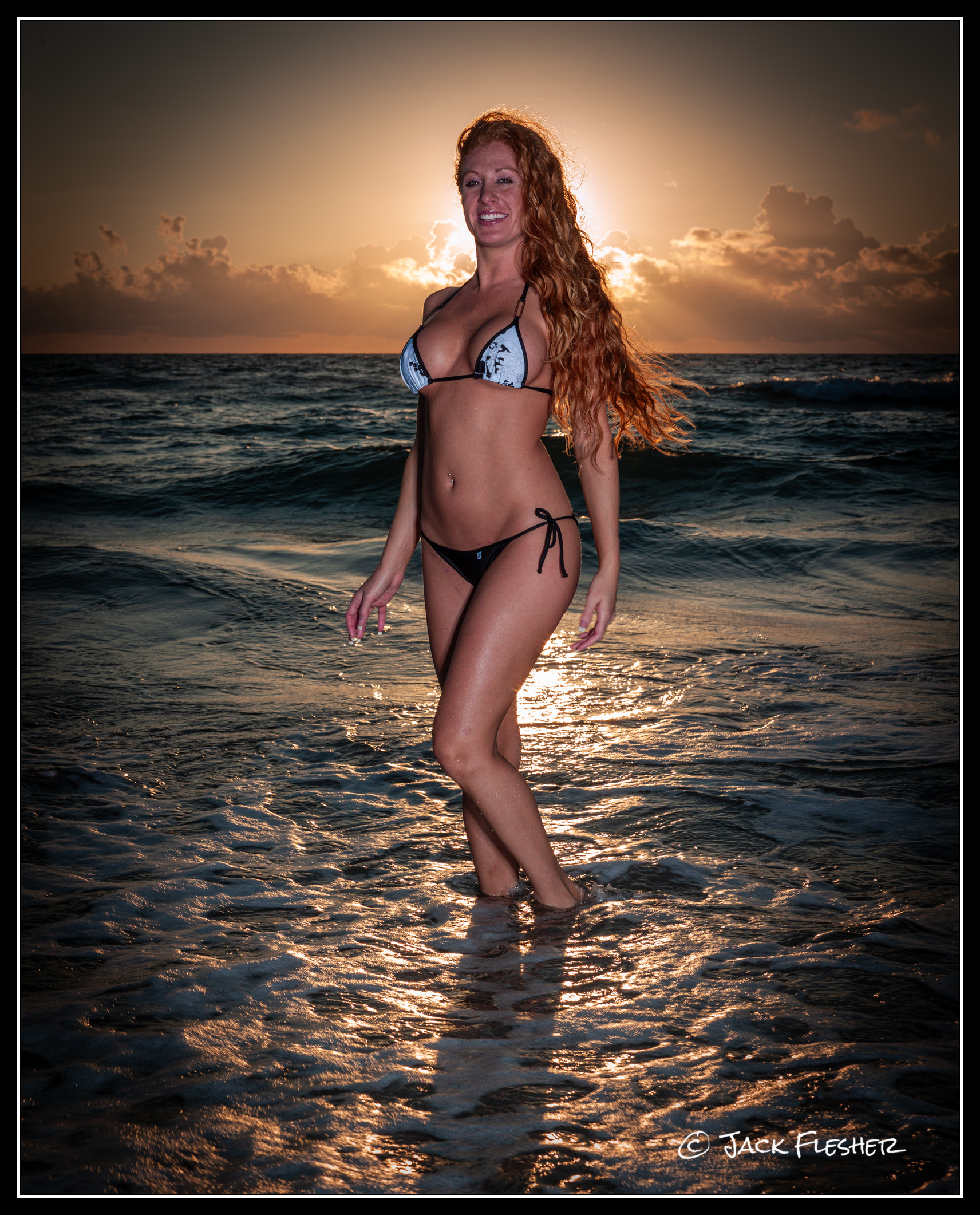
I think he was refering to an actuall well composed interesting subject photo not look at my mouse under the desk, but didnt want to blow out the window 🤨how about a sun backlit head shot of a pretty model. 😊
p.11 #5 · Utility of dynamic range beyond a certain point
A74me wrote:
🤨how about a sun backlit head shot of a pretty model. 😊
Not quite what you asked for, and not really an answer to this thread but...
This was taken in 2008 with a PhaseOne P45+ back. At the time it was considered state of the art for DR and IIRC it just fell short of 12 stops. And FTR nothing in this image is fully blown or clipped.
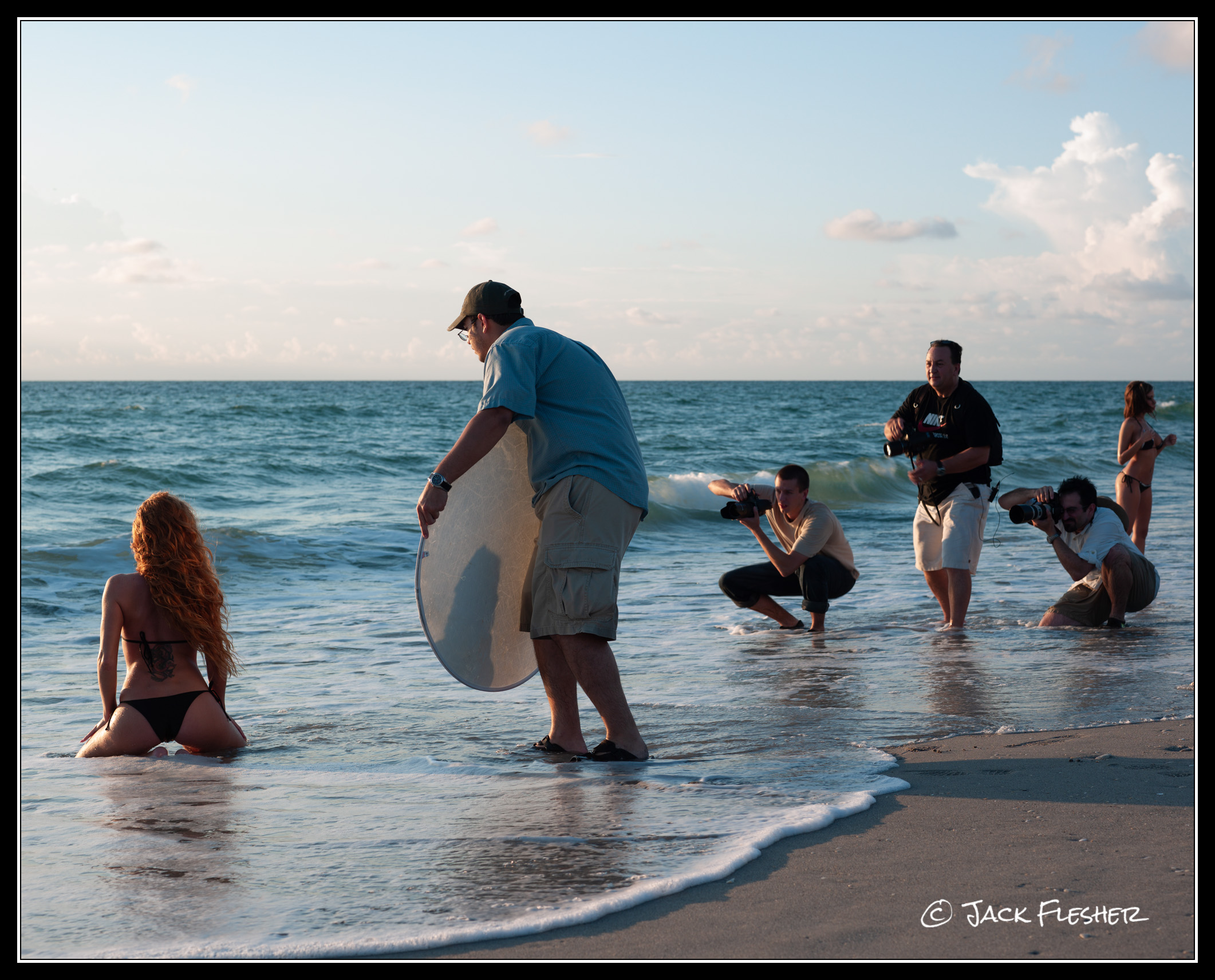
The second pic shows how we did it in a single capture back then And 3 more stops of DR wouldn’t have made enough of a difference to abandon the reflector. 5 or 6 might have though.
PS: That's Guy Mancuso in the white shorts. A few of you from this forum may have known him as he was a Sony guy. (RIP buddy!)
p.11 #6 · Utility of dynamic range beyond a certain point
Jack Flesher wrote:
This was taken in 2008 with a PhaseOne P45+ back. At the time it was considered state of the art for DR and IIRC it just fell short of 12 stops.
The 12 stops claim was just the usual marketing blurb. Only the newer CMOS medium format sensors achieved 12+ stops
Photonstophotos has test results for the Hasselblad H4D-50, which had a slightly updated version of the Kodak medium format CCD that was used in the P45+ and it comes out at 9.7 stops of PDR at ISO 50. The P45+ should have slightly less, around 9.2 to 9.5 stops probably. About 2/3 of a stop more DR than contemporary CMOS DSLRs like the D700 or 5D II.
Most current FF cameras have about 2 stops more DR at base ISO, the A7R VI about 3 Stops.
p.11 #7 · Utility of dynamic range beyond a certain point
Unless one limits himself to shooting in cloudy days or similar close to monotone lighting situations, better dynamic range can always benefit him. In fact, very often I come across situations where a higher dynamic range hugely benefits me. 1 stop extra dynamic range in A7r vi is a limited improvement. I need 4-6 stops improvement so that I don't have to do exposure bracketing in many situations that I currently have to do. Unfortunately, bracketing has its problems and limitations and most often cannot be used.
p.11 #8 · Utility of dynamic range beyond a certain point
raminolta wrote:
Unless one limits himself to shooting in cloudy days or similar close to monotone lighting situations, better dynamic range can always benefit…
But…
… virtually any current high quality camera has plenty of DR to go well beyond shooting only on “ cloudy days or similar close to monotone lighting situations.”
The increasing DR capability of modern cameras is welcomed and useful. But that’s not the issue. Here it is the marginal differences among cameras and how they play out in real world photography. that are the question.
If some camera offers me an extra half-stop of DR and it is time to buy a new camera, then why not? But if my current camera is, say, a high DR camera from a few years back and a new camera offers an additional half-stop of DR… the difference is too small (against the backdrop of already excellent DR) to make an upgrade worthwhile, and it would virtually never make a meaningful difference to photographs.
p.11 #9 · Utility of dynamic range beyond a certain point
gdanmitchell wrote:
But…
… virtually any current high quality camera has plenty of DR to go well beyond shooting only on “ cloudy days or similar close to monotone lighting situations.”
The increasing DR capability of modern cameras is welcomed and useful. But that’s not the issue. Here it is the marginal differences among cameras and how they play out in real world photography. that are the question.
If some camera offers me an extra half-stop of DR and it is time to buy a new camera, then why not? But if my current camera is, say, a highDR camera from a few years back and a new camera offers an additional half-stop of DR… the difference is too small (against the backdrop of already excellent DR) to make an upgrade worthwhile, and it would virtually never make a meaningful difference to photographs....Show more →
Of course, I did exaggerate a bit in order to gather some attention, lol. I am wondering when the OP started this thread and made his bizarre statement about DR implying that he barely if ever hits the limits of DR in his current cameras, Were you were quick to point out his fallacy.
I agree half stop is not that helpful in real scenarios. Like I said myself, I often come across situation where I need 3/4/5 or even 6 stops of DR for my style of photography. I understand this is subjective. Some people may actually prefer a punchy image where DR is compressed even intentionally to create a sort of dramatic effect.
Resolution, noise and DR are three important aspects of photo quality (not saying there aren't any other parameters). While manufactures and many consumers are very focused on the first two parameters, DR may often goes neglected. For me, modern cameras have more than enough resolution. I do not feel limited in that aspect while I feel quite limited in regards to DR. I do understand this is subjective. Some people have been shouting in forums about how much they wanted the next upgrade to A7r v being a 100MP camera! I bet they are quite upset now that A7r vi offers only a very modest resolution hike over A7r v.
p.11 #10 · Utility of dynamic range beyond a certain point
gdanmitchell wrote:
...snip...
If some camera offers me an extra half-stop of DR and it is time to buy a new camera, then why not? But if my current camera is, say, a highDR camera from a few years back and a new camera offers an additional half-stop of DR… the difference is too small (against the backdrop of already excellent DR) to make an upgrade worthwhile, and it would virtually never make a meaningful difference to photographs.
I found the step away from the canon 5dsr to a sony a7riva a big difference in useful dynamic range for the woodland and waterfall images I make.
p.11 #11 · Utility of dynamic range beyond a certain point
guidostow wrote:
I found the step away from the canon 5dsr to a sony a7riva a big difference in useful dynamic range for the woodland and waterfall images I make.
That difference likely was more significant, since the 5DsR is now 11 1/2 years old.
p.11 #13 · Utility of dynamic range beyond a certain point
guidostow wrote:
I thought you were still shooting with the 5DS and still deciding on when and where to jump to a mirrorless.
I am still using hte 5DsR, but I’m virtually certain to move to the A7r6 once the accessories I need are available for it and when the timing is otherwise right for me — that probably means a matter of a couple of months. (I also have to work out my lens strategy.)
the 5DsR has been a great camera for me. I’ve had it since it was released. But I’ve decided that Canon is letting the high res camera market go, so I think Sony is going to be a better fit for me going forward.
Relative to what I’ve posted in this thread: My position is that small increases in DR (like what you might get from one camera model to the next) are actually pretty insignificant, while larger increases do have value, especially if you have a fairly old camera.
p.11 #14 · Utility of dynamic range beyond a certain point
gdanmitchell wrote:
I am still using hte 5DsR, but I’m virtually certain to move to the A7r6 once the accessories I need are available for it and when the timing is otherwise right for me — that probably means a matter of a couple of months. (I also have to work out my lens strategy.)
the 5DsR has been a great camera for me. I’ve had it since it was released. But I’ve decided that Canon is letting the high res camera market go, so I think Sony is going to be a better fit for me going forward.
Relative to what I’ve posted in this thread: My position is that small increases in DR (like what you might get from one camera model to the next) are actually pretty insignificant, while larger increases do have value, especially if you have a fairly old camera....Show more →
So I'm one step further down the upgrade road than you are. I'm highly unlikely to upgrade to the a7rvi (it offers very little I do want and lots that I don't compared to the a7riva), but I am thinking hard about the Fujifilm GFX 100s.
p.11 #15 · Utility of dynamic range beyond a certain point
To me, it doesn’t make sense to talk about dynamic range being sufficient or not without also specifying what kind of output is being targeted
For a small reproduction, especially if you have to downsize the image, you are averaging pixels and reducing the impact of noise.
The opposite is true when enlarging and also sharpening the image
For web use, you typically view the images maybe 8-10” on the long side. In this case, the magnitude of shadow noise is much reduced.
In large prints, you might print at 130 to 150 PPI (roughly a 50-70” print with a7R5). At these sizes, I can definitely appreciate another stop of dynamic range to clean up shadows.
Not many people print that large. And even then, if you view it from far away, you won’t see the noise. It still requires close viewing. But people do view prints from close up on occasion.
Personally I’m pretty excited about the extra stop. This is the first time since I moved to Sony in 2015 that the cameras had any substantial improvement at base iso.
p.11 #16 · Utility of dynamic range beyond a certain point
guidostow wrote:
So I'm one step further down the upgrade road than you are. I'm highly unlikely to upgrade to the a7rvi (it offers very little I do want and lots that I don't compared to the a7riva), but I am thinking hard about the Fujifilm GFX 100s.
The GFX is a fine camera for the right users and subjects but there are some issues, too. First off, you can't get the lens options that you might rely on with the FF system. (That's a bit issue for me. I might have already bought a GFX system if they had something like a 200-500mm zoom.) It is also a slower camera than the Sony cameras, if that matters to you.
If you don't need that speed or the range of lenses and accessories and you frequently print VERY large (not just large) then it can be a fine option.
p.11 #17 · Utility of dynamic range beyond a certain point
guidostow wrote:
So I'm one step further down the upgrade road than you are. I'm highly unlikely to upgrade to the a7rvi (it offers very little I do want and lots that I don't compared to the a7riva), but I am thinking hard about the Fujifilm GFX 100s.
I added this camera (GFX100S II) with the GF20-35MM F4 lens last December. What helped that decision was the opportunity to have the system for a week, on loan from Fuji Canada. You may want to explore this option, if you are not sure whether you should like the GFX. Later on, I similarly had a chance to spend time with the GF500MM F5.6 lens, also loaned by Fuji Canada. I now have my own copy of this lens together with the GF55MM F1.7 prime. I don't have the feeling that there are lenses that , for my uses, are not available for the GFX. I am perfectly happy with the three GF lenses I purchased.
In the last seven months, I really bonded strongly with the GFX. There is something about the camera and about the experience of processing the raw files that I find enjoyable. My Sony A1 and some of the excellent lenses (35mm F1.4 GM, 70-200mm F2.8 GMII, 200-600mm G, Tamron 35-150mm F2-2.8 etc) are, unfairly(!), "collecting dust".
It is true that the GFX100S II is not a fast system, yet it is not as slow as to be a problem. I like the 4 x 3 sensor better than the 3 x 2, and (unexpectedly) I really like having the 100MP. The body design and layout of the buttons and dials on the GFX100S II are very different from the Sony bodies. Thus, it would make sense to try this system before committing to purchasing.
p.11 #18 · Utility of dynamic range beyond a certain point
ruthenium wrote:
I added this camera (GFX100S II) with the GF20-35MM F4 lens last December. What helped that decision was the opportunity to have the system for a week, on loan from Fuji Canada. You may want to explore this option, if you are not sure whether you should like the GFX. Later on, I similarly had a chance to spend time with the GF500MM F5.6 lens, also loaned by Fuji Canada. I now have my own copy of this lens together with the GF55MM F1.7 prime. I don't have the feeling that there are lenses that , for my uses, are not available for the GFX. I am perfectly happy with the three GF lenses I purchased.
In the last seven months, I really bonded strongly with the GFX. There is something about the camera and about the experience of processing the raw files that I find enjoyable. My Sony A1 and some of the excellent lenses (35mm F1.4 GM, 70-200mm F2.8 GMII, 200-600mm G, Tamron 35-150mm F2-2.8 etc) are, unfairly(!), "collecting dust".
It is true that the GFX100S II is not a fast system, yet it is not as slow as to be a problem. I like the 4 x 3 sensor better than the 3 x 2, and (unexpectedly) I really like having the 100MP. The body design and layout of the buttons and dials on the GFX100S II are very different from the Sony bodies. Thus, it would make sense to try this system before committing to purchasing. ...Show more →
Thanks for this... I'd certainly do a "try before I buy" before making the change.
I'm not the average sony user. My practice is very much shaped by my time using large format (mostly 4x10 and 8x20). I work slowly and carefully, entirely on a tripod. I would use my adapted canon TS-E lenses manual focus lenses 24,50,90 and 135 (maybe adding the 17...) I'm excited by the Fringer adapter with the physical aperture ring. I work entirely from the LCD. I'm skeptical about the 4x3, but excited by the 65x24 crop option.
I would keep my sony bodies and sigma zooms for wet/dusty conditions and IR.
I'll keep pondering, I don't want to jump before I'm sure.
p.11 #19 · Utility of dynamic range beyond a certain point
guidostow wrote:
Thanks for this... I'd certainly do a "try before I buy" before making the change.
I'm not the average sony user. My practice is very much shaped by my time using large format (mostly 4x10 and 8x20). I work slowly and carefully, entirely on a tripod. I would use my adapted canon TS-E lenses manual focus lenses 24,50,90 and 135 (maybe adding the 17...) I'm excited by the Fringer adapter with the physical aperture ring. I work entirely from the LCD. I'm skeptical about the 4x3, but excited by the 65x24 crop option.
I would keep my sony bodies and sigma zooms for wet/dusty conditions and IR.
I'll keep pondering, I don't want to jump before I'm sure....Show more →
My point above was not that the GFX system is right or wrong or that it is good or bad — just that working with it is a very different thing than working with high-end FF systems.
Like you, I also work (with my larger camera systems) almost* exclusively from the tripod, and I rely heavily on the LCD for framing and manual focus. (Basically I run the camera in a fully manual mode for this.) However, I moved away from using prime lenses (for my landscape photography) and for a decade or so have used only zooms, with the exception of occasionally using a macro prime. (I use a Pentax medium format zoom lens on a Mirex tilt/shift adapter at times, too.)
My personal issue with GFX — and I acknowledge that it is personal to my style of landscape photography, which often relies on long lenses — is that there is no Fujifilm zoom longer than 200mm (the 100-200). And, of course, that’s a wider angle of view than 200mm on FF. I rely a great deal on 70-200mm and 100-400mm zoom lenses, with the latter occasionally using a 1.4x TC.
I know that Fujifilm makes excellent 250mm and 500mm primes for the GFX cameras, along with a 1.4x TC. But I want (expect, need…) the precise compositional control provided by zoom lenses… and I do not’ want to deal with two big primes and a TC where one lens does the job on FF with greater control.
As I often add, though, YMMV. :-)
I see that you rely on a set of four prime lenses between 24mm and 135mm, and you can certainly find lenses that will work with that approach. Your T/S (Canon EF I presume) lenses should give you sufficient coverage for the somewhat larger miniMF sensor area, though your ability to to T and S will be a bit more limited, if that matters. You will, obviously, be getting larger angles of view, but some photographers are willing to crop to FF size occasionally.
If I had been in your situation — owning a set of lenses that should work well with an adapter — I probably would have moved to GFX several years ago.
- - -
* my “almost” qualifier is that I do sometimes photograph wildlife with my current FF system, and I most often do that handheld. For me — but probably not for you — that is another negative on the miniMF system on several counts: speed, reach, and lenses. When I contemplated GFX while waiting to see if Fujifilm would ever come up with better long lens options, I assumed that I’d need a second system for this photography.
p.11 #20 · Utility of dynamic range beyond a certain point
guidostow wrote:
I'll keep pondering, I don't want to jump before I'm sure.
I recently faced upgrade indecision. I rationalized the move once I realized that I risk the difference between purchase and resale price of the MF equipment. Buy used and this difference reduces further. I’ve rarely been sure of anything.