fredmiranda.com
Login

Moderated by: Fred Miranda
  New fredmiranda.com Mobile Site
  New Feature: SMS Notification alert
  New Feature: Buy & Sell Watchlist
  

FM Forums | Sony Forum | Join Upload & Sell

1       2       3              5       end
  

Sony Full-Frame vs. Olympus OM1 II?


ruthenium
Offline
• • • •
Upload & Sell: On
p.4 #1 · Sony Full-Frame vs. Olympus OM1 II?


Re @Frogfish, in your consideration
"DYNAMIC RANGE
Not that anyone can actually see that on a 4k monitor anyway (and most have lower res. than 4k)! Current Rec.709 displays are really only designed to output between 7 and 9 stops of dynamic range. HDR displays can now show 10-14 stops of dynamic range. UHD is 13 stops. sRGB being an 8-bit space, limits the displayable dynamic range to 8 stops (and this is what the VAST majority of people view at and what printers generally want the files delivered in). Adobe RGB, has a dynamic range of around 10 stops.
The OM1 has a DR of 13.4 stops. OM-3 is 13.7 stops. Sony A7Cii & A7r5 have 15 stops . Nikon Z8 has 14.3 stops. Canon R8 has 14.7 stops."

You conflate the dynamic range with the color depth. This is confusing at best.
For the dynamic range, the commonly used numbers are for the Photographic Dynamic Range (from photonstophotos) and not the Engineering Dynamic Range. Your numbers, like 13.4 for OM-1 look like the EDR. I don't know where you have taken the numbers. Furthermore, the dynamic range (one way or another) is not a constant. It depends on the exposure; thus the numbers are reported with the corresponding ISO.
The importance of dynamic range in photography is not about how the processed images should look on a display. The dynamic range tells how much image one can recover from the shadows while processing the raw data.


Aug 05, 2025 at 07:48 PM
chiron
Offline
• • • • •
Upload & Sell: On
p.4 #2 · Sony Full-Frame vs. Olympus OM1 II?


Frogfish wrote:
Having been through the whole thread I'm going to quote this post not only because it's from the OP but because it invites a response to some critical points. I've also trimmed away anything I consider not pertinent. I apologise in advance for the length of this post !!!

For Sony I shoot (have shot with) : A7r, rii, A7, r4 and I still have the r5 and A6000 (converted to IR FS). Abotu 18 months ago I delved into M43 and because totally hooked, I now have the OM1i, OM3 and OM5i (selling - or I should say sold as
...Show more

Thank you for such an excellent, well-informed, and detailed post. I am still working on absorbing it all, but I think you have persuaded me to give the Olympus 4/3 line a trial!


Aug 05, 2025 at 08:31 PM
AmbientMike
Offline
• • • • • •
[X]
p.4 #3 · Sony Full-Frame vs. Olympus OM1 II?


ruthenium wrote:
A "faster" lens has a larger entrance pupil; thus, it can project MORE LIGHT on a sensor when compared to a "slower" lens. This extra light can be used to set a faster shutter speed. The entrance pupil = focal length/f-number.
For a 20mm f/1.4 lens and a 40 f/2.5 lens, the corresponding numbers are 14.3mm and 16mm, respectively.
The 40 f/2.5 lens has a larger "physical aperture" and can project more light on a sensor - this is the "faster' lens of the two.
Note that this consideration is straightforward for lenses of the same or equivalent focal lengths. I wouldn't compare
...Show more

1.4 is faster than 2.5.

Yes, longer fl require larger apertures to get there. Aperture diameter/ lens opening=f number

ISO is part of the triangle


Aug 05, 2025 at 10:50 PM
johnvanr
Offline
• • • • •
Upload & Sell: On
p.4 #4 · Sony Full-Frame vs. Olympus OM1 II?


ruthenium wrote:
A "faster" lens has a larger entrance pupil; thus, it can project MORE LIGHT on a sensor when compared to a "slower" lens. This extra light can be used to set a faster shutter speed. The entrance pupil = focal length/f-number.
For a 20mm f/1.4 lens and a 40 f/2.5 lens, the corresponding numbers are 14.3mm and 16mm, respectively.
The 40 f/2.5 lens has a larger "physical aperture" and can project more light on a sensor - this is the "faster' lens of the two.
Note that this consideration is straightforward for lenses of the same or equivalent focal lengths. I wouldn't compare
...Show more

I should have said exposure triangle, not pyramid. And that triangle is aperture, shutter speed and ISO.


Aug 06, 2025 at 12:25 AM
ruthenium
Offline
• • • •
Upload & Sell: On
p.4 #5 · Sony Full-Frame vs. Olympus OM1 II?


johnvanr wrote:
I should have said exposure triangle, not pyramid. And that triangle is aperture, shutter speed and ISO.


I thought as much. Nevertheless, the exposure is determined ONLY by TWO settings: the aperture and shutter speed, nothing else. Only these two settings control the light that falls on a sensor.
ISO has no effect on the exposure, as the ISO (gain) is applied after an image has been captured (I keep repeating this). It is the changing exposure that results in the changes that you see in the ISO values.
The ISO that you see is merely an indicator: when ISO is low it means that the amount of light per unit area (that is the exposure) is large, when the ISO is high this means that the amount of light per unit area is low. Manually changing the ISO can not change the amount of light, only the amount of gain applied to the signal from the sensor when this signal is digitized.

One has only two options to gain more light: (a) use a faster lens and/or (b) lower the shutter speed.
Thus, set the ISO to auto and don't worry too much but keep an eye on the number. If it goes above 1600 on mFT or the equivalent ISO 6400 on FF, then try to gain more light by opening the lens or lowering the shutter speed, if possible.


Aug 06, 2025 at 12:59 AM
johnvanr
Offline
• • • • •
Upload & Sell: On
p.4 #6 · Sony Full-Frame vs. Olympus OM1 II?


ruthenium wrote:
I thought as much. Nevertheless, the exposure is determined ONLY by TWO settings: the aperture and shutter speed, nothing else. Only these two settings control the light that falls on a sensor.
ISO has no effect on the exposure, as the ISO (gain) is applied after an image has been captured (I keep repeating this). It is the changing exposure that results in the changes that you see in the ISO values.
The ISO that you see is merely an indicator: when ISO is low it means that the amount of light per unit area (that is the exposure) is
...Show more

Maybe you’re technically right, but you seem to live in a separate world where things don’t mean what they mean elsewhere. Go to Wikipedia and look up lens speed. Read up on the exposure triangle. Yes, there are ifs and buts, but you take those and use them to give a different meaning to long-established definitions.


Aug 06, 2025 at 01:48 AM
AmbientMike
Offline
• • • • • •
[X]
p.4 #7 · Sony Full-Frame vs. Olympus OM1 II?


It has been a while, but I think the correct explanation is that, for instance, 300mm spreads the light from a small part of the image over the frame vs 20mm, so you need larger front aperture to gather more light.

300mm f/5.6 requires MUCH larger opening, ~53.6mm, than the ~14.3mm of 20/1.4. But you can't say a 5.6 lens is faster than 1.4.


Aug 06, 2025 at 10:11 AM
raminolta
Offline
• • •
Upload & Sell: Off
p.4 #8 · Sony Full-Frame vs. Olympus OM1 II?


IMO, you are wrong on some of your arguments. You have not indicated any source for your data (dynamic range of different cameras) but let's assume they are correct. You think monitors maps dynamic range of photos in a one to one fashion onto their screen . So by your logic, one would need a 15 stop monitor to show a photo with 15 stops of dynamic range. This cannot be farther from truth.

Example: Let's assume the camera has 15 stops of dynamic range and the monitor can show up to 10 stops of dynamic range. If the details in the details in the highlights and shadows are preserved in the file, one can see them on that monitor through proper tone mapping (correct post-processing in the software). So the details are not lost just because the monitor has a limited DR range.

Post processing is important even if the source and screen have the same theoretical dynamic range. A photo with 15 stops of dynamic range seen on a monitor with 15 stops of dynamic range does NOT mean you are going to see all the details in the shadows and highlights. Without proper tone mapping, the details and highlights may not be seen on that spectacular monitor while they may become visible on a monitor with only 10 stops of dynamic range!

Next: you are making the same mistake regarding print and resolution. I have a 42mp camera (A7r iii) and a 24" wide printer. Still, sometimes, I have noticed that sometimes if I up-scale the resolution of the image in the software before printing, it would make an observable difference in the output print. Off course, this greatly depends on the scene and the details. If this is a photo of a scene with lots of small details like trees with leaves, ground with many tiny details (sand and stone pieces, etc.), up-scaling the image before printing can make a noticeable difference. I have seen this with my own eyes. Of course, it also depends at what distance you are watching the print. If you are so far away, you may not see a difference. But the difference can be noticeable even at reasonable viewing distances without putting your nose into the print.

Noise. I used to have a m43 camera which I liked its compactness and look, but ended up selling it because the image quality wasn't satisfying to me. While I can reduce noise in the software, I still prefer to have a cleaner image to begin with.

System size and weight: To some extent I agree but it depends on the lens, camera model etc. M43 does not automatically guarantee weight and size reduction over the Sony FF system. With A7c r or A7c ii and some compact lenses, the Sony system can approach or even match a similar m43 system regarding the overall weight and size of the load that one wants to carry.

OM system has probably some advantages over the Sony system. They have implemented features in their cameras since long time ago (like focus bracketing, etc.) some of which are very useful depending on the type of photography one does (macro photography). Sony has started implementing these features too but they are rather slow: they were late in implementing focus bracketing, intervalometer, open bulb time and even the touch interface. They are getting there but they implemented features may not be as maturely implemented as one may see in other systems.


Frogfish wrote:
DYNAMIC RANGE
Not that anyone can actually see that on a 4k monitor anyway (and most have lower res. than 4k)! Current Rec.709 displays are really only designed to output between 7 and 9 stops of dynamic range. HDR displays can now show 10-14 stops of dynamic range. UHD is 13 stops. sRGB being an 8-bit space, limits the displayable dynamic range to 8 stops (and this is what the VAST majority of people view at and what printers generally want the files delivered in). Adobe RGB, has a dynamic range of around 10 stops.
The OM1 has a DR of 13.4 stops. OM-3 is 13.7 stops. Sony A7Cii &
...Show more


Aug 06, 2025 at 11:29 AM
Frogfish
Offline
• • • • •
Upload & Sell: Off
p.4 #9 · Sony Full-Frame vs. Olympus OM1 II?


ruthenium wrote:
Re @Frogfish@, in your consideration
"DYNAMIC RANGE
Not that anyone can actually see that on a 4k monitor anyway (and most have lower res. than 4k)! Current Rec.709 displays are really only designed to output between 7 and 9 stops of dynamic range. HDR displays can now show 10-14 stops of dynamic range. UHD is 13 stops. sRGB being an 8-bit space, limits the displayable dynamic range to 8 stops (and this is what the VAST majority of people view at and what printers generally want the files delivered in). Adobe RGB, has a dynamic range of around 10 stops.
The OM1 has
...Show more

I think you better take it up with the manufacturers then (because that's where I researched the figures) ! All do the same - give you their best DR figures which are of course at the base ISO

Edited on Aug 06, 2025 at 01:41 PM · View previous versions


Aug 06, 2025 at 11:49 AM
AmbientMike
Offline
• • • • • •
[X]
p.4 #10 · Sony Full-Frame vs. Olympus OM1 II?


It was pretty much an eye roll seeing that the 15 stop claim is probably based on rounding the DxO score to the nearest integer. Pretty ridiculous

Bill Claff is supposed to be more realistic, I doubt even DxO claims you'd actually get 14.6 or 14.8 in a real photograph.


Aug 06, 2025 at 12:58 PM


Search in Used Dept. 

Frogfish
Offline
• • • • •
Upload & Sell: Off
p.4 #11 · Sony Full-Frame vs. Olympus OM1 II?


Example: Let's assume the camera has 15 stops of dynamic range and the monitor can show up to 10 stops of dynamic range. If the details in the details in the highlights and shadows are preserved in the file, one can see them on that monitor through proper tone mapping (correct post-processing in the software). So the details are not lost just because the monitor has a limited DR range.


Well that's not exactly true. The final exported image (usually a jpg) has a reduced dynamic range compared to the original RAW file because it has been processed to fit a standard display. The information that was once spread across 14+ stops of a camera's sensor is now compressed into the 10 stops of a typical monitor. It's compressed and for that to happen information is lost to ensure it fits within the new parameters.


Next: you are making the same mistake regarding print and resolution. I have a 42mp camera (A7r iii) and a 24" wide printer. Still, sometimes, I have noticed that sometimes if I up-scale the resolution of the image in the software before printing, it would make an observable difference in the output print. Off course, this greatly depends on the scene and the details. If this is a photo of a scene with lots of small details like trees with leaves, ground with many tiny details (sand and stone pieces, etc.), up-scaling the image before printing can make a noticeable difference....Show more

No mistake. I'm not sure what errors you are making or what software you are using but I actually posted samples here on FM of before/after (of actual prints used in an exhibition in Shanghai) so please go and find them. Even viewing at 200% there was no discernible difference. Upscaling software is superb nowadays.
I would also add that if you can perceive a difference at 200% - it won't matter if viewed at the correct distance for the print size. I don't care about people who stick their nose to the print and say - I can see a difference! They are irrelevant.

Noise. I used to have a m43 camera which I liked its compactness and look, but ended up selling it because the image quality wasn't satisfying to me. While I can reduce noise in the software, I still prefer to have a cleaner image to begin with.

Oh come on - you say I didn't quote sources (the manufacturers themselves) for my quotes yet you don't even say what model you are using ! I gave a link to work from a BTS music video shot at 12,800 - 25,600, there is clearly some detail loss (smoothing) but again after post processing the images look clean and engaging. You are giving a personal opinion whilst I gave you facts, if you want to go in another direction then good for you - we are adults we get to make our own choices!
For me I'm saying I'll go to the shops in my Ford and you want to go in your Ferrari. You'll get there first but we both get there and park in the same spot.

System size and weight: To some extent I agree but it depends on the lens, camera model etc. M43 does not automatically guarantee weight and size reduction over the Sony FF system. With A7c r or A7c ii and some compact lenses, the Sony system can approach or even match a similar m43 system regarding the overall weight and size of the load that one wants to carry.

Sorry but I'm calling BS on this one ! If you want to use Sonys smallest camera fine, then compared to the OM5ii (418g - and there is lighter, the Pen P7 is 289g!) the Sony is more or less the same at 424g however :

As far as lenses are concerned I will go by aperture size (with an aperture of f1.8 for both as light collection is the same on any sensor, not by area, and very low DoF irrelevant for most work) so 1 WA 10mm f2 Laowa, 3 WR primes (17mm, 25mm and the non-WR 45mm) plus the full IPX53 WR 12-45/4 Pro zoom:-

Laowa 10mm : 125g (I guess the Viltrox 20/2.8 at 157g, so a stop slower).
OM 17mm : 120g (Sony 280g)
OM 25mm : 135g (Sony 186g)
OM 45mm : 116g (Sony 85mm 371g)
OM 12-45/4 : 254g (Sony 24-70/4 424g, heavier with less reach)

We won't even get into size because the Sonys are all much bigger. Image quality mostly a push bar the superb OM 12-45 & Laowa 10mm. And again I'll stress the IPX53 weather sealing of 3 of the OM lenses.

OM total of camera + 4 lenses : 1,268g and the Sony line up is virtually 50% heavier at 1,842g

Sony has nothing that comes close to that (I have been with Sony since the original A7 and A7r - of which I had both) not even using 3rd party manufacturers. We'll ignore the 28-60 variable aperture as it's crap - I couldn't wait to sell it (and it's variable).


Edited on Aug 06, 2025 at 04:00 PM · View previous versions


Aug 06, 2025 at 02:33 PM
dblsplayer
Offline
• •
Upload & Sell: On
p.4 #12 · Sony Full-Frame vs. Olympus OM1 II?


I have an a7iv system and an OM-1 mark II system. Mostly an outdoor hiking photographer but I also get roped in to friends and family portrait sessions and an occasional wedding. I use the Sony system for these shoots, but occasionally the OM and their great 1.2 primes.

When outdoors and hiking, without a doubt I prefer the OM system and it’s incredible weather sealing, live ND, and handheld hi res modes. I went to Banff last September and took both systems. One morning only with the Sony and left it in the hotel the rest of the week.

Both are great but if I had to pick only one, for me it’s the OM system.

I don’t get to hooked on some of the technical arguments you read here; everyone knows but no one agrees. I take pictures.
The question I ask myself when I see a photo I like is , not what camera was used, but how did they capture the image.


Aug 06, 2025 at 02:55 PM
Steve Spencer
Online
• • • • • • •
Upload & Sell: On
p.4 #13 · Sony Full-Frame vs. Olympus OM1 II?


Well that's not exactly true. The final exported image (usually a jpg) has a reduced dynamic range compared to the original RAW file because it has been processed to fit a standard display. The information that was once spread across 14+ stops of a camera's sensor is now compressed into the 10 stops of a typical monitor. It's compressed and for that to happen information is lost to ensure it fits within the new parameters.


No mistake. I'm not sure what errors you are making or what software you are using but I actually posted samples here on FM of before/after (of
...Show more

If you keep the f/numbers the same then the opening at entrance pupil will be 4 times as large for the FF lenses when wide open, so of course they will be bigger and they will let in four times as much light. So not really a fair comparison. If you keep the entrance pupil the same size, you will get a better comparison when you can do the comparison. So for f/1.8 lenses it is best to compare them to f/3.5 lenses of FF or when those don't exist f/2.8 lenses which typically do exist.

Laowa 10 f/1.8 120g vs. Viltrox 20 f/2.8 157g, but the Viltrox has a larger entrance pupil when wide open and let's in more light
OM 17 f/1.8 120g vs. Sony/Zeiss 35 f/2.8 100g, even though it has a larger entrance pupil when wide open the Sony is lighter probably because it has so much vignetting
OM 25 f/1.8 135g vs. Sony 50 f/2.5 G 174g, but the Sony has almost double the size of entrance pupil
OM 45 f/1.8 116g vs. Sigma 90 f/2.8 295g, the Sigma has a larger entrance pupil but not enough to account for the difference in size at this longer focal length
OM 12-45 f/4 254g vs. nothing -- there is nothing even close to having this small of an entrance pupil on Sony FF or any FF camera. If you want a small lens and you can live with a small entrance pupil then m4/3rds gives you options that just aren't available for FF.

I think your examples show nicely that m4/3rds provides some interesting very small lenses, but it isn't the small image circle (i.e., small sensor of the cameras) that allows all these lenses to be so small, it is the small entrance pupil of these lenses at wide open that makes it easy to keep their size super small. If FF lenses used this small of max entrance pupil, then they could make small lenses at these shorter focal lengths too as we can see with the 10, 17, and even 25 when we compare lenses that have almost as small of an entrance pupil. We do see when we compare the 45 to the 90 that we start to see a bigger advantage for m4/3rds in keeping lenses small and we can expect that advantage to grow as focal lengths increase.

Zooms are another case. M4/3rds zooms have much smaller entrance pupils at max aperture than anything available for FF, so much so that they totally dwarf FF zooms. If you want this sort of zoom that trades off very small size for big limits in how shallow of depth of field it can obtain, the m4/3rds is definitely the system for you. Similar lenses just aren't available for FF.


Aug 06, 2025 at 03:27 PM
Frogfish
Offline
• • • • •
Upload & Sell: Off
p.4 #14 · Sony Full-Frame vs. Olympus OM1 II?


Steve Spencer wrote:
If you keep the f/numbers the same then the opening at entrance pupil will be 4 times as large for the FF lenses when wide open, so of course they will be bigger and they will let in four times as much light. So not really a fair comparison. If you keep the entrance pupil the same size, you will get a better comparison when you can do the comparison. So for f/1.8 lenses it is best to compare them to f/3.5 lenses of FF or when those don't exist f/2.8 lenses which typically do exist.

Laowa 10 f/1.8 120g
...Show more

Hi Steve, yes the amount of light is much larger on FF (sensor size squared so x4 as much) however the amount of light per well is roughly the same (small swimming pool 1 metre deep vs x2 size swimming pool also 1m deep, so x4 amount of water in total but still just 1 metre deep) so the smaller entrance pupil is not affecting the amount of light per well, of course once this comes to S/N conversion that's another matter (noise).

That is why my f1.2 OM lenses performed just as well as versus my 85/1.4, on the A7r5, in the extreme low light of the BTS music video shoot, they are performing at f1.2 not f2.4. That f1.2 is of course a mathematical equation that has nothing to do with light but physical dimensions.


Aug 06, 2025 at 04:22 PM
Jonas B
Offline
• • • •
Upload & Sell: Off
p.4 #15 · Sony Full-Frame vs. Olympus OM1 II?


Frogfish wrote:
[...]
Sorry but I'm calling BS on this one ! If you want to use Sonys smallest camera fine, then compared to the OM5ii (418g - and there is lighter, the Pen P7 is 289g!) the Sony is more or less the same at 424g however :

As far as lenses are concerned I will go by aperture size (with an aperture of f1.8 for both as light collection is the same on any sensor, not by area, and very low DoF irrelevant for most work) so 1 WA 10mm f2 Laowa, 3 WR primes (17mm, 25mm and the non-WR 45mm)
...Show more

Seeing silly posts like this make me wish for a thumbs down button.
What's next, some Sony fanboy starting to compare images using the same ISO-value for micro 4/3 and FF?


Aug 06, 2025 at 04:32 PM
Frogfish
Offline
• • • • •
Upload & Sell: Off
p.4 #16 · Sony Full-Frame vs. Olympus OM1 II?


Jonas B wrote:
Seeing silly posts like this make me wish for a thumbs down button.
What's next, some Sony fanboy starting to compare images using the same ISO-value for micro 4/3 and FF?


You shouldn't wish for Thumbs Down button Jonas because clearly, throughout this thread, your posts have not been positively received and most disagree with you.


Aug 06, 2025 at 04:41 PM
ruthenium
Offline
• • • •
Upload & Sell: On
p.4 #17 · Sony Full-Frame vs. Olympus OM1 II?


Frogfish wrote:
I think you better take it up with the manufacturers then (because that's where I researched the figures) ! All do the same - give you their best DR figures which are of course at the base ISO


What I saw as the main problem was that you conflated the dynamic range with the color bit depth which you refered to as the "displayable dynamic range". Here is an excerpt from your post that shows this:
"sRGB being an 8-bit space, limits the displayable dynamic range to 8 stops .... The OM1 has a DR of 13.4 stops."
The former is about the representation of colors (256 numerical levels for each of the red, green, and blue channels), the latter is about the levels of tonal range (from dark to bright).
This is not helpful and is confusing at best.
Furthermore, your statements, like "The OM1 has a DR of 13.4 stops" make this sound like the DR is a constant. You mean that 13.4 is the (apparently Engineering) dynamic range at ISO 200, as specified by the manufacturer. I think it is more useful to work with the PDR numbers from Bill Claff.


Aug 06, 2025 at 07:24 PM
Frogfish
Offline
• • • • •
Upload & Sell: Off
p.4 #18 · Sony Full-Frame vs. Olympus OM1 II?


ruthenium wrote:
What I saw as the main problem was that you conflated the dynamic range with the color bit depth which you refered to as the "displayable dynamic range". Here is an excerpt from your post that shows this:
"sRGB being an 8-bit space, limits the displayable dynamic range to 8 stops .... The OM1 has a DR of 13.4 stops."
The former is about the representation of colors (256 numerical levels for each of the red, green, and blue channels), the latter is about the levels of tonal range (from dark to bright).
This is not helpful and is confusing at best.
Furthermore,
...Show more

Yes I can see where my original statement could be confusing.

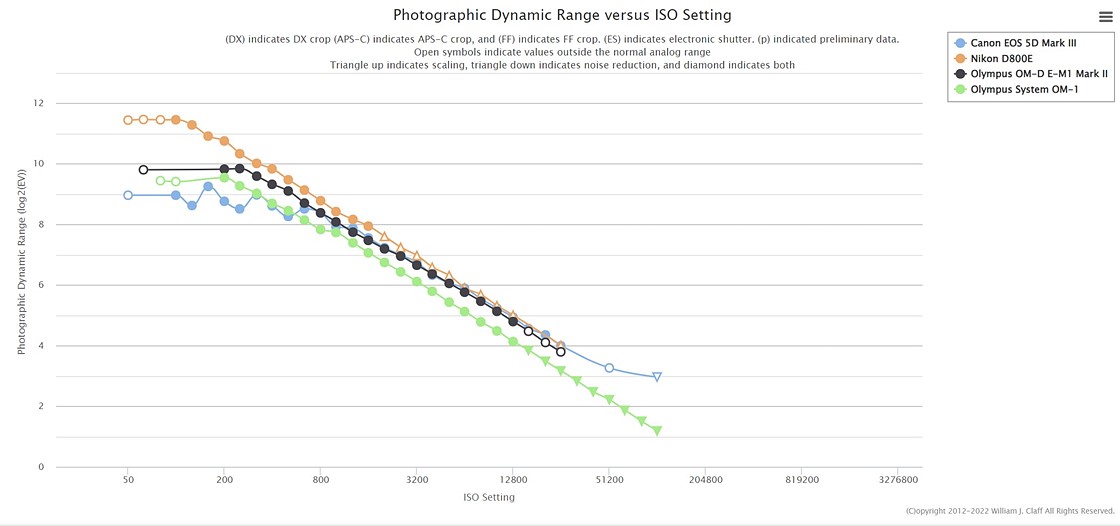
However although it may be more useful to use PDR numbers (and I'll put a chart up below showing how close the OM-1's PDR is to the Nikon D600e - Nikon claim 14.7 stops. That way instead of just debating the science and it's application we have an actual head to head to evaluate throughout the ISO range) the vast majority of people will use the manufacturer's figures - including all the usual review sites.


Aug 06, 2025 at 08:31 PM
ruthenium
Offline
• • • •
Upload & Sell: On
p.4 #19 · Sony Full-Frame vs. Olympus OM1 II?


Frogfish wrote:
Yes I can see where my original statement could be confusing.

However although it may be more useful to use PDR numbers (and I'll put a chart up below showing how close the OM-1's PDR is to the Nikon D600e - Nikon claim 14.7 stops. That way instead of just debating the science and it's application we have an actual head to head to evaluate throughout the ISO range) the vast majority of people will use the manufacturer's figures - including all the usual review sites.

https://i.postimg.cc/0Q4kKJYn/Dynamic-Range-Comparison.jpg


When quoting numbers, it is desirable (for the general audience) to add a brief explanation.
Your numbers in the previous post: "The OM1 has a DR of 13.4 stops. OM-3 is 13.7 stops. Sony A7Cii & A7r5 have 15 stops . Nikon Z8 has 14.3 stops. Canon R8 has 14.7 stops" (presumably, at the base ISO of the cameras) support the statement I made earlier in this thread, see https://www.fredmiranda.com/forum/topic/1911129/1#16863985
"To echo the comments from Steve Spencer, the advantage of camera systems with larger sensors is at their base ISO, and near the base ISO."
The OP specifically "wonders about ... high ISO performance"
On the basis of the PDR at high ISO (quoted in my post), I responded:
"Medium format sensors have NO ADVANTAGE over FF sensors, and FF sensors have NO ADVANTAGE over cropped sensors at high ISO."
and "One can say that the low-light performance of the OM-1 II is slightly better than that of the FF cameras."


Aug 06, 2025 at 09:47 PM
ruthenium
Offline
• • • •
Upload & Sell: On
p.4 #20 · Sony Full-Frame vs. Olympus OM1 II?


Frogfish wrote:
Hi Steve, yes the amount of light is much larger on FF (sensor size squared so x4 as much) however the amount of light per well is roughly the same (small swimming pool 1 metre deep vs x2 size swimming pool also 1m deep, so x4 amount of water in total but still just 1 metre deep) so the smaller entrance pupil is not affecting the amount of light per well, of course once this comes to S/N conversion that's another matter (noise).

That is why my f1.2 OM lenses performed just as well as versus my 85/1.4, on the
...Show more

I am going to make critical comments, please, don't treat these as disrespectful, but as matter-of-fact.
When making technical statements, it is important to formulate these correctly. For example, the statement "the amount of light is much larger on FF (sensor size squared so x4 as much)" is incorrect if it is understood as unconditional. What you meant was "GIVEN SIMILAR EXPOSURE, the amount of light is much larger on FF (sensor size squared so x4 as much)."

Next, "the amount of light per well is roughly the same" should be expressed as "roughly the same EXPOSURE." The term "well" is ambiguous here. The technical expression "full well capacity" is a reference to the maximum amount of electric charge that a pixel can hold; thus, if you are actually saying "the amount of light per pixel is roughly the same" this is incorrect for sensors with different pixel pitches.

Next you state "the smaller entrance pupil is not affecting the amount of light per well, of course once this comes to S/N conversion that's another matter (noise)" but you conveniently avoid explaining the other "matter (noise)." This is also contradictory. If "the amount of light per well is roughly the same", then why the "wells" on different sensors should have different noise? Clearly, what you are saying is questionable.

The claim "my f1.2 OM lenses performed just as well as versus my 85/1.4, on the A7r5, in the extreme low light" is verifiably incorrect and impossible, if the "just as well as versus" is understood as "nearly the same as, or very similar to." If the exposure on both is roughly the same (as you imply, and while ignoring the difference between f/1.2 and f1/4), then the A7RV gathers roughly four times more light. This means roughly four times better signal-to-noise ratio. In other words, while your OM photos are "good enough," the A7RV would have produced considerably less noisier images under the condition of equal exposure (that is under the conditions different from those of photographic equivalence). Unfortunately, comparisons of the kind that you offered (under drastically non-equivalent conditions) are responsible for the myth of larger sensors offering better low-light performance. I find this not only unfortunate but also doing real damage.


Aug 06, 2025 at 10:39 PM
1       2       3              5       end


FM Forums | Sony Forum | Join Upload & Sell

1       2       3              5       end


Welcome back
Log in to your account