chiron
Offline
• • • • •
Upload & Sell: On
|
 p.1 #6 · Sony Full-Frame vs. Olympus OM1 II? p.1 #6 · Sony Full-Frame vs. Olympus OM1 II? | |
Steve Spencer wrote:
I have used a lot of Sony cameras (A7 II, A7r II, A7r V, A7S, A9, A1) and the Olympus OM 5 and OM 1 (but not the OM 1 II), and my general take is that the OM 1 II is an interesting and compelling camera, but how well it will suit your photography depends on what you like to shoot.
Do you shoot at base ISO a lot? If you do then m4/3rds sensors have a lot less DR at base ISO and that may be an issue for you.
What lenses do you use? Can you get photographically equivalent lenses in the other system. Both systems have lenses that don't really have equivalents in the other system. Let me give a couple of examples.
First, if shooting macro is important than the Olympus 90 f/3.5 2X macro lens has nothing like it for Sony or any other FF system. Its longer effective focal length and high magnification are pretty unique and its slow effective aperture really isn't a problem when depth of field is so thin for close focus and allows the lens to stay pretty small. In my view a 180 f/7 FF 2X macro lens doesn't exist for FF, but it is a really interesting option that may suit some people's photography well.
Second, if you shooting with one or two of the new FF f/2 zooms, then you aren't going to be able to get anything close to that experience with m4/3rds. Recently, Panny/Leica has brought out the 10-25 f/1.7 and 25-50 f/1.7 zooms, which finally get a couple of m4/3rds zooms lenses close to the capabilities of f/2.8 zooms (they are still a half stop deeper in depth of field, however), but they are nowhere close to the new f/2 zooms.
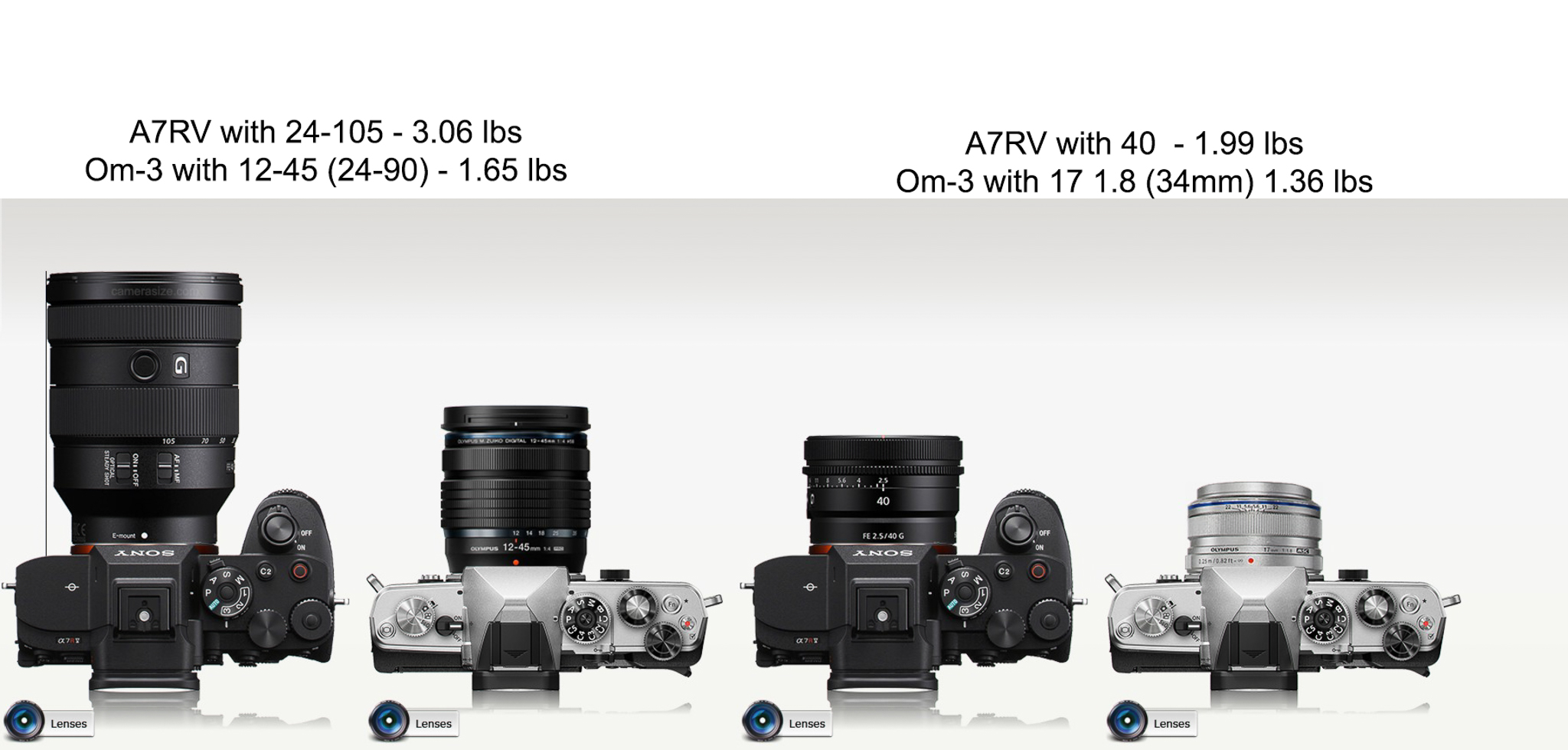
So, I think it is important to consider what lenses you would use for each system. Some will have similar capabilities, but some will be unique. FF lenses will tend to offer shallower depth of field capabilities than is available from any m4/3rds lenses, but that will come with bigger lens size. On the flip size m4/3rds will offer some lenses that are quite small and clearly smaller than anything available for FF but do not offer very shallow depth of field or faster shutter speed capabilities. When lenses offer the same effective focal length and the same depth of field, there won't be much difference in lens size or in what the lens can do or typically even in IQ, except at base ISO where the FF system will still have an advantage.
I hope that helps as you consider the OM 1 II....Show more →
Steve,
Thank you for the detailed and helpful answer. The use cases you specify, where I might find the different systems offer very different capabilities or inabilities, happily do not apply much to me.
I usually don't shoot at base ISO, so that is not an issue for me (but I am likely to be shooting at high ISO, which is one of my concerns about the OM1 II's MFT format).
I rarely shoot macro.
I don't have and I am not drawn to the new f2 zooms--they are too big and heavy to be appealing for me.
Almost all of my shooting takes place in the range from 24mm to 90mm and can be described as documentary in style, whether it is travel, family, street, or even landscape, architecture, and still life.
So, I think I would gain the advantage of smaller lenses and that I would find the lenses I prefer on the Olympus system (though I quail at the thought of starting to acquire more lenses for another system).
The different depths-of-field of the sensor formats seems like more of a trade-off than a relative disadvantage to me. There are as many times that I wish for a bit more depth of field as there are that I wish for more isolation of the focal point. So, I am okay with this difference in the formats.
I prefer the 4:3 MFT ratio to the 3:2 full-frame ratio.
The main concern I have is with overall image quality in printed images (up to 16x20 size, but mostly 5x7), especially with images made at higher ISO settings (usually about 800-3200 and rarely higher than 12800). I am not one who loves very sharp detail in most of my images (I actually find it distracting, calling too much attention to itself). But the image should not appear soft, unless that is what is intended.
As for noise at higher ISOs, the advances in noise reduction technology make me think that high ISO images in MFT format might be quite workable.
Thanks again for your insights and the benefit of your experience.
|