fjablo wrote:
In case you want to rule out moiré with near-certainty, try taking a pixel shift image of a completely static scene. The higher resolution and importantly the true RGB information per-pixel should eliminate moiré.
Potential issues would be any movements or imperfect resampling in Sony‘s pixel shift algorithm. But probably still the best approach to determine whether it’s the lens or the sensor.
That would be lovely, unfortunately on the A7cii there's no pixel shift feature like they have with the a7cr.
Will keep it in mind if I ever upgrade though, thank you.
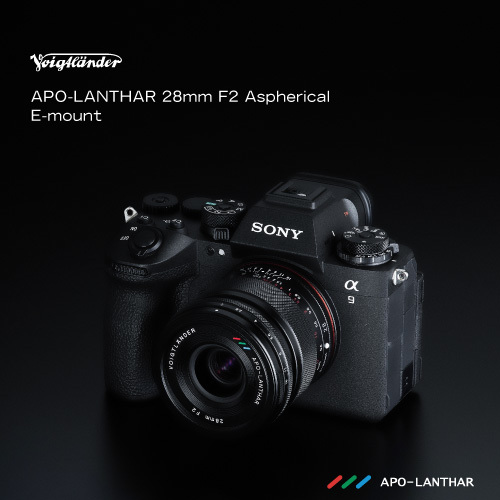
Did anyone compared the 28mm Apo Lanthar with the 35mm Apo Summicron?
I’m wondering whether the 28mm at f/2.0 can match the microcontrast of the M Apo.
Will be interesting to see if using a lens designed for M on an E ... if things get better with an E on E. Personally, I've never expected great things from using things outside of their intended design parameters (i.e. M on M should yield best results). We'll see if the E version accounts for the optical variance between M and E ... or, is it just mounting hardware conversion.
RustyBug wrote:
Will be interesting to see if using a lens designed for M on an E ... if things get better with an E on E. Personally, I've never expected great things from using things outside of their intended design parameters (i.e. M on M should yield best results). We'll see if the E version accounts for the optical variance between M and E ... or, is it just mounting hardware conversion.
RustyBug wrote:
Will be interesting to see if using a lens designed for M on an E ... if things get better with an E on E. Personally, I've never expected great things from using things outside of their intended design parameters (i.e. M on M should yield best results). We'll see if the E version accounts for the optical variance between M and E ... or, is it just mounting hardware conversion.
Cosina routinely optimize their lenses for the applicable sensor stack and they advertise it on the product pages. I have owned all of their E-mount mount lenses released so far (currently keeping 14, including 5 discontinued models) and I also had the M version of 28/2 APO-Lanthar + I've had many of the other VMs and LTMs, still keeping around 10 of them.
28/2 AL VM had obvious field curvature on Sony and needed to be stopped down to f8 for best corner-to-corner results in infinity shots. I'm sure the native version will behave much better on E. My 35/2 AL and 50/2 AL native E versions never need to be stopped down much at all for best corner-to-corner results (I would not stop them down beyond f4 usually). I expect the Sony E version of 28/2 AL will behave pretty similarly as my 35/2 AL for Sony E.
I remember that Fred's reviews also showed big degradation of performance on 35/2 and 50/2 AL VM versions on Sony sensor, against the native versions on native stacks.
Additionally, these APO-Lanthars sell more on E-mount in Japan (Cosina's main market) than they do on M and previously 50/2 AL was first designed for Sony E and released in 2019, while the M version came out in 2021. 35/2 was released almost at the same time for E and M. I think they don't consider them as lenses designed primarily for M.
Juha Kannisto wrote:
Cosina routinely optimize their lenses for the applicable sensor stack and they advertise it on the product pages. I have owned all of their E-mount mount lenses released so far (currently keeping 14, including 5 discontinued models) and I also had the M version of 28/2 APO-Lanthar + I've had many of the other VMs and LTMs, still keeping around 10 of them.
28/2 AL VM had obvious field curvature on Sony and needed to be stopped down to f8 for best corner-to-corner results in infinity shots. I'm sure the native version will behave much better on E. My 35/2 AL and 50/2 AL native E versions never need to be stopped down much at all for best corner-to-corner results (I would not stop them down beyond f4 usually). I expect the Sony E version of 28/2 AL will behave pretty similarly as my 35/2 AL for Sony E.
I remember that Fred's reviews also showed big degradation of performance on 35/2 and 50/2 AL VM versions on Sony sensor, against the native versions on native stacks.
Additionally, these APO-Lanthars sell more on E-mount in Japan (Cosina's main market) than they do on M and previously 50/2 AL was first designed for Sony E and released in 2019, while the M version came out in 2021. 35/2 was released almost at the same time for E and M. I think they don't consider them as lenses designed primarily for M....Show more →
Yes Juha.
However, let me stress that
i) these lenses were first introduced for M; this involves evident design constraints; consequently, I'm not so sure that "they don't consider them as lenses designed primarily for M";
ii) we have no information about the claimed "optimization"; the optical schemes of 35/2 AL is identical for both M and E/Z; Cosina changed the optical scheme of the 50/2 AL (only): the E/Z version has more APD elements;
iii) the wider the focal length the more difficult the optimization could be due to the shorter (I guess) exit pupil distance from sensor (see https://www.lensrentals.com/blog/2014/07/sensor-stack-thickness-part-iii-the-summary/).
The MTF plots (published by Cosina itself) suggests that the M-mount 28/2 AL should perform slightly better than E- and Z-mount versions. How much this will be visible in the final images is difficult to predict, though. I think/hope the E/Z 28/2 Apo will be an excellent performer, better than the adapted VM version. Only field tests will confirm this or not.
Ripolini wrote:
Yes Juha.
However, let me stress that
i) these lenses were first introduced for M; this involves evident design constraints; consequently, I'm not so sure that "they don't consider them as lenses designed primarily for M";
ii) we have no information about the claimed "optimization"; the optical schemes of 35/2 AL is identical for both M and E/Z; Cosina changed the optical scheme of the 50/2 AL (only): the E/Z version has more APD elements;
iii) the wider the focal length the more difficult the optimization could be due to the shorter (I guess) exit pupil distance from sensor (see https://www.lensrentals.com/blog/2014/07/sensor-stack-thickness-part-iii-the-summary/).
The MTF plots (published by Cosina itself) suggests that the M-mount 28/2 AL should perform slightly better than E- and Z-mount versions. How much this will be visible in the final images is difficult to predict, though. I think/hope the E/Z 28/2 Apo will be an excellent performer, better than the adapted VM version. Only field tests will confirm this or not....Show more →
I'm sure Cosina had already decided to do the lenses for E-mount and Z-mount as well when they released the M version. In Japan the M versions of 50/2 and 35/2 APO-Lanthars are consistently selling less than E and also less than Z versions, so I think from commercial perspective it would make no sense to consider the lenses to be primarily for M. I do agree that they will try to base all versions on a common design that will be adaptable to each system without too many changes and the design could have some restrictions based on the M-mount related design constraints.
Here is Fred's review of 35/2 AL that covers both E-mount and VM, and he showed how well the E-mount version performs on Sony camera and how poorly the VM version performed on Sony: https://www.fredmiranda.com/forum/topic/1695782/
The optical schemes of both appears as identical (which is usually the case with Cosina's M and E lenses) but obviously there was a huge difference in results. It just tells that the optimization isn't typically visible from the optical design schemes as presented.
I'm expecting something similar for 28/2 AL with strong confidence and I don't have any worries that E-mount version would perform the same as VM version on Sony. It's true that only tests will confirm this and we'll have to wait for those, but I'm not waiting for test results before purchasing the lens.
E-mount version is planned to be released in December and Z-mount in January. So, when I'll order the Z-mount version, the E-mount version will already have been extensively tested
I will love it!
Just a minute fly in the soup: the barrel design appears not to be consistent accross all Apo Lanthars of a certain mount. Well, it isn‘t a deal breaker…
We are talking about the specific APO-Lanthar lenses here. They are among the top-sellers in Cosina's E-mount lineup and doing well on Z too but in their M-mount lineup they are nowhere near the top sellers. Cosina do sell a lot more of the smaller and cheaper VM lenses and overall M-mount is their biggest thing but it's not the leader in all of their lens categories, especially with these APO-Lanthar type lenses.
The E-mount and Z-mount versions of 50/2 and 35/2 are constantly among the best-selling CV lenses overall in Japan but VM versions of the same lenses trail way back in the Japanese lens sales popularity charts that I regularly keep an eye on. There are other VM lenses that are way more popular (usually the smallest and the cheapest are strongest sellers).
which includes: "In addition to ensuring a full-size image circle, the optical design is optimized for Sony E-mount sensors, maintaining high resolution all the way to the edges of the screen and suppressing phenomena such as color cast."
I wonder why they changed the design of the focus ring for the E-mount, but kept the "traditional" knurled design for the Z-mount?
It's going to be the "ugly duckling" amongst my other CV lenses
graytrekker wrote:
I wonder why they changed the design of the focus ring for the E-mount, but kept the "traditional" knurled design for the Z-mount?
It's going to be the "ugly duckling" amongst my other CV lenses
It's always fun trying to figure to figure out why Cosina makes these design choices. You would think it would make more sense for the 28, 35, and 50 APO-Lanthar E-mount lenses to share the same focusing ring style, but instead the new Voigtlander 28mm f/2 APO-Lanthar follows the look of the 28/1.5 and 50/1 Nokton lenses. My guess is they may eventually update the 35 and 50 f/2 APO-Lanthars to match, and decided to start with the 28/2 APO since it's the newest in the lineup. Just speculation of course.
Interestingly, the Z-mount line stays more visually consistent than the other mounts. Even the M-mount 28mm f/2 APO-Lanthar looks a bit different from its APO siblings.