leolab wrote:
- sensor readout and potential for rolling shutter?
serhan_ wrote:
Based on Leicarumors comments, it is the same sensor from Sigma FP:
"IMX410 is a 24.5MP sensor and it's the only 24x36 sensor available off the shelf from Sony Semiconductor Solutions." https://www.sony-semicon.com/en/products/is/camera/index.html
So 1/15sec readout speed in 14-bit and 1/30sec in 12-bit.
Desmolicious wrote:
Let’s pretend I have no idea what 1/15 sec readout speed means… could you explain how that would effect me doing my usual walking around outside taking pics of stuff?
raizans wrote:
1/15 s = 66.67 ms
1/30 s = 33.33 ms
intangiblethin wrote:
So what does that mean for everyday walk-around shooting?
What suffers?
What's the readout time for the M10/M11?
---------------------------------------------
I don't think the M10 series does full electronic shutter, does it? M11's readout/scan speed is 1/10. See this database compiled by FMer @snapsy: rolling shutter measurements
See the posts in this recent thread about the Hassy X1D's 1/3 second rolling shutter and how it can affect images (the jello effect). The sports examples I posted there were with cameras that have ~1/60 sensor scan speeds.
Is there any news stating it's electronic shutter only? Everyone seems to jump into conclusion? (On a second thought though, if older pixii is upgradable then it strongly suggested that it's electronic shutter only)
Can't imagine if they just stick a slow readout sensor and expect the crowd to be satisfied with it, but if they really do they're missing a whole bunch of opportunity
highdesertmesa wrote:
At least it's BSI. Should have about the same M lens performance as the Zf. I'd have to stop down between 1-2 stops to equal Leica M corner performance. I guess I can hold out hope that they customized the cover glass.
There was a quip on their website with sensor specs (now removed it seems) that talked about a thin (<1mm) filter over sensor and micro lenses to optimize performance...if info is correct I would expect this to be similar to Leica M body performance
Rolling shutter isn’t much of an issue for anything a rangefinder is useful for.
- Balls moving at high speed may become ovals.
- Spinning wheel spokes and propellers get warped.
- Some lights may cause banding at fast shutter speeds…in situations where you normally don’t use very fast shutter speeds.
raizans wrote:
Rolling shutter isn’t much of an issue for anything a rangefinder is useful for.
- Balls moving at high speed may become ovals.
- Spinning wheel spokes and propellers get warped.
- Some lights may cause banding at fast shutter speeds…in situations where you normally don’t use very fast shutter speeds.
If you restrict your perspective and/or limit your use of a rangefinder to those things that don't move much, or you don't pan, etc.
Personally, I use a rangefinder for the same range of subjects that I've always shot ... thinking back to shooting on my Nikon FE, it didn't restrict me wrt subject matter. Why should a rangefinder be perceived as limited in usefulness?
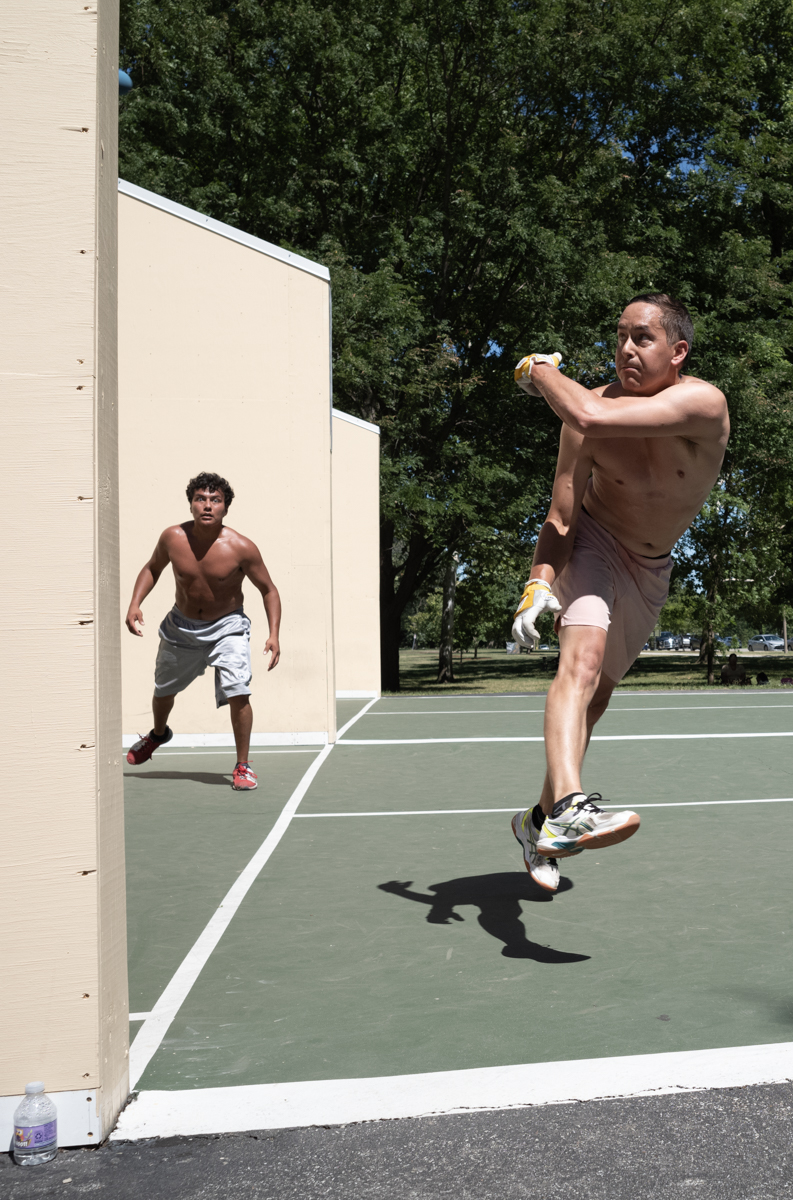
Actually, a rangefinder is quite useful for moving subjects. Note, the speed of the ball does have just a kiss of motion blur at 1/1500s in the last one ... kinda makes me wonder how much s t r e t c h we'd get from an electronic shutter. Could be a cool effect, but it would be a novelty trick, not exactly the kind of thing you'd want a lot. Never mind how much warping or jello the body movements would be.
Electronic shutter otoh (imo) does have limitations / restrictions (toward the jello / slant). Personally, I'd not try to "dumb down" the usefulness of a rangefinder, in order to suggest the issue of a rolling shutter is less significant than it is. Imo, that's using a little bit of faulty logic (I forget which type of faulty logic they call that one).
Kent Southers 2024
LEICA M10-RElmarit-M 1:2,8/24 ASPH. lens24mmf/4.01/1500s200 ISO+0.3 EV
Kent Southers 2024
LEICA M10-RElmarit-M 1:2,8/24 ASPH. lens24mmf/4.01/1500s200 ISO+0.3 EV
Kent Southers 2024
LEICA M10-RElmarit-M 1:2,8/24 ASPH. lens24mmf/6.81/1500s200 ISO+0.3 EV
raizans wrote:
Rolling shutter isn’t much of an issue for anything a rangefinder is useful for.
- Balls moving at high speed may become ovals.
- Spinning wheel spokes and propellers get warped.
- Some lights may cause banding at fast shutter speeds…in situations where you normally don’t use very fast shutter speeds.
It’s a bit more than that at 1/15 sec. Even your own handheld movements if erratic or unsteady can slightly warp the image.
I don’t think this is a deal killer, though, especially since it sounds like the sensor has been optimized for M lenses. I think the M11 sensor scan speed is slower at 1/10 sec., and I’ve been able to use its electronic shutter without issue.
What this camera really needs is something like the new half-stacked Z sensor.
It depends on what the priorities are eg dynamic range vs speed:
https://www.dpreview.com/news/8412798138/early-testing-suggests-nikon-z6-iii-pays-a-price-for-its-speed
"Faster sensor readout is often associated with higher levels of read noise, and this appears to be the case with what Nikon is calling the "Partially Stacked" sensor in the Z6III. Bill Claff's photons to photos site reports a maximum dynamic range of 10.4EV, using his own "photographic DR" metric. This compares to a figure of 11.3EV for the Z6 II."
highdesertmesa wrote:
What this camera really needs is something like the new half-stacked Z sensor.
serhan_ wrote:
It depends on what the priorities are eg dynamic range vs speed:
https://www.dpreview.com/news/8412798138/early-testing-suggests-nikon-z6-iii-pays-a-price-for-its-speed
"Faster sensor readout is often associated with higher levels of read noise, and this appears to be the case with what Nikon is calling the "Partially Stacked" sensor in the Z6III. Bill Claff's photons to photos site reports a maximum dynamic range of 10.4EV, using his own "photographic DR" metric. This compares to a figure of 11.3EV for the Z6 II."
“Alls I’m sayin’ is” that if you don’t include a mechanical shutter, it’s better to give us a sensor with a faster readout. The downsides of a slow electronic shutter are worse than any penalties imposed by fast readout.
raizans wrote:
Rolling shutter isn’t much of an issue for anything a rangefinder is useful for.
Disagree 100%. Rangefinder cameras are frequently used hand held in a spontaneous manner where 'loose' camera technique can often be compensated by using high shutter and ISO speeds. But the slow readout of that Sony 24MP sensor means a higher potential for image distortion caused by camera movement during exposure (not just subject movement).
Also given that the vast majority of artificial lighting is now of the type that rapidly pulses on and off, such as LED and fluorescent, banding can also be prevalent in images primarily illuminated by artificial light unless using a low enough shutter speed to match the AC power frequency of the location (i.e. 1/60 in the US/Canada).
At this price point the Pixii competes with older used Leica M options that won't suffer from these tradeoffs (but may have other tradeoffs). In many situations the rolling shutter performance won't be a problem, or obviously noticeable. I mean, when I shoot sports with my cameras that have ~1/60 e-shutter readout speeds, most rolling shutter distortion is only noticeable when comparing images in a sequence. But it doesn't mean the distortion isn't there and sometimes it is noticeable. Drop down to 1/15 readout and more consideration has to be put into proper technique to minimize the potential for rolling shutter distortion. IMO this will be the major flaw of this camera for my shooting preferences.
highdesertmesa wrote:
It's rolling shutter. If you choose 1/1000 sec. shutter speed, sure each pixel gets exposed for that amount of time. But it takes the camera 1/15 second to fire off all the pixels in a cascade across the sensor. It's essentially a second shutter that can cause warping in/of the image if the subject is moving such that 1/15 sec. will not freeze their motion – or if you do not hold super still, you can move the frame and cause warping as well. It's the major drawback to using the electronic shutters on cameras with slow readout (scan) speeds.
Do other people know about this? Who thought this was a good idea?
highdesertmesa wrote:
I thought everybody knew about rolling shutter (insert shoulder shrug). I’m going to assume the second question is rhetorical
Cameras without rolling shutter are actually the exception. Most cameras have rolling shutter, and only those with fast read-out sensors avoid it.
1/30s read-out is usually quite good for most types of photography that don't involve fast action.
Film cameras, of course, which are Desmolicious's capture method of choice, have no rolling shutter at all. The original global shutter cameras, available for $25 on up .
Fred Miranda wrote:
Cameras without rolling shutter are actually the exception. Most cameras have rolling shutter, and only those with fast read-out sensors avoid it.
1/30s read-out is usually quite good for most types of photography that don't involve fast action.
The majority of cameras also have mechanical shutters, which this one does not. And this camera is reported to have a 1/15 sec. scan speed, not 1/30 sec. It’s not the slowest scan speed out there, but I feel like 1/15 sec. with no mechanical shutter to fall back on is a limitation the buyer/shooter has to be very aware of.
bjhurley wrote:
Film cameras, of course, which are Desmolicious's capture method of choice, have no rolling shutter at all. The original global shutter cameras, available for $25 on up .
Not quite. Here is Lartigue's famous image of a race car
which he did by panning the camera so both background and subject are distorted. He used a large-format camera with a moving slit focal plane shutter.
Focal plane mechanical shutters are rolling shutters too, just these days they are fast enough not to show any artifacts like that. I think the point was more that film itself, by its analogue nature, has no electronic rolling shutter, although it has no shutter functionality at all, so that point is somewhat moot.
bjhurley wrote:
Film cameras, of course, which are Desmolicious's capture method of choice, have no rolling shutter at all. The original global shutter cameras, available for $25 on up .
As already mentioned, film cameras can also be affected if the mechanical focal plane shutter moves the exposure slit between the first and second curtains slowly, equivalent to a slow scanning sensor as discussed here. But I don't think any relatively recent film cameras were in the 1/15 range. Those with better vertical travel shutters operated in the 1/250 second range (hence 1/250 flash sync) where such distortion wouldn't be noticed. And it's why stacked sensors in the 1/250 range are considered generally distortion free.
It's true film would be equivalent to a global sensor, but the problem is that you can't turn film's light sensitivity on and off like a global shutter. You need a shutter of some sort and AFAIK, no mechanical shutter is truly global over the full image area. Leaf shutters probably comes closer than focal plane shutters, but there's still the time it takes for the leaves to move from closed to fully open, meaning there is exposure unevenness, which I believe is a reason leaf shutters top out somewhere between 1/1000 and 1/2000. A best shutter solution could be some sort of LCD overlay that can instantly and uniformly switch the entire crystal orientation 'open' and 'closed' to switch between opaque and transparent. I recall reading about research into this to replace mechanical shutters back in the film days, but I believe a significant challenge was that LCD performance in such an application was affected by temperature and was therefore unreliable outside of a certain temperature range. It's also possible that in the opaque state that the LCD isn't 100% opaque, which obviously would be a problem with film.
Interesting conversation with the CEO of Pixii Cameras, starting from an idea in 2014 to the team of 5 engineers producing approx. 1000 cameras:
&t=2s&ab_channel=snappiness
and a comment on Pixii rf calibration:
"I had a pixii and sold it used for one reason only. That the rangefinder adjustment is behind the hotshoe and must be done via screws. Leica’s adjustment is simply in front of the sensor and can be done with an allenkey. Additionally, the screws for the pixii are extremely finicky. I had to adjust 2 screws, 1 screw to looosen, and another to adjust, and then tighten the first again. When tightening the first the second would often turn and move. It made rangefinder calibration change from a quick 2-3 minutes to 30-1 hour. Which is crazy when in the field. If they changed that i would hop right back unto the bandwagon"
RustyBug wrote:
Note, the speed of the ball does have just a kiss of motion blur at 1/1500s in the last one ... kinda makes me wonder how much s t r e t c h we'd get from an electronic shutter.
Actually, I would file sports photography taken with a 24mm lens under “not much of an issue.” Try using a rangefinder with a telephoto zoom in a situation where you’d appreciate 30-60 fps with an electronic shutter.
raizans wrote:
Actually, I would file sports photography taken with a 24mm lens under “not much of an issue.” Try using a rangefinder with a telephoto zoom in a situation where you’d appreciate 30-60 fps with an electronic shutter.


 (On a second thought though, if older pixii is upgradable then it strongly suggested that it's electronic shutter only)