This topic is in the 2022 archive. You can read it and like its posts here. It is read only.
Archive 2022Learning Leica "M", a 30 day project
p.10 #1Learning Leica "M", a 30 day project
Michael H wrote:
I've seen this thread popup rom time to time, and have glanced, but today I took the time to actually try and get through the 9 pages of comments. I am really glad I did. This truly is a great conversation, and not the far-too-common ones of my way/camera/lens/approach is better than yours threads. I've appreciated seeing all the input and respectful interaction.
I'd like to second Michael's observations about this thread, which is one of the best I've seen in the fourteen years I've been an FM member. Many thanks, not just to 1bwana1 for starting it and for his admirable commitment to mastering rangefinder photography, but for all the insightful contributions from various members.
Mar 02, 2022 at 10:09 PM
p.10 #2Learning Leica "M", a 30 day project
Great image Steve, what a beautiful building!
Mar 03, 2022 at 05:39 AM
p.10 #3Learning Leica "M", a 30 day project
lifeandmylens wrote:
Great image Steve, what a beautiful building!
+1.
Great image Steve, what a beautiful building!
+1.
Mar 03, 2022 at 06:19 AM
p.10 #4Learning Leica "M", a 30 day project
genji wrote:
I don't shoot from the hip and wasn't saying that anyone should. Both shooting in the moment and engaging have their place. I do both.I wasn't speaking to any persons comment here, just offering that generally, zone focusing leads to pictures that don't have a lot interesting or compelling from viewers perspective except for very, very rare exceptions.Thats certainly not what Bresson, Frank or Winogrand would do. It you are taking a portrait, yes. If you are working in the moment, no.
A few words by me in a piece Leica did on my work a few years back
https://www.leica-camera.blog/2016/12/15/spontaneous-relationships/
Now some words by the greats:
To take photographs means to recognize -- simultaneously and within a fraction of a second -- both the fact itself and the rigorous organization of visually perceived forms that give it meaning. -Henri Cartier-Bresson
"You cannot be sure in advance exactly how the situation, the scene, is going to unfold. You must stay with the scene, just in case the elements of the situation shoot off from the core again... Of all the means of expression, photography is the only one that fixes forever the precise and transitory instant. We photographers deal in things which are continually vanishing, and when they have vanished, there is no contrivance on earth which can make them come back again. We cannot develop and print a memory."
Henri Cartier-Bresson
"Of all the means of expression, photography is the only one that fixes a precise moment in time. We play with subjects that disappear; and when they’re gone, it’s impossible to bring them back to life. We can’t alter our subject afterward.... Writers can reflect before they put words on paper.... As photographers, we don’t have the luxury of this reflective time....We can’t redo our shoot once we’re back at the hotel. Our job consists of observing reality with help of our camera (which serves as a kind of sketchbook), of fixing reality in a moment, but not manipulating it, neither during the shoot nor in the darkroom later on. These types of manipulation are always noticed by anyone with a good eye."
Henri Cartier-Bresson
"This recognition, in real life, of a rhythm of surfaces, lines, and values is for me the essence of photography" Henri Cartier -Bresson
Great wrods by Meyerowitz
https://www.traileraddict.com/everybody-street/trailer
"You know why your pictures are no fucking good? Because they don’t describe the chaos of life."
Garry Winogrand
"When things move, I get interested, I know that much."
Garry Winogrand
Sometimes a tilted image is necessary to create tension in the frame. And what is engaging to A is not to B.
Like any area of photography, there is and will be a small amount of what is really good.
Winogrand when asked why he shot so much he responded
"Art isn't a product of industrial efficiency"-Garry Winogrand
"“It’s seldom you make a great picture. you have to milk the cow quite a lot to get plenty of milk to make a little cheese.”"-Henri Cartier-Bresson
When talking about Leica M, what it does best and what it is the tool for is working in the moment. In my opinion zone focusing is just one piece of that puzzle. So to be able to use the tool to its fullest that is something that should be mastered. Even when doing landscape work using DoF scales zone or hyper focus can be a valuable tool. A tool that gives the photographer the full control of DoF. For instance with a 24mm lens at f/8 you can use the DoF scales on the lens to get everything from about 4 ft through infinity in focus.Don't disagree, and maybe I'm just more into documentary stuff and stuff with a story. Probably because it's harder to tell a story with a photo than take a picture that looks good and most of the stuff this days is just that, a pretty picture, at best.Maybe you could post a few images to show us all how it should be done…
Why defensive? What I said isn't controversial. It is much harder to put together a sequence of images that are bothg photographically well done and tell a story than to do just the former. This isn't really a big deal statement. But it appears to have made you have feeling in some way.
AndrewNYC wrote
airfrogusmc wrote
AndrewNYC wrote
airfrogusmc wrote
AndrewNYC wrote
This image, where you are engaged with teh subject, is so much more compelling than zone focusing/ shooting from the hip stuff. I love it. The image reflects investment in the scene.A few words by me in a piece Leica did on my work a few years back
https://www.leica-camera.blog/2016/12/15/spontaneous-relationships/
Now some words by the greats:
To take photographs means to recognize -- simultaneously and within a fraction of a second -- both the fact itself and the rigorous organization of visually perceived forms that give it meaning. -Henri Cartier-Bresson
"You cannot be sure in advance exactly how the situation, the scene, is going to unfold. You must stay with the scene, just in case the elements of the situation shoot off from the core again... Of all the means of expression, photography is the only one that fixes forever the precise and transitory instant. We photographers deal in things which are continually vanishing, and when they have vanished, there is no contrivance on earth which can make them come back again. We cannot develop and print a memory."
Henri Cartier-Bresson
"Of all the means of expression, photography is the only one that fixes a precise moment in time. We play with subjects that disappear; and when they’re gone, it’s impossible to bring them back to life. We can’t alter our subject afterward.... Writers can reflect before they put words on paper.... As photographers, we don’t have the luxury of this reflective time....We can’t redo our shoot once we’re back at the hotel. Our job consists of observing reality with help of our camera (which serves as a kind of sketchbook), of fixing reality in a moment, but not manipulating it, neither during the shoot nor in the darkroom later on. These types of manipulation are always noticed by anyone with a good eye."
Henri Cartier-Bresson
"This recognition, in real life, of a rhythm of surfaces, lines, and values is for me the essence of photography" Henri Cartier -Bresson
Great wrods by Meyerowitz
https://www.traileraddict.com/everybody-street/trailer
"You know why your pictures are no fucking good? Because they don’t describe the chaos of life."
Garry Winogrand
"When things move, I get interested, I know that much."
Garry Winogrand
Sometimes a tilted image is necessary to create tension in the frame. And what is engaging to A is not to B.
Like any area of photography, there is and will be a small amount of what is really good.
Winogrand when asked why he shot so much he responded
"Art isn't a product of industrial efficiency"-Garry Winogrand
"“It’s seldom you make a great picture. you have to milk the cow quite a lot to get plenty of milk to make a little cheese.”"-Henri Cartier-Bresson
When talking about Leica M, what it does best and what it is the tool for is working in the moment. In my opinion zone focusing is just one piece of that puzzle. So to be able to use the tool to its fullest that is something that should be mastered. Even when doing landscape work using DoF scales zone or hyper focus can be a valuable tool. A tool that gives the photographer the full control of DoF. For instance with a 24mm lens at f/8 you can use the DoF scales on the lens to get everything from about 4 ft through infinity in focus.
Why defensive? What I said isn't controversial. It is much harder to put together a sequence of images that are bothg photographically well done and tell a story than to do just the former. This isn't really a big deal statement. But it appears to have made you have feeling in some way.
Mar 03, 2022 at 08:52 AM
p.10 #5Learning Leica "M", a 30 day project
lifeandmylens wrote:
Great image Steve, what a beautiful building!
Thanks. Balboa Park has so many beautiful buildings. Coincidentally, the building in this image house the San Diego Museum of Photographic Art.
Great image Steve, what a beautiful building!
Thanks. Balboa Park has so many beautiful buildings. Coincidentally, the building in this image house the San Diego Museum of Photographic Art.
Mar 03, 2022 at 09:00 AM
p.10 #6Learning Leica "M", a 30 day project
1bwana1 wrote:
Day 7 Image:
Today I stopped by Crystal Pier in Pacific Beach on my way home to see what I could find for this project. I was intrigued by this set of stairs marked "PRIVATE" that led up to what appears to be no where. I had thought I would get some typical pier/beach image. But once I saw this, I was focused on it.
It was very bright, and very clear today. The late afternoon light was casting interesting shadows. I saw this as a black and white from the beginning. Strange because before this project I never shot for black...Show more →
Was this metered in ranger finder mode or using live view? I'm only asking because I have read that some people struggled with metering in range finder mode. And if the M10's RF metering were that bad, then this shot would have blown highlights, but it doesn't.
Mar 03, 2022 at 08:47 PM
p.10 #7Learning Leica "M", a 30 day project
theHUN wrote:
1bwana1 wrote
Day 7 Image:Today I stopped by Crystal Pier in Pacific Beach on my way home to see what I could find for this project. I was intrigued by this set of stairs marked "PRIVATE" that led up to what appears to be no where. I had thought I would get some typical pier/beach image. But once I saw this, I was focused on it.
It was very bright, and very clear today. The late afternoon light was casting interesting shadows. I saw this as a black and white from the beginning. Strange because before this project I never shot for black and white. Despite the high contrast I didn't have trouble with exposure this time. I was able to maintain detail in both the whites and the blacks. This camera's sensor is very good in this way. I hear the mono version is even better. Also interesting to see how a clear sky renders in B&W. I once again used the CV 28mm f/2 Ultron. Focus was also easy because I just closed up the aperture, and made sure my DOF fit the stairs from bottom to top. The bigger challenge was working with composition through the Range Finder. This is not that easy. I took a number of images both landscape and portrait. I am still not sure what I am going to get until I review the image on the rear screen. I need a lot more work in this area. This is the full frame image with no crop.
Hard to believe that this completes the first week of images for the project. I have a lot more to learn, and get better at.
Enjoy the image.
-Steve-
This shot was done entirely with the Range fFinder. You are correct the meter does tend to over expose highlights. I am learning to compensate.
Mar 03, 2022 at 09:11 PM
p.10 #8Learning Leica "M", a 30 day project
1bwana1 wrote:
Today I stopped by Crystal Pier in Pacific Beach on my way home to see what I could find for this project. I was intrigued by this set of stairs marked "PRIVATE" that led up to what appears to be no where. I had thought I would get some typical pier/beach image. But once I saw this, I was focused on it.
It was very bright, and very clear today. The late afternoon light was casting interesting shadows. I saw this as a black and white from the beginning. Strange because before this project I never shot for black and white. Despite the high contrast I didn't have trouble with exposure this time. I was able to maintain detail in both the whites and the blacks. This camera's sensor is very good in this way. I hear the mono version is even better. Also interesting to see how a clear sky renders in B&W. I once again used the CV 28mm f/2 Ultron. Focus was also easy because I just closed up the aperture, and made sure my DOF fit the stairs from bottom to top. The bigger challenge was working with composition through the Range Finder. This is not that easy. I took a number of images both landscape and portrait. I am still not sure what I am going to get until I review the image on the rear screen. I need a lot more work in this area. This is the full frame image with no crop.
Hard to believe that this completes the first week of images for the project. I have a lot more to learn, and get better at.
Enjoy the image.
-Steve-Was this metered in ranger finder mode or using live view? I'm only asking because I have read that some people struggled with metering in range finder mode. And if the M10's RF metering were that bad, then this shot would have blown highlights, but it doesn't.This shot was done entirely with the Range fFinder. You are correct the meter does tend to over expose highlights. I am learning to compensate.
Got it. I am assuming you used the RF to force yourself to use it, right? Or was there a reason to not use live view for a landscape shot such as this?
theHUN wrote
1bwana1 wrote
Day 7 Image:Today I stopped by Crystal Pier in Pacific Beach on my way home to see what I could find for this project. I was intrigued by this set of stairs marked "PRIVATE" that led up to what appears to be no where. I had thought I would get some typical pier/beach image. But once I saw this, I was focused on it.
It was very bright, and very clear today. The late afternoon light was casting interesting shadows. I saw this as a black and white from the beginning. Strange because before this project I never shot for black and white. Despite the high contrast I didn't have trouble with exposure this time. I was able to maintain detail in both the whites and the blacks. This camera's sensor is very good in this way. I hear the mono version is even better. Also interesting to see how a clear sky renders in B&W. I once again used the CV 28mm f/2 Ultron. Focus was also easy because I just closed up the aperture, and made sure my DOF fit the stairs from bottom to top. The bigger challenge was working with composition through the Range Finder. This is not that easy. I took a number of images both landscape and portrait. I am still not sure what I am going to get until I review the image on the rear screen. I need a lot more work in this area. This is the full frame image with no crop.
Hard to believe that this completes the first week of images for the project. I have a lot more to learn, and get better at.
Enjoy the image.
-Steve-
Got it. I am assuming you used the RF to force yourself to use it, right? Or was there a reason to not use live view for a landscape shot such as this?
Mar 03, 2022 at 09:29 PM

p.10 #9Learning Leica "M", a 30 day project
1bwana1 wrote:
Today I stopped by Crystal Pier in Pacific Beach on my way home to see what I could find for this project. I was intrigued by this set of stairs marked "PRIVATE" that led up to what appears to be no where. I had thought I would get some typical pier/beach image. But once I saw this, I was focused on it.
It was very bright, and very clear today. The late afternoon light was casting interesting shadows. I saw this as a black and white from the beginning. Strange because before this project I never shot for black and white. Despite the high contrast I didn't have trouble with exposure this time. I was able to maintain detail in both the whites and the blacks. This camera's sensor is very good in this way. I hear the mono version is even better. Also interesting to see how a clear sky renders in B&W. I once again used the CV 28mm f/2 Ultron. Focus was also easy because I just closed up the aperture, and made sure my DOF fit the stairs from bottom to top. The bigger challenge was working with composition through the Range Finder. This is not that easy. I took a number of images both landscape and portrait. I am still not sure what I am going to get until I review the image on the rear screen. I need a lot more work in this area. This is the full frame image with no crop.
Hard to believe that this completes the first week of images for the project. I have a lot more to learn, and get better at.
Enjoy the image.
-Steve-Was this metered in ranger finder mode or using live view? I'm only asking because I have read that some people struggled with metering in range finder mode. And if the M10's RF metering were that bad, then this shot would have blown highlights, but it doesn't.This shot was done entirely with the Range fFinder. You are correct the meter does tend to over expose highlights. I am learning to compensate.
The exposure solution would be to shoot manually.
theHUN wrote
1bwana1 wrote
Day 7 Image:Today I stopped by Crystal Pier in Pacific Beach on my way home to see what I could find for this project. I was intrigued by this set of stairs marked "PRIVATE" that led up to what appears to be no where. I had thought I would get some typical pier/beach image. But once I saw this, I was focused on it.
It was very bright, and very clear today. The late afternoon light was casting interesting shadows. I saw this as a black and white from the beginning. Strange because before this project I never shot for black and white. Despite the high contrast I didn't have trouble with exposure this time. I was able to maintain detail in both the whites and the blacks. This camera's sensor is very good in this way. I hear the mono version is even better. Also interesting to see how a clear sky renders in B&W. I once again used the CV 28mm f/2 Ultron. Focus was also easy because I just closed up the aperture, and made sure my DOF fit the stairs from bottom to top. The bigger challenge was working with composition through the Range Finder. This is not that easy. I took a number of images both landscape and portrait. I am still not sure what I am going to get until I review the image on the rear screen. I need a lot more work in this area. This is the full frame image with no crop.
Hard to believe that this completes the first week of images for the project. I have a lot more to learn, and get better at.
Enjoy the image.
-Steve-
The exposure solution would be to shoot manually.
Mar 03, 2022 at 09:38 PM
p.10 #10Learning Leica "M", a 30 day project
theHUN wrote:
Got it. I am assuming you used the RF to force yourself to use it, right? Or was there a reason to not use live view for a landscape shot such as this?
Yes, I am trying to use the RF as much as possible. After all I am trying t learn to shoot the Leica in the classical way it has been used over the years. That is why I haven't bought a Visoflex yet. It would then be like shooting any other mirrorless camera.
I didn't see this as a landscape. It is a classic street style shot in structure, it is just lacking people. However, I see the stairs with the door to nowhere has mystery and is telling a story.
I have used Live View for a couple of the landscapes in this thread. I do want to explore all features of this camera.
Mar 03, 2022 at 10:04 PM
p.10 #11Learning Leica "M", a 30 day project
airfrogusmc wrote:
Today I stopped by Crystal Pier in Pacific Beach on my way home to see what I could find for this project. I was intrigued by this set of stairs marked "PRIVATE" that led up to what appears to be no where. I had thought I would get some typical pier/beach image. But once I saw this, I was focused on it.
It was very bright, and very clear today. The late afternoon light was casting interesting shadows. I saw this as a black and white from the beginning. Strange because before this project I never shot for black and white. Despite the high contrast I didn't have trouble with exposure this time. I was able to maintain detail in both the whites and the blacks. This camera's sensor is very good in this way. I hear the mono version is even better. Also interesting to see how a clear sky renders in B&W. I once again used the CV 28mm f/2 Ultron. Focus was also easy because I just closed up the aperture, and made sure my DOF fit the stairs from bottom to top. The bigger challenge was working with composition through the Range Finder. This is not that easy. I took a number of images both landscape and portrait. I am still not sure what I am going to get until I review the image on the rear screen. I need a lot more work in this area. This is the full frame image with no crop.
Hard to believe that this completes the first week of images for the project. I have a lot more to learn, and get better at.
Enjoy the image.
-Steve-Was this metered in ranger finder mode or using live view? I'm only asking because I have read that some people struggled with metering in range finder mode. And if the M10's RF metering were that bad, then this shot would have blown highlights, but it doesn't.This shot was done entirely with the Range fFinder. You are correct the meter does tend to over expose highlights. I am learning to compensate.The exposure solution would be to shoot manually.
I get it (I still shoot film with a handheld meter and I enjoy the experience), but I am considering this camera (well, the M10M) for a project where an automated meter would be vastly better to manual metering and blown highlights would be catastrophic, while manual focus would be no issue, and a ranger finder would not be needed (though I don't mind it being present), so I am curious if using live view has any downsides.
1bwana1 wrote
theHUN wrote
1bwana1 wrote
Day 7 Image:Today I stopped by Crystal Pier in Pacific Beach on my way home to see what I could find for this project. I was intrigued by this set of stairs marked "PRIVATE" that led up to what appears to be no where. I had thought I would get some typical pier/beach image. But once I saw this, I was focused on it.
It was very bright, and very clear today. The late afternoon light was casting interesting shadows. I saw this as a black and white from the beginning. Strange because before this project I never shot for black and white. Despite the high contrast I didn't have trouble with exposure this time. I was able to maintain detail in both the whites and the blacks. This camera's sensor is very good in this way. I hear the mono version is even better. Also interesting to see how a clear sky renders in B&W. I once again used the CV 28mm f/2 Ultron. Focus was also easy because I just closed up the aperture, and made sure my DOF fit the stairs from bottom to top. The bigger challenge was working with composition through the Range Finder. This is not that easy. I took a number of images both landscape and portrait. I am still not sure what I am going to get until I review the image on the rear screen. I need a lot more work in this area. This is the full frame image with no crop.
Hard to believe that this completes the first week of images for the project. I have a lot more to learn, and get better at.
Enjoy the image.
-Steve-
I get it (I still shoot film with a handheld meter and I enjoy the experience), but I am considering this camera (well, the M10M) for a project where an automated meter would be vastly better to manual metering and blown highlights would be catastrophic, while manual focus would be no issue, and a ranger finder would not be needed (though I don't mind it being present), so I am curious if using live view has any downsides.
Mar 03, 2022 at 10:05 PM
p.10 #12Learning Leica "M", a 30 day project
airfrogusmc wrote:
The exposure solution would be to shoot manually.
I am using a mix of 100% manual exposure, and some auto modes with exposure compensation. The exposure compensation is often not capable of a strong enough reduction in the metered exposure. Of course shooting full manual can handle pretty much any situation. However, I am not to the point yet where I can look at a scene and set exposure before bringing the camera up to shoot. I am much faster with EC right now.
Mar 03, 2022 at 10:07 PM
p.10 #13Learning Leica "M", a 30 day project
theHUN wrote:
I get it (I still shoot film with a handheld meter and I enjoy the experience), but I am considering this camera (well, the M10M) for a project where an automated meter would be vastly better to manual metering and blown highlights would be catastrophic, while manual focus would be no issue, and a ranger finder would not be needed (though I don't mind it being present), so I am curious if using live view has any downsides.
Managing exposure and focus in live view is very fast and accurate. Roughly on par with shooting from the rear screen with my Sony.
Mar 03, 2022 at 10:10 PM
p.10 #14Learning Leica "M", a 30 day project
1bwana1 wrote:
Yes, I am trying to use the RF as much as possible. After all I am trying t learn to shoot the Leica in the classical way it has been used over the years. That is why I haven't bought a Visoflex yet. It would then be like shooting any other mirrorless camera.
I didn't see this as a landscape. It is a classic street style shot in structure, it is just lacking people. However, I see the stairs with the door to nowhere has mystery and is telling a story.
I have used Live View for a couple of the landscapes...Show more →
Right, poor phrasing on my end. The scene did not require an RF, because you did not anticipate anyone entering the scene. So my brain went straight to landscape, which was wrong.
But I get it - the best way to learn the RF is to use it all the time. I found my RF surprisingly fast to learn.
theHUN wrote
Got it. I am assuming you used the RF to force yourself to use it, right? Or was there a reason to not use live view for a landscape shot such as this?I didn't see this as a landscape. It is a classic street style shot in structure, it is just lacking people. However, I see the stairs with the door to nowhere has mystery and is telling a story.
I have used Live View for a couple of the landscapes...Show more →
Right, poor phrasing on my end. The scene did not require an RF, because you did not anticipate anyone entering the scene. So my brain went straight to landscape, which was wrong.
But I get it - the best way to learn the RF is to use it all the time. I found my RF surprisingly fast to learn.
Mar 03, 2022 at 10:13 PM
p.10 #15Learning Leica "M", a 30 day project
1bwana1 wrote:
I am using a mix of 100% manual exposure, and some auto modes with exposure compensation. The exposure compensation is often not capable of a strong enough reduction in the metered exposure. Of course shooting full manual can handle pretty much any situation. However, I am not to the point yet where I can look at a scene and set exposure before bringing the camera up to shoot. I am much faster with EC right now.
What I would recommend is I take a reading on the bright side of the street before I start shooting. Make an exposure and see where things are falling. Remember the exposure. Then do the same for the shadow or darker side, remember that. Kinda like if I were using an incident meter. If the light doesn't change then the exposure shouldn't change. The big problem is the meter doesn't know the difference of reflected light between snow or deep shadow. Deep red of bright yellow. It see the work as 18% gray. If you set it for auto it will change exposure settings if the reflectance changes but in reality the light hasn't changed thus the exposure should stay the same.
In the case of the shot we are discussing (killer photograph btw) no reason to do two readings and two quick tests. Just one and then leave the exposure alone. The light isn't changing.
airfrogusmc wrote
The exposure solution would be to shoot manually.What I would recommend is I take a reading on the bright side of the street before I start shooting. Make an exposure and see where things are falling. Remember the exposure. Then do the same for the shadow or darker side, remember that. Kinda like if I were using an incident meter. If the light doesn't change then the exposure shouldn't change. The big problem is the meter doesn't know the difference of reflected light between snow or deep shadow. Deep red of bright yellow. It see the work as 18% gray. If you set it for auto it will change exposure settings if the reflectance changes but in reality the light hasn't changed thus the exposure should stay the same.
In the case of the shot we are discussing (killer photograph btw) no reason to do two readings and two quick tests. Just one and then leave the exposure alone. The light isn't changing.
Mar 03, 2022 at 10:27 PM
p.10 #16Learning Leica "M", a 30 day project
Day 13 Image:
Late this afternoon we went for a walk along the cliffs at the La Jolla Cove. There is a strong Pacific storm starting to move in. You can feel it in the air. The clouds are full and detailed, the wind is variable, the surf is large, and the temperature is dropping. There was a good size crowd walking there this afternoon. The birds have all flown ashore to seek shelter and ride out the storm. The same with the Seals and Sea Lions. The rocks were fully packed with them. The bonus was a large pod of California Gray Whales that swam in close to the shore. There was adults and calves of various ages in the pos. They put on quite a show for all the tourists down to watch the animals and the sunset. It was a magical evening. I am blessed to live here.
There was a great number of photographic opportunities, and I got a lot of practice shooting different scenes and subjects. Once again I limited my shooting to zone focus, choosing the focus position by guessing the distance, positioning the knob on the lens before bringing the camera up to shoot. I am getting to the point that I am getting a reasonable hit rate this way. Of course, I am still giving myself large margins by shooting the 28mm stopped down to f/8.
I have a lot to choose from for today's image. I have decided to keep things light and just post a fun shot that I enjoyed shooting, and enjoy looking at. Not every image has to make a statement to have value. This Seagull was sitting on top of a Lifeguard box as if on duty. He was completely comfortable with people getting close. I just walked up to him and was able to get close enough to fill the frame even with the 28mm.
I had shot a similar image a couple of years ago, but never with the Leica method. This one came out better in my opinion. I do prefer the Leica/Voigtlander rendering.
The setup:
CV 28mm
Aperture f/8
Auto shutter Speed with a minimum limit of 250/sec because I am shooting hand held and some slowly moving subjects.
Auto ISO (light levels were already fading when I shot this image so ISO went to 1000)
Auto WB
Anyway, a silly and fun little image.
Enjoy!
-Steve-
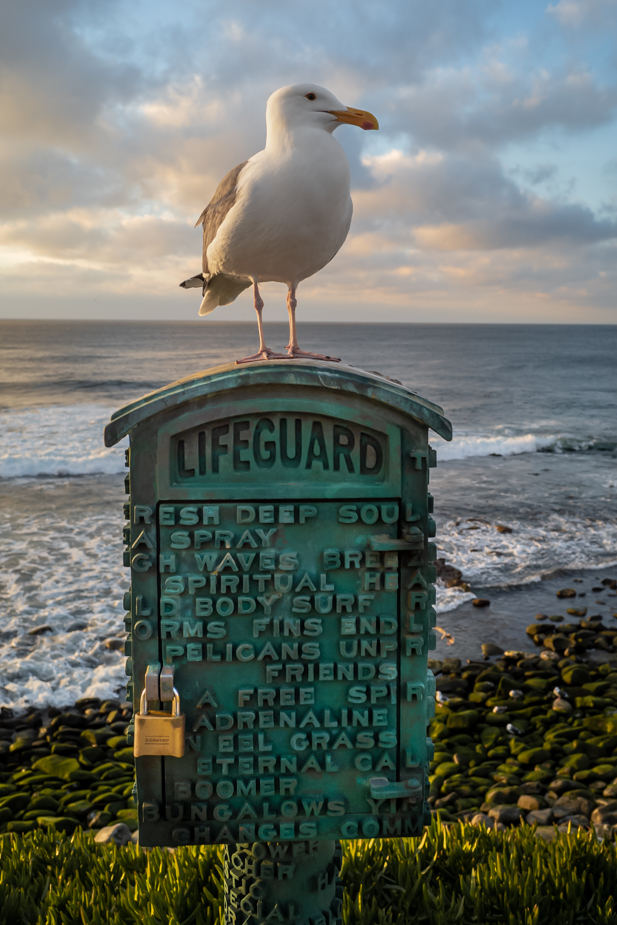
Leica M10-P, Voigtlander 28mm f/2 Ultron, f8, 250/sec, ISO 1000, AWB
Late this afternoon we went for a walk along the cliffs at the La Jolla Cove. There is a strong Pacific storm starting to move in. You can feel it in the air. The clouds are full and detailed, the wind is variable, the surf is large, and the temperature is dropping. There was a good size crowd walking there this afternoon. The birds have all flown ashore to seek shelter and ride out the storm. The same with the Seals and Sea Lions. The rocks were fully packed with them. The bonus was a large pod of California Gray Whales that swam in close to the shore. There was adults and calves of various ages in the pos. They put on quite a show for all the tourists down to watch the animals and the sunset. It was a magical evening. I am blessed to live here.
There was a great number of photographic opportunities, and I got a lot of practice shooting different scenes and subjects. Once again I limited my shooting to zone focus, choosing the focus position by guessing the distance, positioning the knob on the lens before bringing the camera up to shoot. I am getting to the point that I am getting a reasonable hit rate this way. Of course, I am still giving myself large margins by shooting the 28mm stopped down to f/8.
I have a lot to choose from for today's image. I have decided to keep things light and just post a fun shot that I enjoyed shooting, and enjoy looking at. Not every image has to make a statement to have value. This Seagull was sitting on top of a Lifeguard box as if on duty. He was completely comfortable with people getting close. I just walked up to him and was able to get close enough to fill the frame even with the 28mm.
I had shot a similar image a couple of years ago, but never with the Leica method. This one came out better in my opinion. I do prefer the Leica/Voigtlander rendering.
The setup:
CV 28mm
Aperture f/8
Auto shutter Speed with a minimum limit of 250/sec because I am shooting hand held and some slowly moving subjects.
Auto ISO (light levels were already fading when I shot this image so ISO went to 1000)
Auto WB
Anyway, a silly and fun little image.
Enjoy!
-Steve-
Leica M10-P, Voigtlander 28mm f/2 Ultron, f8, 250/sec, ISO 1000, AWB
Mar 03, 2022 at 10:38 PM
p.10 #17Learning Leica "M", a 30 day project
Steve, that is a fun image! It reminds me of a walk I had some years ago when I came across a few deer, including a couple young ones, maybe only a few months old. One was curious about me and allowed me to approach it close enough that I was photographing it with 28 and 21mm lenses. Though deer here have a lot of exposure to people, they remain quite skittish and I have since then not been able to approach any this closely.
1bwana1 wrote:
Day 7 Image:
Today I stopped by Crystal Pier in Pacific Beach on my way home to see what I could find for this project. I was intrigued by this set of stairs marked "PRIVATE" that led up to what appears to be no where. I had thought I would get some typical pier/beach image. But once I saw this, I was focused on it.
theHUN wrote:
Was this metered in ranger finder mode or using live view? I'm only asking because I have read that some people struggled with metering in range finder mode. And if the M10's RF metering were that bad, then this shot would have blown highlights, but it doesn't.
That scene was in full sun, the easiest type of light to correctly expose manually without need for the light meter, once you know how your camera handles it.
Mar 04, 2022 at 01:08 AM
p.10 #18Learning Leica "M", a 30 day project
1bwana1 wrote:
Day 13 Image:
On Wednesday afternoons I teach a lab class on gemology and gem cutting. This is held in the faceting lab at the San Diego Gem and Mineral Club at Spanish Village in Balboa Park. The park is beautiful, popular, and so I though would offer a lot of photographic opportunity. I went about 45 minutes early so I could take a walk around some areas in the Park. I chose the walking area where all the museums are for today.
I set some new rules for myself today. A Bill Maher move for sure.
Today I would take only...Show more →
> Man on crutches in hallway
Two weeks in and I'm still really enjoying this thread. I had previously mentioned that one of the things that I enjoy most about it are Steve's narrations about his thought processes in composition, which assist me in how I look at composition of his scenes. Something else that I am really enjoying is the diversity of Steve's choices for subject matter. It's very easy to get stuck in a rut, taking pictures of the kinds of things that one is good at. I like Steve's willingness to compose such a wide variety of subjects. Doing that would move me out of my comfort zone and force me into a deeper learning experience.
I really like this image of the man in crutches walking the long hallway. Here are my two cents:
* Choice of perspective was excellent. The image tells a great story about hardship and perseverance -- by illustrating the amount of effort that the man in the crutches has to put forth to get where he is going. the length of the hallway definitely accentuates the feeling of hardship that the subject has to endure, and his looking down at the moment of capture reinforces the perception of struggle / the gravity of the situation.
* It was an excellent decision to shoot this image in B/W. Was it originally taken in B/W or converted in post? IMO B/W works very well for this type of image that essentially consists of two main colors (floor vs. walls) which allow you to focus your composition on the subtlety brought forth by the light and shadows on the walls. As an added bonus those same dark/light color tones are echoed in the subjects choice of clothing. What a bonus!
* Exposure choice was excellent. I like the final image, though I have to admit from an educational standpoint it would be helpful to view any test images / preceding images in the series (if there was one, but I see your rules prevented precomposition) with comments about the shooting and the light in general. The exposure in this shot was magically good. If you allowed the camera to make this decision for you, all I can say is that your Leica made a great decision. Being someone who comes from a life in transparencies (where you've got one chance to get it right and you have to bracket exposure) it would be educational for me to compare SOOC vs. post, with a discussion of what steps if any you took in post to balance things out.
* Focus is excellent. Part of your success here was the choice of focal length. 8/28 provides such great DOF that it makes your precise choice of focal distance non-critical and frees you to think about other aspects of the image. With that said, I think that you ended up front-focusing the image more than I would have. It seems as if you focused on the chandelier or the ground right in front of the camera, anticipating the subject's movement into the "trap", rather than on the subject, as when I pixel-peep the defects in the floor seem sharpest in the closest area of the photo. That approach worked out well. If I were doing this composition my instinct would have been to zone focus a little farther back, maybe midway between actual subject distance and the hyperfocal distance, in the hope that I could sacrifice a little up front to give sharper focus to the subject, and a bit sharper focus to the carvings in the walls and the sconces that repeat down the highway to keep more of the distant objects sharp. Of course, getting the distant hallway in sharper focus could be good or bad. As it is in your image, the front-focus and the sacrifice of sharp focus going farther away does tend to accentuate the perception of distance, which may have been part of why your composition is so moving. Does your Leica report distance to subject in EXIF? It would be interesting to compare where you actually focused to where you planned to focus, to get a little "numerical" feedback from the image, as that may help to guide the distance calibration of your eyes.
Once again, Great shot Steve!
Mar 04, 2022 at 09:08 AM
p.10 #19Learning Leica "M", a 30 day project
I don't have a 28mm lens. I do have a 24 and I can set it using the DoF scales and the aperture set at f/8 so everything from about 4 ft to infinity will be in focus. My guess with a 28 is you could set it using the DoF scales so everything from about 6 ft to infinity would in. Without having a 28 to actually see the DoF scales that is just a guess but I think it would close.
Mar 04, 2022 at 09:53 AM
p.10 #20Learning Leica "M", a 30 day project
rscheffler wrote:
... once you know how your camera handles it.
Yes, and that is my issue. The trip I have planned will take me on a glacier and those conditions are difficult to reproduce in Santa Barbara, so I won't really know how the camera handles it until I get there. I know how my other camera handled it, and I was satisfied with the results (no blown highlights), but I want to take a monochrome next time, hence my focus on a Leica. I will not have much time for the camera on that trip, so proper automatic metering will be needed, but a 28 mm lens at f/8 to f/11 will provide plenty of DOF, so I won't need autofocus.
Edit: And since I will be using an orange filter, metering can get even more tricky especially in changing situations. I think I just need to bit the bullet and test it out as best as I can given the terrain I have access to. There are some snowy mountains in Los Angeles where I should be doing some tests. Anyway, ignore my ramblings. All paths lead to the M10M.
Mar 04, 2022 at 10:20 AM