This topic is in the 2022 archive. You can read it and like its posts here. It is read only.
Archive 2022Learning Leica "M", a 30 day project
p.9 #1Learning Leica "M", a 30 day project
wdshuck wrote:
Beautiful! I think you were right to try for a morning without clouds, it really shows off the church.
I’ve also enjoyed following your photography because it helps me revisit La Jolla. Both of my grandparents retired there and I had many fond memories visiting them there. In fact I remember a good Thai restaurant across the street from this church 😉
Thanks for the kind words.
That Thai restaurant is still there. My favorite Thom Yum Soup is from them.
-Steve-
Mar 01, 2022 at 11:04 PM

p.9 #2Learning Leica "M", a 30 day project
1bwana1 wrote:
Old racing habits never leave you....
Muscle Memory
Old racing habits never leave you....
Muscle Memory
Mar 01, 2022 at 11:37 PM
p.9 #3Learning Leica "M", a 30 day project
The idea of candid and HCB photograph has led to 99.9% crud that’s tilted and not very engaging. I realize I’m a contrarian here, but have a conversation and engage until the camera becomes something the subject isn’t thinking about.
1bwana1 wrote:
No, I shot when he was walking by trying to be discreet. I suck at that. It his his natural reaction to being photographed. We did talk to after the shot and I bought him and his Wife an ice cream. Very nice people.
1bwana1 wrote:
AndrewNYC wrote
This image, where you are engaged with teh subject, is so much more compelling than zone focusing/ shooting from the hip stuff. I love it. The image reflects investment in the scene.Mar 02, 2022 at 06:47 AM
p.9 #4Learning Leica "M", a 30 day project
1bwana1 wrote:
For those who wanted to see a 4 x 5 crop, centered, I posted one in the People thread. Here is a link.
https://www.fredmiranda.com/forum/topic/1745433/0#15877340
I prefer the 4x5 crop. It feels like you're engaging the subject more than in the FF crop.
Did you give any thought to trying 1:1 in post?
Mar 02, 2022 at 07:39 AM
p.9 #5Learning Leica "M", a 30 day project
airfrogusmc wrote:
Try a shot each day, completely pre-visualised. That is; SS, aperture ISO and focus all set before you lift the camera to your eye. No cheating. Guess everything. When you get really good you can also guess the focal length and framing.
Doesn't have to be your shot of the day but a really good way to develop pre visualisation skills. One of the most advanced Leica skills of all. Once you get it you'll start doing things like changing your shutter speed when you walk into and out of shadows or when you walk indoors you'll adjust the aperture by feel. Served me well as a wedding shooter who had to change settings on the fly following a bride walking out of a church.
Actually, it's probably unfair to ask you to try this after just a week with the camera. But I have anyway...
GordonGordon, Challenge accepted. Mostly.... 
I decided to get lunch today at sea Port Village. It is a tourist shopping mall down on the waterfront of San Diego Bay. Beautiful, warm day so I thought I could mix eating on the outdoor plaza area with photographic opportunity. The light was super harsh, contrast everywhere, and busy, unattractive backgrounds. So, I knew I would be shooting for a monotone image.
On one side of the plaza was a large white wall. It acted like a big reflector for a walkway that went right by it. On the other side of the walking area was a large tree casting an open shade shadow across the path. I decide that if I shot people as they walked through the shadow, and were lit by the reflecting wall, I would have decent lighting on them. The path wasn't that wide, and the size of the shade patch was small, so I had a good idea of what the distance between me and the subject would be as I leaned against the wall and they walked by. I visually estimated that my subject would be about 10 feet away. I wanted to try and get the busy background to blur as much as possible. So, instead of a safer f/8, I choose the smaller DOF from f/5.6 to test as a starting point. At 10 feet it looked like from the indicator on the lens that I would have about a 5 foot zone of acceptable sharpness.
So, without looking through the Range Finder I had myself positioned for the shot. The aperture set for f/5.6, the shutter speed set 1/250 sec, and the ISO floating on "A" to manage exposure. Then it was about waiting for someone with an interesting "look" to walk through my visualized image. In a few minutes the guy in today's image and his Wife walked through my 'Zone". AS Gordon had suggested I just brought the Range Finder up to my eye, quickly composed, and clicked off 4 shots as he traversed the shadow. By shot number 4 he had noticed that I was photographing him, looks over at me a gave a small smile. I was busted and stopped. I still get intimidated when shooting strangers like that. I am not sure how they will react. I was lucky this time.
I then went over to my lunch table in the shade to review the image. I was lucky, liked the image,, and my zone guesses seemed to have worked OK. This was the only person I shot at this spot. I will say that I was surprised by how tight the shot was at 50mm. Learning to estimate this will take some work as well. I am so used to "seeing" he whole view finder and not the crop lines. they just don't register yet when I am shooting. Still, I did get an decent image by pre-visualizing and setting up the camera and the shot. After this I took a walk along the commercial fishing boat basin and shot a few more images. Done for the day.
Here is the the image. Once again only a slight crop, and minimal Light Room editing. I am Looking forward to you comments and suggestions.This image, where you are engaged with teh subject, is so much more compelling than zone focusing/ shooting from the hip stuff. I love it. The image reflects investment in the scene.I don't shoot from the hip and wasn't saying that anyone should. Both shooting in the moment and engaging have their place. I do both.
I wasn't speaking to any persons comment here, just offering that generally, zone focusing leads to pictures that don't have a lot interesting or compelling from viewers perspective except for very, very rare exceptions.
AndrewNYC wrote
1bwana1 wrote
Day 11 Image:flash wrote
Almost time for a real technical challenge to push your (quickly) growing skills. This one is for advanced and experienced Leica shooters. Failure is expected.Try a shot each day, completely pre-visualised. That is; SS, aperture ISO and focus all set before you lift the camera to your eye. No cheating. Guess everything. When you get really good you can also guess the focal length and framing.
Doesn't have to be your shot of the day but a really good way to develop pre visualisation skills. One of the most advanced Leica skills of all. Once you get it you'll start doing things like changing your shutter speed when you walk into and out of shadows or when you walk indoors you'll adjust the aperture by feel. Served me well as a wedding shooter who had to change settings on the fly following a bride walking out of a church.
Actually, it's probably unfair to ask you to try this after just a week with the camera. But I have anyway...
Gordon
I decided to get lunch today at sea Port Village. It is a tourist shopping mall down on the waterfront of San Diego Bay. Beautiful, warm day so I thought I could mix eating on the outdoor plaza area with photographic opportunity. The light was super harsh, contrast everywhere, and busy, unattractive backgrounds. So, I knew I would be shooting for a monotone image.
On one side of the plaza was a large white wall. It acted like a big reflector for a walkway that went right by it. On the other side of the walking area was a large tree casting an open shade shadow across the path. I decide that if I shot people as they walked through the shadow, and were lit by the reflecting wall, I would have decent lighting on them. The path wasn't that wide, and the size of the shade patch was small, so I had a good idea of what the distance between me and the subject would be as I leaned against the wall and they walked by. I visually estimated that my subject would be about 10 feet away. I wanted to try and get the busy background to blur as much as possible. So, instead of a safer f/8, I choose the smaller DOF from f/5.6 to test as a starting point. At 10 feet it looked like from the indicator on the lens that I would have about a 5 foot zone of acceptable sharpness.
So, without looking through the Range Finder I had myself positioned for the shot. The aperture set for f/5.6, the shutter speed set 1/250 sec, and the ISO floating on "A" to manage exposure. Then it was about waiting for someone with an interesting "look" to walk through my visualized image. In a few minutes the guy in today's image and his Wife walked through my 'Zone". AS Gordon had suggested I just brought the Range Finder up to my eye, quickly composed, and clicked off 4 shots as he traversed the shadow. By shot number 4 he had noticed that I was photographing him, looks over at me a gave a small smile. I was busted and stopped. I still get intimidated when shooting strangers like that. I am not sure how they will react. I was lucky this time.
I then went over to my lunch table in the shade to review the image. I was lucky, liked the image,, and my zone guesses seemed to have worked OK. This was the only person I shot at this spot. I will say that I was surprised by how tight the shot was at 50mm. Learning to estimate this will take some work as well. I am so used to "seeing" he whole view finder and not the crop lines. they just don't register yet when I am shooting. Still, I did get an decent image by pre-visualizing and setting up the camera and the shot. After this I took a walk along the commercial fishing boat basin and shot a few more images. Done for the day.
Here is the the image. Once again only a slight crop, and minimal Light Room editing. I am Looking forward to you comments and suggestions.
I wasn't speaking to any persons comment here, just offering that generally, zone focusing leads to pictures that don't have a lot interesting or compelling from viewers perspective except for very, very rare exceptions.
Mar 02, 2022 at 07:40 AM
p.9 #6Learning Leica "M", a 30 day project
AndrewNYC wrote:
Try a shot each day, completely pre-visualised. That is; SS, aperture ISO and focus all set before you lift the camera to your eye. No cheating. Guess everything. When you get really good you can also guess the focal length and framing.
Doesn't have to be your shot of the day but a really good way to develop pre visualisation skills. One of the most advanced Leica skills of all. Once you get it you'll start doing things like changing your shutter speed when you walk into and out of shadows or when you walk indoors you'll adjust the aperture by feel. Served me well as a wedding shooter who had to change settings on the fly following a bride walking out of a church.
Actually, it's probably unfair to ask you to try this after just a week with the camera. But I have anyway...
GordonGordon, Challenge accepted. Mostly....
I decided to get lunch today at sea Port Village. It is a tourist shopping mall down on the waterfront of San Diego Bay. Beautiful, warm day so I thought I could mix eating on the outdoor plaza area with photographic opportunity. The light was super harsh, contrast everywhere, and busy, unattractive backgrounds. So, I knew I would be shooting for a monotone image.
On one side of the plaza was a large white wall. It acted like a big reflector for a walkway that went right by it. On the other side of the walking area was a large tree casting an open shade shadow across the path. I decide that if I shot people as they walked through the shadow, and were lit by the reflecting wall, I would have decent lighting on them. The path wasn't that wide, and the size of the shade patch was small, so I had a good idea of what the distance between me and the subject would be as I leaned against the wall and they walked by. I visually estimated that my subject would be about 10 feet away. I wanted to try and get the busy background to blur as much as possible. So, instead of a safer f/8, I choose the smaller DOF from f/5.6 to test as a starting point. At 10 feet it looked like from the indicator on the lens that I would have about a 5 foot zone of acceptable sharpness.
So, without looking through the Range Finder I had myself positioned for the shot. The aperture set for f/5.6, the shutter speed set 1/250 sec, and the ISO floating on "A" to manage exposure. Then it was about waiting for someone with an interesting "look" to walk through my visualized image. In a few minutes the guy in today's image and his Wife walked through my 'Zone". AS Gordon had suggested I just brought the Range Finder up to my eye, quickly composed, and clicked off 4 shots as he traversed the shadow. By shot number 4 he had noticed that I was photographing him, looks over at me a gave a small smile. I was busted and stopped. I still get intimidated when shooting strangers like that. I am not sure how they will react. I was lucky this time.
I then went over to my lunch table in the shade to review the image. I was lucky, liked the image,, and my zone guesses seemed to have worked OK. This was the only person I shot at this spot. I will say that I was surprised by how tight the shot was at 50mm. Learning to estimate this will take some work as well. I am so used to "seeing" he whole view finder and not the crop lines. they just don't register yet when I am shooting. Still, I did get an decent image by pre-visualizing and setting up the camera and the shot. After this I took a walk along the commercial fishing boat basin and shot a few more images. Done for the day.
Here is the the image. Once again only a slight crop, and minimal Light Room editing. I am Looking forward to you comments and suggestions.This image, where you are engaged with teh subject, is so much more compelling than zone focusing/ shooting from the hip stuff. I love it. The image reflects investment in the scene.I don't shoot from the hip and wasn't saying that anyone should. Both shooting in the moment and engaging have their place. I do both.I wasn't speaking to any persons comment here, just offering that generally, zone focusing leads to pictures that don't have a lot interesting or compelling from viewers perspective except for very, very rare exceptions.
Thats certainly not what Bresson, Frank or Winogrand would do. It you are taking a portrait, yes. If you are working in the moment, no.
A few words by me in a piece Leica did on my work a few years back
https://www.leica-camera.blog/2016/12/15/spontaneous-relationships/
Now some words by the greats:
'To take photographs means to recognize -- simultaneously and within a fraction of a second -- both the fact itself and the rigorous organization of visually perceived forms that give it meaning.' -Henri Cartier-Bresson
"You cannot be sure in advance exactly how the situation, the scene, is going to unfold. You must stay with the scene, just in case the elements of the situation shoot off from the core again... Of all the means of expression, photography is the only one that fixes forever the precise and transitory instant. We photographers deal in things which are continually vanishing, and when they have vanished, there is no contrivance on earth which can make them come back again. We cannot develop and print a memory."
Henri Cartier-Bresson
"Of all the means of expression, photography is the only one that fixes a precise moment in time. We play with subjects that disappear; and when they’re gone, it’s impossible to bring them back to life. We can’t alter our subject afterward.... Writers can reflect before they put words on paper.... As photographers, we don’t have the luxury of this reflective time....We can’t redo our shoot once we’re back at the hotel. Our job consists of observing reality with help of our camera (which serves as a kind of sketchbook), of fixing reality in a moment, but not manipulating it, neither during the shoot nor in the darkroom later on. These types of manipulation are always noticed by anyone with a good eye."
Henri Cartier-Bresson
"This recognition, in real life, of a rhythm of surfaces, lines, and values is for me the essence of photography" Henri Cartier -Bresson
Great wrods by Meyerowitz
https://www.traileraddict.com/everybody-street/trailer
"You know why your pictures are no fucking good? Because they don’t describe the chaos of life."
Garry Winogrand
"When things move, I get interested, I know that much."
Garry Winogrand
Sometimes a tilted image is necessary to create tension in the frame. And what is engaging to A is not to B.
Like any area of photography, there is and will be a small amount of what is really good.
Winogrand when asked why he shot so much he responded
"Art isn't a product of industrial efficiency"-Garry Winogrand
"“It’s seldom you make a great picture. you have to milk the cow quite a lot to get plenty of milk to make a little cheese.”"-Henri Cartier-Bresson
When talking about Leica M, what it does best and what it is the tool for is working in the moment. In my opinion zone focusing is just one piece of that puzzle. So to be able to use the tool to its fullest that is something that should be mastered. Even when doing landscape work using DoF scales zone or hyper focus can be a valuable tool. A tool that gives the photographer the full control of DoF. For instance with a 24mm lens at f/8 you can use the DoF scales on the lens to get everything from about 4 ft through infinity in focus.
Edited on Mar 03, 2022 at 06:05 AM · View previous versions
airfrogusmc wrote
AndrewNYC wrote
1bwana1 wrote
Day 11 Image:flash wrote
Almost time for a real technical challenge to push your (quickly) growing skills. This one is for advanced and experienced Leica shooters. Failure is expected.Try a shot each day, completely pre-visualised. That is; SS, aperture ISO and focus all set before you lift the camera to your eye. No cheating. Guess everything. When you get really good you can also guess the focal length and framing.
Doesn't have to be your shot of the day but a really good way to develop pre visualisation skills. One of the most advanced Leica skills of all. Once you get it you'll start doing things like changing your shutter speed when you walk into and out of shadows or when you walk indoors you'll adjust the aperture by feel. Served me well as a wedding shooter who had to change settings on the fly following a bride walking out of a church.
Actually, it's probably unfair to ask you to try this after just a week with the camera. But I have anyway...
Gordon
I decided to get lunch today at sea Port Village. It is a tourist shopping mall down on the waterfront of San Diego Bay. Beautiful, warm day so I thought I could mix eating on the outdoor plaza area with photographic opportunity. The light was super harsh, contrast everywhere, and busy, unattractive backgrounds. So, I knew I would be shooting for a monotone image.
On one side of the plaza was a large white wall. It acted like a big reflector for a walkway that went right by it. On the other side of the walking area was a large tree casting an open shade shadow across the path. I decide that if I shot people as they walked through the shadow, and were lit by the reflecting wall, I would have decent lighting on them. The path wasn't that wide, and the size of the shade patch was small, so I had a good idea of what the distance between me and the subject would be as I leaned against the wall and they walked by. I visually estimated that my subject would be about 10 feet away. I wanted to try and get the busy background to blur as much as possible. So, instead of a safer f/8, I choose the smaller DOF from f/5.6 to test as a starting point. At 10 feet it looked like from the indicator on the lens that I would have about a 5 foot zone of acceptable sharpness.
So, without looking through the Range Finder I had myself positioned for the shot. The aperture set for f/5.6, the shutter speed set 1/250 sec, and the ISO floating on "A" to manage exposure. Then it was about waiting for someone with an interesting "look" to walk through my visualized image. In a few minutes the guy in today's image and his Wife walked through my 'Zone". AS Gordon had suggested I just brought the Range Finder up to my eye, quickly composed, and clicked off 4 shots as he traversed the shadow. By shot number 4 he had noticed that I was photographing him, looks over at me a gave a small smile. I was busted and stopped. I still get intimidated when shooting strangers like that. I am not sure how they will react. I was lucky this time.
I then went over to my lunch table in the shade to review the image. I was lucky, liked the image,, and my zone guesses seemed to have worked OK. This was the only person I shot at this spot. I will say that I was surprised by how tight the shot was at 50mm. Learning to estimate this will take some work as well. I am so used to "seeing" he whole view finder and not the crop lines. they just don't register yet when I am shooting. Still, I did get an decent image by pre-visualizing and setting up the camera and the shot. After this I took a walk along the commercial fishing boat basin and shot a few more images. Done for the day.
Here is the the image. Once again only a slight crop, and minimal Light Room editing. I am Looking forward to you comments and suggestions.
Thats certainly not what Bresson, Frank or Winogrand would do. It you are taking a portrait, yes. If you are working in the moment, no.
A few words by me in a piece Leica did on my work a few years back
https://www.leica-camera.blog/2016/12/15/spontaneous-relationships/
Now some words by the greats:
'To take photographs means to recognize -- simultaneously and within a fraction of a second -- both the fact itself and the rigorous organization of visually perceived forms that give it meaning.' -Henri Cartier-Bresson
"You cannot be sure in advance exactly how the situation, the scene, is going to unfold. You must stay with the scene, just in case the elements of the situation shoot off from the core again... Of all the means of expression, photography is the only one that fixes forever the precise and transitory instant. We photographers deal in things which are continually vanishing, and when they have vanished, there is no contrivance on earth which can make them come back again. We cannot develop and print a memory."
Henri Cartier-Bresson
"Of all the means of expression, photography is the only one that fixes a precise moment in time. We play with subjects that disappear; and when they’re gone, it’s impossible to bring them back to life. We can’t alter our subject afterward.... Writers can reflect before they put words on paper.... As photographers, we don’t have the luxury of this reflective time....We can’t redo our shoot once we’re back at the hotel. Our job consists of observing reality with help of our camera (which serves as a kind of sketchbook), of fixing reality in a moment, but not manipulating it, neither during the shoot nor in the darkroom later on. These types of manipulation are always noticed by anyone with a good eye."
Henri Cartier-Bresson
"This recognition, in real life, of a rhythm of surfaces, lines, and values is for me the essence of photography" Henri Cartier -Bresson
Great wrods by Meyerowitz
https://www.traileraddict.com/everybody-street/trailer
"You know why your pictures are no fucking good? Because they don’t describe the chaos of life."
Garry Winogrand
"When things move, I get interested, I know that much."
Garry Winogrand
Sometimes a tilted image is necessary to create tension in the frame. And what is engaging to A is not to B.
Like any area of photography, there is and will be a small amount of what is really good.
Winogrand when asked why he shot so much he responded
"Art isn't a product of industrial efficiency"-Garry Winogrand
"“It’s seldom you make a great picture. you have to milk the cow quite a lot to get plenty of milk to make a little cheese.”"-Henri Cartier-Bresson
When talking about Leica M, what it does best and what it is the tool for is working in the moment. In my opinion zone focusing is just one piece of that puzzle. So to be able to use the tool to its fullest that is something that should be mastered. Even when doing landscape work using DoF scales zone or hyper focus can be a valuable tool. A tool that gives the photographer the full control of DoF. For instance with a 24mm lens at f/8 you can use the DoF scales on the lens to get everything from about 4 ft through infinity in focus.
Edited on Mar 03, 2022 at 06:05 AM · View previous versions
Mar 02, 2022 at 08:30 AM
p.9 #7Learning Leica "M", a 30 day project
I've seen this thread popup rom time to time, and have glanced, but today I took the time to actually try and get through the 9 pages of comments. I am really glad I did. This truly is a great conversation, and not the far-too-common ones of my way/camera/lens/approach is better than yours threads. I've appreciated seeing all the input and respectful interaction.
Watching the journey is a learning process for me as well as I struggle to land where I want to with my approach. I'll continue to read, enjoy and learn while also contributing where it makes sense.
Cheers
Watching the journey is a learning process for me as well as I struggle to land where I want to with my approach. I'll continue to read, enjoy and learn while also contributing where it makes sense.
Cheers
Mar 02, 2022 at 11:00 AM
p.9 #8Learning Leica "M", a 30 day project
coralnut wrote:
https://www.fredmiranda.com/forum/topic/1745433/0#15877340I prefer the 4x5 crop. It feels like you're engaging the subject more than in the FF crop.
Did you give any thought to trying 1:1 in post?
I looked at this one as well, and must say for me I am 100% the opposite. For me, I find the original much better. More inviting, genuine and comfortable. That's the beauty of photography (or maybe all forms of expression)...there are so many ways to view a scene, an image, a vision.
1bwana1 wrote
For those who wanted to see a 4 x 5 crop, centered, I posted one in the People thread. Here is a link.https://www.fredmiranda.com/forum/topic/1745433/0#15877340
Did you give any thought to trying 1:1 in post?
I looked at this one as well, and must say for me I am 100% the opposite. For me, I find the original much better. More inviting, genuine and comfortable. That's the beauty of photography (or maybe all forms of expression)...there are so many ways to view a scene, an image, a vision.
Mar 02, 2022 at 11:02 AM
p.9 #9Learning Leica "M", a 30 day project
Michael H wrote:
I've seen this thread popup rom time to time, and have glanced, but today I took the time to actually try and get through the 9 pages of comments. I am really glad I did. This truly is a great conversation, and not the far-too-common ones of my way/camera/lens/approach is better than yours threads. I've appreciated seeing all the input and respectful interaction.
Watching the journey is a learning process for me as well as I struggle to land where I want to with my approach. I'll continue to read, enjoy and learn while also contributing where it makes...Show more →
Michael,
Welcome to the thread. Your comments and thoughts will always be appreciated here.
Are shooting with a Leica currently?
My Wife is up in Rancho Cucamonga today for her Father's 91st Birthday. We get up your war frequently.
Steve
Mar 02, 2022 at 11:21 AM
p.9 #10Learning Leica "M", a 30 day project
1bwana1 wrote:
Day 12 image:
I wanted to try something different. Todays image was shot at sunrise in the Village of La Jolla where I live. I have often thought of shooting the Spanish Revival style bell towers of Mary's By The Sea Catholic Church, but never got around to it. The weather looked to exactly what I wanted, so I am including it in this project.
I got up in time for sunrise on an absolutely clear morning. This has always been my vision for the shot. I didn't want an clouds competing with the towers for attention. I pretty much had the...Show more →
Steve this is a lovely shot. I think the Leica M is excellent for landscapes, but I would add if you want to shoot them regularly then the Visoflex 020 is really handy with its tilting EVF. Let's you compose from any angle and it is especially nice when you shoot from a lower angle on a tripod. I think you also my find if you shoot from a tripod and especially architecture like this shot, that you might start considering wider lenses. I like your shot a lot, but if it were me (and your take is just as valid as mine) I would have pulled out my 21 SEM or maybe even my Voigtlander 15 f/4.5 and gotten closer for this shot. In my experience the old adage that "if you don't like your photos get closer," is equally true for landscapes (but not all shots of course) and that is what wide angle lens really allow you to do for landscapes--get closer. Just some food for thought as you develop your Leica M shooting.
Mar 02, 2022 at 11:37 AM
p.9 #11Learning Leica "M", a 30 day project
1bwana1 wrote:
Watching the journey is a learning process for me as well as I struggle to land where I want to with my approach. I'll continue to read, enjoy and learn while also contributing where it makes sense.
CheersMichael,
Welcome to the thread. Your comments and thoughts will always be appreciated here.
Are shooting with a Leica currently?
My Wife is up in Rancho Cucamonga today for her Father's 91st Birthday. We get up your war frequently.
Steve
Small world sometimes isn't it! Happy birthday! I can only hope I make it that far.
I have been shooting almost exclusively for a bit, but I seem to be a bit less than firmly committed. I sold my last M (262) when I decided my astigmatism was becoming a hinderance. I've had a Q (fantastic, but not M) and currently a Q2M and SL. The EVF is great and the Q2M especially is an amazing tool. I keep the SL mostly for the ease of adapting alternative glass but it works great with my M-glass. The draw for me with the M is still there and strong, and right now I find myself really thinking about the best direction. I will say I could be perfectly happy if it turns out to be the Q2M which I use in manual mode as much as the automated side. It has been an inspiring tool for me but it also makes me think about the M10M.
It's been a learning experience to say the least. I can easily ad that this migration to Leica has been all I had hoped for a more. I keep a Canon body with some long glass for Special Olympics and other volunteer work but as you would expect, those events have been cancelled for the past 2 years.
Michael H wrote
I've seen this thread popup rom time to time, and have glanced, but today I took the time to actually try and get through the 9 pages of comments. I am really glad I did. This truly is a great conversation, and not the far-too-common ones of my way/camera/lens/approach is better than yours threads. I've appreciated seeing all the input and respectful interaction.Watching the journey is a learning process for me as well as I struggle to land where I want to with my approach. I'll continue to read, enjoy and learn while also contributing where it makes sense.
Cheers
Welcome to the thread. Your comments and thoughts will always be appreciated here.
Are shooting with a Leica currently?
My Wife is up in Rancho Cucamonga today for her Father's 91st Birthday. We get up your war frequently.
Steve
Small world sometimes isn't it! Happy birthday! I can only hope I make it that far.
I have been shooting almost exclusively for a bit, but I seem to be a bit less than firmly committed. I sold my last M (262) when I decided my astigmatism was becoming a hinderance. I've had a Q (fantastic, but not M) and currently a Q2M and SL. The EVF is great and the Q2M especially is an amazing tool. I keep the SL mostly for the ease of adapting alternative glass but it works great with my M-glass. The draw for me with the M is still there and strong, and right now I find myself really thinking about the best direction. I will say I could be perfectly happy if it turns out to be the Q2M which I use in manual mode as much as the automated side. It has been an inspiring tool for me but it also makes me think about the M10M.
It's been a learning experience to say the least. I can easily ad that this migration to Leica has been all I had hoped for a more. I keep a Canon body with some long glass for Special Olympics and other volunteer work but as you would expect, those events have been cancelled for the past 2 years.
Mar 02, 2022 at 11:40 AM
p.9 #12Learning Leica "M", a 30 day project
Steve Spencer wrote:
Steve this is a lovely shot. I think the Leica M is excellent for landscapes, but I would add if you want to shoot them regularly then the Visoflex 020 is really handy with its tilting EVF. Let's you compose from any angle and it is especially nice when you shoot from a lower angle on a tripod. I think you also my find if you shoot from a tripod and especially architecture like this shot, that you might start considering wider lenses. I like your shot a lot, but if it were me (and your take is just...Show more →
Steve,
Thanks for the detailed comments. I did try with the 28mm from close up. The problem with that for me was that it separated the towers and roof peaks too much. I prefered the compression I got from the longer FL.
It is an interesting location and I am sure I will revisit to try different approaches since it so convenient. I will keep your suggestions in mind when I do.
Thanks,
Steve
Mar 02, 2022 at 11:47 AM
p.9 #13Learning Leica "M", a 30 day project
Michael H wrote:
I've seen this thread popup rom time to time, and have glanced, but today I took the time to actually try and get through the 9 pages of comments. I am really glad I did. This truly is a great conversation, and not the far-too-common ones of my way/camera/lens/approach is better than yours threads. I've appreciated seeing all the input and respectful interaction.
Watching the journey is a learning process for me as well as I struggle to land where I want to with my approach. I'll continue to read, enjoy and learn while also contributing where it makes...Show more →
I agree, this is a great conversation with some great info. Please keep it going!
Mar 02, 2022 at 12:02 PM
p.9 #14Learning Leica "M", a 30 day project
Michael H wrote:
I sold my last M (262) when I decided my astigmatism was becoming a hinderance.
Sorry for the tangential information:
There's a company called Walter that makes custom diopter correction eyepieces based on your exact prescription. The eyepiece is designed in a way that allows it to rotate (by gravity) when you change between horizontal and vertical compositions. I don't have personal experience with them, nor has there been much written about these in over 10 years since I recall they first came on the market. But perhaps it's an option? Have I perhaps already posted about this?
Recently I stumbled across an optician in Japan offering a similar service.
It's in Japanese but you can get an idea, or use a translation website:
http://opt-ohno.com/AJ_top.html
http://opt-ohno.com/aj_type-L.html
Mar 02, 2022 at 02:19 PM
p.9 #15Learning Leica "M", a 30 day project
rscheffler wrote:
Sorry for the tangential information:
There's a company called Walter that makes custom diopter correction eyepieces based on your exact prescription. The eyepiece is designed in a way that allows it to rotate (by gravity) when you change between horizontal and vertical compositions. I don't have personal experience with them, nor has there been much written about these in over 10 years since I recall they first came on the market. But perhaps it's an option? Have I perhaps already posted about this?
Recently I stumbled across an optician in Japan offering a similar service.
It's in Japanese but you can get an...Show more →
Thanks for the info, I will look into it. The condition is most troublesome in closer distances, or at least it has been. This combined with age-related Presbyopia and needing reading glasses makes for some fun times!
Michael H wrote
I sold my last M (262) when I decided my astigmatism was becoming a hinderance.There's a company called Walter that makes custom diopter correction eyepieces based on your exact prescription. The eyepiece is designed in a way that allows it to rotate (by gravity) when you change between horizontal and vertical compositions. I don't have personal experience with them, nor has there been much written about these in over 10 years since I recall they first came on the market. But perhaps it's an option? Have I perhaps already posted about this?
Recently I stumbled across an optician in Japan offering a similar service.
It's in Japanese but you can get an...Show more →
Thanks for the info, I will look into it. The condition is most troublesome in closer distances, or at least it has been. This combined with age-related Presbyopia and needing reading glasses makes for some fun times!
Mar 02, 2022 at 03:57 PM
p.9 #16Learning Leica "M", a 30 day project
airfrogusmc wrote:
Try a shot each day, completely pre-visualised. That is; SS, aperture ISO and focus all set before you lift the camera to your eye. No cheating. Guess everything. When you get really good you can also guess the focal length and framing.
Doesn't have to be your shot of the day but a really good way to develop pre visualisation skills. One of the most advanced Leica skills of all. Once you get it you'll start doing things like changing your shutter speed when you walk into and out of shadows or when you walk indoors you'll adjust the aperture by feel. Served me well as a wedding shooter who had to change settings on the fly following a bride walking out of a church.
Actually, it's probably unfair to ask you to try this after just a week with the camera. But I have anyway...
GordonGordon, Challenge accepted. Mostly....
I decided to get lunch today at sea Port Village. It is a tourist shopping mall down on the waterfront of San Diego Bay. Beautiful, warm day so I thought I could mix eating on the outdoor plaza area with photographic opportunity. The light was super harsh, contrast everywhere, and busy, unattractive backgrounds. So, I knew I would be shooting for a monotone image.
On one side of the plaza was a large white wall. It acted like a big reflector for a walkway that went right by it. On the other side of the walking area was a large tree casting an open shade shadow across the path. I decide that if I shot people as they walked through the shadow, and were lit by the reflecting wall, I would have decent lighting on them. The path wasn't that wide, and the size of the shade patch was small, so I had a good idea of what the distance between me and the subject would be as I leaned against the wall and they walked by. I visually estimated that my subject would be about 10 feet away. I wanted to try and get the busy background to blur as much as possible. So, instead of a safer f/8, I choose the smaller DOF from f/5.6 to test as a starting point. At 10 feet it looked like from the indicator on the lens that I would have about a 5 foot zone of acceptable sharpness.
So, without looking through the Range Finder I had myself positioned for the shot. The aperture set for f/5.6, the shutter speed set 1/250 sec, and the ISO floating on "A" to manage exposure. Then it was about waiting for someone with an interesting "look" to walk through my visualized image. In a few minutes the guy in today's image and his Wife walked through my 'Zone". AS Gordon had suggested I just brought the Range Finder up to my eye, quickly composed, and clicked off 4 shots as he traversed the shadow. By shot number 4 he had noticed that I was photographing him, looks over at me a gave a small smile. I was busted and stopped. I still get intimidated when shooting strangers like that. I am not sure how they will react. I was lucky this time.
I then went over to my lunch table in the shade to review the image. I was lucky, liked the image,, and my zone guesses seemed to have worked OK. This was the only person I shot at this spot. I will say that I was surprised by how tight the shot was at 50mm. Learning to estimate this will take some work as well. I am so used to "seeing" he whole view finder and not the crop lines. they just don't register yet when I am shooting. Still, I did get an decent image by pre-visualizing and setting up the camera and the shot. After this I took a walk along the commercial fishing boat basin and shot a few more images. Done for the day.
Here is the the image. Once again only a slight crop, and minimal Light Room editing. I am Looking forward to you comments and suggestions.This image, where you are engaged with teh subject, is so much more compelling than zone focusing/ shooting from the hip stuff. I love it. The image reflects investment in the scene.I don't shoot from the hip and wasn't saying that anyone should. Both shooting in the moment and engaging have their place. I do both.I wasn't speaking to any persons comment here, just offering that generally, zone focusing leads to pictures that don't have a lot interesting or compelling from viewers perspective except for very, very rare exceptions.Thats certainly not what Bresson, Frank or Winogrand would do. It you are taking a portrait, yes. If you are working in the moment, no.
A few words by me in a piece Leica did on my work a few years back
https://www.leica-camera.blog/2016/12/15/spontaneous-relationships/
Now some words by the greats:
To take photographs means to recognize -- simultaneously and within a fraction of a second -- both the fact itself and the rigorous organization of visually perceived forms that give it meaning. -Henri Cartier-Bresson
"You cannot be sure in advance exactly how the situation, the scene, is going to unfold. You must stay with the...Show more →
Don't disagree, and maybe I'm just more into documentary stuff and stuff with a story. Probably because it's harder to tell a story with a photo than take a picture that looks good and most of the stuff this days is just that, a pretty picture, at best.
AndrewNYC wrote
airfrogusmc wrote
AndrewNYC wrote
1bwana1 wrote
Day 11 Image:flash wrote
Almost time for a real technical challenge to push your (quickly) growing skills. This one is for advanced and experienced Leica shooters. Failure is expected.Try a shot each day, completely pre-visualised. That is; SS, aperture ISO and focus all set before you lift the camera to your eye. No cheating. Guess everything. When you get really good you can also guess the focal length and framing.
Doesn't have to be your shot of the day but a really good way to develop pre visualisation skills. One of the most advanced Leica skills of all. Once you get it you'll start doing things like changing your shutter speed when you walk into and out of shadows or when you walk indoors you'll adjust the aperture by feel. Served me well as a wedding shooter who had to change settings on the fly following a bride walking out of a church.
Actually, it's probably unfair to ask you to try this after just a week with the camera. But I have anyway...
Gordon
I decided to get lunch today at sea Port Village. It is a tourist shopping mall down on the waterfront of San Diego Bay. Beautiful, warm day so I thought I could mix eating on the outdoor plaza area with photographic opportunity. The light was super harsh, contrast everywhere, and busy, unattractive backgrounds. So, I knew I would be shooting for a monotone image.
On one side of the plaza was a large white wall. It acted like a big reflector for a walkway that went right by it. On the other side of the walking area was a large tree casting an open shade shadow across the path. I decide that if I shot people as they walked through the shadow, and were lit by the reflecting wall, I would have decent lighting on them. The path wasn't that wide, and the size of the shade patch was small, so I had a good idea of what the distance between me and the subject would be as I leaned against the wall and they walked by. I visually estimated that my subject would be about 10 feet away. I wanted to try and get the busy background to blur as much as possible. So, instead of a safer f/8, I choose the smaller DOF from f/5.6 to test as a starting point. At 10 feet it looked like from the indicator on the lens that I would have about a 5 foot zone of acceptable sharpness.
So, without looking through the Range Finder I had myself positioned for the shot. The aperture set for f/5.6, the shutter speed set 1/250 sec, and the ISO floating on "A" to manage exposure. Then it was about waiting for someone with an interesting "look" to walk through my visualized image. In a few minutes the guy in today's image and his Wife walked through my 'Zone". AS Gordon had suggested I just brought the Range Finder up to my eye, quickly composed, and clicked off 4 shots as he traversed the shadow. By shot number 4 he had noticed that I was photographing him, looks over at me a gave a small smile. I was busted and stopped. I still get intimidated when shooting strangers like that. I am not sure how they will react. I was lucky this time.
I then went over to my lunch table in the shade to review the image. I was lucky, liked the image,, and my zone guesses seemed to have worked OK. This was the only person I shot at this spot. I will say that I was surprised by how tight the shot was at 50mm. Learning to estimate this will take some work as well. I am so used to "seeing" he whole view finder and not the crop lines. they just don't register yet when I am shooting. Still, I did get an decent image by pre-visualizing and setting up the camera and the shot. After this I took a walk along the commercial fishing boat basin and shot a few more images. Done for the day.
Here is the the image. Once again only a slight crop, and minimal Light Room editing. I am Looking forward to you comments and suggestions.
A few words by me in a piece Leica did on my work a few years back
https://www.leica-camera.blog/2016/12/15/spontaneous-relationships/
Now some words by the greats:
To take photographs means to recognize -- simultaneously and within a fraction of a second -- both the fact itself and the rigorous organization of visually perceived forms that give it meaning. -Henri Cartier-Bresson
"You cannot be sure in advance exactly how the situation, the scene, is going to unfold. You must stay with the...Show more →
Don't disagree, and maybe I'm just more into documentary stuff and stuff with a story. Probably because it's harder to tell a story with a photo than take a picture that looks good and most of the stuff this days is just that, a pretty picture, at best.
Mar 02, 2022 at 04:38 PM
p.9 #17Learning Leica "M", a 30 day project
Andrew,
I can't say this any better than Garry did. I have posted this before and to topic you can go to 1:25 through about 2:45.
Edited on Mar 03, 2022 at 06:09 AM · View previous versions
I can't say this any better than Garry did. I have posted this before and to topic you can go to 1:25 through about 2:45.
Edited on Mar 03, 2022 at 06:09 AM · View previous versions
Mar 02, 2022 at 07:32 PM
p.9 #18Learning Leica "M", a 30 day project
AndrewNYC wrote:
Gordon, Challenge accepted. Mostly....
I decided to get lunch today at sea Port Village. It is a tourist shopping mall down on the waterfront of San Diego Bay. Beautiful, warm day so I thought I could mix eating on the outdoor plaza area with photographic opportunity. The light was super harsh, contrast everywhere, and busy, unattractive backgrounds. So, I knew I would be shooting for a monotone image.
On one side of the plaza was a large white wall. It acted like a big reflector for a walkway that went right by it. On the other side of the walking area was a large tree casting an open shade shadow across the path. I decide that if I shot people as they walked through the shadow, and were lit by the reflecting wall, I would have decent lighting on them. The path wasn't that wide, and the size of the shade patch was small, so I had a good idea of what the distance between me and the subject would be as I leaned against the wall and they walked by. I visually estimated that my subject would be about 10 feet away. I wanted to try and get the busy background to blur as much as possible. So, instead of a safer f/8, I choose the smaller DOF from f/5.6 to test as a starting point. At 10 feet it looked like from the indicator on the lens that I would have about a 5 foot zone of acceptable sharpness.
So, without looking through the Range Finder I had myself positioned for the shot. The aperture set for f/5.6, the shutter speed set 1/250 sec, and the ISO floating on "A" to manage exposure. Then it was about waiting for someone with an interesting "look" to walk through my visualized image. In a few minutes the guy in today's image and his Wife walked through my 'Zone". AS Gordon had suggested I just brought the Range Finder up to my eye, quickly composed, and clicked off 4 shots as he traversed the shadow. By shot number 4 he had noticed that I was photographing him, looks over at me a gave a small smile. I was busted and stopped. I still get intimidated when shooting strangers like that. I am not sure how they will react. I was lucky this time.
I then went over to my lunch table in the shade to review the image. I was lucky, liked the image,, and my zone guesses seemed to have worked OK. This was the only person I shot at this spot. I will say that I was surprised by how tight the shot was at 50mm. Learning to estimate this will take some work as well. I am so used to "seeing" he whole view finder and not the crop lines. they just don't register yet when I am shooting. Still, I did get an decent image by pre-visualizing and setting up the camera and the shot. After this I took a walk along the commercial fishing boat basin and shot a few more images. Done for the day.
Here is the the image. Once again only a slight crop, and minimal Light Room editing. I am Looking forward to you comments and suggestions.This image, where you are engaged with teh subject, is so much more compelling than zone focusing/ shooting from the hip stuff. I love it. The image reflects investment in the scene.I don't shoot from the hip and wasn't saying that anyone should. Both shooting in the moment and engaging have their place. I do both.I wasn't speaking to any persons comment here, just offering that generally, zone focusing leads to pictures that don't have a lot interesting or compelling from viewers perspective except for very, very rare exceptions.Thats certainly not what Bresson, Frank or Winogrand would do. It you are taking a portrait, yes. If you are working in the moment, no.
A few words by me in a piece Leica did on my work a few years back
https://www.leica-camera.blog/2016/12/15/spontaneous-relationships/
Now some words by the greats:
To take photographs means to recognize -- simultaneously and within a fraction of a second -- both the fact itself and the rigorous organization of visually perceived forms that give it meaning. -Henri Cartier-Bresson
"You cannot be sure in advance exactly how the situation, the scene, is going to unfold. You must stay with the scene, just in case the elements of the situation shoot off from the core again... Of all the means of expression, photography is the only one that fixes forever the precise and transitory instant. We photographers deal in things which are continually vanishing, and when they have vanished, there is no contrivance on earth which can make them come back again. We cannot develop and print a memory."
Henri Cartier-Bresson
"Of all the means of expression, photography is the only one that fixes a precise moment in time. We play with subjects that disappear; and when they’re gone, it’s impossible to bring them back to life. We can’t alter our subject afterward.... Writers can reflect before they put words on paper.... As photographers, we don’t have the luxury of this reflective time....We can’t redo our shoot once we’re back at the hotel. Our job consists of observing reality with help of our camera (which serves as a kind of sketchbook), of fixing reality in a moment, but not manipulating it, neither during the shoot nor in the darkroom later on. These types of manipulation are always noticed by anyone with a good eye."
Henri Cartier-Bresson
"This recognition, in real life, of a rhythm of surfaces, lines, and values is for me the essence of photography" Henri Cartier -Bresson
Great wrods by Meyerowitz
https://www.traileraddict.com/everybody-street/trailer
"You know why your pictures are no fucking good? Because they don’t describe the chaos of life."
Garry Winogrand
"When things move, I get interested, I know that much."
Garry Winogrand
Sometimes a tilted image is necessary to create tension in the frame. And what is engaging to A is not to B.
Like any area of photography, there is and will be a small amount of what is really good.
Winogrand when asked why he shot so much he responded
"Art isn't a product of industrial efficiency"-Garry Winogrand
"“It’s seldom you make a great picture. you have to milk the cow quite a lot to get plenty of milk to make a little cheese.”"-Henri Cartier-Bresson
When talking about Leica M, what it does best and what it is the tool for is working in the moment. In my opinion zone focusing is just one piece of that puzzle. So to be able to use the tool to its fullest that is something that should be mastered. Even when doing landscape work using DoF scales zone or hyper focus can be a valuable tool. A tool that gives the photographer the full control of DoF. For instance with a 24mm lens at f/8 you can use the DoF scales on the lens to get everything from about 4 ft through infinity in focus.Don't disagree, and maybe I'm just more into documentary stuff and stuff with a story. Probably because it's harder to tell a story with a photo than take a picture that looks good and most of the stuff this days is just that, a pretty picture, at best.
Maybe you could post a few images to show us all how it should be done…
airfrogusmc wrote
AndrewNYC wrote
airfrogusmc wrote
AndrewNYC wrote
1bwana1 wrote
Day 11 Image:Gordon, Challenge accepted. Mostly....
I decided to get lunch today at sea Port Village. It is a tourist shopping mall down on the waterfront of San Diego Bay. Beautiful, warm day so I thought I could mix eating on the outdoor plaza area with photographic opportunity. The light was super harsh, contrast everywhere, and busy, unattractive backgrounds. So, I knew I would be shooting for a monotone image.
On one side of the plaza was a large white wall. It acted like a big reflector for a walkway that went right by it. On the other side of the walking area was a large tree casting an open shade shadow across the path. I decide that if I shot people as they walked through the shadow, and were lit by the reflecting wall, I would have decent lighting on them. The path wasn't that wide, and the size of the shade patch was small, so I had a good idea of what the distance between me and the subject would be as I leaned against the wall and they walked by. I visually estimated that my subject would be about 10 feet away. I wanted to try and get the busy background to blur as much as possible. So, instead of a safer f/8, I choose the smaller DOF from f/5.6 to test as a starting point. At 10 feet it looked like from the indicator on the lens that I would have about a 5 foot zone of acceptable sharpness.
So, without looking through the Range Finder I had myself positioned for the shot. The aperture set for f/5.6, the shutter speed set 1/250 sec, and the ISO floating on "A" to manage exposure. Then it was about waiting for someone with an interesting "look" to walk through my visualized image. In a few minutes the guy in today's image and his Wife walked through my 'Zone". AS Gordon had suggested I just brought the Range Finder up to my eye, quickly composed, and clicked off 4 shots as he traversed the shadow. By shot number 4 he had noticed that I was photographing him, looks over at me a gave a small smile. I was busted and stopped. I still get intimidated when shooting strangers like that. I am not sure how they will react. I was lucky this time.
I then went over to my lunch table in the shade to review the image. I was lucky, liked the image,, and my zone guesses seemed to have worked OK. This was the only person I shot at this spot. I will say that I was surprised by how tight the shot was at 50mm. Learning to estimate this will take some work as well. I am so used to "seeing" he whole view finder and not the crop lines. they just don't register yet when I am shooting. Still, I did get an decent image by pre-visualizing and setting up the camera and the shot. After this I took a walk along the commercial fishing boat basin and shot a few more images. Done for the day.
Here is the the image. Once again only a slight crop, and minimal Light Room editing. I am Looking forward to you comments and suggestions.
A few words by me in a piece Leica did on my work a few years back
https://www.leica-camera.blog/2016/12/15/spontaneous-relationships/
Now some words by the greats:
To take photographs means to recognize -- simultaneously and within a fraction of a second -- both the fact itself and the rigorous organization of visually perceived forms that give it meaning. -Henri Cartier-Bresson
"You cannot be sure in advance exactly how the situation, the scene, is going to unfold. You must stay with the scene, just in case the elements of the situation shoot off from the core again... Of all the means of expression, photography is the only one that fixes forever the precise and transitory instant. We photographers deal in things which are continually vanishing, and when they have vanished, there is no contrivance on earth which can make them come back again. We cannot develop and print a memory."
Henri Cartier-Bresson
"Of all the means of expression, photography is the only one that fixes a precise moment in time. We play with subjects that disappear; and when they’re gone, it’s impossible to bring them back to life. We can’t alter our subject afterward.... Writers can reflect before they put words on paper.... As photographers, we don’t have the luxury of this reflective time....We can’t redo our shoot once we’re back at the hotel. Our job consists of observing reality with help of our camera (which serves as a kind of sketchbook), of fixing reality in a moment, but not manipulating it, neither during the shoot nor in the darkroom later on. These types of manipulation are always noticed by anyone with a good eye."
Henri Cartier-Bresson
"This recognition, in real life, of a rhythm of surfaces, lines, and values is for me the essence of photography" Henri Cartier -Bresson
Great wrods by Meyerowitz
https://www.traileraddict.com/everybody-street/trailer
"You know why your pictures are no fucking good? Because they don’t describe the chaos of life."
Garry Winogrand
"When things move, I get interested, I know that much."
Garry Winogrand
Sometimes a tilted image is necessary to create tension in the frame. And what is engaging to A is not to B.
Like any area of photography, there is and will be a small amount of what is really good.
Winogrand when asked why he shot so much he responded
"Art isn't a product of industrial efficiency"-Garry Winogrand
"“It’s seldom you make a great picture. you have to milk the cow quite a lot to get plenty of milk to make a little cheese.”"-Henri Cartier-Bresson
When talking about Leica M, what it does best and what it is the tool for is working in the moment. In my opinion zone focusing is just one piece of that puzzle. So to be able to use the tool to its fullest that is something that should be mastered. Even when doing landscape work using DoF scales zone or hyper focus can be a valuable tool. A tool that gives the photographer the full control of DoF. For instance with a 24mm lens at f/8 you can use the DoF scales on the lens to get everything from about 4 ft through infinity in focus.
Maybe you could post a few images to show us all how it should be done…
Mar 02, 2022 at 08:08 PM
p.9 #19Learning Leica "M", a 30 day project
Day 13 Image:
On Wednesday afternoons I teach a lab class on gemology and gem cutting. This is held in the faceting lab at the San Diego Gem and Mineral Club at Spanish Village in Balboa Park. The park is beautiful, popular, and so I though would offer a lot of photographic opportunity. I went about 45 minutes early so I could take a walk around some areas in the Park. I chose the walking area where all the museums are for today.
I set some new rules for myself today. A Bill Maher move for sure.
Today I would take only one lens on the walk. I chose my CV 28mm f/2 Ultron. This is the easiest lens I have to shoot. It has a tab on the focus ring to estimate focus without looking. It has been productive for me so far.
Stopping and staking out a scene waiting for someone to walk into it was out. I had to keep walking and shoot what I ran into. This was to force me to react, and properly estimate the scene quickly to get a shot.
Visually focusing was not allowed. I had to estimate the distance and set the zone focus by the tab position.
Then I had to just bring the camera to my eye and take the image.
I would set aperture, but leave both shutter speed, and ISO, up to the camera by setting these to "A" to get a good exposure. I tend to concentrate on developing one skill at a time until I get good with it.
When I saw this guy coming down the long walk through the arches, I hoped for a good opportunity. We kept walking towards each other. As the distance changed I kept adjusting the focus tab slightly. When he was about to come out of the shadow and into the light, I raise the camera to my eye, composed and shot. I never even looked at focus when shooting. It was all happening too fast. Interestingly we never acknowledged each other as we passed. I am not sure if he was even aware I took the picture. Most people bust me when I do.
I had set the aperture high enough (f/8) to give me what I hoped was a depth of field deep enough to ensure success. Why make it harder than it has to be.
Below, is the image I got. I thing I should have waited another half a step. He would have been more in the light, and more centered in the arches. But, I am happy with how it came out. Especially the learning aspect of it.
Enjoy,
-Steve-
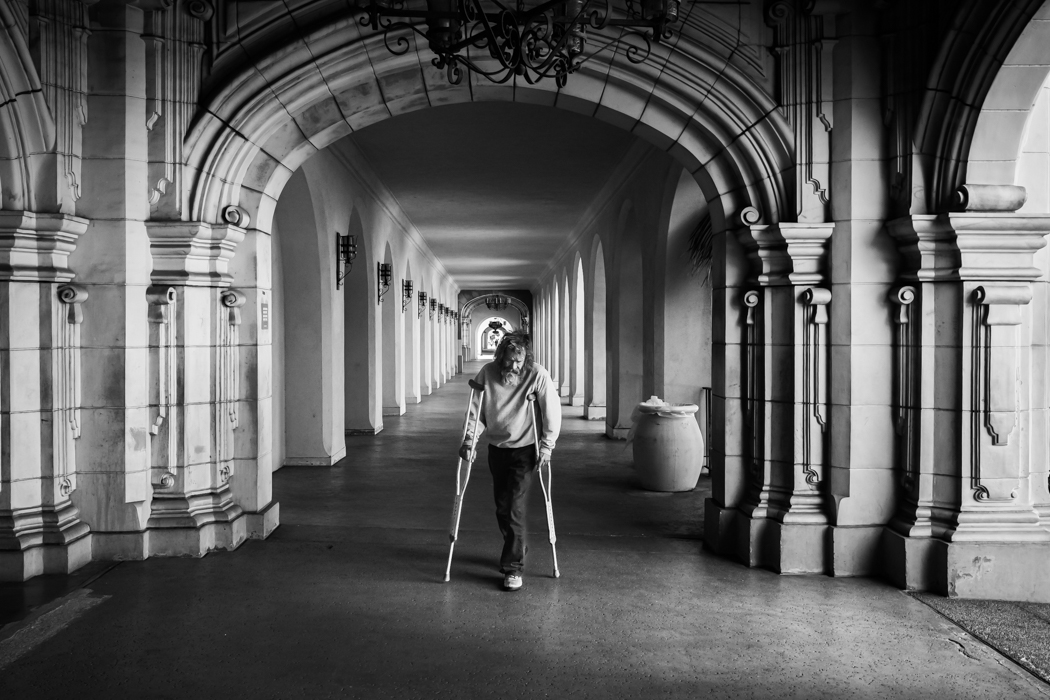
Leica M10-P, CV 28mm f/2 Ultron, f/8, 125 sec, ISO 1600
On Wednesday afternoons I teach a lab class on gemology and gem cutting. This is held in the faceting lab at the San Diego Gem and Mineral Club at Spanish Village in Balboa Park. The park is beautiful, popular, and so I though would offer a lot of photographic opportunity. I went about 45 minutes early so I could take a walk around some areas in the Park. I chose the walking area where all the museums are for today.
I set some new rules for myself today. A Bill Maher move for sure.
Today I would take only one lens on the walk. I chose my CV 28mm f/2 Ultron. This is the easiest lens I have to shoot. It has a tab on the focus ring to estimate focus without looking. It has been productive for me so far.
Stopping and staking out a scene waiting for someone to walk into it was out. I had to keep walking and shoot what I ran into. This was to force me to react, and properly estimate the scene quickly to get a shot.
Visually focusing was not allowed. I had to estimate the distance and set the zone focus by the tab position.
Then I had to just bring the camera to my eye and take the image.
I would set aperture, but leave both shutter speed, and ISO, up to the camera by setting these to "A" to get a good exposure. I tend to concentrate on developing one skill at a time until I get good with it.
When I saw this guy coming down the long walk through the arches, I hoped for a good opportunity. We kept walking towards each other. As the distance changed I kept adjusting the focus tab slightly. When he was about to come out of the shadow and into the light, I raise the camera to my eye, composed and shot. I never even looked at focus when shooting. It was all happening too fast. Interestingly we never acknowledged each other as we passed. I am not sure if he was even aware I took the picture. Most people bust me when I do.
I had set the aperture high enough (f/8) to give me what I hoped was a depth of field deep enough to ensure success. Why make it harder than it has to be.
Below, is the image I got. I thing I should have waited another half a step. He would have been more in the light, and more centered in the arches. But, I am happy with how it came out. Especially the learning aspect of it.
Enjoy,
-Steve-
Leica M10-P, CV 28mm f/2 Ultron, f/8, 125 sec, ISO 1600
Mar 02, 2022 at 09:06 PM
p.9 #20Learning Leica "M", a 30 day project
1bwana1 wrote:
Why make it harder than it has to be.
Imo, this is probably the part that many folks have the hardest time getting a grip on.
Guilty as charged, but once it finally "clicks" ... off to the races.
BTW, Balboa is definitely one of the (many) gems I miss about SD.
Why make it harder than it has to be.
Imo, this is probably the part that many folks have the hardest time getting a grip on.
Guilty as charged, but once it finally "clicks" ... off to the races.
BTW, Balboa is definitely one of the (many) gems I miss about SD.
Mar 02, 2022 at 09:30 PM