This topic is in the 2022 archive. You can read it and like its posts here. It is read only.
Archive 2022Learning Leica "M", a 30 day project

p.6 #1Learning Leica "M", a 30 day project
My advice is turn off the drive mode and learn to see and shoot in the moment. I never use it. That to takes a little practice but once mastered you will not turn it on again.
Feb 26, 2022 at 04:27 PM
p.6 #2Learning Leica "M", a 30 day project
RustyBug wrote:
When I entered Digital (after an hiatus), there really was mostly AF glass available for native EF mounts. I had never shot AF (back when Minolta introduced, I abstained). So, I spent a lot of time learning the foibles of AF, and wishing for the focusing system(s) of manual focus (ground glass, split prism, 100% silver mirror, etc).
Then, once I started adapting MF lenses onto DSLR, the AF system (mirror %, etc.) didn't support the process as well as an SLR did.
BUT, all the while ... I always had this "nagging" thought that "I used to shoot all manual" (with...Show more →
This echoes my experience. I had trouble adopting primitive AF in the day, and rather than converting to AF DSLR (which had lousy focusing screens and poor AF performance) or primitive digital (which had lousy focusing screens, poor AF performance AND poor resolution compared to film) I just stuck with film and manual bodies that were optimized for MF. I did everything manually -- from focusing to exposure guesstimation (I grew up on a camera that had a broken light meter). I learned to do things the old old school way, considering focus and exposure calculation all as part of image composition. One of the lessons that I learned was that there was a huge difference between images that were shot with what I think of as "proactive" focusing vs. "reactive" focusing. By "proactive" focusing I'm thinking of predictive focusing methods like hyperfocal distance and zone focusing, where you focus as part of the process of composition, anticipating an event that is about to occur, rather than trying to respond to an event that is already taking place, which I think of as being "reactive."
I took a long hiatus during the Dark Ages where film became less and less available, and digital just wasn't very good. When I finally decided to adopt digital I was more interested in a digital body performing as nothing more as a data back to capture a lens' rendering. I ignored all of the electronic gadgets that they had been adding to cameras. I found navigating the menus, controlling the camera, and the way that the designers thought about photography to be in conflict with my own ideas -- it was burdensome and distracting -- so I just turned everything off. I approached the digital camera body as if it were just a digitizing film back for my old Nikon F series cameras. I turned off all of the electronic gizmos, put the camera in M mode and focused just like I used to, and I never really adopted AF or all of the electronic gadgetry. I stuck with old MF lenses because of their longer focus throws and eventually found my way to using modern Zeiss MF lenses. By doing things this way (never completely adopting all of the electronic nonsense that's built into modern cameras) I don't feel like I ever "lost" the ability to focus or to do aperture calculations. I just kept on shooting the way I always had been shooting, maintained the necessary skills, and I didn't let the new style of cameras change me. (I honestly don't know if that is good or bad, but as more time passes and more and more people grow up in the era where cameras make all of the decisions, I'm thinking it was a good decision.)
Being so Old Old School, I'm just elated to follow Steve's progress as he casts aside much of the technical dependence on modern camera systems and rediscovers photography in it's pure form. To a great extent, I think that part of the wonder that he's experiencing can be attributed to prospectively seeing and composing the scene before the image is captured, rather than just reacting to a scene as it occurs with a camera that focuses and calculates exposure as it reacts technically to capture an event that as it occurs. To me at least, a large part of what I think of as the Leica experience amounts to seeing and understanding a scene, and composing the image before the moment of image capture, rather than just responding to an event by making all of the technical decisions that are necessary for snapping a photo to freeze an image in time.
My understanding of what many people describe as the "Leica experience" involves a return to the roots of photography. Maybe I'm right on that, or maybe I'm wrong. I'm following this thread to see if following Steve's experience agrees with my own idea. At this point I think that my Zeiss experience (MF lenses on a fully manual camera body) is very similar to his Leica experience, with the main difference between our approaches being the difference in how RF vs. SLR viewing effects composition. I haven't quite wrapped my mind around that yet, so I'm really enjoying following Steve in this thread.
Thanks to all.
When I entered Digital (after an hiatus), there really was mostly AF glass available for native EF mounts. I had never shot AF (back when Minolta introduced, I abstained). So, I spent a lot of time learning the foibles of AF, and wishing for the focusing system(s) of manual focus (ground glass, split prism, 100% silver mirror, etc).
Then, once I started adapting MF lenses onto DSLR, the AF system (mirror %, etc.) didn't support the process as well as an SLR did.
BUT, all the while ... I always had this "nagging" thought that "I used to shoot all manual" (with...Show more →

This echoes my experience. I had trouble adopting primitive AF in the day, and rather than converting to AF DSLR (which had lousy focusing screens and poor AF performance) or primitive digital (which had lousy focusing screens, poor AF performance AND poor resolution compared to film) I just stuck with film and manual bodies that were optimized for MF. I did everything manually -- from focusing to exposure guesstimation (I grew up on a camera that had a broken light meter). I learned to do things the old old school way, considering focus and exposure calculation all as part of image composition. One of the lessons that I learned was that there was a huge difference between images that were shot with what I think of as "proactive" focusing vs. "reactive" focusing. By "proactive" focusing I'm thinking of predictive focusing methods like hyperfocal distance and zone focusing, where you focus as part of the process of composition, anticipating an event that is about to occur, rather than trying to respond to an event that is already taking place, which I think of as being "reactive."
I took a long hiatus during the Dark Ages where film became less and less available, and digital just wasn't very good. When I finally decided to adopt digital I was more interested in a digital body performing as nothing more as a data back to capture a lens' rendering. I ignored all of the electronic gadgets that they had been adding to cameras. I found navigating the menus, controlling the camera, and the way that the designers thought about photography to be in conflict with my own ideas -- it was burdensome and distracting -- so I just turned everything off. I approached the digital camera body as if it were just a digitizing film back for my old Nikon F series cameras. I turned off all of the electronic gizmos, put the camera in M mode and focused just like I used to, and I never really adopted AF or all of the electronic gadgetry. I stuck with old MF lenses because of their longer focus throws and eventually found my way to using modern Zeiss MF lenses. By doing things this way (never completely adopting all of the electronic nonsense that's built into modern cameras) I don't feel like I ever "lost" the ability to focus or to do aperture calculations. I just kept on shooting the way I always had been shooting, maintained the necessary skills, and I didn't let the new style of cameras change me. (I honestly don't know if that is good or bad, but as more time passes and more and more people grow up in the era where cameras make all of the decisions, I'm thinking it was a good decision.)
Being so Old Old School, I'm just elated to follow Steve's progress as he casts aside much of the technical dependence on modern camera systems and rediscovers photography in it's pure form. To a great extent, I think that part of the wonder that he's experiencing can be attributed to prospectively seeing and composing the scene before the image is captured, rather than just reacting to a scene as it occurs with a camera that focuses and calculates exposure as it reacts technically to capture an event that as it occurs. To me at least, a large part of what I think of as the Leica experience amounts to seeing and understanding a scene, and composing the image before the moment of image capture, rather than just responding to an event by making all of the technical decisions that are necessary for snapping a photo to freeze an image in time.
My understanding of what many people describe as the "Leica experience" involves a return to the roots of photography. Maybe I'm right on that, or maybe I'm wrong. I'm following this thread to see if following Steve's experience agrees with my own idea. At this point I think that my Zeiss experience (MF lenses on a fully manual camera body) is very similar to his Leica experience, with the main difference between our approaches being the difference in how RF vs. SLR viewing effects composition. I haven't quite wrapped my mind around that yet, so I'm really enjoying following Steve in this thread.
Thanks to all.
Feb 26, 2022 at 05:07 PM
p.6 #3Learning Leica "M", a 30 day project
1bwana1 wrote:
Day 8 Image:
I hope those of you following this thread don't mind that I am spending time explaining how the images came about.
Steve, keep up the great work. For me, following your explanations of how you composed the images is the best part of this thread. It's why I'm here.
Day 8 Image:
I hope those of you following this thread don't mind that I am spending time explaining how the images came about.
Steve, keep up the great work. For me, following your explanations of how you composed the images is the best part of this thread. It's why I'm here.
Feb 26, 2022 at 05:14 PM
p.6 #4Learning Leica "M", a 30 day project
My first Leica was a Q2, but the M is a totally different ball game. I think you can master the RF in weeks but it took me over a year to gain the confidence to shoot my m10-p on assignments. And until you're confident enough to shoot a camera, you have not truly mastered it yet.
Feb 26, 2022 at 05:38 PM
p.6 #5Learning Leica "M", a 30 day project
nana kofi wrote:
My first Leica was a Q2, but the M is a totally different ball game. I think you can master the RF in weeks but it took me over a year to gain the confidence to shoot my m10-p on assignments. And until you're confident enough to shoot a camera, you have not truly mastered it yet.
Habari Bwana Kofi. Karibu kwenye tukio langu!!!!
Being from Ghana I know you probably don't speak Kiswahili, But I thought that since you say you work all across Africa there is a possibility.
In any case, I am happy you are watching this thread and enjoying. Please feel free to contribute.
Steve
Feb 26, 2022 at 06:32 PM
p.6 #6Learning Leica "M", a 30 day project
Almost time for a real technical challenge to push your (quickly) growing skills. This one is for advanced and experienced Leica shooters. Failure is expected.
Try a shot each day, completely pre-visualised. That is; SS, aperture ISO and focus all set before you lift the camera to your eye. No cheating. Guess everything. When you get really good you can also guess the focal length and framing.
Doesn't have to be your shot of the day but a really good way to develop pre visualisation skills. One of the most advanced Leica skills of all. Once you get it you'll start doing things like changing your shutter speed when you walk into and out of shadows or when you walk indoors you'll adjust the aperture by feel. Served me well as a wedding shooter who had to change settings on the fly following a bride walking out of a church.
Actually, it's probably unfair to ask you to try this after just a week with the camera. But I have anyway...
Gordon
Feb 26, 2022 at 09:36 PM
p.6 #7Learning Leica "M", a 30 day project
Day 9 Image:
Here in San Diego we have what I call the "sunset season" that runs from Fall through February. There is a weather pattern where we get airflow from the North East (Santa Ana winds). This blows the normal coastal low clouds well off shore, and has a large dust component. As weather fronts from the Gulf of Alaska move down the coast, they are preceded by beautiful high wispy weather change cloud formations. This sets up perfect conditions for sunsets over the Pacific Ocean.
Today was one such day. So, as sunset time neared I went down to famous "Wind N Sea" beach to make an image with the Leica M10-P. I cannot count how many such sunset I have shot here in La Jolla. The process of doing so is familiar and pretty much guaranties good results. I normally put a nice, wide zoom lens on my Sony, try and find interesting foreground rocks, and exposure bracket to get detail in the foreground, and maximum color in the sky. The sunset is the focus of the shot. Using the zoom I try bunces of compositions. Each "shot" is actually three. So I end up with a ton of images. Post process involves significant culling, and work blending the images. Results are beautiful, and look nice hanging on a wall.
I wanted to try and do it differently this evening. Usually I am doing my best to find compositions with no people in them. If I can't then out comes the clone tool in post. For this shot I decided to try and tell the story of all the people who come down to watch these wonderful sunsets. I would use the actual sunset as just a backdrop for the story of the "watchers". Never have done that before. I credit the way the Leica has me seeing differently. It has reframed the focus of the work.
This evenings process went like this:
I set the composition by briefly experimenting with position and framing. I then put the camera on the tripod and stuck with this the whole evening. The composition was looking North towards the grass shack on the rocks. The goal was to position the environment, and the people to attractively tell the story of watching this sunset, and give it context in the environment. I set the camera as follows:
ISO to 100. Looking for best IQ at base ISO (for some reason it only goes to 200 ISO in Auto ISO?)
Aperture at f/8. Peak IQ for the lens.
Focus at Infinity
Shutter speed was changed to manage exposure as light levels changed.
Drive mode set to 2 Seconds delay to remove any camera shake.
All the work was done. In fact once set up i really didn't need to look through the camera again. I watched as the light, colors, and people changed. Then just click off an image when things looked interesting. Funny to say it this way, but I was paying full attention to the image, and almost zero attention to the camera. Most of the time I never even reviewed the image after a shot. Much like shooting film I guess, I felt like I had a good handle on the settings, and the composition. I could check the results when I developed the images. It was a very enjoyable experience. I think it resulted in an interesting mage as well.
Another bonus is I went home with far fewer images to go through. Post processing was also very minimal. Just a small final crop, and normal adjustments.
Did all of this give me a better image than the old way. Maybe, maybe not. But I like the image, and it has a different orientation, and purpose that it would have prior to this learning exercise.
Enjoy the image.
Steve
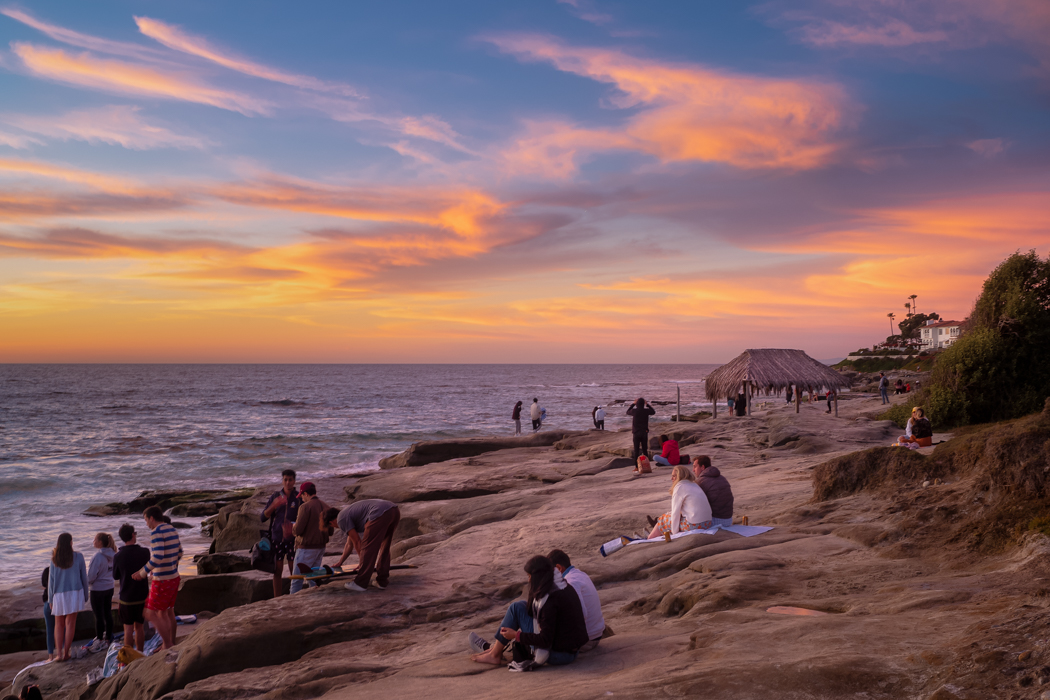
Here in San Diego we have what I call the "sunset season" that runs from Fall through February. There is a weather pattern where we get airflow from the North East (Santa Ana winds). This blows the normal coastal low clouds well off shore, and has a large dust component. As weather fronts from the Gulf of Alaska move down the coast, they are preceded by beautiful high wispy weather change cloud formations. This sets up perfect conditions for sunsets over the Pacific Ocean.
Today was one such day. So, as sunset time neared I went down to famous "Wind N Sea" beach to make an image with the Leica M10-P. I cannot count how many such sunset I have shot here in La Jolla. The process of doing so is familiar and pretty much guaranties good results. I normally put a nice, wide zoom lens on my Sony, try and find interesting foreground rocks, and exposure bracket to get detail in the foreground, and maximum color in the sky. The sunset is the focus of the shot. Using the zoom I try bunces of compositions. Each "shot" is actually three. So I end up with a ton of images. Post process involves significant culling, and work blending the images. Results are beautiful, and look nice hanging on a wall.
I wanted to try and do it differently this evening. Usually I am doing my best to find compositions with no people in them. If I can't then out comes the clone tool in post. For this shot I decided to try and tell the story of all the people who come down to watch these wonderful sunsets. I would use the actual sunset as just a backdrop for the story of the "watchers". Never have done that before. I credit the way the Leica has me seeing differently. It has reframed the focus of the work.
This evenings process went like this:
I set the composition by briefly experimenting with position and framing. I then put the camera on the tripod and stuck with this the whole evening. The composition was looking North towards the grass shack on the rocks. The goal was to position the environment, and the people to attractively tell the story of watching this sunset, and give it context in the environment. I set the camera as follows:
ISO to 100. Looking for best IQ at base ISO (for some reason it only goes to 200 ISO in Auto ISO?)
Aperture at f/8. Peak IQ for the lens.
Focus at Infinity
Shutter speed was changed to manage exposure as light levels changed.
Drive mode set to 2 Seconds delay to remove any camera shake.
All the work was done. In fact once set up i really didn't need to look through the camera again. I watched as the light, colors, and people changed. Then just click off an image when things looked interesting. Funny to say it this way, but I was paying full attention to the image, and almost zero attention to the camera. Most of the time I never even reviewed the image after a shot. Much like shooting film I guess, I felt like I had a good handle on the settings, and the composition. I could check the results when I developed the images. It was a very enjoyable experience. I think it resulted in an interesting mage as well.
Another bonus is I went home with far fewer images to go through. Post processing was also very minimal. Just a small final crop, and normal adjustments.
Did all of this give me a better image than the old way. Maybe, maybe not. But I like the image, and it has a different orientation, and purpose that it would have prior to this learning exercise.
Enjoy the image.
Steve
Feb 26, 2022 at 10:53 PM
p.6 #8Learning Leica "M", a 30 day project
This is another excellent result, Steve. I'm very happy to see a landscape/sunset scene that uses people to tell a story. IMO there are plenty of very impressive landscape/sunset images that focus on the exclusion of people. I think that it's a refreshing perspective to see people enjoying the sunset as part of your composition.
The colors are outstanding. Had you not told the story of how the image was composed, I would have assumed that you "cheated" by exaggerating the sunset in post. I hope you understand how lucky you are to live in a place where you get access to such wonderful subjects.
Would you mind posting the EXIF data? I'm thinking that this had to be a fairly long exposure, as I think I'm seeing some motion artifact in some of your models, which I kind of like as it reminds me of the realism that you're capturing in your images. Well done.
Feb 26, 2022 at 11:10 PM
p.6 #9Learning Leica "M", a 30 day project
coralnut wrote:
Would you mind posting the EXIF data? I'm thinking that this had to be a fairly long exposure, as I think I'm seeing some motion artifact in some of your models, which I kind of like as it reminds me of the realism that you're capturing in your images. Well done.
EXIF indicates 75mm at 1/8 second.
When you edited the image, did you feel DOF suitably covered the foreground? Just wondering if setting focus at infinity with a 75mm was the way to go? Setting focus based on hyperfocal distance might have improved foreground focus, given that's where a lot of the viewer's attention will be 'focused.' Of course it's also dependent on final image size and viewing distance. There's also the question of whether stopping down more for increased DOF outweighs the diffraction penalty.
Feb 26, 2022 at 11:19 PM
p.6 #10Learning Leica "M", a 30 day project
Edited on Feb 27, 2022 at 12:05 AM · View previous versions
Feb 27, 2022 at 12:02 AM
p.6 #11Learning Leica "M", a 30 day project
rscheffler wrote:
coralnut wrote
Would you mind posting the EXIF data? I'm thinking that this had to be a fairly long exposure, as I think I'm seeing some motion artifact in some of your models, which I kind of like as it reminds me of the realism that you're capturing in your images. Well done.When you edited the image, did you feel DOF suitably covered the foreground? Just wondering if setting focus at infinity with a 75mm was the way to go? Setting focus based on hyperfocal distance might have improved foreground focus, given that's where a lot of the viewer's attention will be 'focused.' Of course it's also dependent on final image size and viewing distance. There's also the question of whether stopping down more for increased DOF outweighs the diffraction penalty.
Sorry about the EXIF data guys. Like I posted earlier I have given up on it for now because it is never correct. I had played with my CV 75mm in the morning and set the lens manually in the camera. I didn't reset for this evenings shoot. I actually used my 28mm for this shot. Set to f/8 and infinity focus. Plenty of DOF for the shot. Shutter speed and ISO in the EXIF are probably correct because they are not lens dependant and the camera knows what they are.
Any softness in the people is probably due to movement with the slow shutter speed.
Feb 27, 2022 at 12:04 AM
p.6 #12Learning Leica "M", a 30 day project
If there's a question of whether or not hyperfocal distance focusing would render the foreground more sharp then one could do focus bracketing during image capture (or just a simple duplicate shot at HFD vs. a shot at infinity).
Whether or not that would be useful would depend on how big you want to print. For the size image that we're looking at here it's not necessary. OTOH for a wall print it might be relevant. But going up to a wall sized print would enhance recognition of subject movement due to the long exposure (such as the hand movement of the man standing near the lower left rule-of-thirds intersection).
If we want to be critical, we could object to something either way. I guess one could even make an argument that in an image like this the foreground needs to be in focus while infinity does not, because the clouds are already soft, and the palm trees and the white building aren't important enough in the image to demand sharp focus at infinity.
In the big scheme of things I don't think it matters. It's a very pleasing image either way. It has a very relaxing quality that I like.
Feb 27, 2022 at 01:42 AM
p.6 #13Learning Leica "M", a 30 day project
For the M10 the native base is 200 ISO. 100 is a pull.
Gordon
Gordon
Feb 27, 2022 at 03:52 AM
p.6 #14Learning Leica "M", a 30 day project
1bwana1 wrote:
EXIF indicates 75mm at 1/8 second.
When you edited the image, did you feel DOF suitably covered the foreground? Just wondering if setting focus at infinity with a 75mm was the way to go? Setting focus based on hyperfocal distance might have improved foreground focus, given that's where a lot of the viewer's attention will be 'focused.' Of course it's also dependent on final image size and viewing distance. There's also the question of whether stopping down more for increased DOF outweighs the diffraction penalty.Sorry about the EXIF data guys. Like I posted earlier I have given up on it for now because it is never correct. I had played with my CV 75mm in the morning and set the lens manually in the camera. I didn't reset for this evenings shoot. I actually used my 28mm for this shot. Set to f/8 and infinity focus. Plenty of DOF for the shot. Shutter speed and ISO in the EXIF are probably correct because they are not lens dependant and the camera knows what they are.
Any softness in the people is probably due to movement...Show more →
Steve, this is a really nice shot, but I think I do see a bit of movement blur in the foreground which is fine if that was what you wanted. For me I would have set the shutter speed at 1/60 to avoid most movement blur. To get the best IQ with a Leica M10 (or M10-P like you have) set it to ISO 200 (not 100), which is a pull like ISO 50 on your Sony which makes protecting highlights harder. I would with the 28 also stick to f/5.6 here but focus just shy of infinity. ISO 200 and f/5.6 still would not have gotten you to 1/60, so you would need to make a choice to open the aperture to f/4 or turn the ISO up to 400 (backing off the infinity focus a bit more for f/4), I probably would have tried some shots with a bit faster shutter speed as well.
This is all some food for thought as you approach such a scene. I like shooting my Leica M by just setting the apertures and ISO I would like and not thinking about exposure and thinking primarily about composition, but I find when the light is low in a shot like this I still need to think about exposure a fair bit and try out different exposure strategies. I like setting the exposure and forgetting it, but I don't find that really works when the light is this low. For me anyway. You did a good job here and I certainly wouldn't say your strategy wasn't a good one, but personally I would have played around with the exposure parameters on this shot quite a bit and I do so whenever the light is this low.
rscheffler wrote
coralnut wrote
Would you mind posting the EXIF data? I'm thinking that this had to be a fairly long exposure, as I think I'm seeing some motion artifact in some of your models, which I kind of like as it reminds me of the realism that you're capturing in your images. Well done.When you edited the image, did you feel DOF suitably covered the foreground? Just wondering if setting focus at infinity with a 75mm was the way to go? Setting focus based on hyperfocal distance might have improved foreground focus, given that's where a lot of the viewer's attention will be 'focused.' Of course it's also dependent on final image size and viewing distance. There's also the question of whether stopping down more for increased DOF outweighs the diffraction penalty.
Any softness in the people is probably due to movement...Show more →
Steve, this is a really nice shot, but I think I do see a bit of movement blur in the foreground which is fine if that was what you wanted. For me I would have set the shutter speed at 1/60 to avoid most movement blur. To get the best IQ with a Leica M10 (or M10-P like you have) set it to ISO 200 (not 100), which is a pull like ISO 50 on your Sony which makes protecting highlights harder. I would with the 28 also stick to f/5.6 here but focus just shy of infinity. ISO 200 and f/5.6 still would not have gotten you to 1/60, so you would need to make a choice to open the aperture to f/4 or turn the ISO up to 400 (backing off the infinity focus a bit more for f/4), I probably would have tried some shots with a bit faster shutter speed as well.
This is all some food for thought as you approach such a scene. I like shooting my Leica M by just setting the apertures and ISO I would like and not thinking about exposure and thinking primarily about composition, but I find when the light is low in a shot like this I still need to think about exposure a fair bit and try out different exposure strategies. I like setting the exposure and forgetting it, but I don't find that really works when the light is this low. For me anyway. You did a good job here and I certainly wouldn't say your strategy wasn't a good one, but personally I would have played around with the exposure parameters on this shot quite a bit and I do so whenever the light is this low.
Feb 27, 2022 at 05:54 AM
p.6 #15Learning Leica "M", a 30 day project
I think it's a beautiful image Steve! I like the people in the shot. So many pictures nowadays are not even pictures but more like digital art with so much post processing. I used to live in SD (Point Loma), so seeing your pictures brings back memories. La Jolla is like a fantasy - I always loved going there.
Feb 27, 2022 at 06:55 AM
p.6 #16Learning Leica "M", a 30 day project
Thanks to all of who commented on this latest image. Many great suggestions, an I learned some things from them. As always, that is very much appreciated.
First I learned that base ISO is 200 not 100. I won't make that mistake again. Thanks for that!
Like I said I was purposely not reviewing the image on the rear screen when shooting. When I started shooting the scene the proper exposure was at 1/90 sec, so no motion blur in those shots. These are also interesting images, with good people content, and nice soft wispy skies. They of course lack the color of the image I settled on. As the sun set and the light levels dropped, I chased the exposure by lowering the shutter speed. I probably would have been better off leaving the shutter speed higher and once I got to a minimum speed adjusted with a combination of ISO, and aperture. I don't think the image would have suffer much all the way up ISO 1600 or so. I also feel that DOF would have been fine at f/5.6. where the lens IQ is also excellent.
I of course I do have the means to produce an image with the best of both solutions using time blending. I could use a people image from earlier, and blend in the sky from later. This is a technique I have used for a number of situations in the past. There is nothing wrong with that in my opinion. However, I feel that doing so would not be in keeping with the intent of this thread. I wanted a single exposure to learn from. If I were making an image to print large I may do a blended image. On the other had I have some frames shot at even lower shutter speeds with some big motion blur. I almost choose one of those, because there is something about the blur that says something I like.
In the end I like the image. I like the colors and textures in the sky, the position and gesture of the people. I think it does tell the visual story as intended. The slight motion blur doesn't bother me much, in fact I almost like it. It accurately reflects the environment of the evening.
The most important thing is that making this image, and all of your generous efforts to post constructive comments does contribute to the most important thing. It serves as a learning tool for me, and hopefully others following this thread. I thank you all for that!
Today I am meeting some friends at a vineyard up in Ramona around noon. This winery has a large sculpture collection on display. I will of course be wearing the Leica looking for opportunity for today's image.
-Steve-
Feb 27, 2022 at 10:31 AM
p.6 #17Learning Leica "M", a 30 day project
Further pursuing this image as a topic I have decided to post a Straight Out Of Camera (similar crop only) image taken a few minutes later.
This the actual exposure, nothing done to it. This was my second choice. As you can see the sensor of the M10-P captures the colors in the sky beautifully. No need to touch them in post. I prefered this later color palette as it turned more pink than yellow. This should confirm that no tricks were done with the sky. I also prefer the position and gesture of the people, especially the standing guy with the surfboard. I also like the flight of Pelicans which is what I was trying to time this shot to position. Their blurry wings are nice in my view. They add to the story.
Yes there is a significant amount of motion blur in the image. But maybe that is also better in a "in for a Nickel, in for a Dollar sort of way". Make the commitment. To accent that I would probably keep the rocks/people a little underexposed and for sure less sharpened. It adds to the mood.
Maybe this should have been my firs choice.
Looking forward to your thoughts on this.....
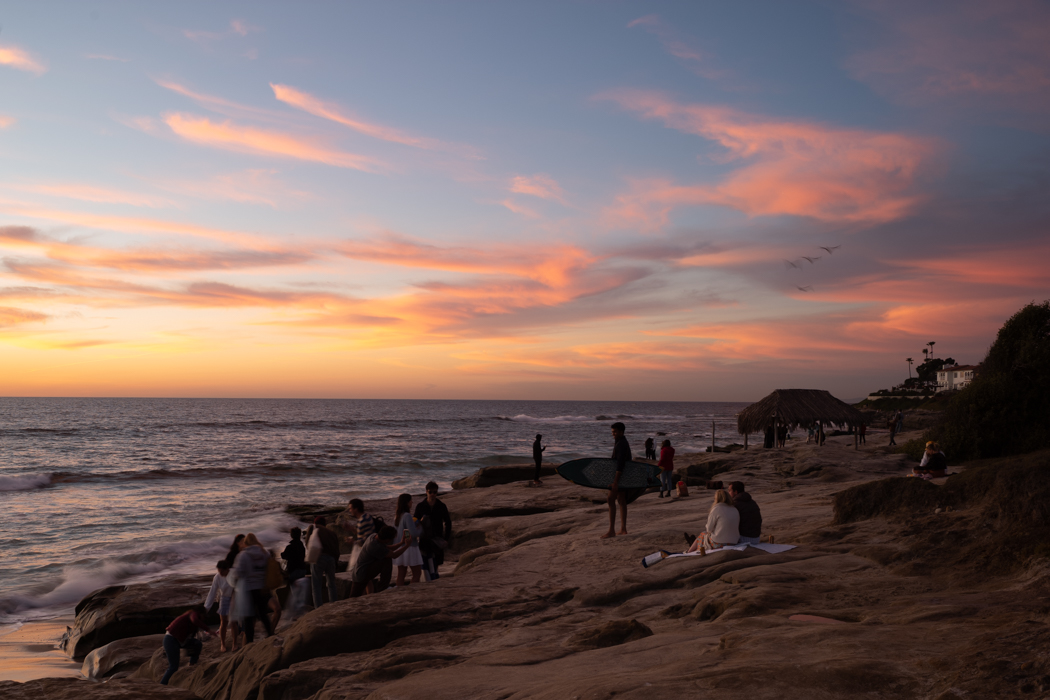
This the actual exposure, nothing done to it. This was my second choice. As you can see the sensor of the M10-P captures the colors in the sky beautifully. No need to touch them in post. I prefered this later color palette as it turned more pink than yellow. This should confirm that no tricks were done with the sky. I also prefer the position and gesture of the people, especially the standing guy with the surfboard. I also like the flight of Pelicans which is what I was trying to time this shot to position. Their blurry wings are nice in my view. They add to the story.
Yes there is a significant amount of motion blur in the image. But maybe that is also better in a "in for a Nickel, in for a Dollar sort of way". Make the commitment. To accent that I would probably keep the rocks/people a little underexposed and for sure less sharpened. It adds to the mood.
Maybe this should have been my firs choice.
Looking forward to your thoughts on this.....
Feb 27, 2022 at 11:08 AM
p.6 #18Learning Leica "M", a 30 day project
I prefer the horizon line not cutting the frame in half as it is in the original Also prefer this overall image over the original as well as liking it a lot. (the birds are just icing on the cake)
Feb 27, 2022 at 11:25 AM
p.6 #19Learning Leica "M", a 30 day project
1bwana1 wrote:
It adds to the mood.
Maybe this should have been my firs choice.
Looking forward to your thoughts on this.....
Having sat there (many years ago), I can relate.
I used to hang out at Sunset Cliffs, too (closer to Point Loma / SD / CV / IB). I could just sit there with my camera for hours ... as the light faded from late afternoon, through sunset into twilight looking at the cliff's, people, water, sky and up the coastline. I might only snap 3 or 4 shots (shooting chrome) or sometimes even none, while slowly embracing the changing light over a period of hours. I recall how my eyes would accommodate over time, then I suddenly realize just how dark it had become. It always felt like I could hang there all night.
I mention that to bring in the point of our ability to choose to capture / convey anything from a "recording" to a "rendering". A variety ways of saying it, but "Here's what I want you to be able to see." may be different from "Here's what I want to convey to you."
Each (et al) has their place, so I tend to let my intent guide my capture / processing. In the case of your two renderings ... I can "feel" the coolness of the evening setting in, with the darker FG, as in the experience of being there. Of course, I have the vantage point of actually having been there ... but, the main point being that convey a mood and recording the data can indeed be two different things.
Sometimes, we already know what it is we want to convey before we press the shutter. But, even if we don't have it THAT much thought through at capture (i.e. intuitive response vs. cognitive approach) ... when we go to process (imo) we might pause to consider mood / presence vs. facts / information as our goal(s) for the image. Then proceed to process accordingly to your goal for the message you want to convey.
One says to me: "Hey, look at all the people hanging out at sunset."
The other says to me: "It's that time of day when things are gettin' quiet and peaceful. Everybody's windin' down."
This last one reminds of hangin' out with friends in the dunes of Daytona Beach, even though it is a different location.
Again, depends on what it is YOU want to convey. How you choose to illuminate it, your call. Interestingly (to me), the same capture of a given moment in time can offer multiple perspectives for intent to be conveyed. So, it can be natural to have the dilemma of which it is that you want to convey. My .02 would be somewhere between the two, leaning toward the darker (and surfer), with a slight FG reveal.
Your pic, your message, your call.
They both work.
Feb 27, 2022 at 12:14 PM
p.6 #20Learning Leica "M", a 30 day project
Hi Steve, thanks for the added info. I kind of thought it was a bit wide looking for 75 and my initial thought was you used 50... At least from my experience with these kinds of scenes with 50mm and longer lenses, when there's potentially interesting subject content nearer, I'll try to keep it within DOF. Since you used a 28, DOF at f/8 certainly will be deep enough for this image. I also don't mind some motion blur in the people and water. That said, I actually prefer the foreground composition of the first image. The nearer seated couple have gone and the group of people at bottom left are all lumped together in the second image.
If you're still having problems with setting lens codes, maybe just turn it off? Not sure how much this would affect edge color corrections for the 28 but shouldn't make a significant difference when using the 50 or 75.
If you're still having problems with setting lens codes, maybe just turn it off? Not sure how much this would affect edge color corrections for the 28 but shouldn't make a significant difference when using the 50 or 75.
Feb 27, 2022 at 02:22 PM