This topic is in the 2020 archive. You can read it and like its posts here. It is read only.
Archive 2020R5 stills overheating
p.8 #1R5 stills overheating
Jesse Evans wrote:
Not trying to be argumentative, but the latest high-end Intel Core i9 Extreme CPU has a max temperature limit of 86c. The chip physically turns off at 86c to prevent damage. Prior generation Intel processors were thermal limited to the low 90's.
https://ark.intel.com/content/www/us/en/ark/products/198017/intel-core-i9-10980xe-extreme-edition-processor-24-75m-cache-3-00-ghz.htmlThanks for confirming--I thought I was going crazy over here!Those are high end desktop / workstation chips. You can see that the CPUs frequently run at 95+C regularly in MacBooks.
You are comparing liquid / large air hsf cooled chips with laptop chips which are designed to overheat and then throttle regularly.Keep in mind those Intel/AMD CPU temps are internally measured within the chip, whereas the temp reported by Canon in the EXIF is likely an internal-chamber ambient, so the two temps likely aren't comparable (ie, the CPU temp is much higher than even the immediate ambient area around it).There is no substance to that claim of where the temperature is being measured from. Canons DIGIC processors are based on ARM designs which also include internal thermal monitoring. Nobody knows from where that temperature is being pulled. Since it’s 76c at times, it is much more likely measured internal to the chip and not an air temperature surrounding it.
The Canon firmware refers to the temperature sensor as "EFIC temp" (source). Canon's documentation for the 1DM3 (during a time when Canon was more forthcoming with their technical marketing info) refers to the EFIC as a dedicated chip for handling the interface to the lens and speedlite and states it's located on the camera control board, separate from the DIGIC which is also described in the same reference (source, page #33). Presuming this arrangement hasn't changed in subsequent bodies this implies the temperature sensor is not measuring DIGIC or the image sensor.
snapsy wrote
Jesse Evans wrote
lw235 wrote
John_TX wrote
Jesse Evans wrote
That is actually not very hot for CPU. Macbooks routinely run at 100c.https://ark.intel.com/content/www/us/en/ark/products/198017/intel-core-i9-10980xe-extreme-edition-processor-24-75m-cache-3-00-ghz.html
You are comparing liquid / large air hsf cooled chips with laptop chips which are designed to overheat and then throttle regularly.
The Canon firmware refers to the temperature sensor as "EFIC temp" (source). Canon's documentation for the 1DM3 (during a time when Canon was more forthcoming with their technical marketing info) refers to the EFIC as a dedicated chip for handling the interface to the lens and speedlite and states it's located on the camera control board, separate from the DIGIC which is also described in the same reference (source, page #33). Presuming this arrangement hasn't changed in subsequent bodies this implies the temperature sensor is not measuring DIGIC or the image sensor.
Aug 04, 2020 at 03:40 PM
p.8 #2R5 stills overheating
Usually cpu temperatures are measured in the cpu socket and the internally on each core. But these temperature nodes are not that exact, they can vary up to +- three degrees C in precision.
/ Magnus
/ Magnus
Aug 04, 2020 at 03:43 PM
p.8 #3R5 stills overheating
EB-1 wrote:
Exactly. If the air were 76°C, the CPU would be fried without throttling.
However, there may be more than one temperature measurement and/or there is a high value for hysteresis that explains why it takes so long to reset.
EBH
The fact the R5 refuses to shoot video even after being powered off for minutes after reaching its thermal limit might argue the camera is using an indirect temperature sampling to establish temps of critical components (DIGIC especially). For example, an Intel/AMD CPU transitioning from full-load to idle can drop by 30C or more in the matter of seconds - I presume the same would be true for a load-dependent processing-intensive chip like DIGIC. In contrast, an ambient or at least DIGIC-removed PCB temp sampling would taper much more slowly. That said, they might also be using a empirically-derived heuristic based on a DIGIC-sampled temp that assumes a base+load temperature range - for example, if they sample the chip at relative idle at 55C, presume the temp would rise to 75C under load. That would require the DIGIC to reach its steady-state idle temp rather quickly for the camera to immediately know that video isn't possible immediately after powering up the camera after a previous thermal-limit load.
Jesse Evans wrote
There is no substance to that claim of where the temperature is being measured from. Canons DIGIC processors are based on ARM designs which also include internal thermal monitoring. Nobody knows from where that temperature is being pulled. Since it’s 76c at times, it is much more likely measured internal to the chip and not an air temperature surrounding it.However, there may be more than one temperature measurement and/or there is a high value for hysteresis that explains why it takes so long to reset.
EBH
The fact the R5 refuses to shoot video even after being powered off for minutes after reaching its thermal limit might argue the camera is using an indirect temperature sampling to establish temps of critical components (DIGIC especially). For example, an Intel/AMD CPU transitioning from full-load to idle can drop by 30C or more in the matter of seconds - I presume the same would be true for a load-dependent processing-intensive chip like DIGIC. In contrast, an ambient or at least DIGIC-removed PCB temp sampling would taper much more slowly. That said, they might also be using a empirically-derived heuristic based on a DIGIC-sampled temp that assumes a base+load temperature range - for example, if they sample the chip at relative idle at 55C, presume the temp would rise to 75C under load. That would require the DIGIC to reach its steady-state idle temp rather quickly for the camera to immediately know that video isn't possible immediately after powering up the camera after a previous thermal-limit load.
Aug 04, 2020 at 04:09 PM
p.8 #4R5 stills overheating
snapsy wrote:
https://ark.intel.com/content/www/us/en/ark/products/198017/intel-core-i9-10980xe-extreme-edition-processor-24-75m-cache-3-00-ghz.htmlThanks for confirming--I thought I was going crazy over here!Those are high end desktop / workstation chips. You can see that the CPUs frequently run at 95+C regularly in MacBooks.
You are comparing liquid / large air hsf cooled chips with laptop chips which are designed to overheat and then throttle regularly.Keep in mind those Intel/AMD CPU temps are internally measured within the chip, whereas the temp reported by Canon in the EXIF is likely an internal-chamber ambient, so the two temps likely aren't comparable (ie, the CPU temp is much higher than even the immediate ambient area around it).There is no substance to that claim of where the temperature is being measured from. Canons DIGIC processors are based on ARM designs which also include internal thermal monitoring. Nobody knows from where that temperature is being pulled. Since it’s 76c at times, it is much more likely measured internal to the chip and not an air temperature surrounding it.The Canon firmware refers to the temperature sensor as "EFIC temp" (source). Canon's documentation for the 1DM3 (during a time when Canon was more forthcoming with their technical marketing info) refers to the EFIC as a dedicated chip for handling the interface to the lens and speedlite and states it's located on the camera control board, separate from the DIGIC which is also described in the same reference (source, page #33). Presuming this arrangement hasn't changed in subsequent bodies this implies the temperature sensor is not measuring DIGIC or the image sensor.
Thanks, that is useful information. It still leaves lots of information yet TBD. As the magic lantern thread discusses, the efic_temp the temperature is read from, it doesn't tell us what sensor is used to generate the temperature from which the number is sampled. Additionally, later on in the thread they discuss the disparity in temperatures vs readings, as well as finding additional temperature sensors, as well as a disparity between efic_temp and the exif temperature recording.
Additionally, the EFIC is for the EF interface, likely a different set up is being used for the RF mount since the lens controller is not the same as with the 1DX III which is EF.
Jesse Evans wrote
snapsy wrote
Jesse Evans wrote
lw235 wrote
John_TX wrote
Not trying to be argumentative, but the latest high-end Intel Core i9 Extreme CPU has a max temperature limit of 86c. The chip physically turns off at 86c to prevent damage. Prior generation Intel processors were thermal limited to the low 90's.https://ark.intel.com/content/www/us/en/ark/products/198017/intel-core-i9-10980xe-extreme-edition-processor-24-75m-cache-3-00-ghz.html
You are comparing liquid / large air hsf cooled chips with laptop chips which are designed to overheat and then throttle regularly.
Thanks, that is useful information. It still leaves lots of information yet TBD. As the magic lantern thread discusses, the efic_temp the temperature is read from, it doesn't tell us what sensor is used to generate the temperature from which the number is sampled. Additionally, later on in the thread they discuss the disparity in temperatures vs readings, as well as finding additional temperature sensors, as well as a disparity between efic_temp and the exif temperature recording.
Additionally, the EFIC is for the EF interface, likely a different set up is being used for the RF mount since the lens controller is not the same as with the 1DX III which is EF.
Aug 04, 2020 at 04:10 PM
p.8 #5R5 stills overheating
snapsy wrote:
Exactly. If the air were 76°C, the CPU would be fried without throttling.
However, there may be more than one temperature measurement and/or there is a high value for hysteresis that explains why it takes so long to reset.
EBHThe fact the R5 refuses to shoot video even after being powered off for minutes after reaching its thermal limit might argue the camera is using an indirect temperature sampling to establish temps of critical components (DIGIC especially). For example, an Intel/AMD CPU transitioning from full-load to idle can drop by 30C or more in the matter of seconds - I presume the same would be true for a load-dependent processing-intensive chip like DIGIC. In contrast, an ambient or at least DIGIC-removed PCB temp sampling would taper much more slowly. That said, they might also be using a empirically-derived heuristic...Show more →
Given that numerous people have confirmed:
1. Cooldown time is consistent no matter the methods used (leave closed up, open all bay doors and remove lens, put in fridge, attach ice packs) have no change on the cooldown rate.
2. The cooldown rate is absurdly long for such a small device.
3. When "overheating" while shooting 4k HQ or 8k video that the battery, back panel underneath the LCD, inside the battery compartment, anywhere they could find, was cool or barely warm to the touch.
It is highly likely that the system is designed such that there is software at play that limits record times regardless of the cooldown state of the camera.
EB-1 wrote
Jesse Evans wrote
There is no substance to that claim of where the temperature is being measured from. Canons DIGIC processors are based on ARM designs which also include internal thermal monitoring. Nobody knows from where that temperature is being pulled. Since it’s 76c at times, it is much more likely measured internal to the chip and not an air temperature surrounding it.However, there may be more than one temperature measurement and/or there is a high value for hysteresis that explains why it takes so long to reset.
EBH
Given that numerous people have confirmed:
1. Cooldown time is consistent no matter the methods used (leave closed up, open all bay doors and remove lens, put in fridge, attach ice packs) have no change on the cooldown rate.
2. The cooldown rate is absurdly long for such a small device.
3. When "overheating" while shooting 4k HQ or 8k video that the battery, back panel underneath the LCD, inside the battery compartment, anywhere they could find, was cool or barely warm to the touch.
It is highly likely that the system is designed such that there is software at play that limits record times regardless of the cooldown state of the camera.
Aug 04, 2020 at 04:17 PM
p.8 #6R5 stills overheating
Jesse Evans wrote:
Exactly. If the air were 76°C, the CPU would be fried without throttling.
However, there may be more than one temperature measurement and/or there is a high value for hysteresis that explains why it takes so long to reset.
EBHThe fact the R5 refuses to shoot video even after being powered off for minutes after reaching its thermal limit might argue the camera is using an indirect temperature sampling to establish temps of critical components (DIGIC especially). For example, an Intel/AMD CPU transitioning from full-load to idle can drop by 30C or more in the matter of seconds - I presume the same would be true for a load-dependent processing-intensive chip like DIGIC. In contrast, an ambient or at least DIGIC-removed PCB temp sampling would taper much more slowly. That said, they might also be using a empirically-derived heuristic based on a DIGIC-sampled temp that assumes a base+load temperature range - for example, if they sample the chip at relative idle at 55C, presume the temp would rise to 75C under load. That would require the DIGIC to reach its steady-state idle temp rather quickly for the camera to immediately know that video isn't possible immediately after powering up the camera after a previous thermal-limit load.Given that numerous people have confirmed:
1. Cooldown time is consistent no matter the methods used (leave closed up, open all bay doors and remove lens, put in fridge, attach ice packs) have no change on the cooldown rate.
2. The cooldown rate is absurdly long for such a small device.
3. When "overheating" while shooting 4k HQ or 8k video that the battery, back panel underneath the LCD, inside the battery compartment, anywhere they could find, was cool or barely warm to the touch.
It is highly likely that the system is designed such that there is software at play that limits...Show more →
The battery appears well isolated from the internal camera heat - that's likely by design since Li-ion doesn't respond well to extreme temperatures. But the camera gets unmistakably warm during video recording even before shutting off. For example, Dan Watson measured a surface temp of 122.9F (50.5C) on the R5's rear body panel while recording video (video link, starts at 10:38):
https://photos.smugmug.com/photos/i-XQ9965k/0/d6215f87/L/i-XQ9965k-L.jpg
snapsy wrote
EB-1 wrote
Jesse Evans wrote
There is no substance to that claim of where the temperature is being measured from. Canons DIGIC processors are based on ARM designs which also include internal thermal monitoring. Nobody knows from where that temperature is being pulled. Since it’s 76c at times, it is much more likely measured internal to the chip and not an air temperature surrounding it.However, there may be more than one temperature measurement and/or there is a high value for hysteresis that explains why it takes so long to reset.
EBH
1. Cooldown time is consistent no matter the methods used (leave closed up, open all bay doors and remove lens, put in fridge, attach ice packs) have no change on the cooldown rate.
2. The cooldown rate is absurdly long for such a small device.
3. When "overheating" while shooting 4k HQ or 8k video that the battery, back panel underneath the LCD, inside the battery compartment, anywhere they could find, was cool or barely warm to the touch.
It is highly likely that the system is designed such that there is software at play that limits...Show more →
The battery appears well isolated from the internal camera heat - that's likely by design since Li-ion doesn't respond well to extreme temperatures. But the camera gets unmistakably warm during video recording even before shutting off. For example, Dan Watson measured a surface temp of 122.9F (50.5C) on the R5's rear body panel while recording video (video link, starts at 10:38):
https://photos.smugmug.com/photos/i-XQ9965k/0/d6215f87/L/i-XQ9965k-L.jpg
Aug 04, 2020 at 04:25 PM
p.8 #7R5 stills overheating
Jesse Evans wrote:
Exactly. If the air were 76°C, the CPU would be fried without throttling.
However, there may be more than one temperature measurement and/or there is a high value for hysteresis that explains why it takes so long to reset.
EBHThe fact the R5 refuses to shoot video even after being powered off for minutes after reaching its thermal limit might argue the camera is using an indirect temperature sampling to establish temps of critical components (DIGIC especially). For example, an Intel/AMD CPU transitioning from full-load to idle can drop by 30C or more in the matter of seconds - I presume the same would be true for a load-dependent processing-intensive chip like DIGIC. In contrast, an ambient or at least DIGIC-removed PCB temp sampling would taper much more slowly. That said, they might also be using a empirically-derived heuristic based on a DIGIC-sampled temp that assumes a base+load temperature range - for example, if they sample the chip at relative idle at 55C, presume the temp would rise to 75C under load. That would require the DIGIC to reach its steady-state idle temp rather quickly for the camera to immediately know that video isn't possible immediately after powering up the camera after a previous thermal-limit load.Given that numerous people have confirmed:
1. Cooldown time is consistent no matter the methods used (leave closed up, open all bay doors and remove lens, put in fridge, attach ice packs) have no change on the cooldown rate.
2. The cooldown rate is absurdly long for such a small device.
3. When "overheating" while shooting 4k HQ or 8k video that the battery, back panel underneath the LCD, inside the battery compartment, anywhere they could find, was cool or barely warm to the touch.
It is highly likely that the system is designed such that there is software at play that limits...Show more →
Or the boards are so close together to almost form a chamber of which heat cannot escape. This temp sensor would then be able to measure this envelope of air/heat, and also could explain why all these attempts have failed in getting the temps down faster.
snapsy wrote
EB-1 wrote
Jesse Evans wrote
There is no substance to that claim of where the temperature is being measured from. Canons DIGIC processors are based on ARM designs which also include internal thermal monitoring. Nobody knows from where that temperature is being pulled. Since it’s 76c at times, it is much more likely measured internal to the chip and not an air temperature surrounding it.However, there may be more than one temperature measurement and/or there is a high value for hysteresis that explains why it takes so long to reset.
EBH
1. Cooldown time is consistent no matter the methods used (leave closed up, open all bay doors and remove lens, put in fridge, attach ice packs) have no change on the cooldown rate.
2. The cooldown rate is absurdly long for such a small device.
3. When "overheating" while shooting 4k HQ or 8k video that the battery, back panel underneath the LCD, inside the battery compartment, anywhere they could find, was cool or barely warm to the touch.
It is highly likely that the system is designed such that there is software at play that limits...Show more →
Or the boards are so close together to almost form a chamber of which heat cannot escape. This temp sensor would then be able to measure this envelope of air/heat, and also could explain why all these attempts have failed in getting the temps down faster.
Aug 04, 2020 at 04:29 PM
p.8 #8R5 stills overheating
snapsy wrote:
Exactly. If the air were 76°C, the CPU would be fried without throttling.
However, there may be more than one temperature measurement and/or there is a high value for hysteresis that explains why it takes so long to reset.
EBHThe fact the R5 refuses to shoot video even after being powered off for minutes after reaching its thermal limit might argue the camera is using an indirect temperature sampling to establish temps of critical components (DIGIC especially). For example, an Intel/AMD CPU transitioning from full-load to idle can drop by 30C or more in the matter of seconds - I presume the same would be true for a load-dependent processing-intensive chip like DIGIC. In contrast, an ambient or at least DIGIC-removed PCB temp sampling would taper much more slowly. That said, they might also be using a empirically-derived heuristic based on a DIGIC-sampled temp that assumes a base+load temperature range - for example, if they sample the chip at relative idle at 55C, presume the temp would rise to 75C under load. That would require the DIGIC to reach its steady-state idle temp rather quickly for the camera to immediately know that video isn't possible immediately after powering up the camera after a previous thermal-limit load.Given that numerous people have confirmed:
1. Cooldown time is consistent no matter the methods used (leave closed up, open all bay doors and remove lens, put in fridge, attach ice packs) have no change on the cooldown rate.
2. The cooldown rate is absurdly long for such a small device.
3. When "overheating" while shooting 4k HQ or 8k video that the battery, back panel underneath the LCD, inside the battery compartment, anywhere they could find, was cool or barely warm to the touch.
It is highly likely that the system is designed such that there is software at play that limits record times regardless of the cooldown state of the camera.The battery appears well isolated from the internal camera heat - that's likely by design since Li-ion doesn't respond well to extreme temperatures. But the camera gets unmistakably warm during video recording even before shutting off. For example, Dan Watson measured a surface temp of 122.9F (50.5C) on the R5's rear body panel while recording video (video link, starts at 10:38):
https://photos.smugmug.com/photos/i-XQ9965k/0/d6215f87/L/i-XQ9965k-L.jpg
That is also an interesting data point (I also watched the video), but that was recording in sunlight in high humidity, the back panel probably heated up from both internal and external heat sources. Armando Ferreira, while he didn't use a sensor, said that when his camera overheated it was cool while recording indoors.
It will be nice to see what's going on when the camera is torn down. And I'm curious what Canon's reply to this all will be, if they reply at all.
I wish I could get this camera so I could go take photos with it on my trip in a few weeks, instead of analyzing YouTube reviews.
Jesse Evans wrote
snapsy wrote
EB-1 wrote
Jesse Evans wrote
There is no substance to that claim of where the temperature is being measured from. Canons DIGIC processors are based on ARM designs which also include internal thermal monitoring. Nobody knows from where that temperature is being pulled. Since it’s 76c at times, it is much more likely measured internal to the chip and not an air temperature surrounding it.However, there may be more than one temperature measurement and/or there is a high value for hysteresis that explains why it takes so long to reset.
EBH
1. Cooldown time is consistent no matter the methods used (leave closed up, open all bay doors and remove lens, put in fridge, attach ice packs) have no change on the cooldown rate.
2. The cooldown rate is absurdly long for such a small device.
3. When "overheating" while shooting 4k HQ or 8k video that the battery, back panel underneath the LCD, inside the battery compartment, anywhere they could find, was cool or barely warm to the touch.
It is highly likely that the system is designed such that there is software at play that limits record times regardless of the cooldown state of the camera.
https://photos.smugmug.com/photos/i-XQ9965k/0/d6215f87/L/i-XQ9965k-L.jpg
That is also an interesting data point (I also watched the video), but that was recording in sunlight in high humidity, the back panel probably heated up from both internal and external heat sources. Armando Ferreira, while he didn't use a sensor, said that when his camera overheated it was cool while recording indoors.
It will be nice to see what's going on when the camera is torn down. And I'm curious what Canon's reply to this all will be, if they reply at all.
I wish I could get this camera so I could go take photos with it on my trip in a few weeks, instead of analyzing YouTube reviews.
Aug 04, 2020 at 04:31 PM
p.8 #9R5 stills overheating
TeamSpeed wrote:
Exactly. If the air were 76°C, the CPU would be fried without throttling.
However, there may be more than one temperature measurement and/or there is a high value for hysteresis that explains why it takes so long to reset.
EBHThe fact the R5 refuses to shoot video even after being powered off for minutes after reaching its thermal limit might argue the camera is using an indirect temperature sampling to establish temps of critical components (DIGIC especially). For example, an Intel/AMD CPU transitioning from full-load to idle can drop by 30C or more in the matter of seconds - I presume the same would be true for a load-dependent processing-intensive chip like DIGIC. In contrast, an ambient or at least DIGIC-removed PCB temp sampling would taper much more slowly. That said, they might also be using a empirically-derived heuristic based on a DIGIC-sampled temp that assumes a base+load temperature range - for example, if they sample the chip at relative idle at 55C, presume the temp would rise to 75C under load. That would require the DIGIC to reach its steady-state idle temp rather quickly for the camera to immediately know that video isn't possible immediately after powering up the camera after a previous thermal-limit load.Given that numerous people have confirmed:
1. Cooldown time is consistent no matter the methods used (leave closed up, open all bay doors and remove lens, put in fridge, attach ice packs) have no change on the cooldown rate.
2. The cooldown rate is absurdly long for such a small device.
3. When "overheating" while shooting 4k HQ or 8k video that the battery, back panel underneath the LCD, inside the battery compartment, anywhere they could find, was cool or barely warm to the touch.
It is highly likely that the system is designed such that there is software at play that limits record times regardless of the cooldown state of the camera.Or the boards are so close together to almost form a chamber of which heat cannot escape. This temp sensor would then be able to measure this envelope of air/heat, and also could explain why all these attempts have failed in getting the temps down faster.
The camera has molded plastic wrapped around a magnesium alloy body and lots of empty space, not a double walled vacuum sealed steal thermos designed to retain heat. The inability to extract heat from the system in a way that enables full recording times in a shorter period of time points to something very odd going on that can't be explained fully by weather sealing or anything else.
Jesse Evans wrote
snapsy wrote
EB-1 wrote
Jesse Evans wrote
There is no substance to that claim of where the temperature is being measured from. Canons DIGIC processors are based on ARM designs which also include internal thermal monitoring. Nobody knows from where that temperature is being pulled. Since it’s 76c at times, it is much more likely measured internal to the chip and not an air temperature surrounding it.However, there may be more than one temperature measurement and/or there is a high value for hysteresis that explains why it takes so long to reset.
EBH
1. Cooldown time is consistent no matter the methods used (leave closed up, open all bay doors and remove lens, put in fridge, attach ice packs) have no change on the cooldown rate.
2. The cooldown rate is absurdly long for such a small device.
3. When "overheating" while shooting 4k HQ or 8k video that the battery, back panel underneath the LCD, inside the battery compartment, anywhere they could find, was cool or barely warm to the touch.
It is highly likely that the system is designed such that there is software at play that limits record times regardless of the cooldown state of the camera.
The camera has molded plastic wrapped around a magnesium alloy body and lots of empty space, not a double walled vacuum sealed steal thermos designed to retain heat. The inability to extract heat from the system in a way that enables full recording times in a shorter period of time points to something very odd going on that can't be explained fully by weather sealing or anything else.
Aug 04, 2020 at 04:34 PM
p.8 #10R5 stills overheating
Jesse Evans wrote:
Exactly. If the air were 76°C, the CPU would be fried without throttling.
However, there may be more than one temperature measurement and/or there is a high value for hysteresis that explains why it takes so long to reset.
EBHThe fact the R5 refuses to shoot video even after being powered off for minutes after reaching its thermal limit might argue the camera is using an indirect temperature sampling to establish temps of critical components (DIGIC especially). For example, an Intel/AMD CPU transitioning from full-load to idle can drop by 30C or more in the matter of seconds - I presume the same would be true for a load-dependent processing-intensive chip like DIGIC. In contrast, an ambient or at least DIGIC-removed PCB temp sampling would taper much more slowly. That said, they might also be using a empirically-derived heuristic based on a DIGIC-sampled temp that assumes a base+load temperature range - for example, if they sample the chip at relative idle at 55C, presume the temp would rise to 75C under load. That would require the DIGIC to reach its steady-state idle temp rather quickly for the camera to immediately know that video isn't possible immediately after powering up the camera after a previous thermal-limit load.Given that numerous people have confirmed:
1. Cooldown time is consistent no matter the methods used (leave closed up, open all bay doors and remove lens, put in fridge, attach ice packs) have no change on the cooldown rate.
2. The cooldown rate is absurdly long for such a small device.
3. When "overheating" while shooting 4k HQ or 8k video that the battery, back panel underneath the LCD, inside the battery compartment, anywhere they could find, was cool or barely warm to the touch.
It is highly likely that the system is designed such that there is software at play that limits record times regardless of the cooldown state of the camera.Or the boards are so close together to almost form a chamber of which heat cannot escape. This temp sensor would then be able to measure this envelope of air/heat, and also could explain why all these attempts have failed in getting the temps down faster.The camera has molded plastic wrapped around a magnesium alloy body and lots of empty space, not a double walled vacuum sealed steal thermos designed to retain heat. The inability to extract heat from the system in a way that enables full recording times in a shorter period of time points to something very odd going on that can't be explained fully by weather sealing or anything else.
I'm more and more convinced this could be fixed with an enterprising group of engineers and entrepreneurs. If you're Canon, do you really want the camera to be usable for long periods of time at 8K? Would it cut into their higher end unit sales? For me, it makes little difference. However I'm still hoping there's a way to cool this down properly since all electronics tend to function better with lower temperatures. I agree - I can't wait to see a tear down of this camera and see what could be done.
TeamSpeed wrote
Jesse Evans wrote
snapsy wrote
EB-1 wrote
Jesse Evans wrote
There is no substance to that claim of where the temperature is being measured from. Canons DIGIC processors are based on ARM designs which also include internal thermal monitoring. Nobody knows from where that temperature is being pulled. Since it’s 76c at times, it is much more likely measured internal to the chip and not an air temperature surrounding it.However, there may be more than one temperature measurement and/or there is a high value for hysteresis that explains why it takes so long to reset.
EBH
1. Cooldown time is consistent no matter the methods used (leave closed up, open all bay doors and remove lens, put in fridge, attach ice packs) have no change on the cooldown rate.
2. The cooldown rate is absurdly long for such a small device.
3. When "overheating" while shooting 4k HQ or 8k video that the battery, back panel underneath the LCD, inside the battery compartment, anywhere they could find, was cool or barely warm to the touch.
It is highly likely that the system is designed such that there is software at play that limits record times regardless of the cooldown state of the camera.
I'm more and more convinced this could be fixed with an enterprising group of engineers and entrepreneurs. If you're Canon, do you really want the camera to be usable for long periods of time at 8K? Would it cut into their higher end unit sales? For me, it makes little difference. However I'm still hoping there's a way to cool this down properly since all electronics tend to function better with lower temperatures. I agree - I can't wait to see a tear down of this camera and see what could be done.
Aug 04, 2020 at 04:38 PM
p.8 #11R5 stills overheating
Jesse Evans wrote:
Exactly. If the air were 76°C, the CPU would be fried without throttling.
However, there may be more than one temperature measurement and/or there is a high value for hysteresis that explains why it takes so long to reset.
EBHThe fact the R5 refuses to shoot video even after being powered off for minutes after reaching its thermal limit might argue the camera is using an indirect temperature sampling to establish temps of critical components (DIGIC especially). For example, an Intel/AMD CPU transitioning from full-load to idle can drop by 30C or more in the matter of seconds - I presume the same would be true for a load-dependent processing-intensive chip like DIGIC. In contrast, an ambient or at least DIGIC-removed PCB temp sampling would taper much more slowly. That said, they might also be using a empirically-derived heuristic based on a DIGIC-sampled temp that assumes a base+load temperature range - for example, if they sample the chip at relative idle at 55C, presume the temp would rise to 75C under load. That would require the DIGIC to reach its steady-state idle temp rather quickly for the camera to immediately know that video isn't possible immediately after powering up the camera after a previous thermal-limit load.Given that numerous people have confirmed:
1. Cooldown time is consistent no matter the methods used (leave closed up, open all bay doors and remove lens, put in fridge, attach ice packs) have no change on the cooldown rate.
2. The cooldown rate is absurdly long for such a small device.
3. When "overheating" while shooting 4k HQ or 8k video that the battery, back panel underneath the LCD, inside the battery compartment, anywhere they could find, was cool or barely warm to the touch.
It is highly likely that the system is designed such that there is software at play that limits record times regardless of the cooldown state of the camera.The battery appears well isolated from the internal camera heat - that's likely by design since Li-ion doesn't respond well to extreme temperatures. But the camera gets unmistakably warm during video recording even before shutting off. For example, Dan Watson measured a surface temp of 122.9F (50.5C) on the R5's rear body panel while recording video (video link, starts at 10:38):
https://photos.smugmug.com/photos/i-XQ9965k/0/d6215f87/L/i-XQ9965k-L.jpgThat is also an interesting data point (I also watched the video), but that was recording in sunlight in high humidity, the back panel probably heated up from both internal and external heat sources. Armando Ferreira, while he didn't use a sensor, said that when his camera overheated it was cool while recording indoors.
It will be nice to see what's going on when the camera is torn down. And I'm curious what Canon's reply to this all will be, if they reply at all.
I wish I could get this camera so I could go take photos with it on...Show more →
If you look closely at the photo you can see an EVF-shaped shadow being cast behind the camera, indicating the sun is above and perhaps slightly front of the camera rather than shinning on the rear panel. That said, he has the cameras sitting on what looks like a plastic bin lid, so there may be a bit of heat reflecting off the platform to the camera from all directions.
If I had a copy on hand I would love to test the instantaneous internal temp jumps for each of the video codec/frame rate cases, ie take a photo before starting video, shoot maybe 30 seconds, then a photo after (analyzing the EXIF later). That would allow a nice matrix to quickly be formed showing the relative temp differences of each of those configurations (rather than having to shoot for 30 minutes and then cool down for each mode).
snapsy wrote
Jesse Evans wrote
snapsy wrote
EB-1 wrote
Jesse Evans wrote
There is no substance to that claim of where the temperature is being measured from. Canons DIGIC processors are based on ARM designs which also include internal thermal monitoring. Nobody knows from where that temperature is being pulled. Since it’s 76c at times, it is much more likely measured internal to the chip and not an air temperature surrounding it.However, there may be more than one temperature measurement and/or there is a high value for hysteresis that explains why it takes so long to reset.
EBH
1. Cooldown time is consistent no matter the methods used (leave closed up, open all bay doors and remove lens, put in fridge, attach ice packs) have no change on the cooldown rate.
2. The cooldown rate is absurdly long for such a small device.
3. When "overheating" while shooting 4k HQ or 8k video that the battery, back panel underneath the LCD, inside the battery compartment, anywhere they could find, was cool or barely warm to the touch.
It is highly likely that the system is designed such that there is software at play that limits record times regardless of the cooldown state of the camera.
https://photos.smugmug.com/photos/i-XQ9965k/0/d6215f87/L/i-XQ9965k-L.jpg
It will be nice to see what's going on when the camera is torn down. And I'm curious what Canon's reply to this all will be, if they reply at all.
I wish I could get this camera so I could go take photos with it on...Show more →
If you look closely at the photo you can see an EVF-shaped shadow being cast behind the camera, indicating the sun is above and perhaps slightly front of the camera rather than shinning on the rear panel. That said, he has the cameras sitting on what looks like a plastic bin lid, so there may be a bit of heat reflecting off the platform to the camera from all directions.
If I had a copy on hand I would love to test the instantaneous internal temp jumps for each of the video codec/frame rate cases, ie take a photo before starting video, shoot maybe 30 seconds, then a photo after (analyzing the EXIF later). That would allow a nice matrix to quickly be formed showing the relative temp differences of each of those configurations (rather than having to shoot for 30 minutes and then cool down for each mode).
Aug 04, 2020 at 04:39 PM
p.8 #12R5 stills overheating
snapsy wrote:
However, there may be more than one temperature measurement and/or there is a high value for hysteresis that explains why it takes so long to reset.
EBHThe fact the R5 refuses to shoot video even after being powered off for minutes after reaching its thermal limit might argue the camera is using an indirect temperature sampling to establish temps of critical components (DIGIC especially). For example, an Intel/AMD CPU transitioning from full-load to idle can drop by 30C or more in the matter of seconds - I presume the same would be true for a load-dependent processing-intensive chip like DIGIC. In contrast, an ambient or at least DIGIC-removed PCB temp sampling would taper much more slowly. That said, they might also be using a empirically-derived heuristic based on a DIGIC-sampled temp that assumes a base+load temperature range - for example, if they sample the chip at relative idle at 55C, presume the temp would rise to 75C under load. That would require the DIGIC to reach its steady-state idle temp rather quickly for the camera to immediately know that video isn't possible immediately after powering up the camera after a previous thermal-limit load.Given that numerous people have confirmed:
1. Cooldown time is consistent no matter the methods used (leave closed up, open all bay doors and remove lens, put in fridge, attach ice packs) have no change on the cooldown rate.
2. The cooldown rate is absurdly long for such a small device.
3. When "overheating" while shooting 4k HQ or 8k video that the battery, back panel underneath the LCD, inside the battery compartment, anywhere they could find, was cool or barely warm to the touch.
It is highly likely that the system is designed such that there is software at play that limits record times regardless of the cooldown state of the camera.The battery appears well isolated from the internal camera heat - that's likely by design since Li-ion doesn't respond well to extreme temperatures. But the camera gets unmistakably warm during video recording even before shutting off. For example, Dan Watson measured a surface temp of 122.9F (50.5C) on the R5's rear body panel while recording video (video link, starts at 10:38):
https://photos.smugmug.com/photos/i-XQ9965k/0/d6215f87/L/i-XQ9965k-L.jpgThat is also an interesting data point (I also watched the video), but that was recording in sunlight in high humidity, the back panel probably heated up from both internal and external heat sources. Armando Ferreira, while he didn't use a sensor, said that when his camera overheated it was cool while recording indoors.
It will be nice to see what's going on when the camera is torn down. And I'm curious what Canon's reply to this all will be, if they reply at all.
I wish I could get this camera so I could go take photos with it on my trip in a few weeks, instead of analyzing YouTube reviews.If you look closely at the photo you can see an EVF-shaped shadow being cast behind the camera, indicating the sun is above and perhaps slightly front of the camera rather than shinning on the rear panel. That said, he has the cameras sitting on what looks like a plastic bin lid, so there may be a bit of heat reflecting off the platform to the camera from all directions.
If I had a copy on hand I would love to test the instantaneous internal temp jumps for each of the video codec/frame rate cases, ie take a photo before starting...Show more →
Yeah, that would be interesting to see.
Regarding the internal heat source vs external heat source, presumably warming the entire camera from the sun will result in higher temperatures over the entire unit. He doesn't take temps from anywhere other than the back panel and it's over 30ish minutes, so it's reasonable to think the heat radiated around the whole body. But it is probably also true that the back panel temp was not as warmed by the sun as it would have been if it was directly on it.
Jesse Evans wrote
snapsy wrote
Jesse Evans wrote
snapsy wrote
EB-1 wrote
Exactly. If the air were 76°C, the CPU would be fried without throttling.However, there may be more than one temperature measurement and/or there is a high value for hysteresis that explains why it takes so long to reset.
EBH
1. Cooldown time is consistent no matter the methods used (leave closed up, open all bay doors and remove lens, put in fridge, attach ice packs) have no change on the cooldown rate.
2. The cooldown rate is absurdly long for such a small device.
3. When "overheating" while shooting 4k HQ or 8k video that the battery, back panel underneath the LCD, inside the battery compartment, anywhere they could find, was cool or barely warm to the touch.
It is highly likely that the system is designed such that there is software at play that limits record times regardless of the cooldown state of the camera.
https://photos.smugmug.com/photos/i-XQ9965k/0/d6215f87/L/i-XQ9965k-L.jpg
It will be nice to see what's going on when the camera is torn down. And I'm curious what Canon's reply to this all will be, if they reply at all.
I wish I could get this camera so I could go take photos with it on my trip in a few weeks, instead of analyzing YouTube reviews.
If I had a copy on hand I would love to test the instantaneous internal temp jumps for each of the video codec/frame rate cases, ie take a photo before starting...Show more →
Yeah, that would be interesting to see.
Regarding the internal heat source vs external heat source, presumably warming the entire camera from the sun will result in higher temperatures over the entire unit. He doesn't take temps from anywhere other than the back panel and it's over 30ish minutes, so it's reasonable to think the heat radiated around the whole body. But it is probably also true that the back panel temp was not as warmed by the sun as it would have been if it was directly on it.
Aug 04, 2020 at 04:47 PM
p.8 #13R5 stills overheating
Jesse Evans wrote:
Exactly. If the air were 76°C, the CPU would be fried without throttling.
However, there may be more than one temperature measurement and/or there is a high value for hysteresis that explains why it takes so long to reset.
EBHThe fact the R5 refuses to shoot video even after being powered off for minutes after reaching its thermal limit might argue the camera is using an indirect temperature sampling to establish temps of critical components (DIGIC especially). For example, an Intel/AMD CPU transitioning from full-load to idle can drop by 30C or more in the matter of seconds - I presume the same would be true for a load-dependent processing-intensive chip like DIGIC. In contrast, an ambient or at least DIGIC-removed PCB temp sampling would taper much more slowly. That said, they might also be using a empirically-derived heuristic based on a DIGIC-sampled temp that assumes a base+load temperature range - for example, if they sample the chip at relative idle at 55C, presume the temp would rise to 75C under load. That would require the DIGIC to reach its steady-state idle temp rather quickly for the camera to immediately know that video isn't possible immediately after powering up the camera after a previous thermal-limit load.Given that numerous people have confirmed:
1. Cooldown time is consistent no matter the methods used (leave closed up, open all bay doors and remove lens, put in fridge, attach ice packs) have no change on the cooldown rate.
2. The cooldown rate is absurdly long for such a small device.
3. When "overheating" while shooting 4k HQ or 8k video that the battery, back panel underneath the LCD, inside the battery compartment, anywhere they could find, was cool or barely warm to the touch.
It is highly likely that the system is designed such that there is software at play that limits record times regardless of the cooldown state of the camera.Or the boards are so close together to almost form a chamber of which heat cannot escape. This temp sensor would then be able to measure this envelope of air/heat, and also could explain why all these attempts have failed in getting the temps down faster.The camera has molded plastic wrapped around a magnesium alloy body and lots of empty space, not a double walled vacuum sealed steal thermos designed to retain heat. The inability to extract heat from the system in a way that enables full recording times in a shorter period of time points to something very odd going on that can't be explained fully by weather sealing or anything else.
Actually no, it doesn't have alot of dead space. You can see the tear down of the R, the cameras are packed with various boards for battery/power, cards, main PCB, sensor board, etc. Combine that with the seals around the side panels for the ports, the rear panel is covered in material and rear LCD control, etc. Heat isn't coming out of the cameras very well at all. There are about 4-5 layers of material and electronics front to back with reinforced frame on the bottom for the tripod, and more.
The R5 will run MUCH hotter than the R and likely has even more goodies packed inside it like an IBIS system and a more powerful processor system.
The best chance you have to get the heat out of the camera is from the front, thus why Canon is considering an EF adapter that has a cooler in it. Buy hey, maybe they are just stupid and trying strange little tricks to appease the masses.
People doing astrophotography have been pretty diligent in tracking their camera temps, even the older bodies end up getting over 100 deg inside. Also, temps just don't come down very quickly. This is why these people build chiller boxes.
https://www.cloudynights.com/topic/532005-canon-testing-for-exif-to-actual-sensor-temperatures/
https://www.cloudynights.com/topic/265161-canon-5d-mk2-sensor-temperature-measurments/
The Canon 5D2, for example, needed 8 minutes to cool down from the heat increase of 1 minute live view. Not even that well sealed compared to today's cameras like the R5 and 5D4...
Edited on Aug 04, 2020 at 05:08 PM · View previous versions
TeamSpeed wrote
Jesse Evans wrote
snapsy wrote
EB-1 wrote
Jesse Evans wrote
There is no substance to that claim of where the temperature is being measured from. Canons DIGIC processors are based on ARM designs which also include internal thermal monitoring. Nobody knows from where that temperature is being pulled. Since it’s 76c at times, it is much more likely measured internal to the chip and not an air temperature surrounding it.However, there may be more than one temperature measurement and/or there is a high value for hysteresis that explains why it takes so long to reset.
EBH
1. Cooldown time is consistent no matter the methods used (leave closed up, open all bay doors and remove lens, put in fridge, attach ice packs) have no change on the cooldown rate.
2. The cooldown rate is absurdly long for such a small device.
3. When "overheating" while shooting 4k HQ or 8k video that the battery, back panel underneath the LCD, inside the battery compartment, anywhere they could find, was cool or barely warm to the touch.
It is highly likely that the system is designed such that there is software at play that limits record times regardless of the cooldown state of the camera.
Actually no, it doesn't have alot of dead space. You can see the tear down of the R, the cameras are packed with various boards for battery/power, cards, main PCB, sensor board, etc. Combine that with the seals around the side panels for the ports, the rear panel is covered in material and rear LCD control, etc. Heat isn't coming out of the cameras very well at all. There are about 4-5 layers of material and electronics front to back with reinforced frame on the bottom for the tripod, and more.
The R5 will run MUCH hotter than the R and likely has even more goodies packed inside it like an IBIS system and a more powerful processor system.
The best chance you have to get the heat out of the camera is from the front, thus why Canon is considering an EF adapter that has a cooler in it. Buy hey, maybe they are just stupid and trying strange little tricks to appease the masses.
People doing astrophotography have been pretty diligent in tracking their camera temps, even the older bodies end up getting over 100 deg inside. Also, temps just don't come down very quickly. This is why these people build chiller boxes.
https://www.cloudynights.com/topic/532005-canon-testing-for-exif-to-actual-sensor-temperatures/
https://www.cloudynights.com/topic/265161-canon-5d-mk2-sensor-temperature-measurments/
The Canon 5D2, for example, needed 8 minutes to cool down from the heat increase of 1 minute live view. Not even that well sealed compared to today's cameras like the R5 and 5D4...
Edited on Aug 04, 2020 at 05:08 PM · View previous versions
Aug 04, 2020 at 04:50 PM
p.8 #14R5 stills overheating
aae991 wrote:
However, there may be more than one temperature measurement and/or there is a high value for hysteresis that explains why it takes so long to reset.
EBHThe fact the R5 refuses to shoot video even after being powered off for minutes after reaching its thermal limit might argue the camera is using an indirect temperature sampling to establish temps of critical components (DIGIC especially). For example, an Intel/AMD CPU transitioning from full-load to idle can drop by 30C or more in the matter of seconds - I presume the same would be true for a load-dependent processing-intensive chip like DIGIC. In contrast, an ambient or at least DIGIC-removed PCB temp sampling would taper much more slowly. That said, they might also be using a empirically-derived heuristic based on a DIGIC-sampled temp that assumes a base+load temperature range - for example, if they sample the chip at relative idle at 55C, presume the temp would rise to 75C under load. That would require the DIGIC to reach its steady-state idle temp rather quickly for the camera to immediately know that video isn't possible immediately after powering up the camera after a previous thermal-limit load.Given that numerous people have confirmed:
1. Cooldown time is consistent no matter the methods used (leave closed up, open all bay doors and remove lens, put in fridge, attach ice packs) have no change on the cooldown rate.
2. The cooldown rate is absurdly long for such a small device.
3. When "overheating" while shooting 4k HQ or 8k video that the battery, back panel underneath the LCD, inside the battery compartment, anywhere they could find, was cool or barely warm to the touch.
It is highly likely that the system is designed such that there is software at play that limits record times regardless of the cooldown state of the camera.Or the boards are so close together to almost form a chamber of which heat cannot escape. This temp sensor would then be able to measure this envelope of air/heat, and also could explain why all these attempts have failed in getting the temps down faster.The camera has molded plastic wrapped around a magnesium alloy body and lots of empty space, not a double walled vacuum sealed steal thermos designed to retain heat. The inability to extract heat from the system in a way that enables full recording times in a shorter period of time points to something very odd going on that can't be explained fully by weather sealing or anything else.I'm more and more convinced this could be fixed with an enterprising group of engineers and entrepreneurs. If you're Canon, do you really want the camera to be usable for long periods of time at 8K? Would it cut into their higher end unit sales? For me, it makes little difference. However I'm still hoping there's a way to cool this down properly since all electronics tend to function better with lower temperatures. I agree - I can't wait to see a tear down of this camera and see what could be done.
Heat dissipation is a tough nut to crack, esp without the benefit of vents/fans or more exotic solutions like liquid cooling. The best solution is to avoid generating the heat in the first place, ie more efficient logic on the ASIC for the computationally-intensive algorithms and/or better semi process technology.
Jesse Evans wrote
TeamSpeed wrote
Jesse Evans wrote
snapsy wrote
EB-1 wrote
Exactly. If the air were 76°C, the CPU would be fried without throttling.However, there may be more than one temperature measurement and/or there is a high value for hysteresis that explains why it takes so long to reset.
EBH
1. Cooldown time is consistent no matter the methods used (leave closed up, open all bay doors and remove lens, put in fridge, attach ice packs) have no change on the cooldown rate.
2. The cooldown rate is absurdly long for such a small device.
3. When "overheating" while shooting 4k HQ or 8k video that the battery, back panel underneath the LCD, inside the battery compartment, anywhere they could find, was cool or barely warm to the touch.
It is highly likely that the system is designed such that there is software at play that limits record times regardless of the cooldown state of the camera.
Heat dissipation is a tough nut to crack, esp without the benefit of vents/fans or more exotic solutions like liquid cooling. The best solution is to avoid generating the heat in the first place, ie more efficient logic on the ASIC for the computationally-intensive algorithms and/or better semi process technology.
Aug 04, 2020 at 04:57 PM
p.8 #15R5 stills overheating
snapsy wrote:
Given that numerous people have confirmed:
1. Cooldown time is consistent no matter the methods used (leave closed up, open all bay doors and remove lens, put in fridge, attach ice packs) have no change on the cooldown rate.
2. The cooldown rate is absurdly long for such a small device.
3. When "overheating" while shooting 4k HQ or 8k video that the battery, back panel underneath the LCD, inside the battery compartment, anywhere they could find, was cool or barely warm to the touch.
It is highly likely that the system is designed such that there is software at play that limits record times regardless of the cooldown state of the camera.Or the boards are so close together to almost form a chamber of which heat cannot escape. This temp sensor would then be able to measure this envelope of air/heat, and also could explain why all these attempts have failed in getting the temps down faster.The camera has molded plastic wrapped around a magnesium alloy body and lots of empty space, not a double walled vacuum sealed steal thermos designed to retain heat. The inability to extract heat from the system in a way that enables full recording times in a shorter period of time points to something very odd going on that can't be explained fully by weather sealing or anything else.I'm more and more convinced this could be fixed with an enterprising group of engineers and entrepreneurs. If you're Canon, do you really want the camera to be usable for long periods of time at 8K? Would it cut into their higher end unit sales? For me, it makes little difference. However I'm still hoping there's a way to cool this down properly since all electronics tend to function better with lower temperatures. I agree - I can't wait to see a tear down of this camera and see what could be done.Heat dissipation is a tough nut to crack, esp without the benefit of vents/fans or more exotic solutions like liquid cooling. The best solution is to avoid generating the heat in the first place, ie more efficient logic on the ASIC for the computationally-intensive algorithms and/or better semi process technology.
Yes, it's definitely a challenge. Have you looked at Tilta's claims? They are claiming a lot! Assuming they've tested this on an R5, they should be reporting its affect (if any) of extending recording times. If it is effective and allows for more frequent use of 8K, that might be an interesting option for capturing 33-35MP stills from the camera. I did that on an industrial project with 6K footage using a Panasonic GH5 for a client. We were filming explosions with a Phantom but they wanted larger stills than we could pull from the 2K footage. The GH5 gave us 18MP still that were quite usable for their purposes. I'd be willing to pay a reasonable price for this ability.
aae991 wrote
Jesse Evans wrote
TeamSpeed wrote
Jesse Evans wrote
snapsy wrote
The fact the R5 refuses to shoot video even after being powered off for minutes after reaching its thermal limit might argue the camera is using an indirect temperature sampling to establish temps of critical components (DIGIC especially). For example, an Intel/AMD CPU transitioning from full-load to idle can drop by 30C or more in the matter of seconds - I presume the same would be true for a load-dependent processing-intensive chip like DIGIC. In contrast, an ambient or at least DIGIC-removed PCB temp sampling would taper much more slowly. That said, they might also be using a empirically-derived heuristic based on a DIGIC-sampled temp that assumes a base+load temperature range - for example, if they sample the chip at relative idle at 55C, presume the temp would rise to 75C under load. That would require the DIGIC to reach its steady-state idle temp rather quickly for the camera to immediately know that video isn't possible immediately after powering up the camera after a previous thermal-limit load.1. Cooldown time is consistent no matter the methods used (leave closed up, open all bay doors and remove lens, put in fridge, attach ice packs) have no change on the cooldown rate.
2. The cooldown rate is absurdly long for such a small device.
3. When "overheating" while shooting 4k HQ or 8k video that the battery, back panel underneath the LCD, inside the battery compartment, anywhere they could find, was cool or barely warm to the touch.
It is highly likely that the system is designed such that there is software at play that limits record times regardless of the cooldown state of the camera.
Yes, it's definitely a challenge. Have you looked at Tilta's claims? They are claiming a lot! Assuming they've tested this on an R5, they should be reporting its affect (if any) of extending recording times. If it is effective and allows for more frequent use of 8K, that might be an interesting option for capturing 33-35MP stills from the camera. I did that on an industrial project with 6K footage using a Panasonic GH5 for a client. We were filming explosions with a Phantom but they wanted larger stills than we could pull from the 2K footage. The GH5 gave us 18MP still that were quite usable for their purposes. I'd be willing to pay a reasonable price for this ability.
Aug 04, 2020 at 05:03 PM
p.8 #16R5 stills overheating
TeamSpeed wrote:
However, there may be more than one temperature measurement and/or there is a high value for hysteresis that explains why it takes so long to reset.
EBHThe fact the R5 refuses to shoot video even after being powered off for minutes after reaching its thermal limit might argue the camera is using an indirect temperature sampling to establish temps of critical components (DIGIC especially). For example, an Intel/AMD CPU transitioning from full-load to idle can drop by 30C or more in the matter of seconds - I presume the same would be true for a load-dependent processing-intensive chip like DIGIC. In contrast, an ambient or at least DIGIC-removed PCB temp sampling would taper much more slowly. That said, they might also be using a empirically-derived heuristic based on a DIGIC-sampled temp that assumes a base+load temperature range - for example, if they sample the chip at relative idle at 55C, presume the temp would rise to 75C under load. That would require the DIGIC to reach its steady-state idle temp rather quickly for the camera to immediately know that video isn't possible immediately after powering up the camera after a previous thermal-limit load.Given that numerous people have confirmed:
1. Cooldown time is consistent no matter the methods used (leave closed up, open all bay doors and remove lens, put in fridge, attach ice packs) have no change on the cooldown rate.
2. The cooldown rate is absurdly long for such a small device.
3. When "overheating" while shooting 4k HQ or 8k video that the battery, back panel underneath the LCD, inside the battery compartment, anywhere they could find, was cool or barely warm to the touch.
It is highly likely that the system is designed such that there is software at play that limits record times regardless of the cooldown state of the camera.Or the boards are so close together to almost form a chamber of which heat cannot escape. This temp sensor would then be able to measure this envelope of air/heat, and also could explain why all these attempts have failed in getting the temps down faster.The camera has molded plastic wrapped around a magnesium alloy body and lots of empty space, not a double walled vacuum sealed steal thermos designed to retain heat. The inability to extract heat from the system in a way that enables full recording times in a shorter period of time points to something very odd going on that can't be explained fully by weather sealing or anything else.Actually no, it doesn't have alot of dead space. You can see the tear down of the R, the cameras are packed with various boards for battery/power, cards, main PCB, sensor board, etc. Combine that with the seals around the side panels for the ports, the rear panel is covered in material and rear LCD control, etc. Heat isn't coming out of the cameras very well at all. There are about 4-5 layers of material and electronics front to back with reinforced frame on the bottom for the tripod, and more.
The R5 will run MUCH hotter than the R and...Show more →
One crazy idea I considered was to optionally place DIGIC external to the camera (mounted on hot shoe?), where it can be better vented/cooled, connected to the internal data paths via a fast, low-latency interconnect like TB3 or some bastardized NVMe bus. But at that point you might as well use an external recorder, where the R5 performs for much longer than internal recording.
Jesse Evans wrote
TeamSpeed wrote
Jesse Evans wrote
snapsy wrote
EB-1 wrote
Exactly. If the air were 76°C, the CPU would be fried without throttling.However, there may be more than one temperature measurement and/or there is a high value for hysteresis that explains why it takes so long to reset.
EBH
1. Cooldown time is consistent no matter the methods used (leave closed up, open all bay doors and remove lens, put in fridge, attach ice packs) have no change on the cooldown rate.
2. The cooldown rate is absurdly long for such a small device.
3. When "overheating" while shooting 4k HQ or 8k video that the battery, back panel underneath the LCD, inside the battery compartment, anywhere they could find, was cool or barely warm to the touch.
It is highly likely that the system is designed such that there is software at play that limits record times regardless of the cooldown state of the camera.
The R5 will run MUCH hotter than the R and...Show more →
One crazy idea I considered was to optionally place DIGIC external to the camera (mounted on hot shoe?), where it can be better vented/cooled, connected to the internal data paths via a fast, low-latency interconnect like TB3 or some bastardized NVMe bus. But at that point you might as well use an external recorder, where the R5 performs for much longer than internal recording.
Aug 04, 2020 at 05:08 PM
p.8 #17R5 stills overheating
If the rear panel of the camera really does get to over 120deg, then that Tilta peltier plate directly attached to the back might make a difference. It will at least create enough of a temp delta to keep temps down to a decent level. If the heat is escaping from the back is like that (the first plate is the main board with the processors on it), then getting the peltier close to that board should be helpful.
I may have to eat my words about how that device doesn't stand a great chance at all on cooling the camera.
If the rear panel shows 122 degrees, I wonder what the processors are running at. If the peltier plate runs a 50 deg delta to the body, and we assume 30% of that actually makes it to the inside (if that), it should bring the temps inside down to around 100 or so which is where all the older bodies operated at during long exposures. The only thing that worries me is whether their device simply fools the temps sensor inside into thinking its lower but generally the rest of the electronics are still hot or even hotter.
Edited on Aug 04, 2020 at 06:18 PM · View previous versions
I may have to eat my words about how that device doesn't stand a great chance at all on cooling the camera.
If the rear panel shows 122 degrees, I wonder what the processors are running at.
If the peltier plate runs a 50 deg delta to the body, and we assume 30% of that actually makes it to the inside (if that), it should bring the temps inside down to around 100 or so which is where all the older bodies operated at during long exposures. The only thing that worries me is whether their device simply fools the temps sensor inside into thinking its lower but generally the rest of the electronics are still hot or even hotter.Edited on Aug 04, 2020 at 06:18 PM · View previous versions
Aug 04, 2020 at 05:10 PM
p.8 #18R5 stills overheating
aae991 wrote:
1. Cooldown time is consistent no matter the methods used (leave closed up, open all bay doors and remove lens, put in fridge, attach ice packs) have no change on the cooldown rate.
2. The cooldown rate is absurdly long for such a small device.
3. When "overheating" while shooting 4k HQ or 8k video that the battery, back panel underneath the LCD, inside the battery compartment, anywhere they could find, was cool or barely warm to the touch.
It is highly likely that the system is designed such that there is software at play that limits record times regardless of the cooldown state of the camera.Or the boards are so close together to almost form a chamber of which heat cannot escape. This temp sensor would then be able to measure this envelope of air/heat, and also could explain why all these attempts have failed in getting the temps down faster.The camera has molded plastic wrapped around a magnesium alloy body and lots of empty space, not a double walled vacuum sealed steal thermos designed to retain heat. The inability to extract heat from the system in a way that enables full recording times in a shorter period of time points to something very odd going on that can't be explained fully by weather sealing or anything else.I'm more and more convinced this could be fixed with an enterprising group of engineers and entrepreneurs. If you're Canon, do you really want the camera to be usable for long periods of time at 8K? Would it cut into their higher end unit sales? For me, it makes little difference. However I'm still hoping there's a way to cool this down properly since all electronics tend to function better with lower temperatures. I agree - I can't wait to see a tear down of this camera and see what could be done.Heat dissipation is a tough nut to crack, esp without the benefit of vents/fans or more exotic solutions like liquid cooling. The best solution is to avoid generating the heat in the first place, ie more efficient logic on the ASIC for the computationally-intensive algorithms and/or better semi process technology.Yes, it's definitely a challenge. Have you looked at Tilta's claims? They are claiming a lot! Assuming they've tested this on an R5, they should be reporting its affect (if any) of extending recording times. If it is effective and allows for more frequent use of 8K, that might be an interesting option for capturing 33-35MP stills from the camera. I did that on an industrial project with 6K footage using a Panasonic GH5 for a client. We were filming explosions with a Phantom but they wanted larger stills than we could pull from the 2K footage. The GH5 gave...Show more →
Looks promising. It'll depend on how thermally-conductive the R5's rear panel is.
snapsy wrote
aae991 wrote
Jesse Evans wrote
TeamSpeed wrote
Jesse Evans wrote
Given that numerous people have confirmed:1. Cooldown time is consistent no matter the methods used (leave closed up, open all bay doors and remove lens, put in fridge, attach ice packs) have no change on the cooldown rate.
2. The cooldown rate is absurdly long for such a small device.
3. When "overheating" while shooting 4k HQ or 8k video that the battery, back panel underneath the LCD, inside the battery compartment, anywhere they could find, was cool or barely warm to the touch.
It is highly likely that the system is designed such that there is software at play that limits record times regardless of the cooldown state of the camera.
Looks promising. It'll depend on how thermally-conductive the R5's rear panel is.
Aug 04, 2020 at 05:16 PM
p.8 #19R5 stills overheating
The R's design won't be too terribly different than the R5 other than framing material perhaps.
https://www.diyphotography.net/the-unbiased-canon-eos-r-disassembly-and-teardown/
https://www.shutterbug.com/content/check-out-eye-opening-teardown-new-canon-r-mirrorless-camera-lensrentalscom
If you go to the lens rental teardown, you can see the rear panel. There is a u-shaped dark section on that rear panel. I believe that is actually a gap in the rear material stuck to that panel and that would have access to part of the processor board. If so, running a peltier cooler there should distribute more of the cooler temps to the main board.
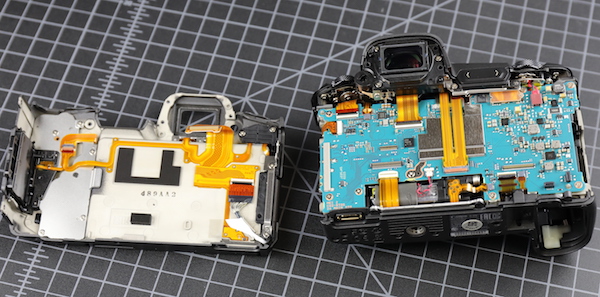
Edited on Aug 04, 2020 at 05:30 PM · View previous versions
https://www.diyphotography.net/the-unbiased-canon-eos-r-disassembly-and-teardown/
https://www.shutterbug.com/content/check-out-eye-opening-teardown-new-canon-r-mirrorless-camera-lensrentalscom
If you go to the lens rental teardown, you can see the rear panel. There is a u-shaped dark section on that rear panel. I believe that is actually a gap in the rear material stuck to that panel and that would have access to part of the processor board. If so, running a peltier cooler there should distribute more of the cooler temps to the main board.
Edited on Aug 04, 2020 at 05:30 PM · View previous versions
Aug 04, 2020 at 05:18 PM
p.8 #20R5 stills overheating
I have no problem believing a company like Neewer could make a grip that blows air through the battery compartment.
Aug 04, 2020 at 05:19 PM