gdanmitchell wrote:
- we were looking at crops out of larger images that had been sized to print at 30" x 40"
This was a good and thoughtful post, but it highlights the need of what I would (sadly) describe as a dying breed: large prints. I mean I loved it when Calypso was still in business (in my home town no less), when I could print 80" wide. I have a 60x40 RA-4 print hanging over my home office desk, made with a 1DS no less. But I have exactly two of such prints in my home, because I don't have that much wall.
What I do have however is three laptops, and one iMac Pro with an attached 6K XDR display. While this may be a rarity now, it sure will be standard pretty soon, and boy I can immediately tell what camera a photo came from. I have a library of 29k photos from all parts of my life that randomly cycle as background (and as screen saver, when idle) and I can tell between the 1Ds3 and the 5DSR and the a7r4. Worse, when the same 1DS photo that is hanging 60x40 above my desk comes up on my 6K, it looks ... well, old, outdated.
I love to print big, but (sadly) it's a diminishing market / segment, kinda like a BW darkroom in one's bathroom or basement. The thing that's coming more and more are 80" 8K HDR TVs and 6K+ HDR desktop displays. Even on the 16" laptop I can tell the age of a photo, and that's before the next generation of laptop displays hits next year. Paper is beautiful, nostalgic. It is far more forgiving than the XDR display, and that's the future. They will keep improving displays for a long time to come, but they're done improving paper.
robert_in_ca wrote:
That’s really interesting. Since I don’t really crop much, I personally find dynamic range to be more important then having a high resolution sensor.
In my experience, while the DR of various sensors is not identical, all of them provide a great deal of dynamic range. When it comes to DR, it seems to me that subjects fit into three categories:
1. The DR of the scene is within the capabilities of essentially all sensors — in other words DR is not a limiting factor at all.
2. The DR of the scene is gigantic and no current sensor is able to handle it.
3. The DR range is in a narrow band where it barely fits within the range of the widest DR camera and does not fit within the range of narrower DR range cameras.
As to the likelihood of encountering each of these scenarios: #1 is by far the most likely. I'd bet that it accounts for nearly all photographs. #2 is the second most likely, which is why we still understand a lot of things about how to photograph subjects where the DR exceeds the capability of the camera.
#3 is the least likely, but let's look at it more closely. The result is not a binary — as in camera A can make a photograph and camera B cannot. Rather, the degradation of the image that occurs as we approach the DR limit is more obvious with a given subject in camera B and less so in camera A. Both are increasingly likely to see blown highlights and/or noisy shadows, but one shows a bit more of those effects than the other. (DR "limits" are arbitrary things, set to specific values so that they can be compared, but because a camera measures as having, say, 11.5 stops of DR by those measuring standards, it does not necessarily follow that the camera cannot produce a rather good photograph of a scene with 11.7 stops of DR.)
So, what we get is a marginally higher quality of image in the least likely scenario. We still need to be prepared to handled case #3 with either camera, and in the most common case #1 it doesn't matter.
Finally one more point that should be obvious, but it seems like sometimes it isn't. No current means of photograph reproduction that is in regular use can reproduce the full dynamic range of current cameras. A print most certainly cannot, and your monitor probably doesn't either — and if it did, your ambient light in your viewing situation would probably render the full DR unviewable.
This means that the added DR doesn't really "give you a better picture" coming out of your camera. (Either the image is dynamically flattened to fit within the viewable range — which you probably won't like — or the full range is output and your viewing system can't reproduce it accurately.)
What it does do is capture more scene data in the exposure. This can be used to allow the application of more radical post-processing to recover detail in areas where it would otherwise not be visible. In other words, the value of added DR does not accrue to those who don't do some pretty significant post processing.
gdanmitchell, an interesting analysis. I do think as one is forced into higher ISO, the DR does drop. So the number of photos that fit into #1 also drops. Re #2, the DR doesn't have to be 'gigantic' to not fit within any sensor, but it could still be enough that no camera captures it. I would still rather have 95% captured than 85% (for example). Varying degrees of recovery come from varying degrees of PP. It doesn't have to be 'significant' to derive some value.
Lastly, even if print and screens today can't show all of the DR, those of tomorrow will. So again, I would rather have more than less.
EverLearning wrote:
Lastly, even if print and screens today can't show all of the DR, those of tomorrow will. So again, I would rather have more than less.
Print will never show it. There isn't enough range between paper white and print black.
Plus, you can't actually see the full actual scene of subject with the DR you are thinking of in the way a camera can. In order to do so you visual system actually adjusts to the light of what it is looking at — this is why you can see details in shadow and then look at a bright snow field and see detail there. But you can't actually do both at once.
Again, the reason for higher DR is not that you can "see" or print the wide DR that the camera can capture. It is so that you an capture image data that you can flatten in post (bright up shadow lightness, drop highlight brightness) in order to fit in a range that we can reproduce and view.
stanj wrote:
... or to show it on a 21st century output device that actually can show the DR to begin with
mdvaden wrote:
That sure isn't instagram viewing or Facebook ..
True, or at least not today. Personally I take photos today that I would like to enjoy to the fullest even a decade in the future, if I'm still around then. My current screen surely has more dynamic range (or resolution) than what my first DSLRs could capture, and I have a sense we're not quite done yet with display tech. And by then even Instagram may catch up. Not that I'm that much of a user.
"A full launch of the R5 is unlikely to happen until sometime in Summer 2020 and it's not yet clear how availability will be hit by the global pandemic."
gdanmitchell wrote:
Print will never show it. There isn't enough range between paper white and print black.
A large print can show it. As you spread the photo over a larger area, the dynamic range of the original per unit area is reduced. How large a print you'd need, I haven't looked into it but it's not like there is no noise visible in prints. It's not like today's camera captures produced perfect print quality in all conditions - they do not. There is plenty of desire and application for improved signal quality.
Plus, you can't actually see the full actual scene of subject with the DR you are thinking of in the way a camera can. In order to do so you visual system actually adjusts to the light of what it is looking at
[— this is why you can see details in shadow and then look at a bright snow field and see detail there. But you can't actually do both at once.
The brain nevertheless perceives the scene details in each area even if this is based on scanning the scene and some kind of processing the data. When you're looking at e.g. brightly lit backround with your fovea, you see its details, and when you look at an animal in the shadows, the brain sees the object, and forms a memory of the scene parts as when they were looking at them directly (in their adjusted form). A good print accomplishes something similar and some regional adjustment of the tones is necessary to accomplish this. It's not "radical post-processing" but a basic part of print-making that has been practiced for 100 years. Now, if you start with a high-quality original, you can make these adjustments and the final print will appear higher quality than if you started with an original with lower signal-to-noise overall and in the shadows in particular.
gdanmitchell wrote:
In my experience, while the DR of various sensors is not identical, all of them provide a great deal of dynamic range. When it comes to DR, it seems to me that subjects fit into three categories:
1. The DR of the scene is within the capabilities of essentially all sensors — in other words DR is not a limiting factor at all.
2. The DR of the scene is gigantic and no current sensor is able to handle it.
3. The DR range is in a narrow band where it barely fits within the range of the widest DR camera and does not fit within the range of narrower DR range cameras.
As to the likelihood of encountering each of these scenarios: #1 is by far the most likely. I'd bet that it accounts for nearly all photographs. #2 is the second most likely, which is why we still understand a lot of things about how to photograph subjects where the DR exceeds the capability of the camera.
It really depends on what kind of subjects you shoot. A landscape photographer who prefers to include the sun in the scene (these are quite well-liked even if hard to do well) will often find in category 2, and may have to work with multiple different exposures and masks, but if there is movement in the scene, then the multiple-exposure approach often fails, and one has to work from a single image, and in that case one can get a higher-quality image by starting with the highest-quality original and that includes the best dynamic range sensor that is available on the market. I would argue that there is some movement in most scenes, be it animal movement, human movement, ripples in water, tree or cloud movement, or cars in a cityscape.
In event photography, often one has to work with what kind of weather and lighting conditions are available, and quite often there is something happening where a part of the people that are in the scene and moment are lit well and others are in the shadow, and more often than not, some local adjustments need to be made. Again the higher-quality original helps immensely to achieve a good outcome for printing. This isn't radical post-processing but par for the course.
rbeasley wrote:
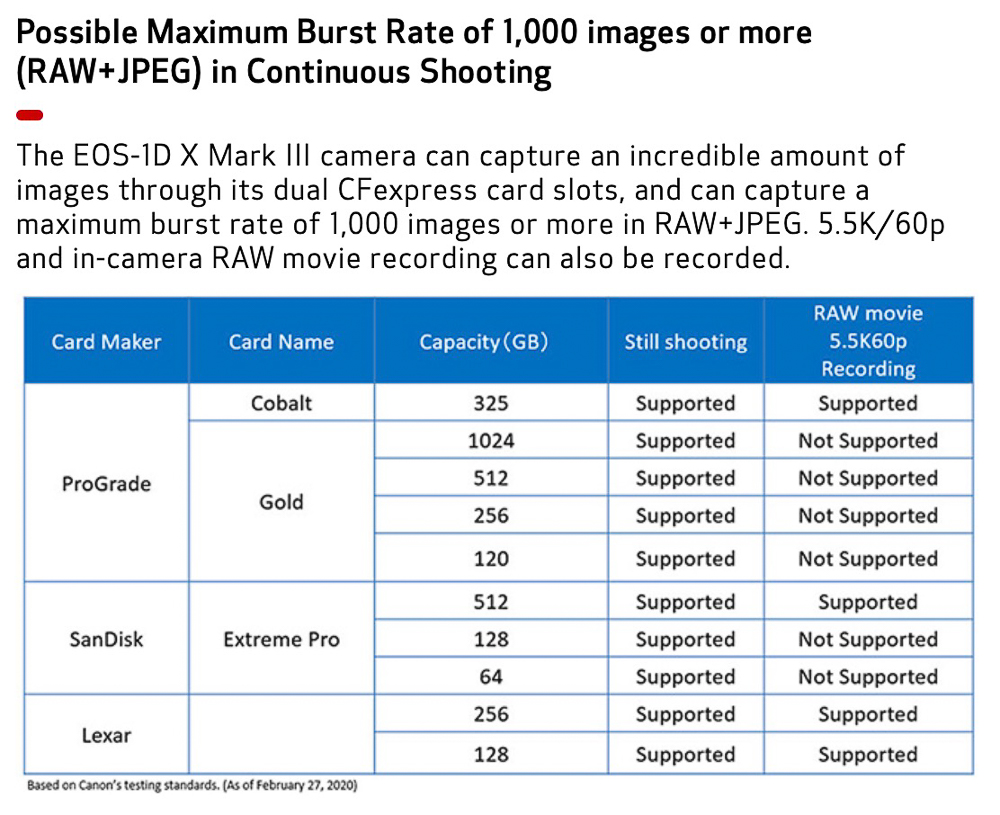
Knock on wood I could be lucky. I can record the raw video to the 64gb card although I don't. I have tired a few clips and it worked. I have used 128gb cards mostly. It eats them up fast. I get 6 minutes with he 64gb card. I wondered off topic though.
Correction I just looked at the card in my 1dx3 and it is the 128gb carb providing 6 minutes of raw video. I have recorded short clips on the 64gb card however. I don't remember switching them out. Didn't want to continue with the false info
rbeasley wrote:
Correction I just looked at the card in my 1dx3 and it is the 128gb carb providing 6 minutes of raw video. I have recorded short clips on the 64gb card however. I don't remember switching them out. Didn't want to continue with the false info
rbeasley wrote:
Correction I just looked at the card in my 1dx3 and it is the 128gb carb providing 6 minutes of raw video. I have recorded short clips on the 64gb card however. I don't remember switching them out. Didn't want to continue with the false info
Thats just crazy. Think of all the 6tb+ drives one would need if they started recording in 8k for any length of time. It would make storage beyond the completion of final work almost impossible without spending $$$. I already realized a few days back that I need to buy some new drives just to store photos for backup and get them off my main NVME computer drive. Also need to make sure I am culling my non keepers a whole lot better when out and about shooting. The space taken is growing exponentially from my 18mp 1Dx to my 30mp EOS R, and if I get the R5 it will grow exponentially faster yet.
So lets just say camera $3500+, plus about $500 in CF Express cards, plus another $300 or so for at least two good size backup drives.
arbitrage wrote:
It is not a replacement for either. Both of those cameras are still for sale and my guess is they will be for a long while beside the R5. The R5 is a 5 series camera designed around 8K video spec and DCI 8K resolution drove the sensor resolution to be 45MPs.
Will Canon make a high res R body...who knows? Maybe, maybe not. If the 45MP doesn't fit your needs then you will just have to wait and see or buy an A7RIV and get on with things.
For landscape, the 51mpx 5dsr is a better choice absent the need for lower weight and 10% ability to print bigger.
a7riv can print ~15% bigger than r5 but only ~10% bigger than 5dsr. Given that lens are challenged at 61mpx and defraction increasing, it is getting into diminishing returns on a7riv vs 5dsr vs R5. [but I would buy the r5sr at 85mpx for 30% potential gain and the canon ergonomics and more dynamic range - 10% is a bit low]. And Sony has lousy lcd, poor performance in the cold, lessor lens....
gdanmitchell wrote:
Again, the reason for higher DR is not that you can "see" or print the wide DR that the camera can capture. It is so that you an capture image data that you can flatten in post (bright up shadow lightness, drop highlight brightness) in order to fit in a range that we can reproduce and view.
We can debate your first point (the president of IBM decades ago said “I think there is a world market for about five computers.” Many said that man would never go to the moon. The "impossible" has been made possible again and again with time and determination), but it is the second point, the one in your quoted paragraph, that says it all. There absolutely is value to higher DR in a camera. Just think of the DR on digital cameras 10 years ago and the tools we had to manipulate DR and compare it to now.
Perhaps your shooting style or genre doesn't push the DR bounds, or you are otherwise content with current DR. Fair enough. If a manufacturer can give me more, I'll gladly take it; just as I would with better high ISO and better AF.
I am not a mind-reader. I can only look at your comments, replete with an ardent belief that there is no need for further DR, to gain insight to what you think. i have seen quite a number of posts where you repeat your three scenario treatise on why improved DR is of no practical value, so you have certainly been emphatic and consistent about it.
You are entitled to your opinion. Based on the comments in this thread, there are a fair number of people who do not share your opinion.
I think we will have to agree to disagree. I will look forward to improved DR and be happy to have it.