pdmphoto wrote:
I have never been happy with as Sony lens that it not G or GM, so I passed on this one. I really wish Sony would have got serious and made a 35mm G or GM lens to go along with the excellent 24mm GM.
After the release of the vanilla FE 35/1.8, I find it difficult for Sony to come up with a 35mm GM anytime soon.
Perhaps it will come as a 40mm lens instead. (24, 40, 85, 135 GM line)
Fred Miranda wrote:
After the release of the vanilla FE 35/1.8, I find it difficult for Sony to come up with a 35mm GM anytime soon.
Perhaps it will come as a 40mm lens instead. (24, 40, 85, 135 GM line)
The current popularity of 40mm lenses continues to amaze me. 40mm lenses were available 10 years ago, such as the Olympus Zuiko OM 40/2, the M-mount CV Nokton 40/1.4, and the CV Ultron SL & SL II 40/2 lenses for DSLRs but they appealed to a relatively small niche of enthusiasts, many of whom I suspect had read Mike Johnston’s 2008 essay Why 40mm? (which persuaded me to buy an Ultron 40/2 to use on my Nikon D700).
Yet it doesn’t seem all that long ago that the most common response to any mention of a 40mm lens was “What kind of weird focal length is that?” or “It’s neither fish nor fowl!”. Recently, however, both M and FE versions of the CV Nokton 40/1.2 have been overwhelmingly popular with FM members—more so than any other lens I can recall since I joined in early 2008. And since the Nokton release we’ve had the Batis 40/2 and the Sigma 40/1.4 plus the soon to be released Sigma 40/2.8. What happened?
genji wrote:
The current popularity of 40mm lenses continues to amaze me. 40mm lenses were available 10 years ago, such as the Olympus Zuiko OM 40/2, the M-mount CV Nokton 40/1.4, and the CV Ultron SL & SL II 40/2 lenses for DSLRs but they appealed to a relatively small niche of enthusiasts, many of whom I suspect had read Mike Johnston’s 2008 essay Why 40mm? (which persuaded me to buy an Ultron 40/2 to use on my Nikon D700).
Yet it doesn’t seem all that long ago that the most common response to any mention of a 40mm lens was “What kind of weird focal length is that?” or “It’s neither fish nor fowl!”. Recently, however, both M and FE versions of the CV Nokton 40/1.2 have been overwhelmingly popular with FM members—more so than any other lens I can recall since I joined in early 2008. And since the Nokton release we’ve had the Batis 40/2 and the Sigma 40/1.4 plus the soon to be released Sigma 40/2.8. What happened?...Show more →
The Sigma is a 45/2.8, not 40/2.8. Samyang recently introduced their 45/1.8, so it seems that even 45mm reappears.
genji wrote:
The current popularity of 40mm lenses continues to amaze me. 40mm lenses were available 10 years ago, such as the Olympus Zuiko OM 40/2, the M-mount CV Nokton 40/1.4, and the CV Ultron SL & SL II 40/2 lenses for DSLRs but they appealed to a relatively small niche of enthusiasts, many of whom I suspect had read Mike Johnston’s 2008 essay Why 40mm? (which persuaded me to buy an Ultron 40/2 to use on my Nikon D700).
Yet it doesn’t seem all that long ago that the most common response to any mention of a 40mm lens was “What kind of weird focal length is that?” or “It’s neither fish nor fowl!”. Recently, however, both M and FE versions of the CV Nokton 40/1.2 have been overwhelmingly popular with FM members—more so than any other lens I can recall since I joined in early 2008. And since the Nokton release we’ve had the Batis 40/2 and the Sigma 40/1.4 plus the soon to be released Sigma 40/2.8. What happened?...Show more →
I'll add two, for illustration: the Canon EF 40/2.8 STM and the Pentax 43/1.9 Limited.
These two lenses in actual focal length are essentially 42.5mm, which also happens to be the diameter of the 135-format / 35mm full-frame image circle.
Thus, the lenses are the most 'normal' of normal primes, with their perspective most matching human vision, and providing a 'natural' perspective.
I can't speak to the actual focal length of all of the other lenses listed, but I think for many that 'natural' perspective is the draw is there. Further, unlike many 35mm lenses, many ~40mm lenses have been more compact in the past, with Sigma's 40/1.4 | Art somewhat bucking that trend.
p.21 #11 · Now in Stock: Sony FE 35mm f/1.8 ($748)
Fred Miranda wrote:
After the release of the vanilla FE 35/1.8, I find it difficult for Sony to come up with a 35mm GM anytime soon.
Perhaps it will come as a 40mm lens instead. (24, 40, 85, 135 GM line)
p.21 #12 · Now in Stock: Sony FE 35mm f/1.8 ($748)
genji wrote:
The current popularity of 40mm lenses continues to amaze me. 40mm lenses were available 10 years ago, such as the Olympus Zuiko OM 40/2, the M-mount CV Nokton 40/1.4, and the CV Ultron SL & SL II 40/2 lenses for DSLRs but they appealed to a relatively small niche of enthusiasts, many of whom I suspect had read Mike Johnston’s 2008 essay Why 40mm? (which persuaded me to buy an Ultron 40/2 to use on my Nikon D700).
Yet it doesn’t seem all that long ago that the most common response to any mention of a 40mm lens was “What kind of weird focal length is that?” or “It’s neither fish nor fowl!”. Recently, however, both M and FE versions of the CV Nokton 40/1.2 have been overwhelmingly popular with FM members—more so than any other lens I can recall since I joined in early 2008. And since the Nokton release we’ve had the Batis 40/2 and the Sigma 40/1.4 plus the soon to be released Sigma 40/2.8. What happened?...Show more →
They might once have been the most common lenses by far. Practically every decent Japanese non-interchangeable rangefinder in the sixties and seventies had a forty-ish lens as standard, and these far outsold SLRs Or. interchangeable rangefinders. And were often great cameras.
p.21 #14 · Now in Stock: Sony FE 35mm f/1.8 ($748)
DavidBM wrote:
They might once have been the most common lenses by far. Practically every decent Japanese non-interchangeable rangefinder in the sixties and seventies had a forty-ish lens as standard, and these far outsold SLRs Or. interchangeable rangefinders. And were often great cameras.
My father used a Petri camera with a 45/2.8, which is Tessar type, afaik. It was actually quite sharp, and I’ve scanned those images a few years ago with a Nikon Coolscan V. Lots of childhood memories there.
p.21 #15 · Now in Stock: Sony FE 35mm f/1.8 ($748)
bjornthun wrote:
They’re all normal or semi-normal lenses.
If you think 35 and 65mm are close to the same thing then that's... interesting...
Even 55 and 65mm are very different. I would love more options in the 65 to 75mm range but sadly we only have a couple, and they're either manual focus or slow macro lenses
p.21 #16 · Now in Stock: Sony FE 35mm f/1.8 ($748)
So I see some folks are getting their copies from Canada or the UK for a discount. What foreign retailer are people using, and could they provide links?
Are imported lenses still serviceable under warranty?
If one needed their copy replaced or fixed, would it then have to be shipped back to the foreign retailer?
Would a foreign warranty cover a lens used in a different country? Is the warranty still applicable at all?
What is the return process like when sending back imported lenses?
If anyone could answer some or any of these questions that would be absolutely amazing.
p.21 #18 · Now in Stock: Sony FE 35mm f/1.8 ($748)
genji wrote:
The current popularity of 40mm lenses continues to amaze me. 40mm lenses were available 10 years ago...
They go back a lot further than that!
DavidBM wrote:
They might once have been the most common lenses by far. Practically every decent Japanese non-interchangeable rangefinder in the sixties and seventies had a forty-ish lens as standard
What's old is new again.
bjornthun wrote:
My father used a Petri camera with a 45/2.8, which is Tessar type, afaik. It was actually quite sharp.
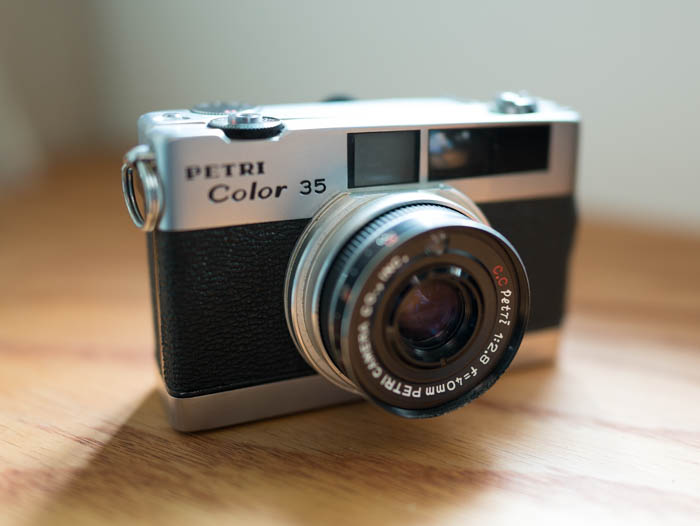
Indeed. Here's my Petri Color 35, that I bought in 1971, with its excellent 40mm lens.
p.21 #19 · Now in Stock: Sony FE 35mm f/1.8 ($748)
phototiimo wrote:
If you think 35 and 65mm are close to the same thing then that's... interesting...
Even 55 and 65mm are very different. I would love more options in the 65 to 75mm range but sadly we only have a couple, and they're either manual focus or slow macro lenses
50 +- 15
Of course 35-65 is almost the range of old 35-70 standard zooms with too little range.
p.21 #20 · Now in Stock: Sony FE 35mm f/1.8 ($748)
The original Rollei 35 cameras with a 40mm Tessar lens was introduced at Photkina in 1966. I have a more recent Rollei 35S with a 40mm f2.8 Sonnar. It has no battery cover and I can not remember if when I purchased it if the meter wasn't working. But, I would normally usage my Zone VI modified Soligor spot meter for metering so that was not a real issue. I purchased the camera from Krikor Maralian when he was still in business and providing Rollei repairs.