This topic is in the 2018 archive. You can read it and like its posts here. It is read only.
Archive 2018Sigma Art FE-mount discussion/tests/etc.
p.1 #1Sigma Art FE-mount discussion/tests/etc.
We have had now over week some of these lenses available on native FE-mount. I didn't find existing discussion thread and therefore adding this one. Due to size and weigth these most likely will not be very popular.
In Finland 85mm has been available over 1 week, and 50mm little less. I have not seen others yet. Earlier I did buy EF-mount 24-35 f/2 Art just for sh#ts and giggles, as all manufacturers ignore 28mm focal length (I don't like Sony 28mm f/2), and it was much better than I expected it to be => made me think that these modern Sigmas are maybe better than the brand image in my head learned from their horrible lenses +15 years ago. I did buy 50mm Art as I was not super happy to any of the existing ones, adapted or native.
Lens fits A7r mkII very nicely, there is no play between mount and lens, camera & lens feels like solid piece. Ergonomically lens is too big for A7r mkII, it helps a little that I had bottom part of L-bracket in camera providing little more support for right hand fingers. If I would normally shoot handhold, I would concider using vertical grip.
Manual focus is good for an AF-lens. but focus throw is only ~90 degrees, which makes focusing slow compared to real manual focus lenses as it requires ~2-5x time to place focus plane exactly to the distance your subject requires.
I'm not expert on autofocus stuff as I shoot 99% from tripod and strongly prefer manual focusing. I took first shots with AF, and from 78 pictures I took all except one focused correctly. 1/78 = 1.28% is not much, but I'm used to 0% - that one missfocused was first I have misfocused since 2008 for static target (2008 = 5DmkII -> never used optical viewfinder/AF after that for static subjects). Most likely it was my fault, not cameras (I assume Sony AF is closed loop, so lens plays no role on this?). I used only AF-S and selected the focus point myself and all worked as expected (except in that one image), focus was very fast. Focus struggled when f/8-16, but with such apertures I think it's very bad idea to focus at shooting aperture.
Anyways I enjoyed shooting handhold w/ IBIS and AF, I have not done this much earlier and I was surprised that I could get 1/20s systematically sharp.
Here is how the "inbuild adapter" looks like in Sigma 50mm Art:
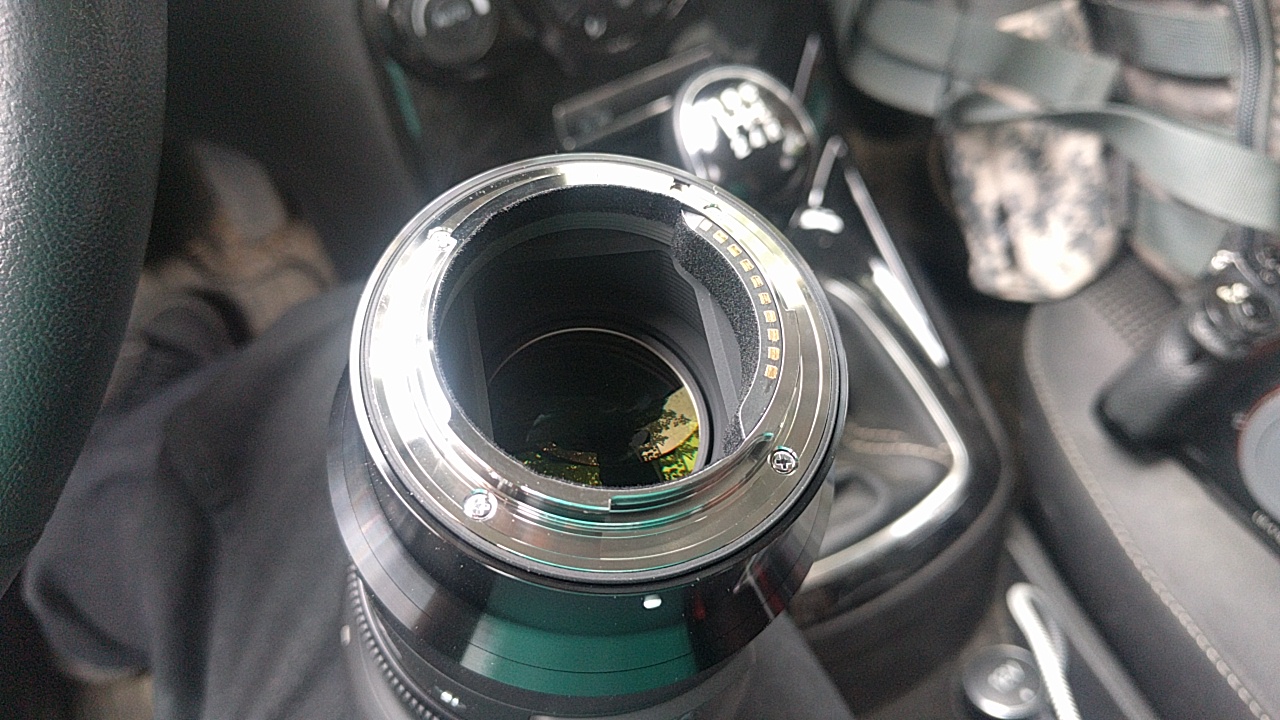
Very good blocking of light, leaving just rectangular "hole" for light to come to the sensor. Also anti-reflective material close to mount. Exactly same way I have found best to do with C/Y, FD, MD, OM, F, K, M42, etc. adapters, which are generally useless flare generators as they come just painted black without any blocking when you order them from eBay.
Samuli
In Finland 85mm has been available over 1 week, and 50mm little less. I have not seen others yet. Earlier I did buy EF-mount 24-35 f/2 Art just for sh#ts and giggles, as all manufacturers ignore 28mm focal length (I don't like Sony 28mm f/2), and it was much better than I expected it to be => made me think that these modern Sigmas are maybe better than the brand image in my head learned from their horrible lenses +15 years ago. I did buy 50mm Art as I was not super happy to any of the existing ones, adapted or native.
Lens fits A7r mkII very nicely, there is no play between mount and lens, camera & lens feels like solid piece. Ergonomically lens is too big for A7r mkII, it helps a little that I had bottom part of L-bracket in camera providing little more support for right hand fingers. If I would normally shoot handhold, I would concider using vertical grip.
Manual focus is good for an AF-lens. but focus throw is only ~90 degrees, which makes focusing slow compared to real manual focus lenses as it requires ~2-5x time to place focus plane exactly to the distance your subject requires.
I'm not expert on autofocus stuff as I shoot 99% from tripod and strongly prefer manual focusing. I took first shots with AF, and from 78 pictures I took all except one focused correctly. 1/78 = 1.28% is not much, but I'm used to 0% - that one missfocused was first I have misfocused since 2008 for static target (2008 = 5DmkII -> never used optical viewfinder/AF after that for static subjects). Most likely it was my fault, not cameras (I assume Sony AF is closed loop, so lens plays no role on this?). I used only AF-S and selected the focus point myself and all worked as expected (except in that one image), focus was very fast. Focus struggled when f/8-16, but with such apertures I think it's very bad idea to focus at shooting aperture.
Anyways I enjoyed shooting handhold w/ IBIS and AF, I have not done this much earlier and I was surprised that I could get 1/20s systematically sharp.
Here is how the "inbuild adapter" looks like in Sigma 50mm Art:
Very good blocking of light, leaving just rectangular "hole" for light to come to the sensor. Also anti-reflective material close to mount. Exactly same way I have found best to do with C/Y, FD, MD, OM, F, K, M42, etc. adapters, which are generally useless flare generators as they come just painted black without any blocking when you order them from eBay.
Samuli
Jun 07, 2018 at 03:07 AM
p.1 #2Sigma Art FE-mount discussion/tests/etc.
I noticed when shooting first images that Sigma 50 Art background boke was rougher than expected on image short edges and corners. Seeing images in computer doesn't change the observation. I wonder is this because of using Canon/Nikon sensor cover glass optical thickness in optical design of lens, and just using the same design in Sony which sensor optical thickness is at least 50% more than Canon/Nikon.
So I did test setup, which I also used to check decentering of the lens (lens was fine, I would never pixelpeep real life image corners of f/1.4 shot, but they did look very good for f/1.4). Only difference to picture's setup is that I focused to lamp in foreground boke instead of targets taped to window frame:
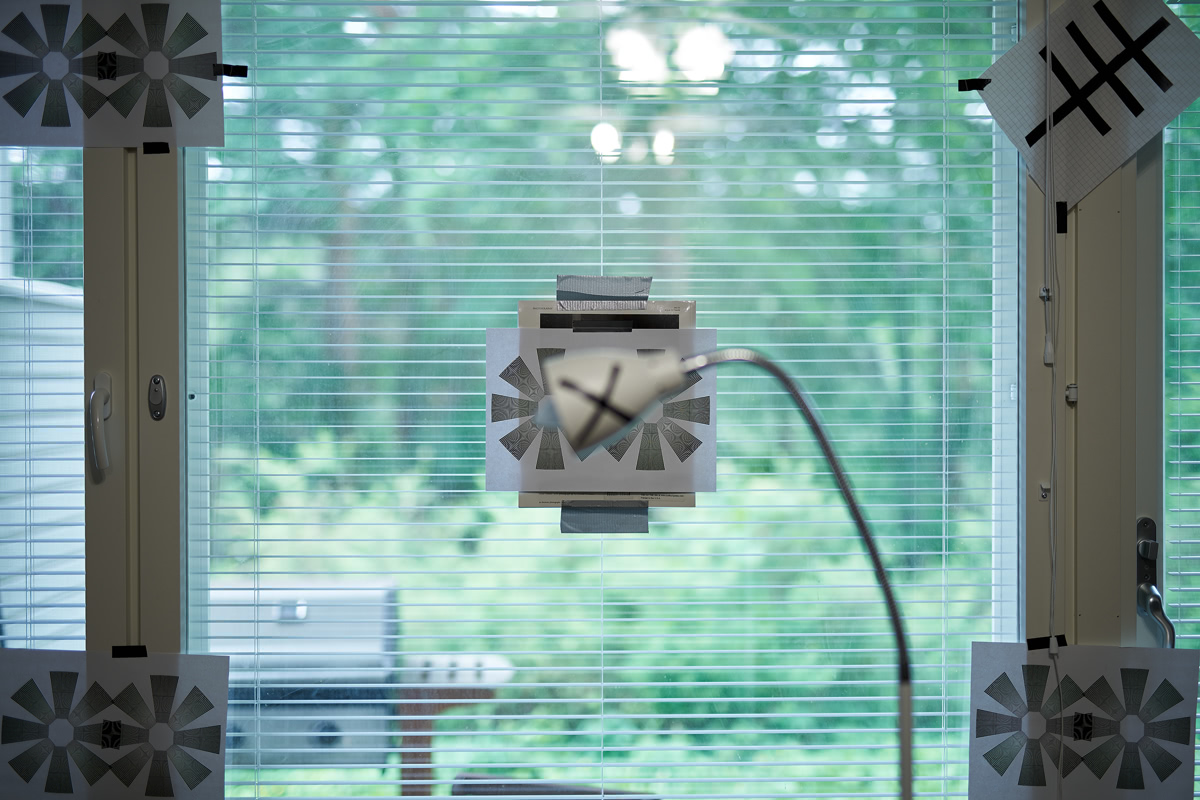
Distance to lamp in foreground: 160cm (USA: 64,9606inch / 5 feet and 4.96063 inches)
Distance to window frame: 225cm (USA: 88.5827inch / 7 feet and 4.58268 inches)
First I took photo with A7, which is modified by Kolarivision to have thinner sensor cover glass and no AA (Kolari v2), focused to lamp. Then I took other photo with A7r mkII, which has standard super thick sensor cover glass, focused to the lamp as well. Also took photos in which I focused to focus targets on window frame with both camera to rule out sensor tilt etc. Lens performed similarly in both cameras.
As a result here is image pair, where both camera original RAW has been reduced to 4500px width to make the detail size same, and then compared in PhotoShop:
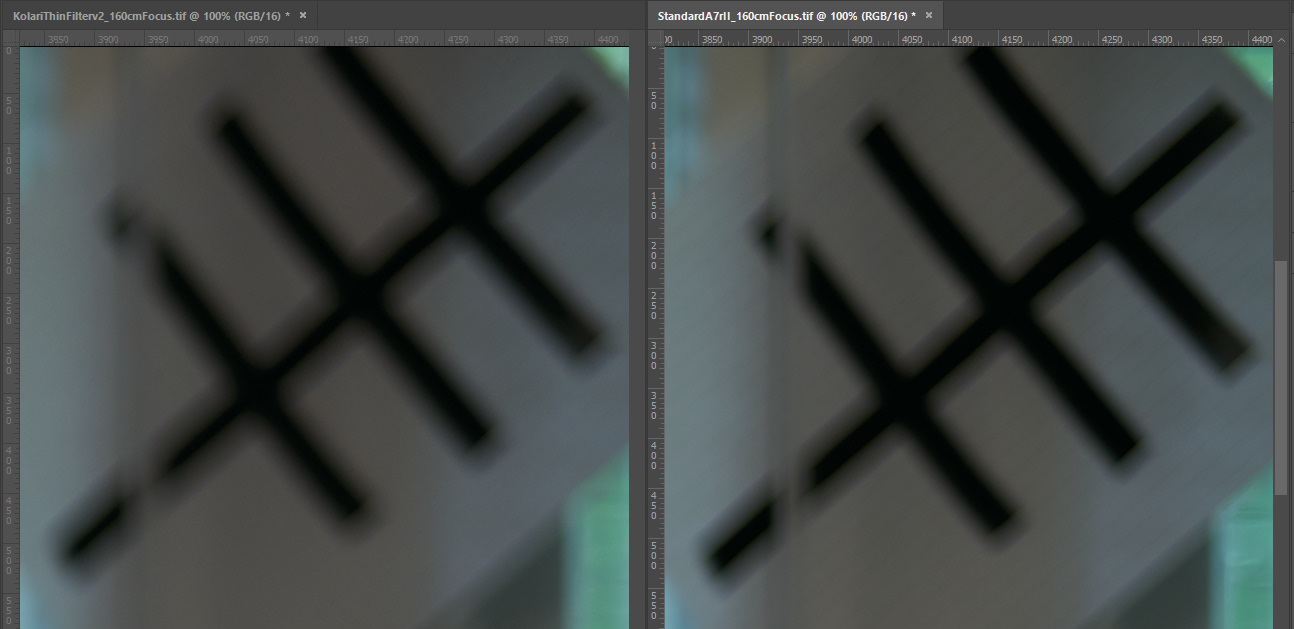
If we first compare tangential detail we can see that the in Kolari v2 thin sensor the tangential line is more blurred, specially the "core" (the black thick center of line) of the tangential line has softer edges with thinner sensor cover stack (Kolari v2). Also the overall width of tangential line is wider = more blurred with thinner sensor cover stack. Also the very thin lines in paper are visible with standard sensor, where they are not at all visible with thin sensor!
The difference in sagittal lines is less obvious, but it can be seen that again thin sensor cover glass (Kolari v2) causes the sagittal lines to be softer compared to standard Sony camera.
From these observations we can 100% sure say that there is outward field curvature due to thick Sony sensor cover glass. Astigmatism is hard to say without optical bench measurements.
So as an summary: with some lenses (at least 50mm Art) Sony users suffer due to Sigma optimized their optical design for Canon/Nikon sensor cover glass thickness. I'm personally disappointed as Sigma could have fixed this easily by changing one or two glass surfaces in the optical design. I doubt that lens mount changing becomes ever popular choice for people.
Samuli
So I did test setup, which I also used to check decentering of the lens (lens was fine, I would never pixelpeep real life image corners of f/1.4 shot, but they did look very good for f/1.4). Only difference to picture's setup is that I focused to lamp in foreground boke instead of targets taped to window frame:
Distance to lamp in foreground: 160cm (USA: 64,9606inch / 5 feet and 4.96063 inches)
Distance to window frame: 225cm (USA: 88.5827inch / 7 feet and 4.58268 inches)
First I took photo with A7, which is modified by Kolarivision to have thinner sensor cover glass and no AA (Kolari v2), focused to lamp. Then I took other photo with A7r mkII, which has standard super thick sensor cover glass, focused to the lamp as well. Also took photos in which I focused to focus targets on window frame with both camera to rule out sensor tilt etc. Lens performed similarly in both cameras.
As a result here is image pair, where both camera original RAW has been reduced to 4500px width to make the detail size same, and then compared in PhotoShop:
If we first compare tangential detail we can see that the in Kolari v2 thin sensor the tangential line is more blurred, specially the "core" (the black thick center of line) of the tangential line has softer edges with thinner sensor cover stack (Kolari v2). Also the overall width of tangential line is wider = more blurred with thinner sensor cover stack. Also the very thin lines in paper are visible with standard sensor, where they are not at all visible with thin sensor!
The difference in sagittal lines is less obvious, but it can be seen that again thin sensor cover glass (Kolari v2) causes the sagittal lines to be softer compared to standard Sony camera.
From these observations we can 100% sure say that there is outward field curvature due to thick Sony sensor cover glass. Astigmatism is hard to say without optical bench measurements.
So as an summary: with some lenses (at least 50mm Art) Sony users suffer due to Sigma optimized their optical design for Canon/Nikon sensor cover glass thickness. I'm personally disappointed as Sigma could have fixed this easily by changing one or two glass surfaces in the optical design. I doubt that lens mount changing becomes ever popular choice for people.
Samuli
Jun 07, 2018 at 04:10 AM
p.1 #3Sigma Art FE-mount discussion/tests/etc.
Samuli Vahonen wrote:
Here is how the "inbuild adapter" looks like in Sigma 50mm Art:
Thanks for sharing this. I've been anxious to see/hear any firsthand reports of the Sigma FE lenses.
PS
If you have a chance, I'd love to see a shot of the lens mounted on the camera.
Here is how the "inbuild adapter" looks like in Sigma 50mm Art:
Thanks for sharing this. I've been anxious to see/hear any firsthand reports of the Sigma FE lenses.
PS
If you have a chance, I'd love to see a shot of the lens mounted on the camera.
Jun 07, 2018 at 05:40 AM
p.1 #4Sigma Art FE-mount discussion/tests/etc.
I wasn't interested but now I do wonder about the 35mm art. Would be nice to have better focus accuracy in the off center focus points. I usually just use manual focus for those with the MC-11 now. Centered focus/eye AF is great.
Edited on Jun 07, 2018 at 06:53 AM · View previous versions
Edited on Jun 07, 2018 at 06:53 AM · View previous versions
Jun 07, 2018 at 06:13 AM
p.1 #5Sigma Art FE-mount discussion/tests/etc.
MikeEvangelist wrote:
If you have a chance, I'd love to see a shot of the lens mounted on the camera.
Always time for cameraporn Took a video, 4K once YouTube finishes processing
Samuli
If you have a chance, I'd love to see a shot of the lens mounted on the camera.
Always time for cameraporn
Took a video, 4K once YouTube finishes processing Samuli
Jun 07, 2018 at 06:22 AM
p.1 #6Sigma Art FE-mount discussion/tests/etc.
Samuli Vahonen wrote:
Always time for cameraporn
Looks pretty good.
I've been planning to get the 35mm, but the surprisingly excellent performance of my new Samyang 35mm ƒ1.4 has got me rethinking that.
Always time for cameraporn
Looks pretty good.
I've been planning to get the 35mm, but the surprisingly excellent performance of my new Samyang 35mm ƒ1.4 has got me rethinking that.
Jun 07, 2018 at 07:17 AM
p.1 #7Sigma Art FE-mount discussion/tests/etc.
That 50mm looks in size like most companies 24-70 f2.8. It's a big enough lens to start with. It's nice that they're extending the barrel for FE but lenses designed for the short flange distance of the FE mount are too few and far between.
Jun 07, 2018 at 07:18 AM
p.1 #8Sigma Art FE-mount discussion/tests/etc.
Thank you for this post, I’ve been really curious about the new FE-mount sigmas.
Regarding the harsh/unpleasant bokeh, I personally have found this to be the case with the sigma art 50 and 35 on canon, Nikon and adapted to Sony - I much prefer the rendering of the FE Zeiss Planar 50 f1.4 (a lens I liked enough that I often try to justify picking up another full frame Sony body)
Samuli Vahonen wrote:
I noticed when shooting first images that Sigma 50 Art background boke was rougher than expected on image short edges and corners. Seeing images in computer doesn't change the observation. I wonder is this because of using Canon/Nikon sensor cover glass optical thickness in optical design of lens, and just using the same design in Sony which sensor optical thickness is at least 50% more than Canon/Nikon.
So I did test setup, which I also used to check decentering of the lens (lens was fine, I would never pixelpeep real life image corners of f/1.4 shot, but they did look...Show more →
Jun 07, 2018 at 08:12 AM
p.1 #9Sigma Art FE-mount discussion/tests/etc.
I’m awaiting test results for the 135 as it’s image quality is lovely. Just want to see how much better AF will be compared to the Canon mount version adapted.
Jun 07, 2018 at 09:22 AM
p.1 #10Sigma Art FE-mount discussion/tests/etc.
Samuli Vahonen wrote:
So as an summary: with some lenses (at least 50mm Art) Sony users suffer due to Sigma optimized their optical design for Canon/Nikon sensor cover glass thickness. I'm personally disappointed as Sigma could have fixed this easily by changing one or two glass surfaces in the optical design. I doubt that lens mount changing becomes ever popular choice for people.
Samuli
I thought Canon/Nikon have thick(ish) cover glass like a Sony, not thin glass like a Leica M9 or the Kolari thin filter.
Jun 07, 2018 at 09:22 AM
p.1 #11Sigma Art FE-mount discussion/tests/etc.
chez wrote:
I’m awaiting test results for the 135 as it’s image quality is lovely. Just want to see how much better AF will be compared to the Canon mount version adapted.
The Sigma 135 + MC-11 is quite a bit better on the R3 body as it can do 10 fps tracking, while the 135L + metabones is a no go.
aside from that, the 135L does decent, just not very good in very low light. Even moderately low light, I think the 135L does fine, it's just the lack of going full speed on the R3 bodies is kind of a big deal.
hard to fault the sigma other than being heavy as hell. It's pin sharp wide open, about as sharp as the canon @ f4
considering how good the MC-11 is now, switching to native is on the back burner, it's practically native as is, cant say the same about other adapted lenses.
Jun 07, 2018 at 09:53 AM
p.1 #12Sigma Art FE-mount discussion/tests/etc.
I have seen these videos about Sigma FE lenses:
A video comparing Sigma FE 50/1.4 Art with Sigma 50/1.4 Art Canon + MC-11:
It is in German and translated subtitles are poor. Native version of lens works better for them.
A video comparing AF-C of 50/1.4 native FE vs. MC-11
I'm now comparing my Nikon D750 against A7iii to decide which to keep and so far A7iii is winning.
I have Sigma 24/1.4 and 135/1.8 in Nikon mount that I will want to convert to E-mount so I'm interested if I can get same AF speed and better accuracy than on my Nikon D750. My D750 is not very accurate with 24 (but better than D610 I had before which when tunned for center would make peripheral AF points significantly fontfocus), but ok with 135. My A7iii focuses better in AF-C than my D750 when comparing 55/1.8 FE vs 50/1.8G or 24-105/4 FE vs 24-120/4vr. Also both Sony lenses are sharper than respective Nikon lenses.
Sharpness of 24 and 135 on D750 is amazing when it focuses well. Examples (both Sigma 24/1.4 at f/2, D750, Godox AD200 with AD-S7 softbox):
http://jtra.cz/foto/20180525-travnikovi-ad200-ad-s7/preview/20180525184802_9401.medium.jpg
full resolution
http://jtra.cz/foto/20180525-travnikovi-ad200-ad-s7/preview/20180525185902_9439.medium.jpg
full resolution
Jun 07, 2018 at 11:47 AM
p.1 #13Sigma Art FE-mount discussion/tests/etc.
Interesting thread Samuli. Thanks for starting it and posting some examples. I've ordered the Sigma 1.8/14mm in FE mount. It should arrive mid July. I report my experience after somes testing.
Boris
Boris
Jun 07, 2018 at 11:58 AM
p.1 #14Sigma Art FE-mount discussion/tests/etc.
elimoss wrote:
I thought Canon/Nikon have thick(ish) cover glass like a Sony, not thin glass like a Leica M9 or the Kolari thin filter.
Unfortunately this is not the case. Modern Canons are between 1mm and 1.5mm in physical thickness. Earlier it used to be so that 1D series had thinner sensor cover glass, because thinner AA-filter is was considerably more expensive to manufacture 10+ years ago. For example 70D (I assume this is quite new, I have not followed Canon world for years...) has mechanically 1.2mm, which will result ~1.6mm optical thickness. Sony optical thickness is somewhere between 2.5mm and 3mm (due to cemented sensor people have had difficulties to measure this). This was very clearly visible as I needed to stop use many lenses in 2013 when I moved from Canon 5DmkII to A7 and A7r, e.g. Carl Zeiss Distagon T* 2.8/28 C/Y-mount was OK with Canon 5DmkII, but had really bad outward field curvature with standard A7/A7r. So there is clear grouping:
Leica(or Sony w/ Kolari UltraThin) < Canon/Nikon(or Kolari v2) < Sony < FourThirds.
Samuli
I thought Canon/Nikon have thick(ish) cover glass like a Sony, not thin glass like a Leica M9 or the Kolari thin filter.
Unfortunately this is not the case. Modern Canons are between 1mm and 1.5mm in physical thickness. Earlier it used to be so that 1D series had thinner sensor cover glass, because thinner AA-filter is was considerably more expensive to manufacture 10+ years ago. For example 70D (I assume this is quite new, I have not followed Canon world for years...) has mechanically 1.2mm, which will result ~1.6mm optical thickness. Sony optical thickness is somewhere between 2.5mm and 3mm (due to cemented sensor people have had difficulties to measure this). This was very clearly visible as I needed to stop use many lenses in 2013 when I moved from Canon 5DmkII to A7 and A7r, e.g. Carl Zeiss Distagon T* 2.8/28 C/Y-mount was OK with Canon 5DmkII, but had really bad outward field curvature with standard A7/A7r. So there is clear grouping:
Leica(or Sony w/ Kolari UltraThin) < Canon/Nikon(or Kolari v2) < Sony < FourThirds.
Samuli
Jun 07, 2018 at 12:14 PM
p.1 #15Sigma Art FE-mount discussion/tests/etc.
Samuli Vahonen wrote:
Unfortunately this is not the case. Modern Canons are between 1mm and 1.5mm in physical thickness. Earlier it used to be so that 1D series had thinner sensor cover glass, because thinner AA-filter is was considerably more expensive to manufacture 10+ years ago. For example 70D (I assume this is quite new, I have not followed Canon world for years...) has mechanically 1.2mm, which will result ~1.6mm optical thickness. Sony optical thickness is somewhere between 2.5mm and 3mm (due to cemented sensor people have had difficulties to measure this). This was very clearly visible as I needed to stop...Show more →
If I am interpreting your testing correctly, it is interesting to note that for 50mm focal length you are finding that Sigma is not optimized for the Sony sensor stack. This reminds me of the early debates when adopting Leica M glass to Sony and it was initially assumed that 50mm would be fine on Sony and that only wide angles would be affected. Then it was clear in testing that the Summilux 50/1.4 was quite significantly affected by the Sony sensor stack. I loved my Leica 50 Summilux, but sold it in favor of the FE 55/1.8 due to poor performance away from center especially at large apertures and at infinity. It is a shame that this lesson has not yet been fully learned (or is being ignored) by Sigma in this case. Of course, this lens seems less significantly affected by the sensor stack thickness than the Leica was (the thickness is closer between Canon/Nikon and Sony than Leica M and Sony). What this means for me is that apart from the large size of these lenses, I will not be considering the Sigma 50mm ART or any wider lenses than that for Sony. I suspect the 135mm will not be affected and therefore I might consider trying that lens, though it is a beast, due to its fine performance.
elimoss wrote
I thought Canon/Nikon have thick(ish) cover glass like a Sony, not thin glass like a Leica M9 or the Kolari thin filter.If I am interpreting your testing correctly, it is interesting to note that for 50mm focal length you are finding that Sigma is not optimized for the Sony sensor stack. This reminds me of the early debates when adopting Leica M glass to Sony and it was initially assumed that 50mm would be fine on Sony and that only wide angles would be affected. Then it was clear in testing that the Summilux 50/1.4 was quite significantly affected by the Sony sensor stack. I loved my Leica 50 Summilux, but sold it in favor of the FE 55/1.8 due to poor performance away from center especially at large apertures and at infinity. It is a shame that this lesson has not yet been fully learned (or is being ignored) by Sigma in this case. Of course, this lens seems less significantly affected by the sensor stack thickness than the Leica was (the thickness is closer between Canon/Nikon and Sony than Leica M and Sony). What this means for me is that apart from the large size of these lenses, I will not be considering the Sigma 50mm ART or any wider lenses than that for Sony. I suspect the 135mm will not be affected and therefore I might consider trying that lens, though it is a beast, due to its fine performance.
Jun 07, 2018 at 01:03 PM
p.1 #16Sigma Art FE-mount discussion/tests/etc.
Luvwine, it's not as bad as Summilux-M 50mm ASPH (which is worst of the 50mm from "how it works in standard Sony"-point of view). As you can see from my example I have hard time seeing is there astigmatism or just field curvature - with rangefinder lenses the astigmatism is most of the case very obvious, no need to guess is it there and field curvature is many times stronger.
For boke shooting also Leica APO-Summilux-M 90mm is conciderably worse with standard camera vs. Kolari v2, but the "slanted landscape people" claimed it was OK (I have always considered landscape as wrong test method for field curvature as the DOF is so gigantic in landscape distances that is tends to mask issues, and it's hard to make difference "crappy corners" vs "sensor cover glass caused issues"). So I would not draw any line "50mm and above is fine"...
Sigma Art series wide angles are VERY telecentric, so most likely they will work better than the 50mm. At least by design 24mm, 20mm and 14mm are so telecentric that most likely there will be no issue (I'm assuming, this is NOT knowledge). With rangefinder lenses the problem comes due to symmetric design (or less telecentric...), and large ray angle caused by that.
Samuli
Jun 07, 2018 at 01:19 PM
p.1 #17Sigma Art FE-mount discussion/tests/etc.
Luvwine wrote:
If I am interpreting your testing correctly, it is interesting to note that for 50mm focal length you are finding that Sigma is not optimized for the Sony sensor stack. This reminds me of the early debates when adopting Leica M glass to Sony and it was initially assumed that 50mm would be fine on Sony and that only wide angles would be affected.
Exit pupil of a 50mm DSLR lens is likely to be farther away from the the sensor than the Leica M 50mm lens, so the effect of the cover glass disparity should be less, I think.
Jun 07, 2018 at 01:24 PM
p.1 #18Sigma Art FE-mount discussion/tests/etc.
Samuli Vahonen wrote:
Sigma Art series wide angles are VERY telecentric, so most likely they will work better than the 50mm. At least by design 24mm, 20mm and 14mm are so telecentric that most likely there will be no issue (I'm assuming, this is NOT knowledge). With rangefinder lenses the problem comes due to symmetric design (or less telecentric...), and large ray angle caused by that.
Samuli
Great explanation, Samuli. Really appreciate your knowledge as I really enjoy the Sigma lenses, but I prefer the Sony bodies over DSLR.
Jun 07, 2018 at 01:49 PM
p.1 #19Sigma Art FE-mount discussion/tests/etc.
elimoss wrote:
Exit pupil of a 50mm DSLR lens is likely to be farther away from the the sensor than the Leica M 50mm lens, so the effect of the cover glass disparity should be less, I think.
Agreed. I did not list that factor, however, Samuli indicates there is still an effect from Sigma not customizing the lens for the Sony E mount. This "bolt on" approach has been done before and is a less than ideal solution--especially at wide angle to normal focal lengths.
Samuli points out that the wides are telecentric. This is of course important. I used to use the Leica WATE which worked quite well due to its telecentric design. Still, not really attracted to the wide Sigmas due to their large size.
Luvwine wrote
If I am interpreting your testing correctly, it is interesting to note that for 50mm focal length you are finding that Sigma is not optimized for the Sony sensor stack. This reminds me of the early debates when adopting Leica M glass to Sony and it was initially assumed that 50mm would be fine on Sony and that only wide angles would be affected.Agreed. I did not list that factor, however, Samuli indicates there is still an effect from Sigma not customizing the lens for the Sony E mount. This "bolt on" approach has been done before and is a less than ideal solution--especially at wide angle to normal focal lengths.
Samuli points out that the wides are telecentric. This is of course important. I used to use the Leica WATE which worked quite well due to its telecentric design. Still, not really attracted to the wide Sigmas due to their large size.
Jun 07, 2018 at 01:55 PM
p.1 #20Sigma Art FE-mount discussion/tests/etc.
I just saw this and instantly lost all interest. So much for "mirrorless has no size benefit above 50mm".

Image belongs to David Kilpatrick
Image belongs to David Kilpatrick
Jun 07, 2018 at 03:32 PM