hiepphotog wrote:
David, seeing as it is right now, I think track-and-stack is a better option. And I understand your desire to shoot it at ISO 800 . Have you done any ISO 800 shot so far?
Try 640 I did a test the other night no hot pixels at 640 but 800 I did
hiepphotog wrote:
David, seeing as it is right now, I think track-and-stack is a better option. And I understand your desire to shoot it at ISO 800 . Have you done any ISO 800 shot so far?
I have the A7R version 1 and track with the astrotrac at ISO 800 for 4 minutes, depending on light pollution. I will often take sequential images for up to an hour. I then stack usually my best 6+ lights with same or more dark & bias frames. For this, the A7R version 1 is wonderful.
I can provide unprocessed dark or light frames for these exposure settings with the A7R version 1.
My line of thought is that the IBIS feature means that it will be more difficult to conduct the heat away from the sensor since it is not attach firmly to the camera body mass.
It might help to open the screen from the body though. I read that this was the cure for overheating when shooting 4K.
So, I did a new test. (mentioned here)
I waited until my A7RII was 'cold' after many hours of being turned off. The reason to re-do this was to see if perhaps the results would change since I captured the 1.10 firmware image after over 20 minutes of the camera being "on" getting the update.
The results were identical to the one I demonstrated on my first post, so "camera" temperature from being "On" for 20 minutes somehow didn't make any difference. In a real shooting with the sensor capturing images for a while it could make a bigger difference though.
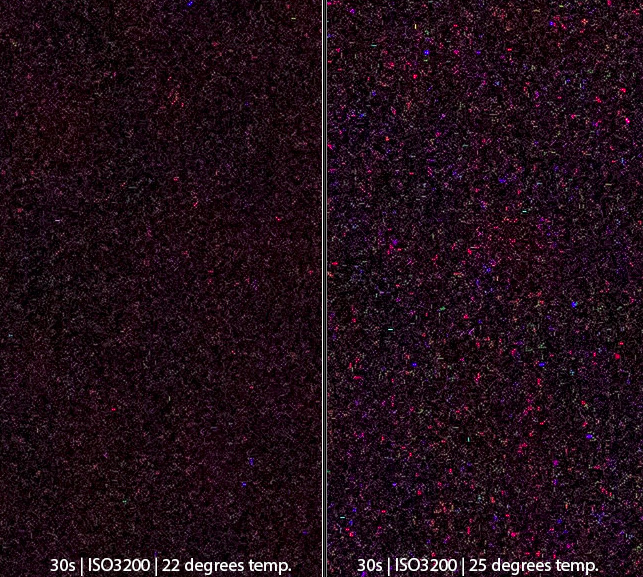
In another test, I lowered the "ambient" temperature and it did make a difference. On my first test, I had my room temperature at 25 degrees celsius. I lowered to 22 degrees to see if that would makes any difference and it did. (see crops below)
That suggests a small 3 degree drop in ambient temperature plays a big role in the results and that is why we are seeing some many difference results.
Heat will affect all sensors and it has been a issue for a long time. That won't end but maybe using the A7r for astro stuff might not be a bad idea. Tell you right now , there is no medium format back that can go past 2 minutes in a CCD sensor, CMOS has changed things but I still don't think it's good for Astro work like some are doing here.
I forgot to mention that there is zero difference between 30s/ISO3200 when compared to "bulb" 30s/ISO3200 even after the loss of precision (14 to 12 bits). I could post the crops but they are visually identical at 1:1.
Also 1:1 crops posted here were pushed 3EV from ISO 3200 which is a very extreme test for real world shooting. I expect to see way better performance in low temperatures at more normal settings like ISO 1600 to 6400. (without any further push) even without LENR. If I were shooting ISO 100 up to a minute, I would not even turn LERN on. And, yes, if you have a A7R as well, it may be your preferred long exposure camera.
Of course, my comment was meant to be tongue and cheek, but this is what the astro people do with their huge refactor setups. That was a canon rebel in the cooler.
Guess I'll just stick with my wonderful A7R version 1 for now. It's a great camera for me and I can save money by not upgrading right now.
Not being a LR user, myself, (I use PS CS 5.5) I have a couple of questions regarding your techniques using this software in these tests for general clarification purposes...
First, "Pushed +3EV" was accomplished using the Exposure, Brightness, selective tonal ranges using the Histogram, or Tone Curve?
Second, that any of the first three methods were used why were they favorable to direct gamma adjustments available using the latter method? (As I understand it, the histogram in LR is not a direct analogue to the Gamma adjustments available in PS Levels? And LR Tone Curve is not the same as PS Curves?)
And a point of curiosity...the LR manual states, "You may see a tone curve that isn’t straight when you first view a photo that you haven’t adjusted. This initial curve reflects default adjustments that Lightroom applied to your photo during import."...do these dark frames exhibit a non-straight curve on import?
I'm just trying to get a clear sense of what these testing methods reflect and how they compare/correlate to PS adjustments. Any and all insights and education here would be greatly appreciated!
Matt Grum wrote:
I'm going to update my A7R II on Saturday - if anyone wants any specific before and after tests shooting (preferably that can be done indoors), let me know!
I shot the tests you suggested but things got a little busy for me and the last thing I had to do before I left for a trip was upload the images but I somehow didn't manage...
I'm back home on Saturday so I'll get it done then!
I hereby release all copyright claims to these images
dgdg wrote:
ISO 800, 4 minutes, LENR OFF, bulb, FW1.00
ISO 800, 4 minutes, LENR OFF, bulb, FW1.10
I'm afraid I didn't manage this test - only realised when I was about to do the upgrade that I didn't have a timer remote with which to do a 4-minute exposure. I can still do the "after" images when I do get a remote.
Body cap on test at ISO 100, exposure pushed +5 in LR
- 30s
- 30s on continuous shooting (invoking 12 bit mode)
- 30s on bulb
I did all the above on firmware 1.10, then 2.00 compressed, then 2.00 uncompressed
Hot pixels, I can't see a difference. Less general red noise on the uncompressed versions.
Note that there is a fine line here.. I first did the 2.00 tests immediately after upgrading, and the showed hotter pixels and slightly more noise, then re-did the test an hour later after the camera had been doing nothing then got the results described.
I did the same at ISO 3200 (pushed +3) and can't see a difference at all.


 . Have you done any ISO 800 shot so far?