Vern Dewit wrote:
I spent 5.5 hours from 21:00 to 02:30 Saturday night freezing my __s off in -15 degree temps with wolves howling in the distance in the middle of nowhere to witness the most intense meteor shower I've ever seen - the Geminid. I saw between 150 and 200 meteors or more. Unfortunately I wasn't 100% prepared and couldn't do "Bulb" mode on my A7S yet (I couldn't get the star trails app due to the camera not having the latest FW and I don't have my remote yet - it's on the way! ).
I still managed to capture some meteors and Aurora Borealis and had a fantastic night anyway. Sleep in my truck afterwards was a bit chilly though... I'll process some more photos tonight but here's a couple - both taken with the A7S and Leica Tri-Elmar-M WATE at f/4, 30s, ISO 8000 for the northern lights and 51,200 for the meteor. The green in the meteor shot is the northern lights sneaking into the shot.
First image with the A7 and an adapted Minolta 45 f/2. Transferred to my iPad and edited with PicTapGo as a quick test. The focus peaking on this camera makes for quick work of MF lenses.
rji2goleez wrote:
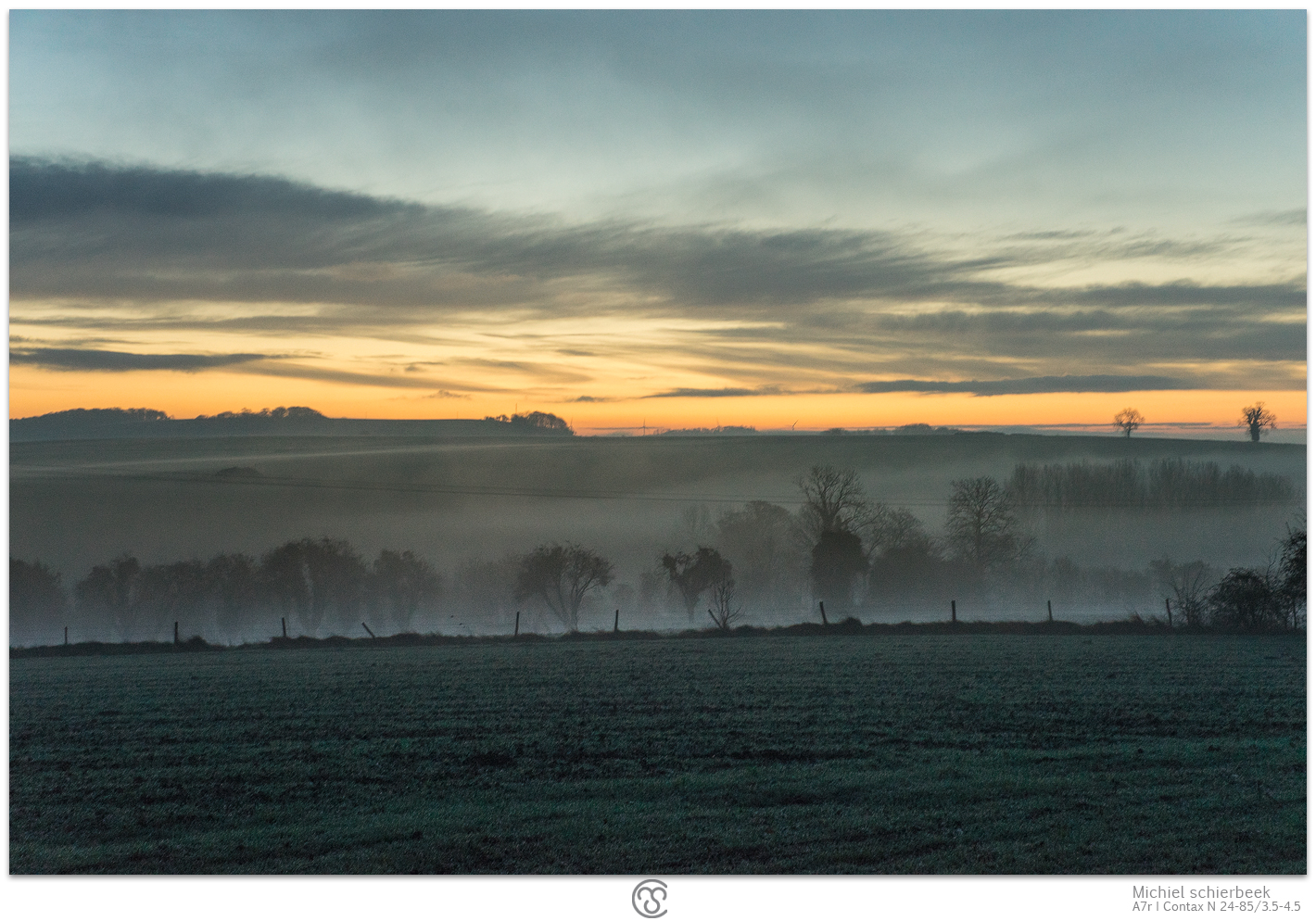
First images with the A7II mounted with the Minolta MD 35-70/3.5, the first at f/8 the second f/3.5. Lots of experimenting to do. Anyone know off hand if it's advisable to turn off Steady Shot when on a tripod?
Bob,
The steady shot should be turned off for tripod use for maximum sharpness. You may get perfectly sharp photos, but there is a chance of steady shot causing blur. The steady shot (lens or camera-based) or any optical stabilization system can potentially create motion blur if it's stable on a tripod (the system is constantly trying to detect motion and may move the sensor/element due to small errors in the motion sensors or over corrections due to minor wind movement which tends to occur infrequently). Hand held results in almost constant movement of a certain frequency. The tripod won't have the same frequency or consistency of motion, so the tuning is probably off for tripod usage. Manufacturers could probably provide a third switch position with different tuning for tripod use, but I suspect they feel that it's a feature that most photographers wouldn't use (we'd just get a heavier tripod to keep the camera from moving).
My OM lenses have a beautiful red flare ring (continuous) that this reminds me of...It definitely works and looks great with some photos. I like it in your photo.
A few days ago, A7r, C/Y 18/f4 Distagon at f11 (I think). That is not the sun in the middle, it was still below the horizon!
Tripod without legs extended, in reality those rocks are small but have been exaggerated by the short lens. Must use waterproof footwear if I try this again
It's what I figured and a very unscientific single shot seemed to bear that out.
Thanks.
carlsote1 wrote:
Bob,
The steady shot should be turned off for tripod use for maximum sharpness. You may get perfectly sharp photos, but there is a chance of steady shot causing blur. The steady shot (lens or camera-based) or any optical stabilization system can potentially create motion blur if it's stable on a tripod (the system is constantly trying to detect motion and may move the sensor/element due to small errors in the motion sensors or over corrections due to minor wind movement which tends to occur infrequently). Hand held results in almost constant movement of a certain frequency. The tripod won't have the same frequency or consistency of motion, so the tuning is probably off for tripod usage. Manufacturers could probably provide a third switch position with different tuning for tripod use, but I suspect they feel that it's a feature that most photographers wouldn't use (we'd just get a heavier tripod to keep the camera from moving).
Any early thoughts on the A7II sensor coatings/processing of the image? In particular, do the sensor reflections still occur in night or twilight shots when the highlights are blown? Does jpg help vs raw (implying software correction)?
Any shots with longer lenses and the body steady shot turned on? Impressions?
Tempted, but waiting for more shots. Early review shots showed no sensor reflections on some shots that I thought would have triggered it.
Any early thoughts on the A7II sensor coatings/processing of the image? In particular, do the sensor reflections still occur in night or twilight shots when the highlights are blown? Does jpg help vs raw (implying software correction)?
Any shots with longer lenses and the body steady shot turned on? Impressions?
Tempted, but waiting for more shots. Early review shots showed no sensor reflections on some shots that I thought would have triggered it.
Todd
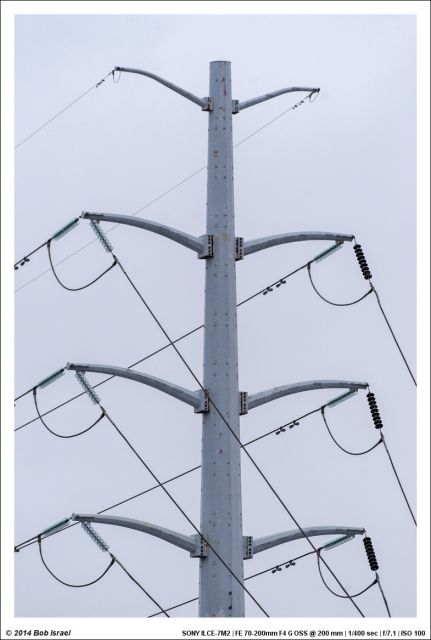
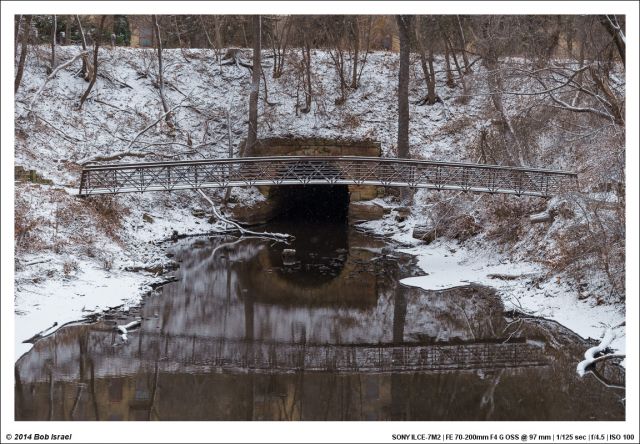
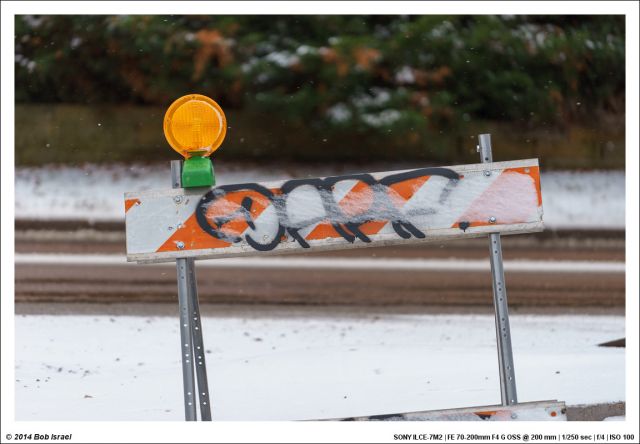
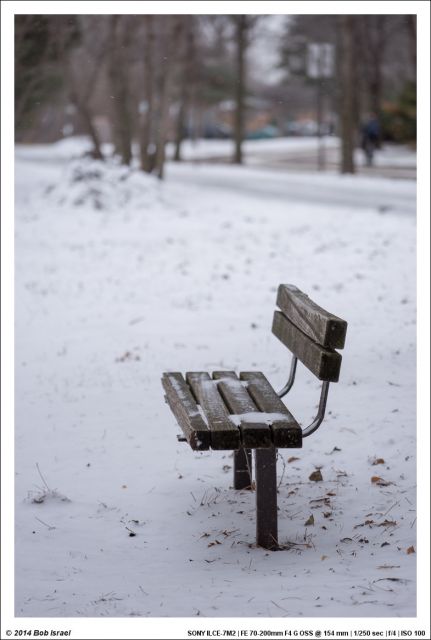
The camera just arrived last night and I have had little ability to do more than a couple of shots. However, I just received the 70-200/4 today. With this lens, you can really 'feel' the steady shot/IBIS in action. I haven't had a chance to try something with a slow shutter speed but coming from an A7r, the whole AF thing is so much better. With the 70-200/4 it all handles like a small yet very responsive version of the 5DIII with 70-200/2.8L. IBIS really steadies the shot at 200mm, so much so that I could probably focus manually very easily.
The shot above is my only night shot on a tripod at low ISO so it's too early to say much about reflections. I will be trying more soon and with a variety of lenses. In the meantime, here a couple of quick snaps with the 70-200/4 while walking the dog (not the greatest way to test out a new lens!).
As for the camera itself, I really like the feel of the new grip and button location. The addition of a 4th custom button is also welcomed. The quieter shutter, compared to the A7r 'feels' better too. Looking foward to really testing this body further.




 ).
). I'll process some more photos tonight but here's a couple - both taken with the A7S and Leica Tri-Elmar-M WATE at f/4, 30s, ISO 8000 for the northern lights and 51,200 for the meteor. The green in the meteor shot is the northern lights sneaking into the shot.