fredmiranda.com
Login

Moderated by: Fred Miranda
  New fredmiranda.com Mobile Site
  New Feature: SMS Notification alert
  New Feature: Buy & Sell Watchlist
  

FM Forums | Leica & Alternative Gear | Join Upload & Sell

1       2       3              7              9              16       17       end
  

Archive 2013 · Digital Medium Format / 35mm equiv difference


Krosavcheg
Offline
• • • •
Upload & Sell: Off
p.8 #1 · Digital Medium Format / 35mm equiv difference


Joakim: I am all ears - this is rather interesting!


Aug 19, 2013 at 05:00 AM
RustyBug
Online
• • • • • • •
Upload & Sell: On
p.8 #2 · Digital Medium Format / 35mm equiv difference


Krosavcheg wrote:


rather than me going over the edge in technicality I want to use necessary skill to pick my gear that will leave me concentrating on the light and composition.

Getting to a place of confidence in one's gear is a component in liberating oneself to where the real difference comes into play ... the vision and command & control necessary to generate/produce that vision. In some instances, the need for a sharper saw is pertinent, in other instances not so much.

Yesterday I pruned some 1" limbs with my Leatherman instead of getting a different tool from the garage. By most accounts, it was the not the "best" tool, but it still got the job done to my satisfaction and needs. I'm rather confident and comfortable with what I can do with my Leatherman. A master gardener would likely only be using Fiskars or some other finely purpose fitted tool. But I certainly didn't feel the need to go buy one.

Personally, I am very confident in my Kodak SLR/C (with it's duly noted foibles) and my 1D MK II N. They will never compete on a technical basis with a $100,000+ MF setup and a team of PP experts that someone like Annie uses. Nor will they compete on a technical basis with Blad's on a 60MP back. But even though I'm shooting on arcane gear @ vintage 2004, I am comfortable with my gear such that it allows me to focus on my subject/light study and evaluate it relative to my lens selections for a given vision goal.


Photography shouldn't be about prancing about choosing angles and complaining that you wish you had a better gear, Working with models should not have you talking CFA, Interpolation, LoCA, DOF - you need a social skill to direct them.

Amen @ social skill vs. technical. But, in order to liberate yourself to attend to them, you have to be able to forget about your gear ... see above @ confidence in your gear.

As long as I don't have gear that can produce results I need I can't concentrate on other things - it's just impossible to chase 4 rabbits at the same time!

Repeat @ confidence in gear/technique associated with the gear. I'm as confident in my SLR/C as I am the hundred year old wheelbarrow I got from my grandfather. The wheelbarrow is a tank made of steel and not plastic. Yet, it handles everything I throw (literally throw) at it. My wife, she much prefers using our lighter wheelbarrow. If she tries to use the larger one, she gets bogged down by the bulk of trying to maneuver with it. If I try to use the lighter one for heavy duty work, it slows me down because I have to be more careful to "place" items in it so it doesn't tip over. They both can get the job done, but I'm more "liberated from concern" (i.e. more confidence) about the larger one tipping over than the smaller one as I'm tossing stuff at it.

I saw Canon shots - amazing stuff hands down, but not my cup of tea, I saw Nikon D800 shots - Super! But not what I want. I see NEX shots - amazing! but you guessed it..
Then I see people shots with MFD and this is what I want.


There is going to be a difference between NEX and MF that's for certain. Diff sensor's @ diff profiles and responses to DR etc. Personally, I'm inclined to believe that the other part of the diff is the fact that the optics generating the projected image have been designed for such a different sized image circle. Kind of like shooting with a 12 gauge shotgun vs. a 410, the barrel variance produces two very different patterns of buckshot projection as they "fan out" at different rates. As long as you're on target, both can hit their mark. But they certainly require a different level of skill/accuracy to produce a winning shot.

But then I look through the model shots I took and something is just not there:

I'd need to review more of your model shots, but ... contrast and falloff in the lighting are likely more significant than choice of camera as to what it is that you're not pleased with. I think that the fact that you are seeing shots with MF that are pleasing to you is also accompanied by lighting that you find pleasing. The skillful use of lighting that accompanies the talent of those shooting MF gear is often times lost in the assessment, with many folks giving immediate credence to the camera ... forgetting how critical a role the light plays.

But I do believe there is a right camera for the job!

And then there are those who would advocate that any camera will do.

There is a myriad of options to which tool(s) to use. I've got some really nice woodworking tools that I thought would help make me a better woodworker. While a good tool is more of a joy to use than a mediocre one and it liberates me from thinking about the tool as much ... I've still not put forth the study and practice into woodworking that can produce the works of talented woodworkers that use good old tools. From that, I know that I am the weak link, not the tool.

True story ... I set out to make finely crafted cutting boards. My tools were chosen and used to produce pieces within .001 inch of tolerance. My first cutting board fell apart because my improperly aligned grain structure orientation along with a non-interlocking layout caused the glue joints to fail. My second board warps because of grain structure alignment issues when it gets wet (flattens back out when it dries). Different species of wood intermixed (very attractive) at different lengths created different tensions. So much for being worried about .001 fine detail capable tools.

I really needed to be worried about my knowledge of wood more than my .001 capable tools. So it is with our knowledge of light and processing vs. our camera selection. Until we understand the utilization of light and processing to achieving our goals for our vision, the tool may not be the reason we aren't getting the results we desire.

Getting a different tool only matters if the tool itself is the limiting factor. Tool mfr's always have a new tool that will make you a better carpenter ... a good carpenter ignores the new tool rave and keeps using his good tools that he has developed a confidence in. Yet he also knows the difference between a rip saw and a finish saw.

Evaluating which tool is right for a given individual and given application is a highly subjective and debatable topic ... but, imo the ".001" capable camera is rarely as important as your vision and your knowledge of light and pp/finishing. To some, this will sound like a weak attempt to justify not getting MF gear and minimize the diff it makes. But think about it this way ... if you took away the MF camera from those who are shooting what you like and handed them a FF camera instead, would they still be able to produce their good works based on their command & control of lighting, processing and their vision, or would they no longer be able to do it, claiming that it was all because of the camera?

Rambling @ perspective ... but, HTH.


Aug 19, 2013 at 07:47 AM
Krosavcheg
Offline
• • • •
Upload & Sell: Off
p.8 #3 · Digital Medium Format / 35mm equiv difference


Rusty: This is certainly a conversation for a moment..
If you ever find yourself in the vicinity - it's on me..


Aug 19, 2013 at 09:38 AM
RustyBug
Online
• • • • • • •
Upload & Sell: On
p.8 #4 · Digital Medium Format / 35mm equiv difference


Krosavcheg wrote:
Rusty: This is certainly a conversation for a moment..
If you ever find yourself in the vicinity - it's on me..


If you'll take care of the plane ticket, I'll take care of the


Aug 19, 2013 at 11:02 AM
Krosavcheg
Offline
• • • •
Upload & Sell: Off
p.8 #5 · Digital Medium Format / 35mm equiv difference


Rusty: take a canoe over, it does the job..


Aug 20, 2013 at 08:35 AM
RustyBug
Online
• • • • • • •
Upload & Sell: On
p.8 #6 · Digital Medium Format / 35mm equiv difference


Trans-Pacific canoe trip ... I should have thought of that. Much more relaxing that a noisy plane.


Aug 20, 2013 at 10:55 AM
burningheart
Offline
• • • •
Upload & Sell: Off
p.8 #7 · Digital Medium Format / 35mm equiv difference


Very interesting thread. A lot of terrific information.


Aug 20, 2013 at 02:36 PM
carstenw
Offline
• • • • • •
Upload & Sell: Off
p.8 #8 · Digital Medium Format / 35mm equiv difference


Krosavcheg wrote:
Then I see people shots with MFD and this is what I want.


And is the difference the MF camera, or the people who use them? It is possible that it is the camera, but I would be surprised if it is that simple.

Here is one of my 5DC shots with a model (2 light setup) taken some 3 years ago (I am honoured someone actually blogged it.)

Great shot! If you can do that, then why can't you get your skin tones under control? I will repeat that i think that artificial lighting can sometimes give more natural results.

I don't think there is a camera that is perfect for everything and I don't quite believe it will ever be made (time will tell). But I do believe there is a right camera for the job!

But if you buy it now, will it make a difference now? My experience is that it won't. Its like jumping up in the air before you get to the end of the jumping board. Like I said, if you really want to do it, and your mind is blocked when using the 5DIII, then go ahead, but it will not solve any problems you might be having with the process. Medium format cameras are very hard to get the most out of. Even just exposing correctly and focusing could take quite a while to master. And you can't just pop things into Lightroom and pull a couple of sliders, the software chain is very different. Making the move now might set you back 3-6 months, before you get to the same level of proficiency you have with your existing equipment.


Aug 20, 2013 at 04:26 PM
Guari
Offline
• • •
Upload & Sell: Off
p.8 #9 · Digital Medium Format / 35mm equiv difference


Love this thread. Always a pleasure to read you guys.

Joaquim, also always a pleasure to read your ramblings, spot on..


Aug 20, 2013 at 04:58 PM
theSuede
Offline
• • • •
Upload & Sell: Off
p.8 #10 · Digital Medium Format / 35mm equiv difference


Krosavcheg wrote:
Joakim: I am all ears - this is rather interesting!


Regarding the Clarkvision site...
He uses a very strange mindset while presenting things, even though he shows some actual figures about some stuff, most of it is used out of context with regards to "an image". And unfortunately he hasn't really grasped the definition of the word "exposure", or maybe more importantly what it IMPLIES with respect to an image (exposure is a point value, and an image is an area...). I put this down to being a scientist within a neighboring field, just learning how to apply his knowledge on a new and fairly advanced physics system...
It is in no way easy to actually CONNECT knowledge of physics and actual image results.

See for instance the part where he compares a 1Dmk2 vs a compact camera (at the same exposure no less!) and comes to the conclusion that "small pixels are bad". He never once reflects on the fact that giving a 550mm˛ sensor and a 40mm˛ sensor the same exposure results in that the larger senor received almost 550/40 = 14x more light... The fourteen times larger area makes the difference, not smaller pixels. Even if the smaller camera had the exact same pixel size as the larger camera, the result had been the same.

After that he goes on to present some "unity gain" figures, and emphasizes that the unity gain is lower for smaller pixels. Yes, it is, but that's a totally useless merit of a parameter. To get something useful out of that merit, you either divide by pixel area (and get a version of QE), or you divide by read noise (and get some kind of read noise per photon merit). In itself, unity gain is as useless as the aperture value. Having a F1.8 lens on a smart-phone camera does not give you the same low-light shooting performance as F1.8 on a FF camera. The aperture value is also a merit that needs a partner, something to define the ramification of its' use.

Then in the "split exposure" where he compares one 1s exposure to the combined result of 64 1/20s exposures without mentioning that smaller pixels always have lower read noise, and that he could have repeated the shorter exposures a thousand times without getting lower noise with the averaging method he used... So it's kind of a skewed comparison.
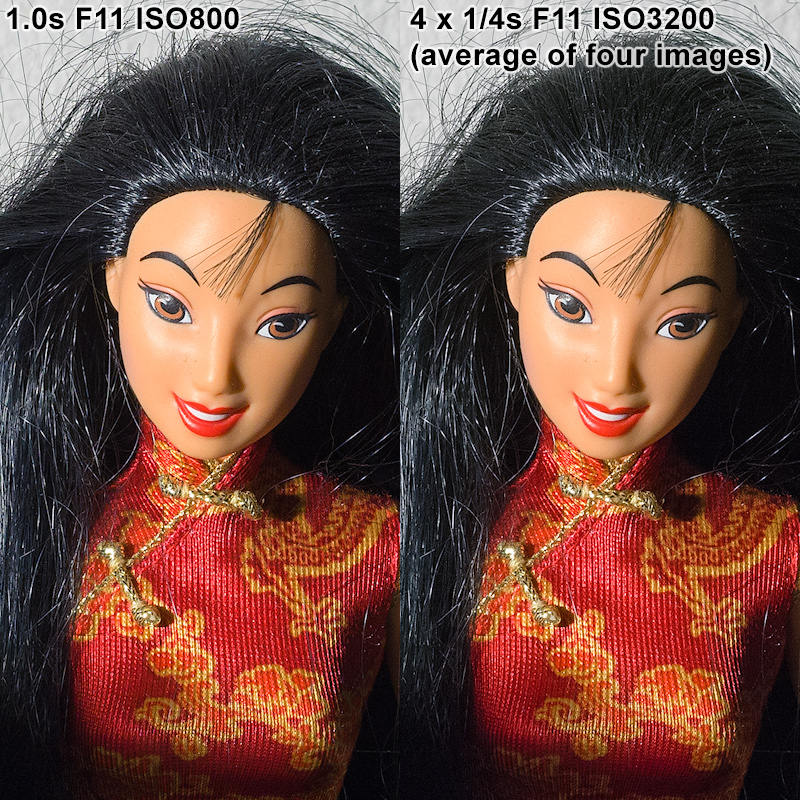
Especially since he COULD have kept it VERY simple and compared one 1s exposure to the average of four 1/4s exposures - with a lot less work. That would still set the combined shorter exposures at a disadvantage (less exposure without the small pixel read noise advantage), but the difference would have been close to zero anyway.

Here's that comparison "done right", though only at ISO800... D800 + 50/1.8 @F11, about 71% image scale (18MP image before cropping). My trusty desktop model had to weather some really crappy fluorescent lighting for this one, but came through well as usual.

To really push the visibility of any differences, I added a LOT of shadow lifting, and then I added a LOT of contrast in Photoshop while cropping. The 1/4s exposures combined should have a small disadvantage (four read noise sources added in the end result), but I actually don't think it's that visible.


This is exactly like using 4x smaller area pixels (4x more MP on the sensor), but without any efficiency losses and with more read noise.
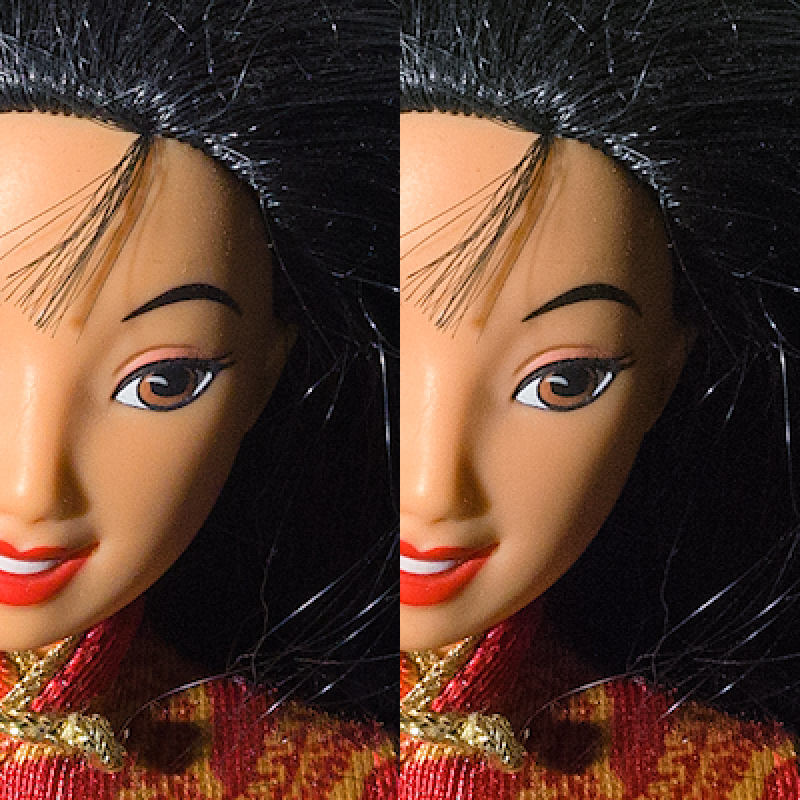
Here's a 200% view from the image. There IS a difference, but I don't think it's that noticeable.


The reason I mentioned it was that it's quite important to know what's what if you're out hunting for "better performance" in your images. Or at least - it's important to stay well away from the worst mistakes! They cost a lot, both in money and in time.


Aug 20, 2013 at 06:36 PM
theSuede
Offline
• • • •
Upload & Sell: Off
p.8 #11 · Digital Medium Format / 35mm equiv difference


This has been an interesting discussion, and it has allowed me to re-evaluate some of my normal "Duh.... I know this...!" opinions. Which is a good thing every now and then...

From your text (and from your images!) I think I've identified two of your problems with the images you produce today. One of them is SLIGHTLY connected to format, the other is totally disconnected.

Well, to the point(s).
The first point:

Talk about "smoothness" and "gradation" is often not really productive, since people don't specify exactly WHAT about the words they mean. The word "smoothness" in an image - what does it mean? And "gradation"?
IMO both words are often subconsciously meant to be understood as "detail within a contrast gradient". To get that elusive "smoothness", you often need to have visually EVEN and UNIFORM internal small detail contrast in all zones of the image. And that was a totally unreadable sentence, phew. Hm... That is:

You want something you KNOW to have some kind of surface structure in reality to look as if that known surface structure is "believable" and realistic - in the image! - no matter if the material is in a highlight, a mid, or a shadow zone. You know the structure is uniform, therefore you need the image to reflect that. If it doesn't, the image lacks both "3D" and "believability". It is also somewhat connected to what many call "microcontrast" - they're two sides of the same coin.

This was the point where format CAN be of importance. MF does have a better uniformity in most images already in the capture, for two reasons - you often use longer lenses (good), stop down more (good) and magnify the result less (also good). If the light conditions are there, then this is easier the better the system is. But it DOES still demand a competent hand in PP work - the detail is there, and it's well defined, but you have to know how to use it.

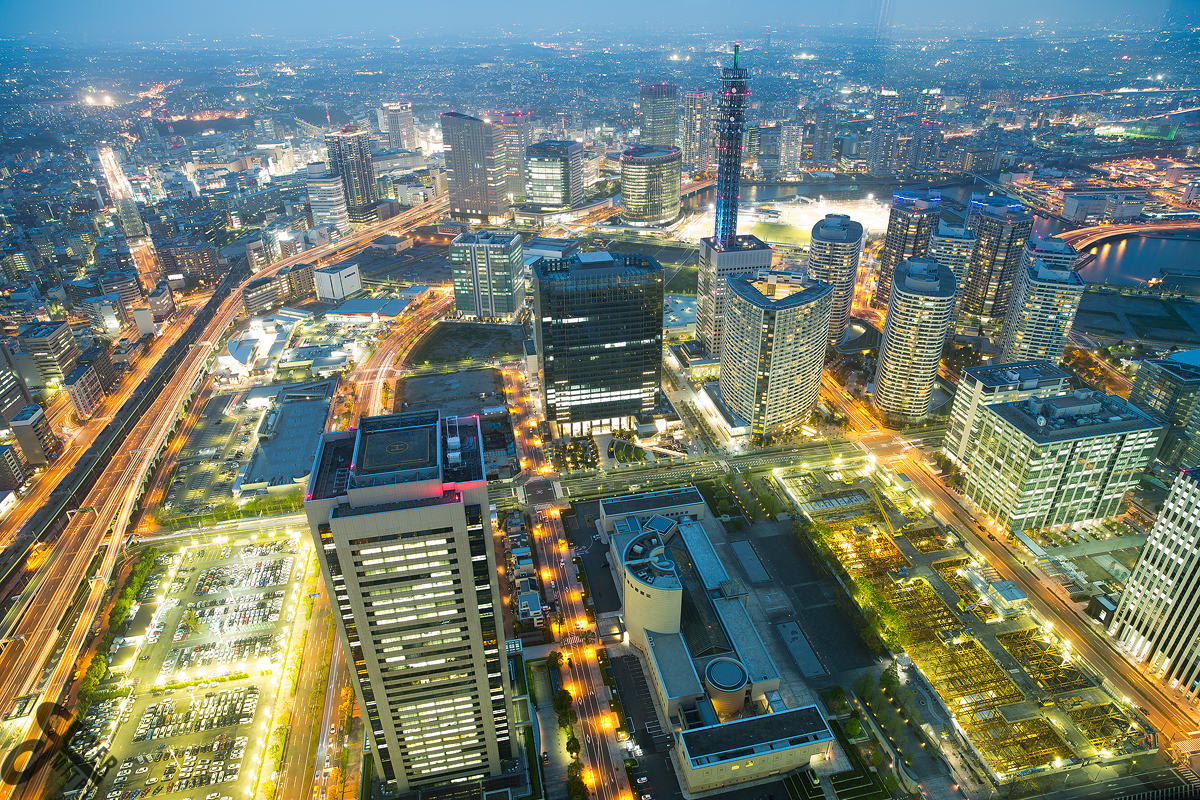
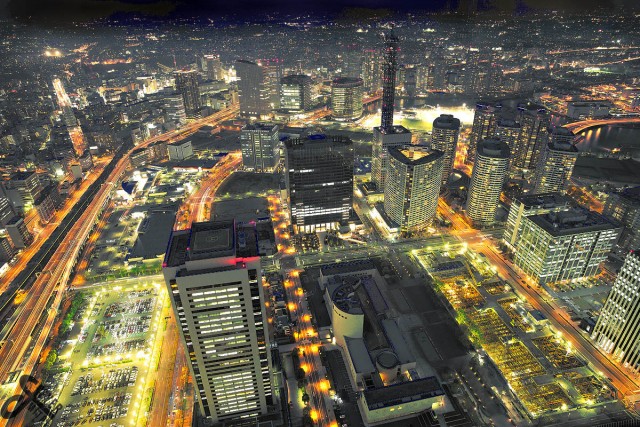
I could use a non-human shot to illustrate this, your cityscape from earlier. Compare those two, one is the original, and one is with some highlight detail contrast re-built.

Original:


Re-built highlight detail, internal shadow detail:


To do this you have both CAPTURE and WORK the image so that detail from highlight to shadow is available, and believable. With models, this goes for color too - skintones and detail have to be balanced, and the "wraparound" detail must also be believable - from deep shadow all the way up to the highlights.

The other point:

You mention that you "see" the image you want in reality, and that you see also see detail and smoothness (and colors!) that you fail to translate into an image output.

This is perfectly normal...

In reality you don't really "see" anything. What you look at is your brain's second-hand interpretation of what your eyes report! Where this gets really tricky is in mixed light scenarios. Your brain sorts this out like a thousand-part stitch where each and every detail in the "brain image" gets its' OWN perfectly white balance little island of ramifications. This means that you don't "see" mixed lighting the same way in reality as when you see it on a screen or on print.

On screen and on print, you see the full image much better, it's a smaller field of view that's covered by the image (unless you mash your face up 30cm from a 30" screen). And your brain can no longer take in the visual clues that it needs to correct for different light temperatures from the surroundings of the scene and apply local WB corrections to separate details. You've basically stripped away all the information your brain uses to make your visual reality in everyday life a more pleasant place to live in.

Part of being a good photographer - either instinctively or by training - is the ability to totally shut that image-correction filter in the brain OFF. Being able to see reality as the camera would see it, i.e NO beauty filter on by default. Just what there is, nothing more and nothing less.

To actively TRY to do this enables you to see mixed lighting and cast colored bounce fill lights - and lighting setups in general - in a totally different and new way. Your eyes work just as they should, it's your brain that's messing stuff up. And you can control that.


Aug 20, 2013 at 07:32 PM
Krosavcheg
Offline
• • • •
Upload & Sell: Off
p.8 #12 · Digital Medium Format / 35mm equiv difference


I think at some junction back where I posted examples we took different turn at traffic lights - Work critique (which I am absolutely not interested in) and How Stuff Works (which was original meaning).

To emphasize again - look at the Zack Arias blog and note the transition from light patches and dispersing light on the wall - this is transitions I mean.
Now if you look at my NSFW shot and notice the light to dark transition on the wall - this is what I DON'T want. I.e I want to keep soft transitions in light within the image but not at the cost of washing out the contrast.

If you look at Eugenio's portfolio and in particular example with the male model (just for the love of god, leave the PP out of this!!!) - think what kind of light source you would need to light the wall that softly. Please, please, please disregard the model in the shots - lighting him was easy part.

Another reason to that is I want to limit PP to skin processing rather than breaking my head how I can get more tonal data in the image and get a rich colour - I want that as close as possible in capture.
Now, if you tell me that 14bit pixel data on a 35mm equivalent sensor can do that - I am all content and will start poking around with PP instead.

Joakim: I think I prefer my PP - the correction looks oversharpened to me. Or perhaps I keep listening too much to others and become stale in order not to make anything sharp to avoid this?
I also would like more colour in the shot plus bottom right looks baked (it appears to me anyway). No offense meant - but it became too sterile.

Btw, you said that Hassy back photo is nearly impossible to mimic? So, how is it possible for me with a 5Dm3 to improve my PP to mimic it?

On the shooting, you mean I should just be calculating technically and just forget about what I want to create?
In other words, you want to say that colour perception is absolute? I.e it doesn't matter how we perceive the colours as long as they are technically correctly captured?
Wow....that puts entire Renaissance era into rubbish bin....Actually, forget Renaissance...all human history of art except for the Malevich's Black Square - which is nearly perfect black technically.

Speaking of the article, this is a serious issue. It also have been quoted as reference in Wikipedia, so it seriously needs to be brought up to the attention!

Carsten: I find that with DSLR I need to double lights and diffuser sizes to get the softness that can be achieved with a single large octa on MF. Please, feel free to correct me, but why would I bring more light for each stop and then subtract in exposure just to double it again and subtract again to reach a soft effect?
Maybe it doesn't make sense, so let's look here:

The last shot of the model I posted was done with one octa to model's right and a bit above. Fill is a soft box. Let's say I needed to create softer light transition to shadows on her but I want shadows to stay same, so I make my source bigger or add more fill, but I still want to keep shadows in the same contrast, so I pull down my exposure, now I need to compensate to make the light softer, so I make my sources bigger again or add more fill, but I still want same shadows, so I bring down exposure....
Repeat as many times as necessary....

The shot of the model I posted was done in a confined environment with 2 average size diffusers and I am happy with it in that sense. Reason I posted it is to address Canon 350D + kit lens masterpieces or "it's not gear - it's photographer".
Here is the straight question: If you think it's shite - I will happily continue shooting until it can appeal to you. Only caveat is that there are many others who might find it lacking, so you think I should shoot in a way others think I should?
If you think it's good - I am happy, but I don't want to continue shooting these shots - just plonk a model arrange lights and push the button. It's just not interesting.

/end addressing posts/

Edit: One thing I notice about my shooting is that I need to definitely improve on my aperture control in terms of isolating subject without washing out the background. So far I been concentrating on aperture control of strobes...

So basically, what we so far agree on:

1. MFD is not different from 35 equivalent.
2. Image capture equipment doesn't matter - it's the person using it.
3. Colour/tone perception is absolute in relation to equipment (negates point 2).
4. Human perception is unimportant (negates point 2).

Correct?


Aug 20, 2013 at 08:58 PM
RustyBug
Online
• • • • • • •
Upload & Sell: On
p.8 #13 · Digital Medium Format / 35mm equiv difference


Disclaimer @ not ideal/complete, but for illustration/reference ...

While sooc color is variable between sensor mfr's and to some degree format, human perception vs. recorded capture vs. presentation can be an even more significant piece of the puzzle as well.

While my revision might be a bit much for taste/style, it serves to illustrate that the blue lighting that is captured, may not be the desired presentation for a black night sky. In an instance such as this ... the difference between formats will be largely irrelevant (as noted before by Joaquim) when it comes to the difference @ as seen and as thought to have been seen.

Granted this is a lighting/color issue ... but the point is that if I said that I shot this on MF and compared it to the FF version, people would think that the MF rendered more black and not give the credence to the PP work involved to achieve it. I realize that this is a bit off tangent from the issue of smooth tonal values, but it is offered to illustrate that the pieces of the puzzle, make up the final product.

Lighting
Projected Image
Capture Media
Algorithm/Profile/PP


Edited on Aug 20, 2013 at 10:10 PM · View previous versions


Aug 20, 2013 at 09:27 PM
Krosavcheg
Offline
• • • •
Upload & Sell: Off
p.8 #14 · Digital Medium Format / 35mm equiv difference


Rusty: Ok, it makes sense. So there is no difference except size then.

I am off to polish my PP...


Aug 20, 2013 at 09:32 PM
RustyBug
Online
• • • • • • •
Upload & Sell: On
p.8 #15 · Digital Medium Format / 35mm equiv difference


Well, I wouldn't so "no difference" at all. If that were the case, I wouldn't bother with shooting MF glass on FF camera or deciding to use a Zeiss vs. an Oly, as glass has different drawing styles and different levels of correction. Similarly, sensor's do have different DR / color response based on different mfr design and pixel density, etc. ... but sometimes those can be subtle compared to the impact from the other pieces of the puzzle.

But, I think until a person gets command & control over their lighting (stuff before the camera) and finishing (stuff after the camera) ... the camera format isn't the most critical factor that is hindering them from achieving their goals. Thus, I don't find the platform change to MF (from FF) to be the "holy grail" solution that some people think it is.

I'm not disavowing the significance of the larger pixels and larger real estate that comes with an MF sensor and the relaxed design of MF glass (I shoot it), but there is an element of "speck vs. log" that one should be wary of before putting $$$$ into MF as a potential solution to perceived problems with achieving their goals. The MF platform itself may not solve them or produce the intended results without the "Before Camera" and "After Camera" pieces of the puzzle being firmly in place first.


Edited on Aug 20, 2013 at 10:50 PM · View previous versions


Aug 20, 2013 at 10:00 PM
Krosavcheg
Offline
• • • •
Upload & Sell: Off
p.8 #16 · Digital Medium Format / 35mm equiv difference


I am confused now - there is a difference, but there is no difference?

A kit lens does the job + equipment is secondary = goal. Why pay the silly money for Zeiss 100/2, 135/2, 35/1.4 or M9 + glass if equipment is secondary?


Aug 20, 2013 at 10:12 PM
RustyBug
Online
• • • • • • •
Upload & Sell: On
p.8 #17 · Digital Medium Format / 35mm equiv difference


Let's try it like this.

I'm going to measure how far I have to canoe to get that

I've got a tree branch, a ruler and a micrometer. I count how many tree branches it takes to get there, until the tree branch is too big make the last measurement. Then I switch to the using the ruler to continue measuring, until all I have left to go is something smaller than the smallest mark on the ruler. Lastly, I switch to using the micrometer to get my final measurement.

How accurate is my measurement? Is there a difference between the tools and did it make a difference or not? If so, why? If not, why not?

A system is only as strong as it's weakest link (or something close to that for simplicity). If our lens is our weak link, going from 999,999 MP to 1,000,000 MP isn't going to improve much. If our lighting / WB is off, getting a Leica won't help us much either. If our PP is unrefined, new Profoto's won't do us much good either.

Before we can know what will make things better, we need to truly know what is holding us back. Is it the engine, the clutch, the transmission or the tires. Getting a bigger engine won't make a dragster faster if the tires are spinning too much already. Sounds like it would, but if that isn't the real problem, then neither is it the real solution to gains. But, putting in a smaller engine that doesn't spin the tires really isn't a step forward either. Getting tires with more grip or making an adjustment to how hard the clutch grabs might be where the answer is to getting down the track quicker. Difference vs. no difference.

There will always be a weakest link to the Nth degree somewhere in a system. The most gains can be made (typically) by improving the weakest link first. Then, there will be something else that is now the new "weakest link" ... and on it goes as you keep strengthening/improving each link. When will your system be strong enough for your needs ... well, that's highly variable, highly subjective, highly individual and highly debatable.


Edited on Aug 20, 2013 at 10:44 PM · View previous versions


Aug 20, 2013 at 10:22 PM
Krosavcheg
Offline
• • • •
Upload & Sell: Off
p.8 #18 · Digital Medium Format / 35mm equiv difference


Hey, it gets the job done - that's most important, or?

Ps you should start paddling now or you miss last order


Aug 20, 2013 at 10:26 PM
snapsy
Offline
• • • • • •
Upload & Sell: On
p.8 #19 · Digital Medium Format / 35mm equiv difference


Krosavcheg wrote:
Btw, you said that Hassy back photo is nearly impossible to mimic? So, how is it possible for me with a 5Dm3 to improve my PP to mimic it?

Here is a photo I took with a 5DM2 + 50mm f/1.4 EF lens. I'm not sure if it achieves the MF look of theSuede's example but to my eyes it's close. I did a lot of processing on this image to maximize the local contrast.

http://horshack.smugmug.com/Other/SanFrancisco/i-jBgS3rQ/0/X2/sf_241-X2.jpg

100% crop (this is a few miles away on an especially clear night):
http://horshack.smugmug.com/photos/i-FwfkXpp/0/O/i-FwfkXpp-O.jpg


Aug 20, 2013 at 10:39 PM
Krosavcheg
Offline
• • • •
Upload & Sell: Off
p.8 #20 · Digital Medium Format / 35mm equiv difference


Snapsy: It's a beautiful photo, but I can't tell if it was taken with MFD or DSLR.

I saw a whole thread of shots with technical cameras with variety of backs, but only 2-3 told me they were taking with MFD.
I can see it in shots like this:

This is an MFD shot

Here is similar lighting setup with DSLR.

Again, please....stop the PP/lighting emphasis!!!!


Aug 20, 2013 at 10:55 PM
1       2       3              7              9              16       17       end


FM Forums | Leica & Alternative Gear | Join Upload & Sell

1       2       3              7              9              16       17       end


Welcome back
Log in to your account