p.2 #1 · Digital Medium Format / 35mm equiv difference
carstenw wrote:
If you are thinking of buying a medium format back, be careful which you pick, not all are equally good, and not all combinations are solid. I had a Sinar e54LV on a Contax 645, and this combination wouldn't behave well (electronically), for some reason. The Phase backs are meant to be great on the Contax, and the Sinars work well on the Rolleiflex.
The Hasselblad is just a camera I couldn't love. It is a competent tool, although it has its fair share of crashes in my experience (like the others), but I could find no personality to love there.
I think one I could afford would be P45+. It should fit GX680III and RZ67IID. Leaf Aptus 7 is apparently a great option, but at nearly double the cost.
I am not quite a commercial shooter, making it a rather expensive way to reach personal gratification..
I hope Sony's FF announcement will indeed happen next month. If so, perhaps I could sell off some gear to fund a compromise having both a small walkaround camera and a MF digital for studio/location work...
Ed: Picking up a 2nd hand, how would shutter actuations affect the condition?
p.2 #2 · Digital Medium Format / 35mm equiv difference
Krosavcheg wrote:
Alundeb: absolutely. Their art makes photos stand out and not their gear, however the artistic approach will vary between all those I mentioned yet technical denominator exists across all of their portfolios.
Not saying that there are not differences, and a denominator. However, the difference in tonal range between FF and digital MF is subtle. Looking for it in these images, beneath TONS of lighting, processing, vignetting, make-up and style is like looking for the needle in the haystack.
Regarding sheer resolution, I have seen many comparisons on the internet that are really flawed. First, lens choice. Often we see a mid range Nikon zoom lens vs a Schneider 80 2.8. Why not use a high quality 50 mm lens?
Then, there is the AA filter. I use the Nikon D800E. Being used to the sharpness with the best primes at 100% crop, I got myself a shock looking at a crop with a Zeiss prime on the NEX5N the other day. It has the same pixel density, but an AA filter. I thought the lens was faulty. Had to cross-check, and the effect of the cancelling AA filter is that much.
And NOW, when these things are cleared out, we can start looking at diffraction. Many of the comparisons are both at f/8, which is skewing both DOF and diffraction. If f/8 is used for 80 mm on MF, then something like f/5.6 should be used for the D800E. This gives the same DOF and impact of diffraction in images at the same output size. Now, when everything is optimal with the AA-cancelled D800E, i can easily see that f/5.6 is sharper than f/8.
So most internet comparisons of sharpness have a three-fold obscuring of the sharpest 35 mm alternative.
I would love to use a Phase One IQ180, but the cost and inconvenience puts me off. Since I am that much interested in resolution, a 40 MP Digatal MF doesn't give enough over the D800E.
p.2 #3 · Digital Medium Format / 35mm equiv difference
Krosavcheg wrote:
MF for me stands out in model photography. Especially well lit scene looks rich in gradation within a tonal range. Skin does look exceptional.
Depending on what you mean by 'model photography'-- keep in mind that final output is more akin to photo-illustration than documentation aided by posed shots and controlled light.
Most of the commercial and model shooters I have known used extremely exactly standards to get a look shot right at the moment the shutter is fired-- spending days on a shoot, after scouting, doing test runs to work out lighting, having an AD and plenty of assistants, and working with a full-time makeup artist with experience in doing the work for photography.
EVERYTHING is shot in a way to allow the post house-- and yes, it almost always goes to a full-time post-house, filled with folks whose full-time job is to take in images and output advertisement photographs/illustrations-- the ability to work their magic.
You like the skin tones? Good, that's a combination of wild amounts of makeup, controlled lighting-- and a swatch of pre-shot skin tones/types/structures seamlessly playing together (along with some additional brilliant post moves) in a final image.
In other words: I think it's a bit more complicated than the camera being used-- or the photographer behind the camera-- if you're looking at final output for high-end, posed, model/commercial work.
p.2 #5 · Digital Medium Format / 35mm equiv difference
Justruss: you forgot stylists, set builders and prop makers.
I know you don't mean your post to be patronising, but I find it in that region. I am well aware of what goes into a shoot of that caliber as well as how much preparation needs to be done at the drawing board.
This thread is not about artistic aspect of it as much as about differences in image feels achieved through use of equipment.
If equipment didn't matter all those photographers would be shooting low end Rebels with kit lenses or iPhones (yes, I know there were cases of photogs showing off with iPhones. Exception to the rule.)
p.2 #6 · Digital Medium Format / 35mm equiv difference
So, in other words only differences between MF and "regular" cameras is MPX count only.
Is it what you are saying?
Subtle meaning not significant enough to pay much attention to.
I.e, my 5D MkIII equals Aptus Leaf II only smaller files? Neat!
Can't wait to take a photo like this: http://www.eugeniorecuenco.com/fichas/1358.html
Already got stylist and MUA as well as scouted a location!!
I am content with that - just wanted some information. For me it doesn't matter that much.
p.2 #7 · Digital Medium Format / 35mm equiv difference
No, that's not what I am saying.
With subtle, I mean like the difference you can see if you shoot the 5DIII at ISO 50 vs ISO 100, for tonal gradations. You can actually try that. Is the improvement you get worth it?
And regarding resolution / sharpness, the AA filter is more influental than people think.
The differences in color accuracy is not critical for me since I don't use models that way.
p.2 #9 · Digital Medium Format / 35mm equiv difference
So the differences are not that subtle after all.
We also need to keep in mind that people perceive details differently.
Believe me, I tried the other day and it just doesn't work. My gradation is not that smooth - I can clearly see transition between areas. Shot in natural light with large beautifully diffused light source...
I am up for the test though. If anyone can take MF and "regular" shot to compare side by side I would like to volunteer to identify MF.
If I am mistaken I will be relieved to know this is self induced "programming" and we can call it a day
p.2 #10 · Digital Medium Format / 35mm equiv difference
edwardkaraa wrote:
I would say that the differences are subtle at small print sizes, but the larger you print, the more evident the differences will become. IMHO.
Ed, but the viewing distance changes proportionally, or?
p.2 #11 · Digital Medium Format / 35mm equiv difference
Krosavcheg wrote:
Ed, but the viewing distance changes proportionally, or?
I can't remember where did I read that, but it seems with large print sizes, people tend to stand away in order to see the whole print in a glance, then step closer and inspect the details, just like what you do on a monitor screen
I am not talking about MP here, but the finer tonal separation and the drawing style of a MF lens on a MF medium. I personally was able to tell a print was done from a MF file even at a humble 8x10 size. During film days, I could see the difference even in a 4x6 print.
p.2 #12 · Digital Medium Format / 35mm equiv difference
alundeb wrote:
With subtle, I mean like the difference you can see if you shoot the 5DIII at ISO 50 vs ISO 100, for tonal gradations. You can actually try that. Is the improvement you get worth it?
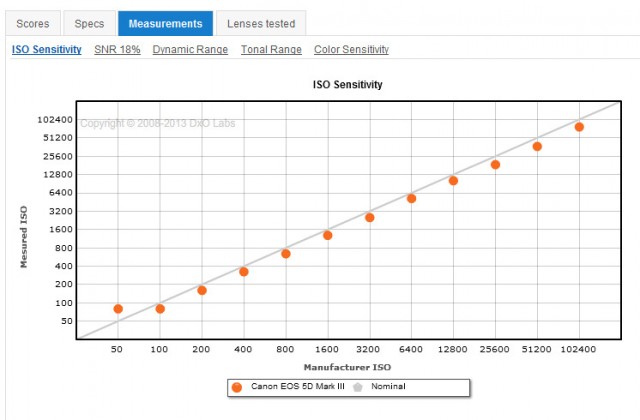
Is their any diff between ISO 50 and ISO 100 ... I thought that Canon's 50 is a false ISO, with both 50 & 100 actually being the same (both approximately 80 according to DXO testing).
p.2 #13 · Digital Medium Format / 35mm equiv difference
RustyBug wrote:
Is their any diff between ISO 50 and ISO 100 ... I thought (at least in the 5D & 5D II) that 50 is a false ISO, with both 50 & 100 actually being the same.
When they say it is the same, they mean that you can use ISO 100 and dial in +1 exposure comp and get the same raw file as using ISO 50. In both cases, you get more light into the image.
Important is that you actually need that extra light to get the improvement, as theSuede pointed out. Given that you shoot with the same DOF and shutter speed.
p.2 #14 · Digital Medium Format / 35mm equiv difference
I get that adding a stop of exposure compensation makes an equivalency. My point is that setting your camera to ISO 50 changes nothing with respect to the actual responsiveness. It just tells the camera to add in that same +1 EC (which emulates ISO 50) yet both record @ ISO 80-ish.
I shot ISO 50 to try and eek out the higher quality image for quite a while till I came to realize their was no actual diff between it and ISO 100 in terms of its sensitivity as they are both the same if you are shooting manual. If you are using the program, then it simply does the +1 EC to what is really the same as ISO 100, but then emulates ISO 50 ... i.e. a false ISO.
p.2 #15 · Digital Medium Format / 35mm equiv difference
It is really elementary what happens at ISO 50 with these cameras. It is not meant to be used as a shooting practice, but for a simple comparison of what happens with the tones you work with, at expense of some blown highlights in this experiment.
If you didn't see any difference in the image quality at ISO 50 vs 100, and given that you actually got twice the exposure, it serves as an opinion that the improvement in tonal gradation is really subtle.
p.2 #16 · Digital Medium Format / 35mm equiv difference
edwardkaraa wrote:
I can't remember where did I read that, but it seems with large print sizes, people tend to stand away in order to see the whole print in a glance, then step closer and inspect the details, just like what you do on a monitor screen
I am not talking about MP here, but the finer tonal separation and the drawing style of a MF lens on a MF medium. I personally was able to tell a print was done from a MF file even at a humble 8x10 size. During film days, I could see the difference even in a 4x6 print....Show more →
I can relate to that.
I spent a long time looking at one URBEX gentleman's blog and was able to deduct straight away that he was using film from 800x600px shots. In fact he did. Just a different feel to the photos - I can't really explain it.
Tbh, I can't really tell the difference between format sizes of film when they are downsampled.
Even looking at my scans I can't tell if it's a 35, 6x45, square or 4x6..
Here is a GW690 shot for instance: http://www.3byk.org/imgposts/film_scans/Ilford_SFX200-Nagano_08.jpg
But then I look at digital MF results and they just stand out to me. In a different way.
DLSR/mirrorless seems to be crisp and clear - almost like you can reach in and touch the subject, you know?
Then MF digital look like paintings to me...perhaps somewhat along surrealism...
Even the high contrast shots got smooth gradients in all frequencies..
p.2 #17 · Digital Medium Format / 35mm equiv difference
carstenw wrote:
I don't think so. The 135 format lenses are highly stressed design, maximising sharpness from a compact build. Medium format lenses are much more relaxed in their look. Large format even more so. You will get all kinds of aberrations in 135 lenses simply because they push the envelope so hard. In medium format, everything is much more moderate.
Exact the reason I need 'high performance', means get close to f2.8 performance at f1.4. so no stress. I was trying to address the difference is mainly DOF. With DFM, you can shoot f2 f2.8 get finer focus and tonal transition at same time keep image sharp, which is extreme hard to recreate with most 35mm lens. Some good Leica lens can approach MF closer like 50lux ASPH, 50Noct and new 55zeiss I hope.
For shooting aperture at f8, I don't believe there is 'bigger' difference at certain magnification than simple pixel counts difference.
Go through the link OP mentioned, I definitely feel 35mm can do the same thing at this size, since most of them are not shallow DOF. but might not meet file size requirement. The color is associate more with setup and PP than sensor to me.
p.2 #18 · Digital Medium Format / 35mm equiv difference
I want add, 35mm is not chosen because of it is optimized format for performance with current lens design tech and sensor performance(physics limit). But a format inherent from old age.
Thus, bigger format always has advantage for a given tech limit. There is no question about it. But how much you will benefit from Bigger format? For me, again, mostly, DOF or put it in other way, images performance at wider aperture. and pixel count for big print.
p.2 #19 · Digital Medium Format / 35mm equiv difference
We all want to justify that our own gear is good enough and stepping up won't make that big of a difference. I bet if prints are our end goal and we saw two prints of the same subject, one from 35mm and one from MF, I bet we would all choose the MF format print. That said there is a lot more to the equation than final print quality.
p.2 #20 · Digital Medium Format / 35mm equiv difference
andyjaggy82 wrote:
We all want to justify that our own gear is good enough and stepping up won't make that big of a difference. I bet if prints are our end goal and we saw two prints of the same subject, one from 35mm and one from MF, I bet we would all choose the MF format print. That said there is a lot more to the equation than final print quality.
Again, depend how big you print AND at what aperture.