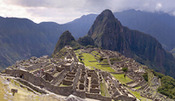
Photographer Jeff Cremer captured the highest resolution photo of Machu Picchu.
Machu Picchu is located in the Cusco Region of Peru, and it's one of the Seven Wonders of the World. It's often referred to as the "Lost City of the Incas".
I guess unattached body parts are not uncommon. I found another detached head bouncing down a stairway and a pair of legs from the knees down walking down another stairway. Found these while looking for the brown bunny that Sellerman mentioned! Haven't found it yet.
Yes.. Great for technology and all, but the end result couldn't be any more bland. There are soooo much better images from machu pichu... Heck, there are even better film images from there...
I do not see the merit on this. It makes me think, so what?
Once again Fred you amaze me with the breadth of the fantastic information you provide to us mere mortals, at my august age and infirmity it stimulates my brain more than most other sites on the web.
Guari wrote:
Yes.. Great for technology and all, but the end result couldn't be any more bland. There are soooo much better images from machu pichu... Heck, there are even better film images from there...
I do not see the merit on this. It makes me think, so what?
With all do respect I think your comment is like saying back in the 60s "going to the moon is great and all but what's the point?". IMO things like (doing things because we can) are the driving force behind research and development which translates into more techonological advancements.
Guari wrote:
Yes.. Great for technology and all, but the end result couldn't be any more bland. There are soooo much better images from machu pichu... Heck, there are even better film images from there...
I do not see the merit on this. It makes me think, so what?
If you don't have something nice to say....
Also, I bet there isn't a higher resolution picture out there.
It's a nifty photo. However, zooming as far in as the viewer allows puts you well past the level of real resolution in the image. My own rough estimates, from zooming out to what I'd consider reasonable resolution for a 100% crop and estimating the fraction of the whole scene, puts the "useful" amount of data in the image at ~1Gpxl --- the remaining factor of 16 just gives you blurry mush.
In other words, you should be able to get about the same actual image info (more quickly and with less processing/storage) by using a sharper wider lens (e.g. a 100mm, instead of a 100-400 @ 400mm); I suspect it would be even better, since I see a lot of areas where the imperfect corner performance of the 100-400 (which would be handily beat by, e.g., a 100/2.8L) creates blurry zones. Chasing after the "biggest number of pixels" is somewhat of an empty feat if 15/16ths of the pixels aren't worth viewing (though the remaining reasonably sharp 1Gpxl of panorama is still a not unimpressive feat).
mpmendenhall wrote:
It's a nifty photo. However, zooming as far in as the viewer allows puts you well past the level of real resolution in the image. My own rough estimates, from zooming out to what I'd consider reasonable resolution for a 100% crop and estimating the fraction of the whole scene, puts the "useful" amount of data in the image at ~1Gpxl --- the remaining factor of 16 just gives you blurry mush.
In other words, you should be able to get about the same actual image info (more quickly and with less processing/storage) by using a sharper wider lens (e.g. a 100mm, instead of a 100-400 @ 400mm); I suspect it would be even better, since I see a lot of areas where the imperfect corner performance of the 100-400 (which would be handily beat by, e.g., a 100/2.8L) creates blurry zones. Chasing after the "biggest number of pixels" is somewhat of an empty feat if 15/16ths of the pixels aren't worth viewing (though the remaining reasonably sharp 1Gpxl of panorama is still a not unimpressive feat)....Show more →
+1
Thanks Fred!
Reminds me of my trip there in the 1980's when they were still building the road from the railway station at the bottom of the valley next to the Urubamba river up to the Bingham hotel at Machu Picchu.
In those days if one wants to see Machu Picchu they'll have to hike a couple of days by trial and some were even robbed by gunmen while they were camping on the trial.
The spot that they mounted their camera is where we camped and slept waiting for the sun to rise behind us, lighting up Machu Picchu the following day.
It is a great sight watching the sun rise over it, and I have a couple of rolls of slides taken with my Nikon F3T which I still have in my collection.
We even climbed up to the peak of the famous Huayna Picchu behind Machu Picchu by ropes to take pictures of the sunset, but it is risky coming down in the dark even with head lamps. Now a days they close and lock up the place in the evening so there is no way one can stay behind to watch the sunset. At the peak there is only space for two to three people standing but not sleeping, one rollover will land you at the bottom of the vertical peak.
Nice going back to memory lane.