gbohannon wrote:
Georg - thank you for sharing this! Very helpful for me. I started reading up on developing last night.
Georg did a great job of explaining things. My setup is very similar, but a bit more streamlined. As I don't have the luxury of having a dedicated space for a darkroom, I use a bathroom counter and sink for my developing. I only use one-shot developers and fixers because I just don't have the space to store mixed chemicals and hate messing with replinishers. Been there, done that and won't do it again. I only use liquid developers and fixers. This allows me to mix only what I need for each session.
I don't use a chemical stop bath, either. You can read for yourself all of the arguments both pro and con, but I choose not to use it. Water works just fine for me. After pouring out the developer, I fill the tank with water, invert a few times, and empty. I repeat once or twice and then move on to the fixer. I used a chemical stop bath for years and don't see any difference in my results since switching to water.
Also, I only use steel reels...not because they are better than plastic, but because it's what I learned on. I have used plastic and they are considerably easier to use. However, steel is just as easy once you figure out how to do it. It just has a greater learning curve.
I try to remember to stop rewinding film in the camera once I feel it pop off of the take-up spool. This allows me a cut off the leader in the daylight, making it easier to make a straight cut. However, it's really not the difficult to do in the dark, either. The leader has to be removed before winding the film on reels.
Good luck and let me know if you have any questions. I'm glad to help. Just like with photography, each person has his own processes that work for him. I'm glad to share mine and to learn better ways of doing things from others.
spoupard wrote:
Georg did a great job of explaining things. My setup is very similar, but a bit more streamlined. As I don't have the luxury of having a dedicated space for a darkroom, I use a bathroom counter and sink for my developing. I only use one-shot developers and fixers because I just don't have the space to store mixed chemicals and hate messing with replinishers. Been there, done that and won't do it again. I only use liquid developers and fixers. This allows me to mix only what I need for each session.
I don't use a chemical stop bath, either. You can read for yourself all of the arguments both pro and con, but I choose not to use it. Water works just fine for me. After pouring out the developer, I fill the tank with water, invert a few times, and empty. I repeat once or twice and then move on to the fixer. I used a chemical stop bath for years and don't see any difference in my results since switching to water.
Also, I only use steel reels...not because they are better than plastic, but because it's what I learned on. I have used plastic and they are considerably easier to use. However, steel is just as easy once you figure out how to do it. It just has a greater learning curve.
I try to remember to stop rewinding film in the camera once I feel it pop off of the take-up spool. This allows me a cut off the leader in the daylight, making it easier to make a straight cut. However, it's really not the difficult to do in the dark, either. The leader has to be removed before winding the film on reels.
Good luck and let me know if you have any questions. I'm glad to help. Just like with photography, each person has his own processes that work for him. I'm glad to share mine and to learn better ways of doing things from others. ...Show more →
Scott - thanks to you too! I love all the help and information freely shared on this thread. I am going to read up for a week or so as time allows and come back with questions
leighton w wrote:
Now, how do you know I was talking about you?
I saw the reference to CA and knew you had to be talking about me since Rafael has been in absentia of late. I have no idea who the "head blabbermouth" might be...
CGrindahl wrote:
I saw the reference to CA and knew you had to be talking about me since Rafael has been in absentia of late. I have no idea who the "head blabbermouth" might be...
Georg, thanks for the detailed description of your film processing workflow. As with your description of shooting with a P.C. lens, this information really should be bookmarked for future reference. Personally, I don't expect I'll be taking this path, but clearly others who frequent this thread are exploring such options. Given these lenses were all made for film cameras, I guess is makes perfect sense that some among us would want to shoot with classic film cameras. Have fun everyone... and be careful playing with chemicals...
David, it is a great pleasure seeing your work on the thread once again. Those are very dramatic shots. I imagine you might find a few folks prepared to thin their herd and make lenses available for you. Scott is just across the border from you in Rochester, so he could be a logical contributor if he has a spare... I really enjoy your contribution to the thread, so I hope you can work it out.
I usually develop two rolls of 135/36 together in a stainless-steel-tank. My copy is from Kindermann. Similar tanks are available new and used.
The pictured example will hold 2 reels filled with 35mm-film or a single reel for 120-type medium-format film in 16 fl oz (450ml) of developer.
I use 2 graduated jugs and 2 cheap funnel, each labeled for use of either developer or stop-bath/fixer. For larger tanks I have larger measuring-jugs, also 2 examples labeled/dedicated with a permanent-marker.
Many folks are using digital thermometers; I'm still happy with an old-style one ("Paterson Colour Thermometer", shown in the protective plastic tube at the bottom of the picture).
A cheap kitchen-timer is used to time the individual steps.
I prefer dedicated film-clips over clothespins.
The "Ilford"-thingy attached to the film-canister is a film-picker to get the leader out of a film-canister. Some people prefer to open the canister with a "bottle-opener-like" device. But this has to be done in the dark.
It's also possible to be careful when rewinding the exposed film into the canister to make the leader stay out.
My F5 can be set up to do this and at least one of my F90x (N90s) was programmed by the Nikon-Service to stop the rewinding-process after the "important part of the film" is back in the can.
I prefer plastic-bottles to store the stop-bath and the fixer, but glass-bottles for the developer.
To the chemicals needed do develop film at home:
The selection of different developers available today is fairly confusing. In most cases I use Kodak Xtol (most of the time diluted for one-shot-use) and Rodinal (the same receipt is available under different names).
But thats just a matter of personal preference. I stay away from expensive developers or stuff with a rather short shelf-life.
The stop-bath (to stop the development-process and to keep the following fixer longer alive) can be stuff from Ilford, Kodak, Adox or simple diluted citric-acid.
For low-strength-developers like highly diluted Rodinal a stop-bath is not really required - a couple of seconds in water are enough.
Today I prefer to use fairly high concentrated fixer and short fixing-times over the classic fixer mixed from powder. I use a two-stage fixing-process, more on this on request ;-)
After carefully rinsing the fixed film (still on the reels), including tanks, caps and my hands too I "wash" the films by filling the tank with tap-water, put the cap on again and inverse the tank like I did during the development.
5 inversions and a short rest-period, empty the tank, fill it with water again, this time 10 inversions and a couple of minutes rest.
And so on. Ilford recommends 3 cycles (if my memory serves) and I use 5-8 cycles with fresh tap-water, inversions and a resting time.
Exact timing is not needed here, you can do this while watching TV and change water/do some inversions during the commercial breaks ;-)
The final step is to give the film (still on the reels/spools) about 30 seconds or a minute (it doesn't matter at all) in distilled water.
After this final bath the film can be unwound from the reel and hung-up for drying.
An alternative to the classic stainless-steel-tanks are the plastic tanks and reels made by Jobo. The 1510 (bottom left) will hold one roll of 135/36 or two short rolls of 135/12.
The red clips is a simple stopping-device to protect the short films from overlapping.
The 1520 (bottom right) is for two reels of 35mm-film or one reel filled with 120-type-medium-format film. The reel/spool can hold a 220-type film or 2 120-type film (the red clip is really useful here too).
The 1540-tank is just a 1510 with extension-tube - for 4 reels of 35mm-fim.
And the fat tank is for 5 reels of 135/36, for sheet-film, for medium-format-film or a mixture of the different formats.
It's made to be used on a Jobo-processor or on a roller-base (I've used the big one a lot in the pre-digital-era).
The color-coded measuring graduates are from my Jobo-processor - I use the small 1510-tank with the dedicated graduates when I have to develop just a single roll of 135/36.
The Jobo-tanks can be filled and emptied much faster than my stainless-steel-tanks and loading the film onto the reels is faster for me too, but somehow I prefer the "haptic" of the stainless-steel-stuff.
I've used other brands of plastic-tanks too, but for me the Jobo-system is the "best in plastic".
To measure up Rodinal or other liquid developer-concentrate I use either a syringe or small measuring-graduates.
I've bought a set of "Kolbenhubpipetten" (sorry, couldn't resist to confuse the brave MFNG-folks
- that's a graduated piston pipette, not pictured here), but those things are to beautiful to be used in the lab ;-)
Please let me know if there are any questions. And I'm happy to edit the text above.
1st edit:
https://c1.staticflickr.com/5/4204/34826441336_cea8675911_z.jpg
This very cheap rinsing-tub (from Ikea) can be used to organize/store the chemicals during the development. It could also serve as device to hold the bottles in a water-bath for temperature-control.
I place the tank during resting-periods next to the sink on a sponge cloth. This place is just occupied by fixing-trays right now ;-)
A sponge-cloth is always within reach. A towel for my hands and another for glass/plastic too.
I don't use beverage-bottles (and other stuff used in the kitchen) in the lab. The plastic-bottles from JOBO pictured here are hoarded old-stock and pretty expensive today. To use well-made bottles/measuring jugs and so on pays off on the long run....Show more →
Georg,
RESPECT! You must have time on your hands....
Brings back fond memories of my University days and time spent in the darkroom. I used to develop my own B&W film in my rented bedroom and use the Uni's facilities for printing. Alas, I have no wish to return to the old ways. On that nostalgic note here is a picture I have just taken of a print of 'The Who' I made in 1981 when they played at the Edinburgh Playhouse. The print sits in my in-tray as a constant reminder to go and find the negatives from the period when I first got into photography. I know all my negatives are stashed away somewhere in the attic of my house and I really should go find them in order to scan them properly.
Too many things to do with and not enough time.....
So, Pentax K1000 + 50mm f/2 lens ---> Probably Ilford paper and chemicals --->D610 & 55mm 1.2
I realized when I was making the post above for Dave, that we have TWO Scotts who need to be accounted for. I just checked your profile Scott P. and have to say there is no such thing as "Too many manual focus lenses..."
My recent sabbatical led to my missing a great many posts, as well as the coming and going of new as well as old friends. I've no doubt you were welcomed when you arrived on this thread. Judging from your registration date, which was 10 months before I arrived AND your very low post total, I'm going to guess that you came to this website for the Buy and Sell forum. It took me about six years to find a home on the Nikon forum which has led to a few extended conversations. Perhaps you're finding your way of being engaged on this wonderful site. I note your first post on this thread was with the announcement you'd just picked up a 200 f/4 Q for $30. That is exactly the spirit of this thread! I paid $88 for a mint condition copy of the Q.C. version with the Nikon AI conversion kit installed. We have a great many manual focus lenses in large measure because they are so inexpensive.
Happy shooting Scott. Enjoy those lenses and enjoy your time on this thread. There are some great folks hanging out here...
I have a few tips for you developing developers....
I used HC110 with great results, dil B IIRC.
Don't use D76, it blocks up highlights.
Shoot for a development time of 6 to 10 minutes, shorter tends to give uneven results. Same with single reel tanks, you are better off with 2 or more for more even development.
I prefer stainless steel tanks and reels. Test your reels by rolling them across a table top, you can detect a bent one because it will wobble. Even slightly bent reels load with difficulty.
I finish off with a final rinse with a photoflow solution. Clean your tanks and reels after using photoflow with hot water because it will leave a gummy residue that make loading difficult.
I don't like using clips on reels because it can interfere with my loading technique. Start winding the reel by bowing the film and wind the reel so it starts loading the film. You can detect if the film is loading correctly by pushing and pulling the film slightly onto and out of the reel, the film should freely move a bit if you have not kinked it.
Master the art of loading 35mm film before trying 120/220, the MF is about twice as hard.
Wow, with all that verbiage, maybe Fuji will make a camera that runs on hot air!
CGrindahl wrote:
I saw the reference to CA and knew you had to be talking about me since Rafael has been in absentia of late. I have no idea who the "head blabbermouth" might be...
HCE HCE wrote:
I have a few tips for you developing developers....
I used HC110 with great results, dil B IIRC.
Don't use D76, it blocks up highlights.
Shoot for a development time of 6 to 10 minutes, shorter tends to give uneven results. Same with single reel tanks, you are better off with 2 or more for more even development.
I prefer stainless steel tanks and reels. Test your reels by rolling them across a table top, you can detect a bent one because it will wobble. Even slightly bent reels load with difficulty.
I finish off with a final rinse with a photoflow solution. Clean your tanks and reels after using photoflow with hot water because it will leave a gummy residue that make loading difficult.
I don't like using clips on reels because it can interfere with my loading technique. Start winding the reel by bowing the film and wind the reel so it starts loading the film. You can detect if the film is loading correctly by pushing and pulling the film slightly onto and out of the reel, the film should freely move a bit if you have not kinked it.
Master the art of loading 35mm film before trying 120/220, the MF is about twice as hard.
Wow, with all that verbiage, maybe Fuji will make a camera that runs on hot air!
Ai-S 55/2.8 Micro MIJ 3+ CRC to 1:2, 52mm filter 179041 179421 - 600814 421774 Dec 1979 -
gbohannon wrote:
According to the Complete Nikon System book I have, the Micro Nikkor 55mm f/2.8 AI first production date of Dec 1979 Serial numbers begin with 179041.
Says the AIS version of the Micro Nikkor 55mm f/2.8 appeared in February 1980 with the beginning serial number 186211, although lower numbers are known.
CGrindahl wrote:
I realized when I was making the post above for Dave, that we have TWO Scotts who need to be accounted for. I just checked your profile Scott P. and have to say there is no such thing as "Too many manual focus lenses..."
My recent sabbatical led to my missing a great many posts, as well as the coming and going of new as well as old friends. I've no doubt you were welcomed when you arrived on this thread. Judging from your registration date, which was 10 months before I arrived AND your very low post total, I'm going to guess that you came to this website for the Buy and Sell forum. It took me about six years to find a home on the Nikon forum which has led to a few extended conversations. Perhaps you're finding your way of being engaged on this wonderful site. I note your first post on this thread was with the announcement you'd just picked up a 200 f/4 Q for $30. That is exactly the spirit of this thread! I paid $88 for a mint condition copy of the Q.C. version with the Nikon AI conversion kit installed. We have a great many manual focus lenses in large measure because they are so inexpensive.
Happy shooting Scott. Enjoy those lenses and enjoy your time on this thread. There are some great folks hanging out here... ...Show more →
Thank you for the warm welcome! I've been around awhile, but have to admit that I haven't done a great deal of contributing. Although I've always had a love for photography, other interests and family had caused me to put it on the back-burner, so to speak. Now that my children are grown, my wife has started to show an interest in photography. This has really reignited my passion, as well. I have also rekindled my love of film and all that goes with it. I'm sure you'll see me around a bit more.
I saved the text along with the photos, and the links, as a Word document, just in case that awful message eating script rears its ugly head here again.
CGrindahl wrote:
Georg, thanks for the detailed description of your film processing workflow. As with your description of shooting with a P.C. lens, this information really should be bookmarked for future reference. Personally, I don't expect I'll be taking this path, but clearly others who frequent this thread are exploring such options. Given these lenses were all made for film cameras, I guess is makes perfect sense that some among us would want to shoot with classic film cameras. Have fun everyone... and be careful playing with chemicals...
We'll have to nominate you as secretary of the thread Laura, though with the services you provide the whole Nikon forum you may more accurately be the secretary for the whole forum.
You might want to create a PDF of that material so it could be easily shared with anyone who is interested... just a thought.
Day 3 of rain and I am itching to get back out shooting in the longer daylight.
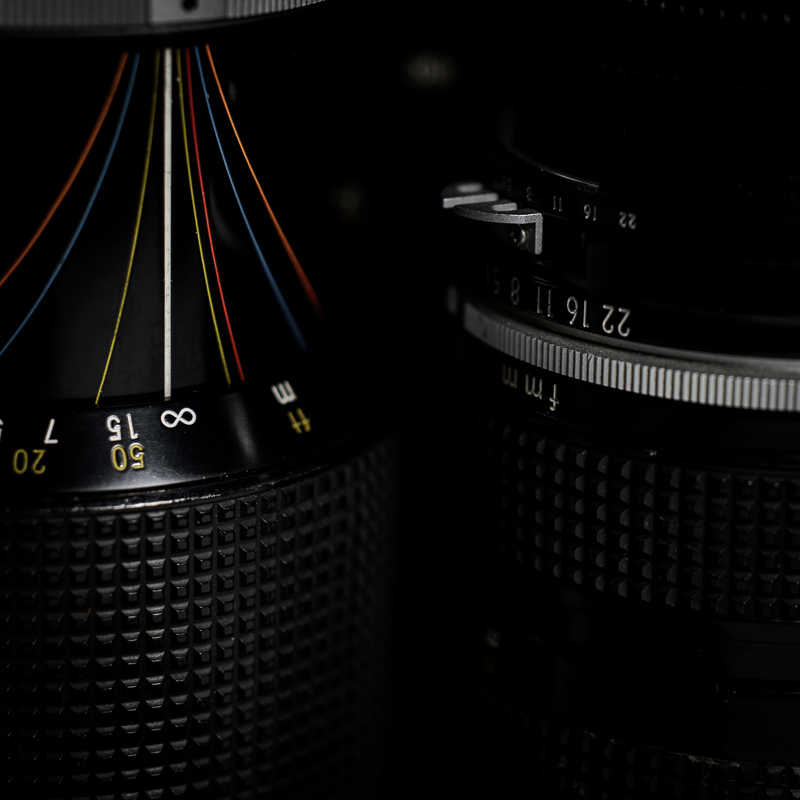
So as I was going through some of my lesser used lenses I grabbed this shot and thought we can do a round of "Guess the lenses". See, told you I was bored.
So, if you want to play, make your guesses for the two lenses in the picture below.
What do you win? 1/2 lb of my home roasted coffee. May be a challenge to send overseas, so if you are participating across the pond, you get my virtual handshake.
These shots are from Picture Rock Pass in central Oregon, named for the boulder with petroglyphs right beside the old wagon road over the pass. There are numerous petroglyphs and other Clovis period aritfacts in this area. In many places the ground is littered with obsidian chips from arrowhead knapping, but they might be from more recent Paiute inhabitants. None of the sites are marked so as to discourage vandalism. Just wandering around in the area turns up many interesting finds.
Wikipedia states: “No one knows when the Picture Rock Pass petroglyphs were created or who carved them. However, they were probably created during either Clovis Period (10,000 and 12,000 years ago) or the Stemmed Point Period that followed (7,500 to 10,000 years ago), placing the likely period of the rock carvings sometime between 7,500 and 12,000 years ago.” https://en.wikipedia.org/wiki/Picture_Rock_Pass_Petroglyphs_Site
The last shot is the old wagon road that crosses the modern highway at the summit of the pass.