So here is my final installment of the early days of the Jesuits among the tribes here.
As I mentioned last time, the Black Robes, led by Fr. De Smet arrived in Montana's Bitterroot Valley south of Missoula in 1841. In short order, De Smet started branching out - heading west to the Coeur d'Alenes, establishing a presence there, that ultimately ended in Fr. Ravalli coming from Montana to built the church there, that I featured last time.
They also struck out to the north. By 1854 they had established a mission in what is now the town of St. Ignatius. In 1855 the Treaty of Hellgate established the Flathead Reservation north of Missoula so the center of catholic activity moved north. They built quite a complex at St. Ignatius. From the guidebook on the church I am showing below is this paragraph: "In the following years it was home to the first Jesuit theologate and industrial arts school in the Northwest, the first Catholic Sisters and Catholic school in Montana, and the first hospital, sawmill, flour mill, printing press, carpenter shop and blacksmith shop in the Mission Valley".
Here is an old historic photo I scanned out of the guide book. I would guess this was taken in the late 1880s:
A new, brick church was built in 1891, the same year the army came into the Bitterroot Valley to round up and escort the remaining Bitterroot Salish out of the Valley, and up, onto the Reservation (~90 miles by foot).
At some point during the late 1800s, or maybe early 1900s, all these wooden building burned down during a span of 30 years. Only two small log cabins remain from that time - the original cabin for the founding priests and a later cabin for the first Sisters.
log home by Doug Stevens, on Flickr
Nikon Df; ISO 100; Nikkor 35mm f2 AIS @ f8; 1/100 sec
In case you can't read the sign on the cabin it says: "This log cabin built in 1854 was the first home of the missionaries". The cabin behind was for the Sisters.
Mission ext by Doug Stevens, on Flickr
Nikon Df; ISO 100; Nikkor 50mm f2 pre-AI Auto-HC @ f8; 1/250 sec.
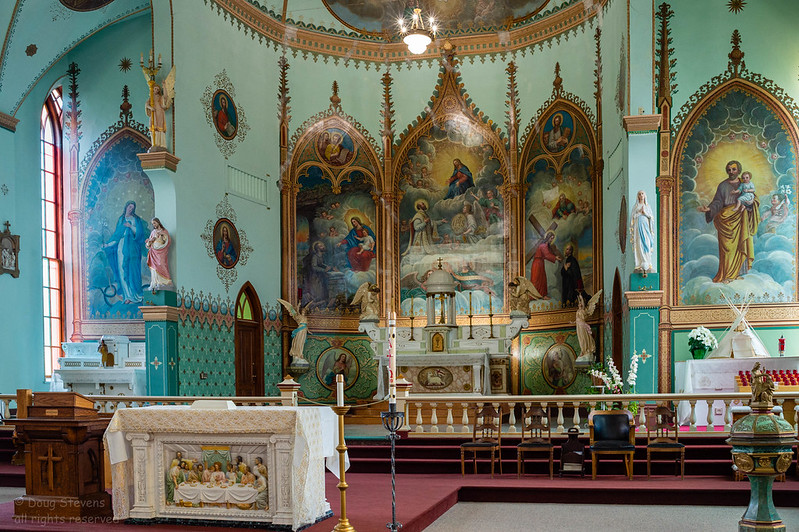
There are two interesting attractions to the church. First, "The interior of the church contains 58 murals and medallions painted in the early twentieth century. The artist was Brother Joseph Caignano, an Italian Jesuit who spent many years as the cook and handyman at the Mission. With no professional training in art...he completed his work in between his regular jobs."
aisle by Doug Stevens, on Flickr
Nikon Df; ISO 3200; Nikkor 35mm f2 AIS @ f16; 1/8 sec
altar by Doug Stevens, on Flickr
Nikon Df; ISO 3200; Nikkor 35mm f2 AIS @ f16; 1/8 sec
Secondly, the church features portraits of both Jesus and Mary as Native M&J St_Ignatius MT LR by Doug Stevens, on Flickr
Nikon Df; ISO 1600; Nikkor 50mm f2 pre-AI Auto-HC @ f5.6; 1/25 sec.
So, that's my "Montana Black Robe Trilogy". I hope it entertained some of you!
As a side note (if you made it this far), you can see I really pushed the ISO on the interior photos - as high as 3200 and the Df handled that with aplomb! Also, I was quite pleased by the "sun stars" from the 35mm f2
graytrekker wrote:
Black Robes in Montana - Part 3
So here is my final installment of the early days of the Jesuits among the tribes here.
As I mentioned last time, the Black Robes, led by Fr. De Smet arrived in Montana's Bitterroot Valley south of Missoula in 1841. In short order, De Smet started branching out - heading west to the Coeur d'Alenes, establishing a presence there, that ultimately ended in Fr. Ravalli coming from Montana to built the church there, that I featured last time.
They also struck out to the north. By 1854 they had established a mission in what is now the town of St. Ignatius. In 1855 the Treaty of Hellgate established the Flathead Reservation north of Missoula so the center of catholic activity moved north. They built quite a complex at St. Ignatius. From the guidebook on the church I am showing below is this paragraph: "In the following years it was home to the first Jesuit theologate and industrial arts school in the Northwest, the first Catholic Sisters and Catholic school in Montana, and the first hospital, sawmill, flour mill, printing press, carpenter shop and blacksmith shop in the Mission Valley".
Here is an old historic photo I scanned out of the guide book. I would guess this was taken in the late 1880s:
A new, brick church was built in 1891, the same year the army came into the Bitterroot Valley to round up and escort the remaining Bitterroot Salish out of the Valley, and up, onto the Reservation (~90 miles by foot).
At some point during the late 1800s, or maybe early 1900s, all these wooden building burned down during a span of 30 years. Only two small log cabins remain from that time - the original cabin for the founding priests and a later cabin for the first Sisters.
In case you can't read the sign on the cabin it says: "This log cabin built in 1854 was the first home of the missionaries". The cabin behind was for the Sisters.
There are two interesting attractions to the church. First, "The interior of the church contains 58 murals and medallions painted in the early twentieth century. The artist was Brother Joseph Caignano, an Italian Jesuit who spent many years as the cook and handyman at the Mission. With no professional training in art...he completed his work in between his regular jobs."
So, that's my "Montana Black Robe Trilogy". I hope it entertained some of you!
As a side note (if you made it this far), you can see I really pushed the ISO on the interior photos - as high as 3200 and the Df handled that with aplomb! Also, I was quite pleased by the "sun stars" from the 35mm f2
rafaelcasd wrote:
Thank you Doug for sharing this interesting history and excellent photographs, beautiful paintings in the church.
I am well versed in the Franciscan history of California, this is quite interesting as well.
And thanks, Rafael, for indulging me in my photo-story.
I am a story teller at heart and I feel caught between two art forms - photography and writing. I don't know if I write to supplement my photos, or photograph to supplement my writing. I draw on both to tell my stories. To hijack an expression: I am a jack of both and master of neither
Doug, keep story telling.
Rafael, always enjoy your maritime shots. I'm always intrigued by the Zumwalt class ships.
James, "Thank you Grasshopper" brought a smile to my face.
More green stuff in the background, 55mm f2.8 Micro.
Doug the primary reason for our road-trips is to see and learn about our past. For example a long one day drive replicates a two-three month trip on the Chisholm Trail in the 1870’s. I marvel at the fortitude of the people then. Life was an adventure. I marvel at Missionaries crossing Lake Superior by small boat or canoe. We traced Lewis & Clark from its start to the finish. I cannot imagine the hearty people who did it first.
So thanks for the series! You provided me another place to visit.
graytrekker wrote:
Black Robes in Montana - Part 3
So here is my final installment of the early days of the Jesuits among the tribes here.
As I mentioned last time, the Black Robes, led by Fr. De Smet arrived in Montana's Bitterroot Valley south of Missoula in 1841. In short order, De Smet started branching out - heading west to the Coeur d'Alenes, establishing a presence there, that ultimately ended in Fr. Ravalli coming from Montana to built the church there, that I featured last time.
They also struck out to the north. By 1854 they had established a mission in what is now the town of St. Ignatius. In 1855 the Treaty of Hellgate established the Flathead Reservation north of Missoula so the center of catholic activity moved north. They built quite a complex at St. Ignatius. From the guidebook on the church I am showing below is this paragraph: "In the following years it was home to the first Jesuit theologate and industrial arts school in the Northwest, the first Catholic Sisters and Catholic school in Montana, and the first hospital, sawmill, flour mill, printing press, carpenter shop and blacksmith shop in the Mission Valley".
Here is an old historic photo I scanned out of the guide book. I would guess this was taken in the late 1880s:
A new, brick church was built in 1891, the same year the army came into the Bitterroot Valley to round up and escort the remaining Bitterroot Salish out of the Valley, and up, onto the Reservation (~90 miles by foot).
At some point during the late 1800s, or maybe early 1900s, all these wooden building burned down during a span of 30 years. Only two small log cabins remain from that time - the original cabin for the founding priests and a later cabin for the first Sisters.
In case you can't read the sign on the cabin it says: "This log cabin built in 1854 was the first home of the missionaries". The cabin behind was for the Sisters.
There are two interesting attractions to the church. First, "The interior of the church contains 58 murals and medallions painted in the early twentieth century. The artist was Brother Joseph Caignano, an Italian Jesuit who spent many years as the cook and handyman at the Mission. With no professional training in art...he completed his work in between his regular jobs."
So, that's my "Montana Black Robe Trilogy". I hope it entertained some of you!
As a side note (if you made it this far), you can see I really pushed the ISO on the interior photos - as high as 3200 and the Df handled that with aplomb! Also, I was quite pleased by the "sun stars" from the 35mm f2
Actually got the camera out and did some shooting at the local zoo. Haven’t shot in 3 years, save for a few clicks here and there. Can’t share here as it’s 100% Fuji. I’m just glad I got out. The itch is starting again.
rafaelcasd wrote:
Beautiful set Riccardo - Thank you for posting, love that deep red cinquecento.
Thanks, that FIAT 500 is very old and in perfect shape, with leather interior. According to the license plate number the car shoul be older than my AI 50/1.4!
kwoodard wrote:
Actually got the camera out and did some shooting at the local zoo. Haven’t shot in 3 years, save for a few clicks here and there. Can’t share here as it’s 100% Fuji. I’m just glad I got out. The itch is starting again.
Kevin, good to hear from you here! Glad you are well enough for the itch!