nikt wrote:
Damn. I'm surprised Ricoh beat Fuji to the release of a lens/sensor unit. I was expecting Fuji to announce theirs next year but maybe they'll do it early.
With the Fuji you'll be able to use lenses and sensors designed for Infrared light and another unit designed for black and white with monochrome sensors and no AA.
I wonder if Ricoh will follow the same path.
Fuji's expected to have a Micro-4/3rds camera for PMA 2010. No weird stuff but rather straight up m43 with a Fuji sensor (which may also be the E-5 sensor now that the E-5 got pushed back to next year and changed from a E-3 with E-P1 sensor and processing to a real upgrade).
mawz wrote:
Fuji's expected to have a Micro-4/3rds camera for PMA 2010. No weird stuff but rather straight up m43 with a Fuji sensor (which may also be the E-5 sensor now that the E-5 got pushed back to next year and changed from a E-3 with E-P1 sensor and processing to a real upgrade).
I didn't know Fuji was entering the m4/3 market. Where is this info coming from?
At first I thought the idea was a bit odd, but now I'm starting to think it makes a good bit of sense for a lot of people assuming the system develops a bit more.
First let's consider all these recent fixed lens P&S cameras that have been coming onto the market...ie sigma dp1/dp2, Leica X1 etc. They aren't exactly cheap, but I do see their appeal and have been tempted to purchase one. Inevitably though as soon as one of these cameras comes out we hear "wow this is great but I won't buy one because it's not a 24mm lens, or a 50mm lens or whatever". If Ricoh had a choice down the road where you could select your favorite prime focal length for that body you wouldn't be stuck with the fixed focal length that isn't quite right for you.
Also, I could keep a 35mm f/2 stuck on a camera body most of the time, but it would be really nice to be able to switch it out to a 24-70 zoom once in a while if I'm just going out to a party or something and want some snap shots. I don't even care if it means dropping down to a smaller sensor size when I switch the module. Now I know people are going to say "you could get a small P&S for less then the sensor/lens combo". While this is true, I myself am getting really tired of having to learn new menu and UI setups for each different camera, dealing with different batteries and chargers and all that crap. I'd gladly pay $2000 for a really high quality fixed focal length 35mm that I could swap to a 24-70 once in a while for some snap shots or maybe down the road grab a 85mm sensor/lens combo for it. Assuming they come out with a 35mm module in the future, it looks like I could get the combo I mentioned for that price and have a much nicer spec camera then the Leica X1 that has a bit more flexibility as well. Just wish it had that red dot
Empire wrote:
Hmm DPreview's samples withthe 50-equiv module DO look pretty darn nice. Only thing is it just isn't hugely compact...
I might become interested when they release a 10mpx f2 28 or 35-equiv module.
Yeah, that's the thing. I think the A12 examples look pretty nice - good bokeh, great sharpness, but the form factor with that combo is no longer in the realm of what I personally consider "pocketable". The GF1 20mm f/1.7 combo appears to be more compact and is over a stop faster so I still can't really see why you'd go for the GXR over it. If you start looking at the entire package, carrying a GXR with a bunch of lens/sensor combos is going to take up a lot more space than carrying a GF1 with a bunch of lenses. I love being able to carry around the GF1 on my hip and a tiny bag with the Voigtlander 40mm in it, so this really holds no appeal to me.
Don't get me wrong, I'm all for innovation and I think it's great that Ricoh's thinking out of the box, but that's not always a good thing. Just because you can do something doesn't mean you should.
At first I thought the idea was a bit odd, but now I'm starting to think it makes a good bit of sense for a lot of people assuming the system develops a bit more.
First let's consider all these recent fixed lens P&S cameras that have been coming onto the market...ie sigma dp1/dp2, Leica X1 etc. They aren't exactly cheap, but I do see they're appeal and have been tempted to purchase one. Inevitably though as soon as one of these cameras comes out we hear "wow this is great but I won't buy one because it's not a 24mm lens, or a 50mm lens or whatever". If Ricoh had a choice down the road where you could select your favorite prime focal length for that body you wouldn't be stuck with the fixed focal length that isn't quite right for you.
Also, I could keep a 35mm f/2 stuck on a camera body most of the time, but it would be really nice to be able to switch it out to a 24-70 zoom once in a while if I'm just going out to a party or something and want some snap shots. I don't even care if it means dropping down to a smaller sensor size when I switch the module. Now I know people are going to say "you could get a small P&S for less then the sensor/lens combo". While this is true, I myself am getting really tired of having to learn new menu and UI setups for each different camera, dealing with different batteries and chargers and all that crap. I'd gladly pay $2000 for a really high quality fixed focal length 35mm that I could swap to a 24-70 once in a while for some snap shots or maybe down the road grab a 85mm sensor/lens combo for it. Assuming they come out with a 35mm module in the future, it looks like I could get the combo I mentioned for that price and have a much nicer spec camera then the Leica X1 that has a bit more flexibility as well. Just wish it had that red dot ...Show more →
I get what you're saying. It's nice that someone finally came out with a compact camera that you can change out the lens for. Too bad you have to buy a whole new sensor every time you want a new lens.
Now if someone came out with a small format, interchangeable lens system without the cost and complexity of putting sensors on the interchangeable lenses, they'd have a real winner on they're hands!
Oh wait...
Joking aside, the smartest thing Ricoh could do is start whipping out separate lens and sensor units. Then they'd have a small format camera, allowing you to choose your own sensor AND choose your own lens.
I think a build-a-cam would be quite the sell. THAT would be something I'd look into.
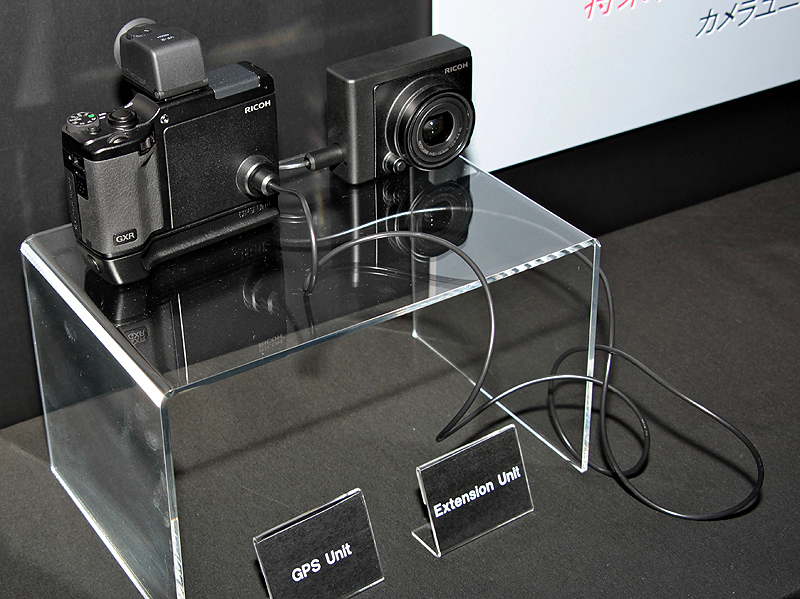
Ricoh is REALLY thinking out-of-the-box! And I like it! Take a look here, it's an article appeared minutes ago on DC.Watch. Scroll to the middle of the page to see other expansion modules... videoprojector, wireless unit, printers(!) & more. Simply crazy but I love it!
I myself am getting really tired of having to learn new menu and UI setups for each different camera, dealing with different batteries and chargers and all that crap.
mawz wrote:
Not much of an advantage given how well the Oly SSWF controls dust problems. Only the wettest, stickiest dust is ever an issue for 4/3rds users.
Dust Is an issue with m43 though. This August I fried a G1 in Nevada from a high-alkaline fine dry dust in the body. and the 14-45 got permanent scratches in the sliding zoom tube and plenty of dust inside the elements. A cleaning fixed that, but the G1 was DOA.
mikethevilla wrote:
...the smartest thing Ricoh could do is start whipping out separate lens and sensor units. Then they'd have a small format camera, allowing you to choose your own sensor AND choose your own lens...quote]
It's bad enough comparing bodies to lenses. I can only imagine the posts comparing bodies -to sensors - to lenses...
From a marketing perspective this is a really good idea.
It locks people into a company's system with minimal cost up front.
Once you buy the body, it basically maximizes profit by bundling the sensor and lens together. Consumer has to buy more updates than the standard camera-lens upgrade model (where lenses last forever and camera+sensor is updated every few years).
Here, if you want a new lens, it's bundled with a new sensor. Likewise, if sensor technology has progressed to the point you want a new sensor, it's bundled with a new lens. You're always paying for something extra, something you probably don't need or even want. Profit is maximed.
To me, it seems like a 'solution in search of a problem'. It is a really nice solution though. I just can't see this catching on, it's too expensive right now for what it does. But you never know.
Oh one more thing. I almost want to buy one just because a company finally had the guts to do something other than cramming a digital sensor in an old film body they designed 20 years ago. Whether it's a good idea or not...I almost don't care
Just to clarify: Ricoh is selling digital cameras that are missing the LCD and controls. You're supposed to buy multiple digital cameras from them, and then one "view/control unit" that you move around between the cameras, so that only one camera at a time can work.
Greg Feldman wrote:
Just to clarify: Ricoh is selling digital cameras that are missing the LCD and controls. You're supposed to buy multiple digital cameras from them, and then one "view/control unit" that you move around between the cameras, so that only one camera at a time can work.
Is that about right?
No, the body has all the controls and LCD screen that you would normally find on a camera. The sensor and lenses are sold separately.
Take a look at the Dpreview preview and you can see how it all works:
I think you missed the saracasm in Greg's post. But if you want to split hairs, Greg's actually right. "Camera" is short for Camera Obscura - "Dark Chamber", so the "Camera" really is the part of the device that's capturing the image. So, in that sense each Lens/Sensor unit is a Camera.
I myself am getting really tired of having to learn new menu and UI setups for each different camera, dealing with different batteries and chargers and all that crap.
Absolutement!
If I want to take a back up body to my 5DII on a trip, unless I take another 5DII or the new 7D, I have to take a camera which will have different handling and different batteries/charger etc: The thought does not please me.
Sam Bennett wrote:
I think you missed the saracasm in Greg's post. But if you want to split hairs, Greg's actually right. "Camera" is short for Camera Obscura - "Dark Chamber", so the "Camera" really is the part of the device that's capturing the image. So, in that sense each Lens/Sensor unit is a Camera.
Right now some might think it is kinda neat and want to buy it, but I guess when the first two lenses are available which use the *same* sensors, the feeling will go away. This is wasteful, even though it is creative.