...and one more thing: it's no good thinking that sensor prices will become insignificant in these sensor/lens modules. I want a pocket camera that has the latest kickass sensor, not a trailing edge commodity sensor. That's probably why I don't use a Ricoh now. I'm even prepared to spend money every couple of years to ensure that I have that kickass sensor, since they are steadily improving. Maybe Ricoh thinks sensors have stopped improving. Meanwhile, I have 3 EOS cameras and a Fuji compact. Both brands put a lot of work into sensors. I just don't see how this thing is going to compete with the successors to the GF-1.
Tariq Gibran wrote:
While I see this new Ricoh only selling to an extremely small, specialized niche market (being able to separate the lens+sensor from the body, viewing system and controls could easily offer huge advantages in specific industrial/technical/scientific photo applications where the photographer can't be in the same place as the lens for instance),
There are tons of industrial cameras consisting of two components -- the lens/sensor, and the viewing LCD -- typically connected by cable. Granted, the IQ/resolution is horrible, but industrial needs rarely require artistic bokeh and such. And if, by chance, you actually need high resolution and good IQ, it's easy to set up a laptop - DSLR combo where you can do everything remotely. Canon's DRebel + a netbook won't be expensive.
brainiac wrote:
It seems obvious to me that profit is maximised when you sell less to the customer for a given price, not more than she wants. Unless Ricoh plans to produce separate lens and sensor modules, they are forced by the design to sell duplicate components which can only increase the price for the customer, and thereby reduce sales. At a time when small
You're oversimplifying. Basically my point was the same point that a lot of others have made in the thread. The 'bundling', or forcing users to buy things they don't normally buy together, it is going to maximize sales, subsequently maximizing profit. The prosumer's budget for photography is not necessarily a limited one, he will spend more on cameras if you force him to do it.
Anyways it sounds nice in theory, but the one thing is that they don't exist as an island. With the competition out there, this will never really catch on. The only way this thing can suceeed is if the government were to take over the camera industry and say "You have no choice, if you want a camera, this is the only one you can buy from now on".
I think that Ricoh is on to something! While their new approach is a bit unorthodox, they may be pioneers in future technology. I think that it would be cool if in the future we had cameras that can have replaceable sensors. Imaging having your favorite DSLR (like a D1X for example) and being able to remove its sensor like you would the hard drive of a lap top. Every time a new sensor was released you would be able to have it without having to buy a whole new camera! It would be a remarkable new concept, kind of like putting new film in a camera.
I have a nice $800 paperweight in my office not too disimilar in concept to this.
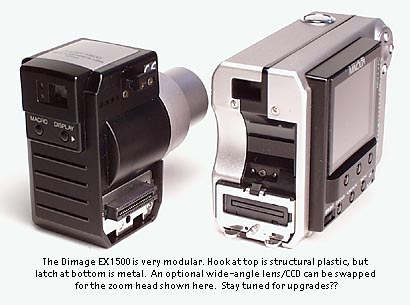
Went by the name of Minolta Dimage EX1500.
A removable/extendible lens module that would be updated over time.
Problem was, it came along too soon in the evolution of digital cameras.
Perhaps the time has come too go down this road again
dasrocket wrote:
The problem here is not that RICOH did not deliver the idea correctly, but that the idea itself is not really resolving any issues that either a much cheaper PS or a similarly priced DSLR cannot solve.
For the record, if CANON or NIKON come up with a mirrorless APS-C body, that, via adapters will accept native glass as well as most third party lenses, both the RICOH idea and the M43 will be in great jeopardy.
I'm not a camera engineer, but there seem to be issues with legacy lenses being able to autofocus quickly using a CDAF system.
Of course, Canon has the marketing power to create a brand new EVIL system which would probably outsell Pansonic/Olympus because of the Canon brand name, even if it's not backwards compatible.
carstenw wrote:
I think we need to keep one thing in mind: this camera is not aimed at us I wonder what the deal will look like to someone who wants a little more than his G11 can give, but doesn't want the size of a DSLR?
Considering that the zoom lens module on the Ricoh system has the same sized sensor as a Canon G11, the Ricoh doesn't really seem like such a big step up to me.
Uncle Mike wrote:
Considering that the zoom lens module on the Ricoh system has the same sized sensor as a Canon G11, the Ricoh doesn't really seem like such a big step up to me.
Indeed, it might actually be a step down. From what I've seen so far, the G11 is superior, to the small sensor-ed Zoom GXR combo.
I am in no way connected with Ricoh, but I prefer to take a wait and see attitude, especially when it comes to new technology. Ricoh does state in their paper on this cam, that they are tuning each sensor and lens combo to maximize image quality.
snegron wrote:
I think that Ricoh is on to something! While their new approach is a bit unorthodox, they may be pioneers in future technology. I think that it would be cool if in the future we had cameras that can have replaceable sensors. Imaging having your favorite DSLR (like a D1X for example) and being able to remove its sensor like you would the hard drive of a lap top. Every time a new sensor was released you would be able to have it without having to buy a whole new camera! It would be a remarkable new concept, kind of like putting new film in a camera. ...Show more →
Yes, if they would singulate the sensor, lens, and body, that would be a good idea. But that is not what they are proposing. The standard model is [body+sensor] and [lens], they are just switching it to [body] and [sensor+lens].
Greg Feldman wrote:
OK. Everyone is still talking about this rationally and debating it on the merits. Allow me to make a blanket statement:
This is a stupid (@#*$# idea.
Let's check back in a year and see if that's correct.
This is not a new idea though. Nikon already did it back when 1 megapixels were all new and stuff. They even look the same. I think it might be a good idea myself though. Won't this allow them to engineer the relationship between the lens and the image sensor for each pair - independently? Aren't there some advantages to be had from doing that?
Ricoh has always been a goofy company though. Their computer parts, their office products, most of their digital cameras so far... Pretty goofy. Goofy as in outside the box and good or bad, not following the herd.
I don't think it will catch on though. This design requires a high user level and high level users won't be interested in this format as a primary device.
I'm pretty sure there was a Nikon too but I can't find it. Maybe it was only a prototype that never got released. Here's is the Minolta of the same basic concept:
"The Minolta Dimage EX Zoom 1500 (phew! - referred to from now onwards as the EX1500) is actually two (and in the future maybe more) cameras in disguise, the most distinguising and unique feature of this camera is the detachable lens/CCD/viewfinder assembly (the black right hand quarter in the image shown).
It can currently be purchased in two guises, the more popular 1500 Zoom (a 38mm to 105 mm lens) and the 1500 Wide (a 28mm non-zoom lens). Alternatively you can purchase the wide "add-on lens" at around US$350, giving you 28mm and 38mm to 105mm.
There is also an optional 1.5m extension cable which allows you to use the lens/CCD assembly remotely from the body. And an external flash accessory which fits between the body and the lens assembly giving the camera flash hot-shoe....Show more →
OK, I was with all you guys on how insane this system was, until the last announcement. Now I think I understand a little more. Still goofy, but...
This lets them amortize the engineering of the parts of a camera that don't change much over a large number of niche models, and might provide a modest savings (in weight, if not cash) to someone who wants more than one of those niche models.
The latest annoucement includes a "P10 28-300 mm", which appears to spec out exactly like the CX3, except for the 120fps mode. One hundred twenty frames per second.
And right next to it they announced a different module that is aimed squarely at the Leica X1/Sigma DP1.
It's weird, but I no longer think it's crazy.
EDIT: I just found the 120fps mode in the CX3 press release. Never mind, it's still crazy.