RF-L or FE-GM (No Trolls, Gatekeepers, or Dismissive Responses)
Steve Spencer Offline • • • • • • • Upload & Sell: Off
p.6 #1 · RF-L or FE-GM (No Trolls, Gatekeepers, or Dismissive Responses)
aCuria wrote:
That’s the contradiction. You’re saying dynamic range has never been an issue, then immediately citing a feature you use to warn you when you’re about to exceed the sensor’s dynamic range. If the limit genuinely never mattered, there would be nothing to warn you about.
Take a simple example: you meter an 18% grey card to establish the correct exposure for the subject. If, at that exposure, the white dress exceeds the sensor’s highlight limit and clips, then the scene requires more dynamic range than the sensor provides at that ISO. You can underexpose to save the dress, but now you’re shifting the problem toward the shadows.
If you have time to slowly compose the shot, sure, you can watch the warning and adjust the exposure until the clipping disappears. But if you’re capturing a spontaneous moment, you may not get that opportunity. The dress may already be irretrievably clipped by the time you see the warning.
A camera with more dynamic range gives you more exposure latitude and reduces the chance of losing either highlights or shadows in the first place.
Alternatively, you can ask all your subjects to get a spray tan and wear dark clothes. That should solve the dynamic-range problem too. /s
I don't think this is right. The key variable for clipping with the camera is how much headroom the camera has when metering at 18% middle grey. I have seen exactly zero evidence that sensors with more dynamic range have more headroom. It is true that having more dynamic range will improve the shadows when highlights are protected, but that doesn't mean the camera will clip highlights less. Clipping highlights is all about exposure and not exposing too far to the right of the histogram.
And let's not forget about the role of the photographer in the process. If you have even a bit of experience and you know you are shooting a white dress (or a similar bight object) and you want to protect the highlights for that target, then you should know that the camera is not setting exposure for that object and you should be using exposure compensation. Clipping the highlights on an object you want to get proper exposure for is really an error of the photographer. You have to know what the camera does (exposes for 18% middle grey) and adjust the camera for the exposure you want. More dynamic range does give you more room in the shadows in this situation, but protecting the highlights you want is on the photographer. Clipped highlights of a feature you want should not be attributed the camera or the dynamic range of the sensor being used. It should be attributed to an error made by the photographer.
Now if you can't keep that dress from being blown out while at the same time getting the shadow details that you want, that cont be attributed to the dynamic range of the sensor, but there are many many times when you can easily avoid clipping highlights and have plenty of shadow detail as well even when shooting bright objects and if you clip the the highlights in those cases it is because the camera was not set properly not because of the camera or the sensor in the camera.
p.6 #2 · RF-L or FE-GM (No Trolls, Gatekeepers, or Dismissive Responses)
chez wrote:
I don’t understand this need for quick changes of lenses. Can you not go out for the day with one prime and change things up the next day with a different prime. Just shoot images that fit the focal length that is on your camera.
Yeah, that’s probably doable if I’m shooting alone. But if I’m out with the wife, she’s gonna get pretty pissed if I go out for the day with just a 50/85/135mm prime and can’t get a decent shot of her or the kids when we’re in a tight space. And god forbid she says, “Can you get the whole facade in the shot?”
p.6 #3 · RF-L or FE-GM (No Trolls, Gatekeepers, or Dismissive Responses)
aCuria wrote:
I am not OP but dynamic range takes a hit on small sensor cameras.
This means its easy to blow out say a white dress.
For example, if the scene needs 7 stops of DR, you wont clip the dress until above ISO 4000+ on A7C but with OM-5 you will clip the dress above ISO 1600
I find it is easier to think about what you are saying by using photographic equivalence, rather than by referencing the dynamic range (because DR depends on the amount of light, whereas the principles of photographic equivalence explicitly assume the same amount of light in equivalent images).
Thus, the base ISO on my OM-1 II is 200, that is equivalent to ISO 800 on a full-frame camera. ISO 1600 is equivalent to ISO 6400 on FF. Indeed, ISO 1600 is a reasonable upper limit for micro-four-thirds systems. Understandably, the cameras do allow going higher in ISO, and good denoising can create an illusion of "noise doesn't matter" - but this is only an illusion.
Note that the problem with cropped sensor cameras is never(!) at the high ISO - it is ALL at the low ISO. Cropped sensor cameras can never capture the amount of light that a full-frame sensor can capture at the base ISO. For ANY high ISO on a full-frame camera, there's an equivalent ISO on a cropped sensor camera. For example, for ISO 12800 on a full-frame body, the same amount of light (for the same dynamic range) is captured at ISO 3200 by a micro-four-thirds sensor.
In other words, full-frame sensors offer no advantage in the high ISO range. It is a mistake to think that larger sensors can capture more light at high ISO. Their larger capacity for ligth can only be taken advantage of when the light is abundant, that is at or near the base ISO.
p.6 #4 · RF-L or FE-GM (No Trolls, Gatekeepers, or Dismissive Responses)
Steve Spencer wrote:
I don't think this is right. The key variable for clipping with the camera is how much headroom the camera has when metering at 18% middle grey. I have seen exactly zero evidence that sensors with more dynamic range have more headroom. It is true that having more dynamic range will improve the shadows when highlights are protected, but that doesn't mean the camera will clip highlights less. Clipping highlights is all about exposure and not exposing too far to the right of the histogram.
And let's not forget about the role of the photographer in the process. If you have even a bit of experience and you know you are shooting a white dress (or a similar bight object) and you want to protect the highlights for that target, then you should know that the camera is not setting exposure for that object and you should be using exposure compensation. Clipping the highlights on an object you want to get proper exposure for is really an error of the photographer. You have to know what the camera does (exposes for 18% middle grey) and adjust the camera for the exposure you want. More dynamic range does give you more room in the shadows in this situation, but protecting the highlights you want is on the photographer. Clipped highlights of a feature you want should not be attributed the camera or the dynamic range of the sensor being used. It should be attributed to an error made by the photographer.
Now if you can't keep that dress from being blown out while at the same time getting the shadow details that you want, that cont be attributed to the dynamic range of the sensor, but there are many many times when you can easily avoid clipping highlights and have plenty of shadow detail as well even when shooting bright objects and if you clip the the highlights in those cases it is because the camera was not set properly not because of the camera or the sensor in the camera. ...Show more →
This is example from 1D, ISO 3200, Straight out of camera.
DR Equivalent to OM5 ~ ISO 12,800, so if you shoot at ISO 12,800 you would have more or less the same problem
To avoid blowing the highlights here I probably have to dial in like -2 or -3 compensation maybe, but the shadows already look bad.
The problem is ultimately lack of DR at higher ISO. This is the biggest problem with 1D. It can beat modern cameras in other areas, for example the only Sony milc that can match 1/500s flash sync is A9iii, and it can do mechanical shutter speed of 1/16000s which the A1 mechanical shutter cant beat.
I have been chasing more high ISO DR for > 20 years already... its hard for me to accept OM5 DR when A7C exists.
p.6 #5 · RF-L or FE-GM (No Trolls, Gatekeepers, or Dismissive Responses)
aCuria wrote:
I am not OP but dynamic range takes a hit on small sensor cameras.
This means its easy to blow out say a white dress.
For example, if the scene needs 7 stops of DR, you wont clip the dress until above ISO 4000+ on A7C but with OM-5 you will clip the dress above ISO 1600
Speaking as someone who shoots multiple formats, I think people make more of this issue than is warranted. It is rarely, if ever, a real world problem for most people.
IT is even less of an issue today than it used to be, given the continuing improvements in sensor performance, camera noise handling, and recently-available post-processing NR tools such as Adobe’s AI Denoise — which, for those of you who havne’t tried it, is nearly miraculous.
If you have a challenging DR subject, you expose to protect the highlights and then, if necessary, lift the lower luminosity values in post.
All gear decisions are trade-offs, and there is no perfect camera. It is true that a larger sensor (for example APS-C compared to MFT, FF compared to APS-C, miniMF compared to FF) can give you even more DR. But the real question isn’t which system has the very most DR — it is whether the system on the camera that interests you — and meets your other needs — has sufficient DR.
p.6 #6 · RF-L or FE-GM (No Trolls, Gatekeepers, or Dismissive Responses)
gdanmitchell wrote:
Speaking as someone who shoots multiple formats, I think people make more of this issue than is warranted. It is rarely, if ever, a real world problem for most people.
IT is even less of an issue today than it used to be, given the continuing improvements in sensor performance, camera noise handling, and recently-available post-processing NR tools such as Adobe’s AI Denoise — which, for those of you who havne’t tried it, is nearly miraculous.
If you have a challenging DR subject, you expose to protect the highlights and then, if necessary, lift the lower luminosity values in post.
All gear decisions are trade-offs, and there is no perfect camera. It is true that a larger sensor (for example APS-C compared to MFT, FF compared to APS-C, miniMF compared to FF) can give you even more DR. But the real question isn’t which system has the very most DR — it is whether the system on the camera that interests you — and meets your other needs — has sufficient DR....Show more →
Let me give you another example with a more modern camera. This is A7iii, f/1.4 and ISO 12,800 also Straight out of camera with no editing
The highlights are definitely blown in the Raw file, but I am not going to dial in -2 compensation because that will mess up shadow detail and make the shot worse.
The shot will certainly be improved if a camera comes out with a couple more stops of DR at ISO 12,800. The lamp shades have pretty nice detail in them.
p.6 #7 · RF-L or FE-GM (No Trolls, Gatekeepers, or Dismissive Responses)
We seem to be veering OT, but I feel the need to say my piece -- or peace
The reality of differing sensor sizes as respects ISO noise, DoF and diffraction is this, paraphrased from about the best article on it I've ever read -- I believe the source was a DPR article:
The reality is that at the same subject, shutter, aperture diameter and angle of view, you get essentially the same results, independent of sensor size.
Note that aperture DIAMETER varies with format for any given f-stop at the same AoV's for each format, so we're not talking equivalent aperture, but rather the same aperture diameters for a given FoV on said format...
Next point on ISO noise is that down-rezzing higher rez sensors improves net noise as it averages out the noise present on each sq mm of sensor. So if I look at the current best noise FF camera listed at 12mp, if I downrez my 67mp A7R6 file to a net of 12mp, the final noise levels will be extremely close, assuming same ISO, lens and image were used for the initial capture. Veering more OT, there's also some argument that if I apply NR to the full 67mp file before downsizing, I can theoretically obtain a superior result to the base 12mp cams. Others argue this comes at the cost of some finer details potentially disappearing. FWIW...
p.6 #8 · RF-L or FE-GM (No Trolls, Gatekeepers, or Dismissive Responses)
Jack Flesher wrote:
We seem to be veering OT, but I feel the need to say my piece -- or peace
The reality of differing sensor sizes as respects ISO noise, DoF and diffraction is this, paraphrased from about the best article on it I've ever read -- I believe the source was a DPR article:
The reality is that at the same subject, shutter, aperture diameter and angle of view, you get essentially the same results, independent of sensor size.
Note that aperture DIAMETER varies with format for any given f-stop at the same AoV's for each format, so we're not talking equivalent aperture, but rather the same aperture diameters for a given FoV on said format... ...Show more →
Most of the confusion seems to stem from technical people try to "dumb down" these concepts for the masses.
p.6 #9 · RF-L or FE-GM (No Trolls, Gatekeepers, or Dismissive Responses)
ruthenium wrote:
I find it is easier to think about what you are saying by using photographic equivalence, rather than by referencing the dynamic range (because DR depends on the amount of light, whereas the principles of photographic equivalence explicitly assume the same amount of light in equivalent images).
Thus, the base ISO on my OM-1 II is 200, that is equivalent to ISO 800 on a full-frame camera. ISO 1600 is equivalent to ISO 6400 on FF. Indeed, ISO 1600 is a reasonable upper limit for micro-four-thirds systems. Understandably, the cameras do allow going higher in ISO, and good denoising can create an illusion of "noise doesn't matter" - but this is only an illusion.
Note that the problem with cropped sensor cameras is never(!) at the high ISO - it is ALL at the low ISO. Cropped sensor cameras can never capture the amount of light that a full-frame sensor can capture at the base ISO. For ANY high ISO on a full-frame camera, there's an equivalent ISO on a cropped sensor camera. For example, for ISO 12800 on a full-frame body, the same amount of light (for the same dynamic range) is captured at ISO 3200 by a micro-four-thirds sensor.
In other words, full-frame sensors offer no advantage in the high ISO range. It is a mistake to think that larger sensors can capture more light at high ISO. Their larger capacity for ligth can only be taken advantage of when the light is abundant, that is at or near the base ISO. ...Show more →
For low-light photography, which is where I run into the most dynamic-range limitations, I’ll be shooting the fastest available lenses wide open, typically at f/1.4 or brighter, regardless of system.
Photographic equivalence is only useful when an equivalent lens actually exists. To match a full-frame f/1.4 lens, M43 would require roughly an f/0.7 lens. In most relevant focal lengths, that lens simply doesn’t exist.
So in this particular use case, equivalence is largely irrelevant. I’m not going to stop the full-frame f/1.4 lens down to f/2.8 just to make the comparison equivalent. I’m going to shoot both systems with the fastest lens available, wide open. If one system can use f/1.4 while the other cannot offer the equivalent f/0.7, that practical advantage is precisely the point.
p.6 #10 · RF-L or FE-GM (No Trolls, Gatekeepers, or Dismissive Responses)
Cliff L. wrote:
Most of the confusion seems to stem from technical people try to "dumb down" these concepts for the masses.
I'd argue back that most photographers lack an adequate enough physics background to understand the full technical explanations, so in this case, an accurate simplification becomes relevant.
p.6 #11 · RF-L or FE-GM (No Trolls, Gatekeepers, or Dismissive Responses)
Jack Flesher wrote:
I'd argue back that most photographers lack adequate physics background to understand the full technical explanations, so in this case, an accurate simplification becomes relevant.
p.6 #15 · RF-L or FE-GM (No Trolls, Gatekeepers, or Dismissive Responses)
aCuria wrote:
That’s the contradiction. You’re saying dynamic range has never been an issue, then immediately citing a feature you use to warn you when you’re about to exceed the sensor’s dynamic range. If the limit genuinely never mattered, there would be nothing to warn you about.
Take a simple example: you meter an 18% grey card to establish the correct exposure for the subject. If, at that exposure, the white dress exceeds the sensor’s highlight limit and clips, then the scene requires more dynamic range than the sensor provides at that ISO. You can underexpose to save the dress, but now you’re shifting the problem toward the shadows.
If you have time to slowly compose the shot, sure, you can watch the warning and adjust the exposure until the clipping disappears. But if you’re capturing a spontaneous moment, you may not get that opportunity. The dress may already be irretrievably clipped by the time you see the warning.
A camera with more dynamic range gives you more exposure latitude and reduces the chance of losing either highlights or shadows in the first place.
Alternatively, you can ask all your subjects to get a spray tan and wear dark clothes. That should solve the dynamic-range problem too. /s
Every sensor has a limit to its dynamic range. Several brands offer blinkies to warn when that range is exceeded. I think my 100mp Fuji does as well. That feature has nothing to do with limitations of dynamic range.
And as I said, I never found the dynamic range of my MFT gear limiting to my photographic needs. There are other reasons I don't exclusively use MFT, but that's not it.
p.6 #16 · RF-L or FE-GM (No Trolls, Gatekeepers, or Dismissive Responses)
Jack Flesher wrote:
We seem to be veering OT, but I feel the need to say my piece -- or peace
The reality of differing sensor sizes as respects ISO noise, DoF and diffraction is this, paraphrased from about the best article on it I've ever read -- I believe the source was a DPR article:
The reality is that at the same subject, shutter, aperture diameter and angle of view, you get essentially the same results, independent of sensor size.
Note that aperture DIAMETER varies with format for any given f-stop at the same AoV's for each format, so we're not talking equivalent aperture, but rather the same aperture diameters for a given FoV on said format...
Next point on ISO noise is that down-rezzing higher rez sensors improves net noise as it averages out the noise present on each sq mm of sensor. So if I look at the current best noise FF camera listed at 12mp, if I downrez my 67mp A7R6 file to a net of 12mp, the final noise levels will be extremely close, assuming same ISO, lens and image were used for the initial capture. Veering more OT, there's also some argument that if I apply NR to the full 67mp file before downsizing, I can theoretically obtain a superior result to the base 12mp cams. Others argue this comes at the cost of some finer details potentially disappearing. FWIW... ...Show more →
“ The reality is that at the same subject, shutter, aperture diameter and angle of view, you get essentially the same results, independent of sensor size.”
We are going even more OT but this quote is not entirely correct.
At the same MP count M43 pixels are 1/4 the area of FF, so it hits the nyquist limit first. Adding more MP is useless past the nyquist limit, so M43 will always have 1/4 the useful MP of FF.
p.6 #17 · RF-L or FE-GM (No Trolls, Gatekeepers, or Dismissive Responses)
aCuria wrote:
“ The reality is that at the same subject, shutter, aperture diameter and angle of view, you get essentially the same results, independent of sensor size.”
We are going even more OT but this quote is not entirely correct.
At the same MP count M43 pixels are 1/4 the area of FF, so it hits the nyquist limit first. Adding more MP is useless past the nyquist limit, so M43 will always have 1/4 the useful MP of FF.
The question still remains whether MFT offers enough for the OP’s use case. My car can go 250 kmh, but even on the Autobahn, I don’t go that fast. What matters is what is enough.
(In case of my car, I don’t need 250, but it also means I can cruise at 175 kmh and be comfortable).
p.6 #18 · RF-L or FE-GM (No Trolls, Gatekeepers, or Dismissive Responses)
johnvanr wrote:
Every sensor has a limit to its dynamic range. Several brands offer blinkies to warn when that range is exceeded. I think my 100mp Fuji does as well. That feature has nothing to do with limitations of dynamic range.
And as I said, I never found the dynamic range of my MFT gear limiting to my photographic needs. There are other reasons I don't exclusively use MFT, but that's not it.
There is no need for your sarcasm.
only the “spray” part is sacarsm (you need a real tan not spray, spray looks orange)
I have and do get the kids to wear clothes darker than their skin tone.
Why don’t you share why you don’t use M43 exclusively?
p.6 #19 · RF-L or FE-GM (No Trolls, Gatekeepers, or Dismissive Responses)
johnvanr wrote:
Every sensor has a limit to its dynamic range. Several brands offer blinkies to warn when that range is exceeded. I think my 100mp Fuji does as well.
Those "blinkies" or zebras are based on your JPEG settings, which may not really show the actual dynamic range of your sensor.
I like everything about both APS-C and MFT cameras except the low dynamic range, and in particular the reduced colour depth, when shooting at really high ISO settings. Unlike sensor read noise, this is still the only facet of imaging that can't be corrected with software yet.
p.6 #20 · RF-L or FE-GM (No Trolls, Gatekeepers, or Dismissive Responses)
aCuria wrote:
For low-light photography, which is where I run into the most dynamic-range limitations, I’ll be shooting the fastest available lenses wide open, typically at f/1.4 or brighter, regardless of system.
Photographic equivalence is only useful when an equivalent lens actually exists. To match a full-frame f/1.4 lens, M43 would require roughly an f/0.7 lens. In most relevant focal lengths, that lens simply doesn’t exist.
So in this particular use case, equivalence is largely irrelevant. I’m not going to stop the full-frame f/1.4 lens down to f/2.8 just to make the comparison equivalent. I’m going to shoot both systems with the fastest lens available, wide open. If one system can use f/1.4 while the other cannot offer the equivalent f/0.7, that practical advantage is precisely the point....Show more →
First, the "dynamic range" of a camera, at a given ISO, is a number calculated by dividing the signal (light captured by the sensor) by the noise originating from the camera. Thus, "For low-light photography, which is where I run into the most dynamic-range limitations" is a tautology (you say that for low light photography, you are limited by the amount of light).
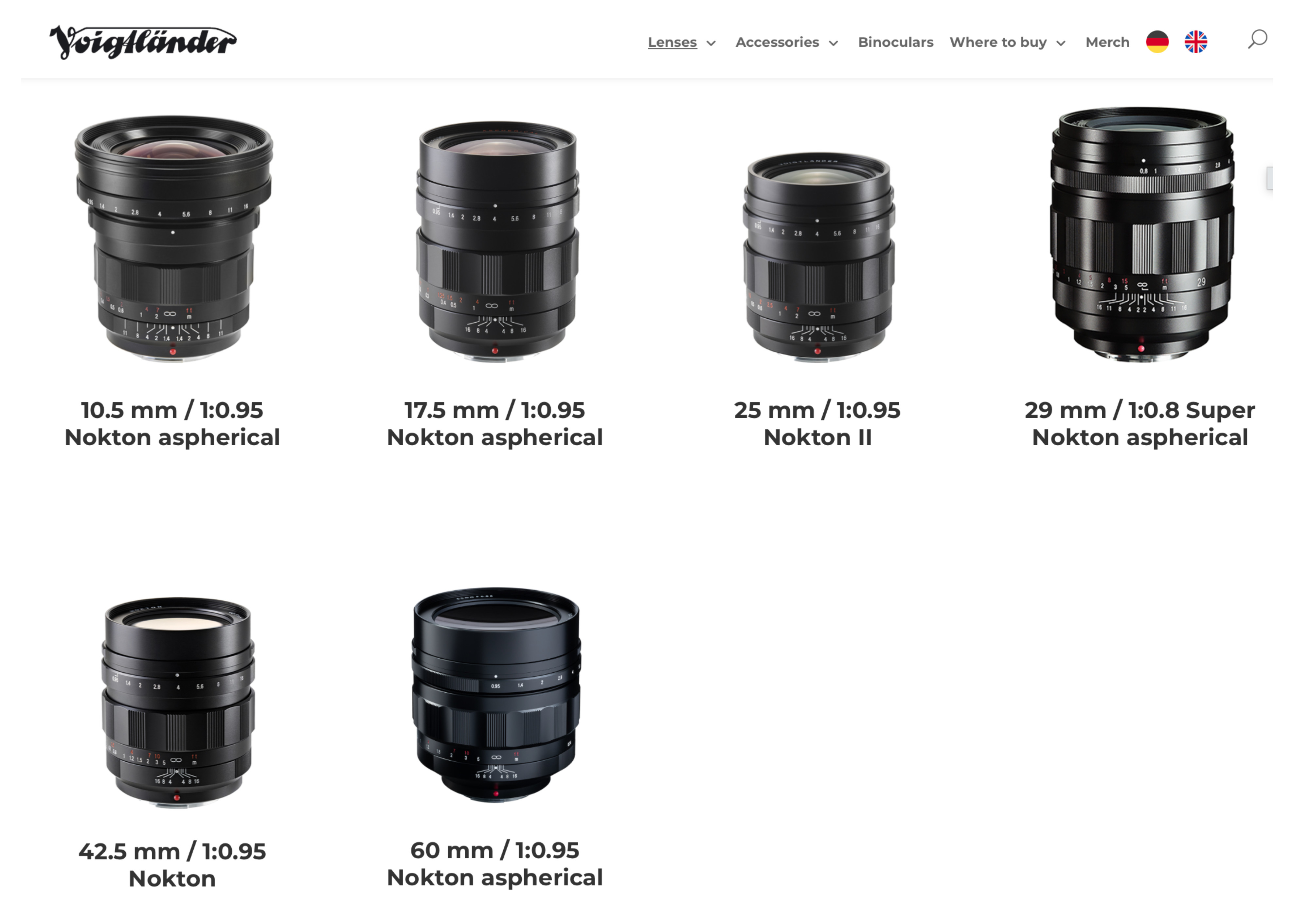
This is correct that f/0.7 lenses (equivalent to full-frame f/1.4) don't exist. There is a series of manual-focus Voigtländer lenses (see the uploaded image) that offer equivalent f/1.9, and one is equivalent to full-frame f/1.6. The auto-focus MFT lenses are at the full-frame equivalent f/2.4 (f/1.2 on the MFT) at the fastest. Thus, if shooting at f/1.4 and auto-focus are critical for your photography, then the micro-four-thirds systems are not your first choice.
Having said the above, there is one peculiar point.
There are two ways of capturing more light: by shooting as wide-open as possible AND/OR by using longer (more slow) shutter speeds (when the subject permits). It is in the latter case that the outstanding IBIS of my OM-1 II allows shooting hand-held with the shutter speeds as long as 2s. In the situations when a tripod cannot be used, I can collect 4 times (2 stops) more light with the OM-1 II than a camera with a larger sensor that I would typically expect to allow slow shutter speed of no longer than 1/2s when shooting hand-held. Understandably, this wouldn't work for moving subjects (unless you want this for artistic reasons); for everything else, for the amount of light captured by a full-frame camera with an f/1.4 lens, the same amount of light can be captured with a micro four-thirds camera equipped with a f/2.8 lens if using a 4-times slower shutter speed.
This exceptional IBIS of the OM-1 II is also a great help for hand-held macro and semi-macro photogrpahy, and the M.Zuiko 90mm F3.5 IS Pro Macro lens can be highly recommended.
To me, the main reason I like my GFX100S II better than the OM-1 II is that the former has 102MP whereas the latter has only 20MP. I find 102MP very useful as this allows extreme cropping and turns every prime lens into an about 2x - range zoom.
When shooting at high ISO (above 2000) the large sensor of the GFX100S II has no advantage in terms of light capture vs. the OM-1.