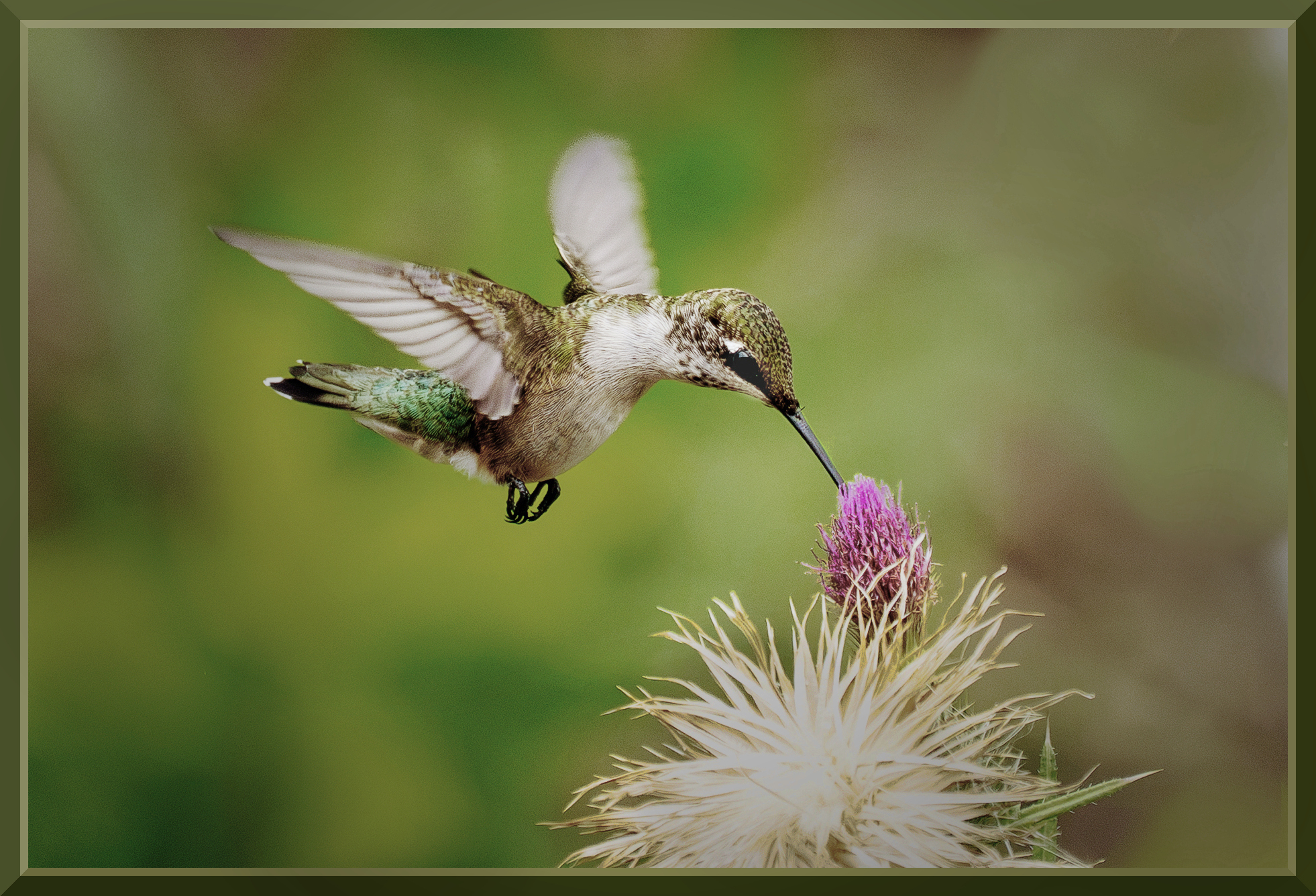
p.1 #1 · Is this as good as it can get or I am missing something?
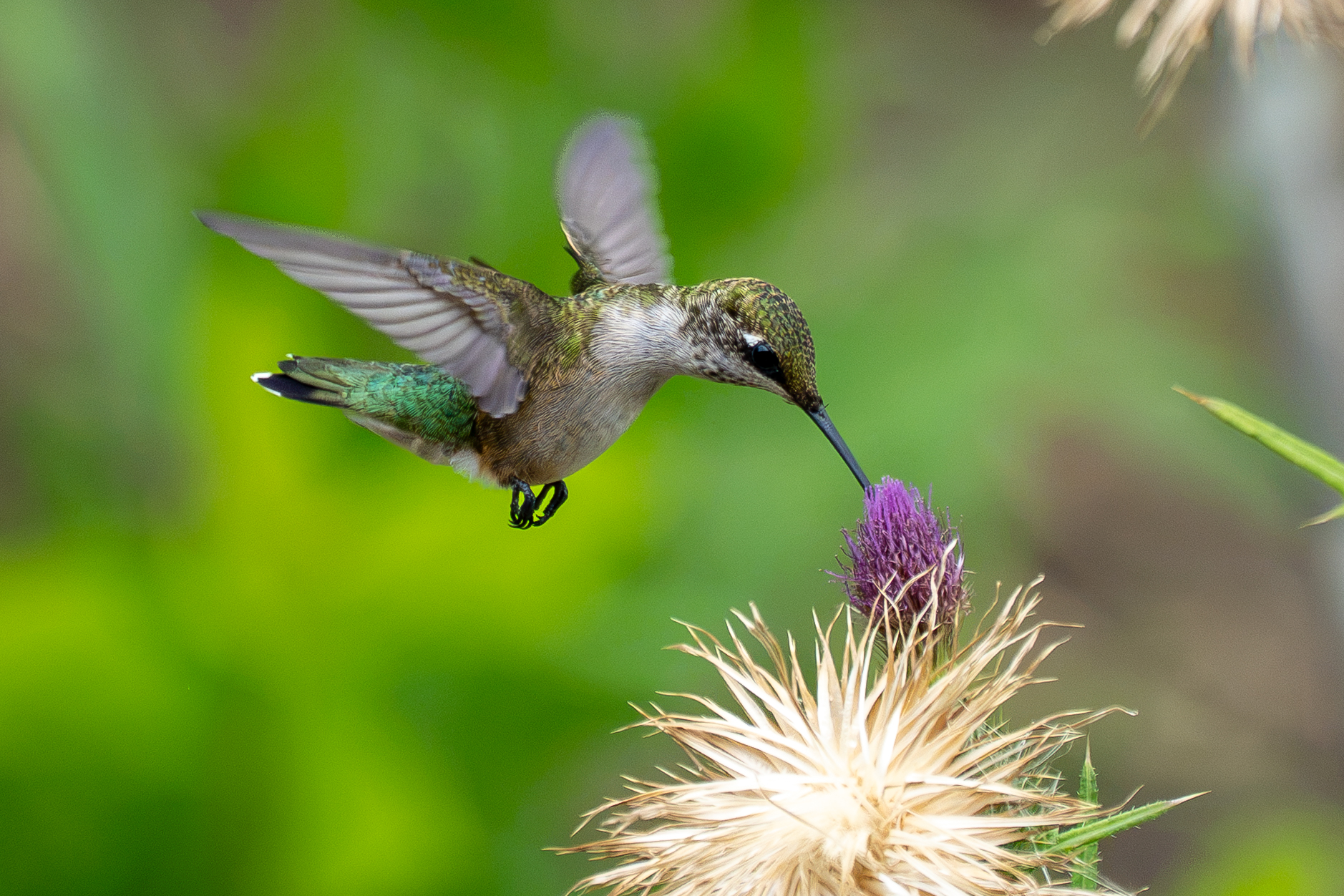
I have a great new camera A7V, a sharp (I think) Sony 100-400 5.6, and I was about 20 ft from the subject. I believe AF was spot on. I processed RAW image with Lightroom, including cropping to about 2/5 (linear) of the original, de-noise and light sharpening. It's a good picture, but I feel it's missing that "something" that is there with other pictures of hummingbirds on this site. What am I missing, if anything?
Thanks in advance!
ILCE-7M5FE 100-400mm F4.5-5.6 GM OSS lens400mmf/5.61/2000s2000 ISO0.0 EV
p.1 #2 · Is this as good as it can get or I am missing something?
Welcome to the Forum.
From about 20 feet with a slow zoom ... that's pretty darn good, imo. I have shot some hummers from less than 5 feet away, with an f/2 lens and with 100-400's at mfd, etc.. I think the thing here is going to be your ability to study / learn your proximity and shutter speeds to get different wing sharp / blur / flutter. That just takes time to become more knowledgeable of your subject matter and the experience with it.
I'm not a master of hummers, dragonfly's, butterfiles, etc. ... but, my experience is that they can be a matter of understanding their behavior and your ability to get closer to them. The more you you increase your ability (just takes time, practice, observation) with that, the closer you'll come to what others do ... till you "come into your own" and find "your way".
Setting up a station / blind can be helpful too. That's something that the masters are keen to do, but few divulge their rigs ... and folks assume they are just finding them "naturally" while walking about kind of thing. Not so much ... when you're talking top tier work. If you want to "level up" to the big boys, this can be a labor of love, too.
p.1 #3 · Is this as good as it can get or I am missing something?
RustyBug wrote:
Welcome to the Forum.
From about 20 feet with a slow zoom ... that's pretty darn good, imo. I have shot some hummers from less than 5 feet away, with an f/2 lens and with 100-400's at mfd, etc.. I think the thing here is going to be your ability to study / learn your proximity and shutter speeds to get different wing sharp / blur / flutter. That just takes time to become more knowledgeable of your subject matter and the experience with it.
I'm not a master of hummers, dragonfly's, butterfiles, etc. ... but, my experience is that they can be a matter of understanding their behavior and your ability to get closer to them. The more you you increase your ability (just takes time, practice, observation) with that, the closer you'll come to what others do ... till you "come into your own" and find "your way".
Setting up a station / blind can be helpful too. That's something that the masters are keen to do, but few divulge their rigs ... and folks assume they are just finding them "naturally" while walking about kind of thing. Not so much ... when you're talking top tier work. If you want to "level up" to the big boys, this can be a labor of love, too.
Thanks for the welcome and the info! I think you're right. Comparing my images to those of the "big boys" (and gals!) is what's giving me the heartburn. I liked the wings as they were, so ss is probably OK. It sounds like proximity might be one of the differentiators in this case. The other might be the lens. Images I observed to be the next level are all taken with primes/GMs.
p.1 #4 · Is this as good as it can get or I am missing something?
Malka_1 wrote:
Thanks for the welcome and the info! I think you're right. Comparing my images to those of the "big boys" (and gals!) is what's giving me the heartburn. I liked the wings as they were, so ss is probably OK. It sounds like proximity might be one of the differentiators in this case. The other might be the lens. Images I observed to be the next level are all taken with primes/GMs.
I wouldn't worry too much ... not just yet ... about your lens. Until you can get to MFD (i.e. much closer than 20 feet), I think you've got some room to grow with. I shot plenty with my 100-400 with pretty good proximity, too. I think there's more to be gained from proximity / animal behavior / stand / blind ... oh, yeah ... and the big boys often implement a (slight under-exposure recommended) fill flash technique with strobed pre-positioned, off camera, etc. for when the sun doesn't provide natural lighting to their chosing, etc. ... catchlight emulation, etc.
Point being, there's plenty of room for technique growth and exploration with your present glass.
p.1 #5 · Is this as good as it can get or I am missing something?
This is a fine image of the interaction between the hummingbird and the flower showing the beautiful detail of both.
I like the vibrant colors of the bird and the clean background that keeps our attention on the bird and creates a sense of depth, a pleasing isolation, and a breathing space that makes the subject to stand out.
Great job on the exposure as it shows the iridescent colors and fine detail w/o harsh highlights.
Good choice of the SS as well. Give that slight blurring effect of the bird's wings that doesn't make feel as if it is "frozen" in space
The only distracting element I see in your photo is the thistle in the foreground. A bit prominent competing for attention with the bird while drawing the eye away from the subject. I would suggest masking or reducing its visual weight. The Remove Tool in PS can help. Also (minor thing) cloning out those blade of grass on the right top and side of the image would give a cleaner BG.
I would also brighten the bird’s eye/face to increase its dominance and to create a better connection with the viewer. Also if you like the slight grainy BG that is fine, otherwise I would think to run a slight noise reduction on it.
Those are the only improvements I see for your already great capture. You did a very good job on this capture and should be proud of it. Keep shooting.
Socrate
P.S. I don't remember who, but somebody said: If you think your photo is not good enough you are not close enough
p.1 #6 · Is this as good as it can get or I am missing something?
Malka_1 wrote:
I have a great new camera A7V, a sharp (I think) Sony 100-400 5.6, and I was about 20 ft from the subject. I believe AF was spot on. I processed RAW image with Lightroom, including cropping to about 2/5 (linear) of the original, de-noise and light sharpening. It's a good picture, but I feel it's missing that "something" that is there with other pictures of hummingbirds on this site. What am I missing, if anything?
Thanks in advance!
Cool capture! Things I like are the wings as they are: The placement of the bird in the frame. The sharpness of the bird.
Things you can think about changing that I think will benefit the image are: The beak is more blue than green or red, you might want to balance those colors by removing some blue. Also if you look close the high light in the eye is blue and not white. After doing that you might want to reduce the saturation a bit and adjust the curves. I also reduced the red saturation a bit more. Removing the intruding stuff on the right side of the image gives a cleaner feel to the whole image. Burn the light colored stuff at the bottom of the image till it no longer pulls the viewers eyes from the bird. Something to think about, the males make a more colorful image than the females.
p.1 #7 · Is this as good as it can get or I am missing something?
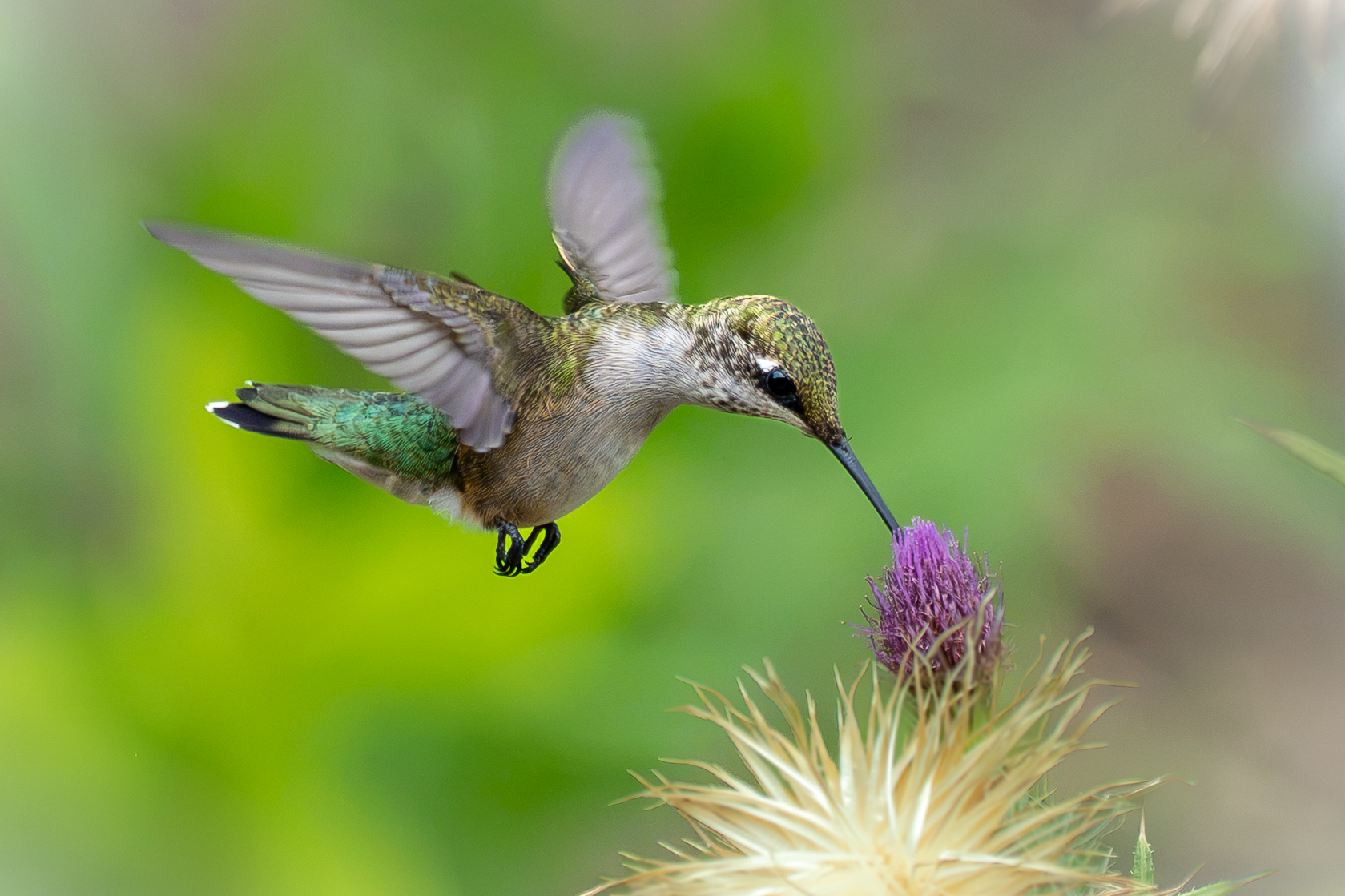
Here is an updated version, incorporated many of the recommendations above. I am afraid the thistle is staying front row and center, but it should be less conspicuous now.
p.1 #8 · Is this as good as it can get or I am missing something?
RustyBug wrote:
I wouldn't worry too much ... not just yet ... about your lens. Until you can get to MFD (i.e. much closer than 20 feet), I think you've got some room to grow with. I shot plenty with my 100-400 with pretty good proximity, too. I think there's more to be gained from proximity / animal behavior / stand / blind ... oh, yeah ... and the big boys often implement a (slight under-exposure recommended) fill flash technique with strobed pre-positioned, off camera, etc. for when the sun doesn't provide natural lighting to their chosing, etc. ... catchlight emulation, etc.
Point being, there's plenty of room for technique growth and exploration with your present glass.
I have been eyeing those lenses, but they not in the budget for now. Which is a good thing, because you're right, they are only one of many factors and there is plenty for me to learn and improve.
Appreciate all the tips you packed into the few lines above! I think there was a recent conversation about using a flash for hummingbirds in one of the other forums here.
I personally prefer the term "masters of the craft". I know it's just an expression, and wasn't meant to offend, but "big boys" carries demeaning implications for me as a female. I have worked for 30+ years in a very technical, male dominated, field, and have never felt the need to measure up to any sort of a boy!
p.1 #9 · Is this as good as it can get or I am missing something?
Shasoc wrote:
This is a fine image of the interaction between the hummingbird and the flower showing the beautiful detail of both.
I like the vibrant colors of the bird and the clean background that keeps our attention on the bird and creates a sense of depth, a pleasing isolation, and a breathing space that makes the subject to stand out.
Great job on the exposure as it shows the iridescent colors and fine detail w/o harsh highlights.
Good choice of the SS as well. Give that slight blurring effect of the bird's wings that doesn't make feel as if it is "frozen" in space
The only distracting element I see in your photo is the thistle in the foreground. A bit prominent competing for attention with the bird while drawing the eye away from the subject. I would suggest masking or reducing its visual weight. The Remove Tool in PS can help. Also (minor thing) cloning out those blade of grass on the right top and side of the image would give a cleaner BG.
I would also brighten the bird’s eye/face to increase its dominance and to create a better connection with the viewer. Also if you like the slight grainy BG that is fine, otherwise I would think to run a slight noise reduction on it.
Those are the only improvements I see for your already great capture. You did a very good job on this capture and should be proud of it. Keep shooting.
Socrate
P.S. I don't remember who, but somebody said: If you think your photo is not good enough you are not close enough...Show more →
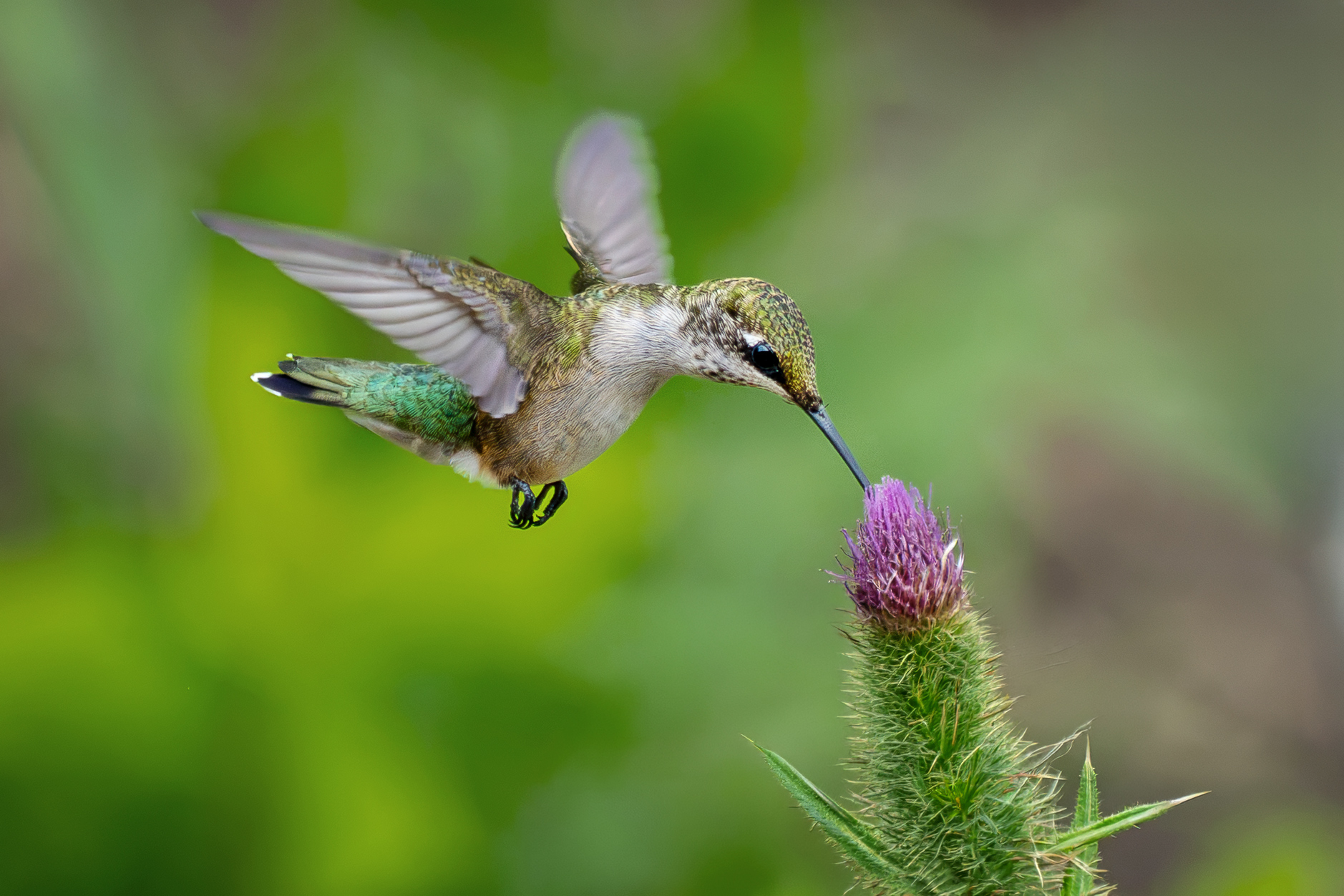
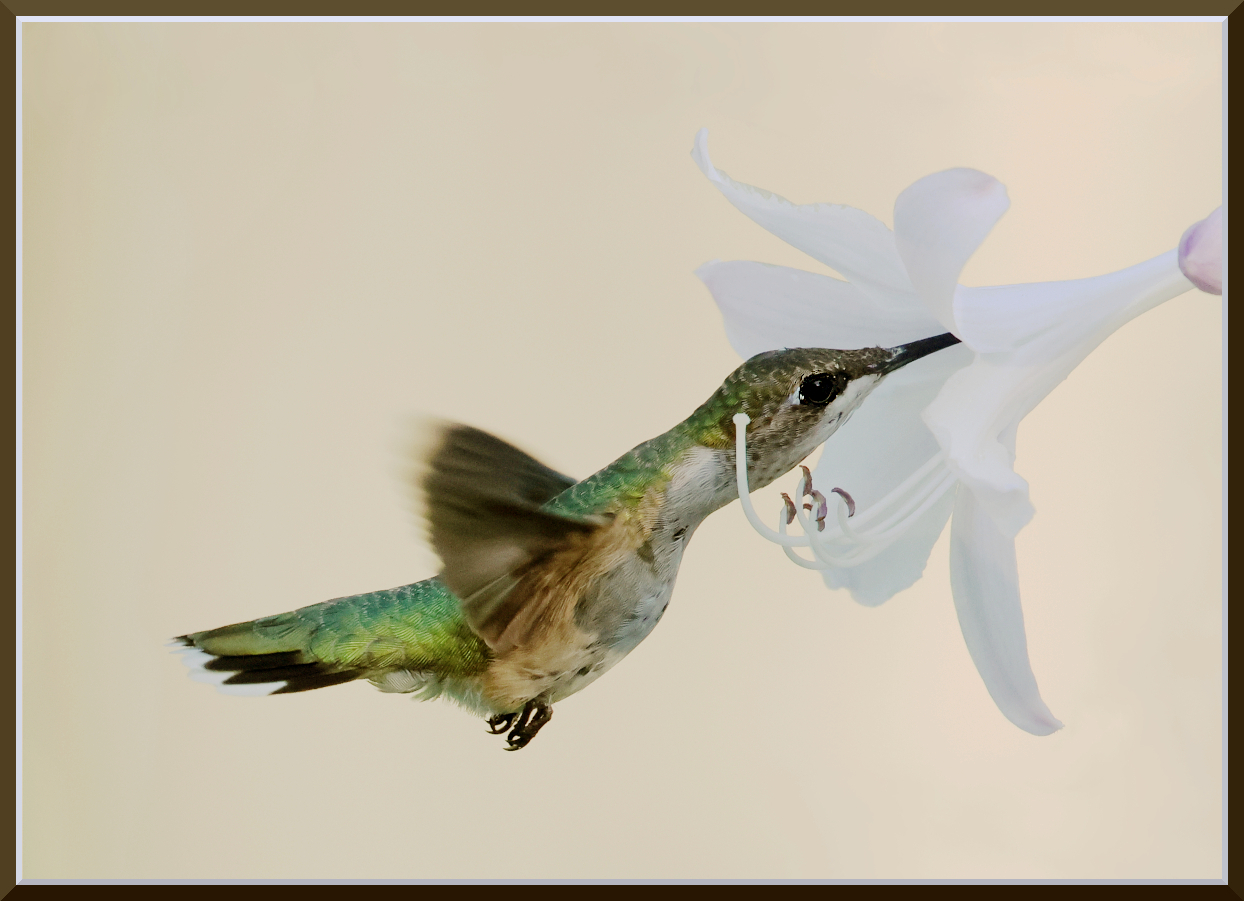
Your recommendations have been very helpful! That very light exposure touch-up on the head made a big difference. I increased noise reduction a bit and applied a few methods to reduce the distractions. Some of these are so obvious in hindsight but weren't until you pointed them out.
Appreciate the encouragement. It's hard not to be intimidates into inaction by some of truly spectacular images on this site. But they are the reason I am here, and working to improve my photography is a labor of love.
p.1 #10 · Is this as good as it can get or I am missing something?
grandmas wrote:
Cool capture! Things I like are the wings as they are: The placement of the bird in the frame. The sharpness of the bird.
Things you can think about changing that I think will benefit the image are: The beak is more blue than green or red, you might want to balance those colors by removing some blue. Also if you look close the high light in the eye is blue and not white. After doing that you might want to reduce the saturation a bit and adjust the curves. I also reduced the red saturation a bit more. Removing the intruding stuff on the right side of the image gives a cleaner feel to the whole image. Burn the light colored stuff at the bottom of the image till it no longer pulls the viewers eyes from the bird. Something to think about, the males make a more colorful image than the females....Show more →
Thank you grandmas! I like your profile image, very vibrant color!
I dialed the saturation back a bit, and de-emphasized the thistle. Here is hoping for a male to present himself to my camera next time .
p.1 #11 · Is this as good as it can get or I am missing something?
Malka_1 wrote:
Your recommendations have been very helpful! That very light exposure touch-up on the head made a big difference. I increased noise reduction a bit and applied a few methods to reduce the distractions. Some of these are so obvious in hindsight but weren't until you pointed them out.
Appreciate the encouragement. It's hard not to be intimidates into inaction by some of truly spectacular images on this site. But they are the reason I am here, and working to improve my photography is a labor of love.
I like what you did with the retouching in your image. Excellent job on reducing the visual weight of those "distractions"!
Now, here is a (sort of) provocation. My approach to editing is based on the idea that if any tool can enhance my vision to make a better experience for the viewer, I have no problems on using it. I mentioned before the Remove Tool.
I know different photogs have different beliefs concerning the level/ethics of manipulation, and I accept/respect that, but I would encourage you to try it when it comes to eliminating distractions, see how far you like to go and see how you feel about it, and mostly see how that can improve your vision and your intent of your photos. Only you can decide what to do with your image. Everyone has a right to decide what kind of tools one wants to use in their photography, and everyone has a right to decide what kind of photography they like.
Below is your image where I used only three brush strokes of the Remove Tool to eliminate the distraction completely. Too much? Not enough? You decide. Mine is only a suggestion.
Here is a thought: whatever is in the final result is all that matters to the viewer.
p.1 #12 · Is this as good as it can get or I am missing something?
Late to join the party. Others have already given some valuable insights and I see you have already improved the photo a lot. My 2 cents..... "catch light" in the eyes always takes bird photography instantly to the next level. I understand it is always hard keeping up with these little dynamites, but something to keep in mind. Also, the greens in backgrounds (in general) get oversaturated and overpower the image. Another minor improvement that I can think of.
Enjoy your new camera, always envied Sony's autofocus capabilities (Nikon shooter here)!
Sreedhar
p.1 #13 · Is this as good as it can get or I am missing something?
Malka_1 wrote:
I have been eyeing those lenses, but they not in the budget for now. Which is a good thing, because you're right, they are only one of many factors and there is plenty for me to learn and improve.
Appreciate all the tips you packed into the few lines above! I think there was a recent conversation about using a flash for hummingbirds in one of the other forums here.
I personally prefer the term "masters of the craft". I know it's just an expression, and wasn't meant to offend, but "big boys" carries demeaning implications for me as a female. I have worked for 30+ years in a very technical, male dominated, field, and have never felt the need to measure up to any sort of a boy!
Understood ... and glad you understand that there was nothing inferred by the phrase. I personally have four daughters (mother, aunt, sister, friends, colleagues, etc.) ... each standing well on their own and the phrase wouldn't infer anything demeaning onto them. But, I do understand that diff folks have diff plights en route to where they are ... so, please accept my apologies if I ticked the wrong box for you. "Big Guns" if you will.
As to the image, the mention of catchlights and saturated BG greens is sound. My previous mention of others using off camera flash (slight under) is one means of bringing the catchlight. A "slight" desaturation of BG greens can help yield differentiation of the subject / BG draw.
Also, the mention of the blue in the beak ... that is the indication of AI / AR relative to the blue sky ... which is an indication of the color of light illuminating your subject, i.e. WB. You might take note of the present color temp WB being used, and then correct the WB for the beak (effectively warming the image). From there, consider that information as endpoints of data ... and you may decide to land your WB (selectively / globally) in a diff place along that spectrum of data range.
p.1 #14 · Is this as good as it can get or I am missing something?
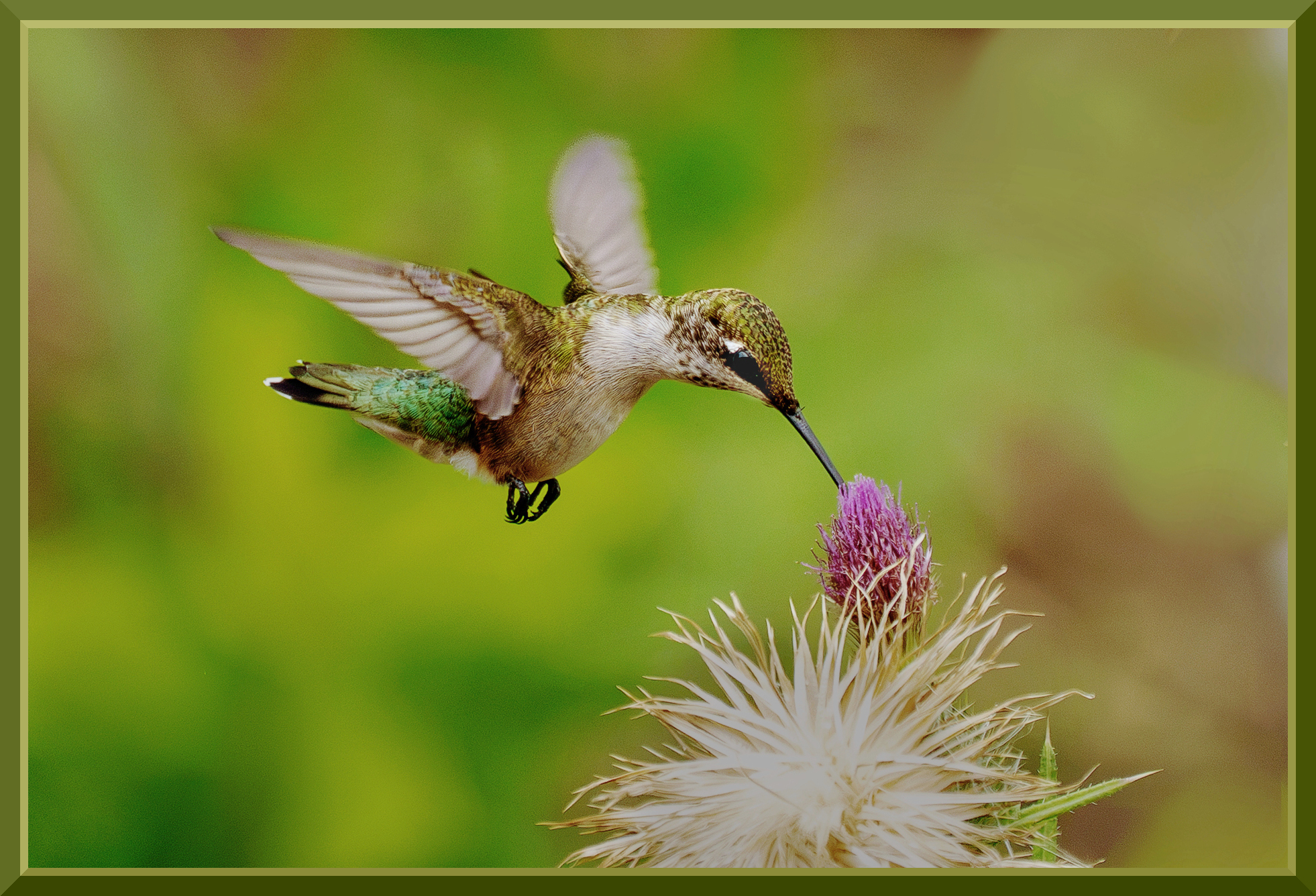
Color corrected version. Notice the beak is now black, not blue black, the catch light is now white and not blue, the wings are no longer lavender, and are a red brown color.
p.1 #15 · Is this as good as it can get or I am missing something?
grandmas wrote:
Color corrected version. Notice the beak is now black, not blue black, the catch light is now white and not blue, the wings are no longer lavender, and are a red brown color.
That looks like a global overcorrection to me.
Bear in mind that AI/AR is predicated on the shape of the object it is reflecting off of. The eye is spherical, etc. The blue that is being reflected, may be only indicative of the color of the FILL light, not the KEY light that is illuminating the subject. As such, it can be that when those areas are receiving little KEY light, the color of the FILL light reveals itself. Whereas areas that have sufficient KEY light, override the FILL light color, and do not warrant that much WB correction ... hence, when FILL color lighting adjustments are made globally, it can lead to an overcorrection.
Which is why I mentioned to consider it as a possible end point (i.e. the range of KEY vs. FILL lighting color). The assessment of adjustment then becomes a matter of discernment.
Personally, the OP looks better, but the adjustment approach may be to selective either adjust just those black areas revealing the FILL color, or to desaturate the blues from them a bit. A few ways to go about it, but one should be keen to understand the diff between KEY light WB vs. FILL light WB. They are not always uniform to warrant global correction.
p.1 #16 · Is this as good as it can get or I am missing something?
I think the colors are correct, and it comes down to what amount of saturation you are comfortable with. The previous version I posted had very little saturation removed. Personally I prefer less saturation, but it seems to be an individual thing. Here is another version with a lot of saturation removed and the background burned down, so it is not as distracting. The wings on this type of hummer are actually dark brown. I'm not sure, but this might be a fledgling male, so his head is not green like the females, and is in the process of a gorget filling in under h/er beak.
p.1 #20 · Is this as good as it can get or I am missing something?
grandmas wrote:
Color corrected version. Notice the beak is now black, not blue black, the catch light is now white and not blue, the wings are no longer lavender, and are a red brown color.
Sorry, colors look worse than the OP's shot. Too much yellow and the frame does not suit. MO