Is this as good as it can get or I am missing something?
p.2 #2Is this as good as it can get or I am missing something?
Shasoc wrote:

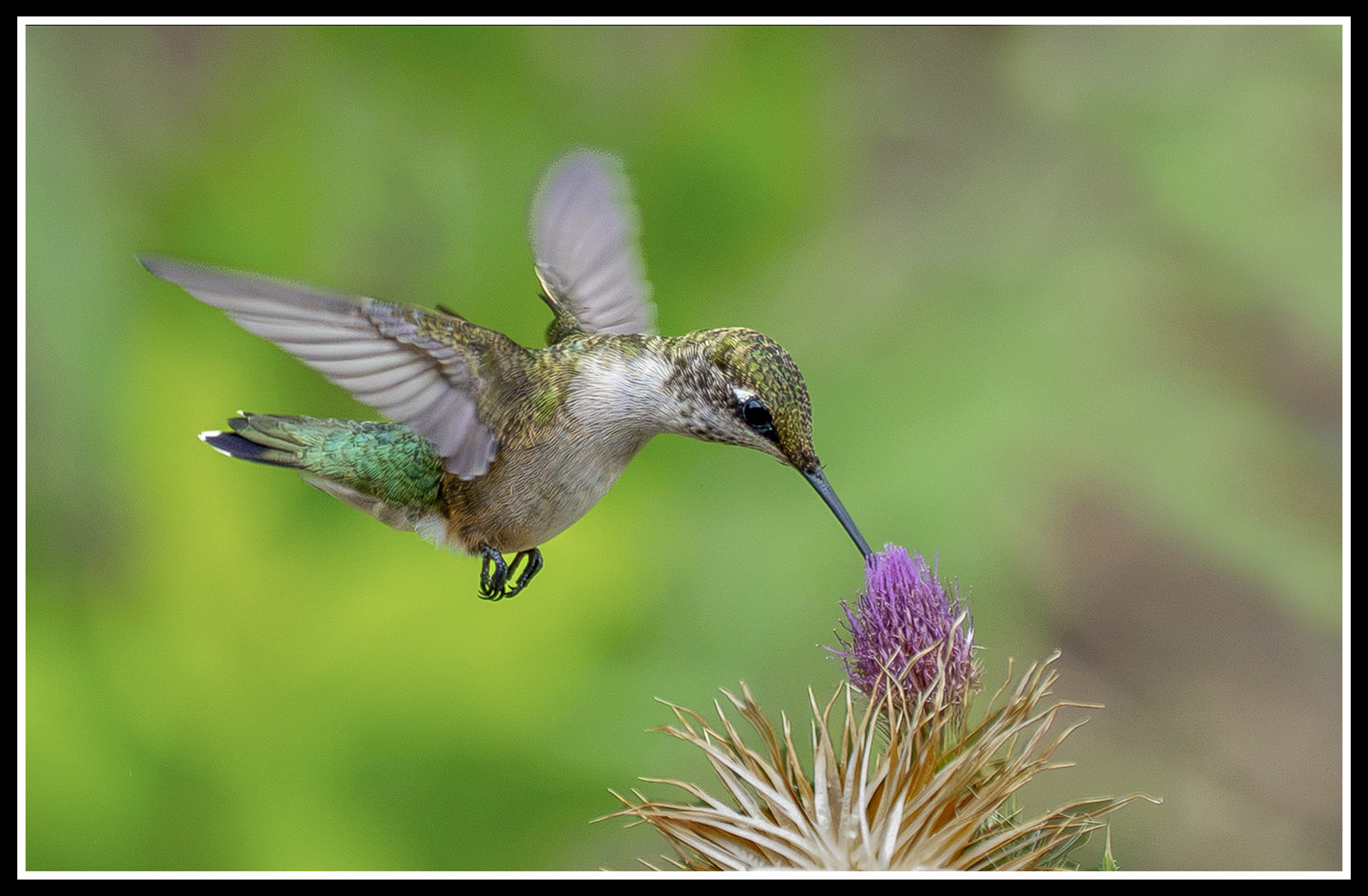
I like the vibrant colors of the bird and the clean background that keeps our attention on the bird and creates a sense of depth, a pleasing isolation, and a breathing space that makes the subject to stand out.
Great job on the exposure as it shows the iridescent colors and fine detail w/o harsh highlights.
Good choice of the SS as well. Give that slight blurring effect of the bird's wings that doesn't make feel as if it is "frozen" in space
The only distracting element I see in your photo is the thistle in the foreground. A bit prominent competing for attention with the bird while drawing the eye away from the subject. I would suggest masking or reducing its visual weight. The Remove Tool in PS can help. Also (minor thing) cloning out those blade of grass on the right top and side of the image would give a cleaner BG.
I would also brighten the bird’s eye/face to increase its dominance and to create a better connection with the viewer. Also if you like the slight grainy BG that is fine, otherwise I would think to run a slight noise reduction on it.
Those are the only improvements I see for your already great capture. You did a very good job on this capture and should be proud of it. Keep shooting.
Socrate
P.S. I don't remember who, but somebody said: If you think your photo is not good enough you are not close enoughYour recommendations have been very helpful! That very light exposure touch-up on the head made a big difference. I increased noise reduction a bit and applied a few methods to reduce the distractions. Some of these are so obvious in hindsight but weren't until you pointed them out.
Appreciate the encouragement. It's hard not to be intimidates into inaction by some of truly spectacular images on this site. But they are the reason I am here, and working to improve my photography is a labor of love. I like what you did with the retouching in your image. Excellent job on reducing the visual weight of those "distractions"!
Now, here is a (sort of) provocation. My approach to editing is based on the idea that if any tool can enhance my vision to make a better experience for the viewer, I have no problems on using it. I mentioned before the Remove Tool.
I know different photogs have different beliefs concerning the level/ethics of manipulation, and I accept/respect that, but I would encourage you to try it when it comes to eliminating distractions, see how far you...Show more →
Oh-oh, you're going to get me started on AI and I can be at it for while. I know there are other techniques that well predate the AI for image manipulation, but the package deal with AI takes it to the next level and it is presently the tool of choice. Here it goes.
I have done extensive research into AI, the technical and moral dirty laundry, for my day job when it first made the splash, so I have the background to speak to it. It's tool, and it's not going away, but is it the devil of our generation that's slowly consuming our souls in return for cheap labor? Or an incredibly useful helpmate that takes on the drudgery and allowing artists to focus on what they do best?
I think the answer is that it depends on usage and intent, but I am afraid a lot people out there are getting it foisted upon them in many sneaky ways so that they never get the choice and the clarity as to what they're giving up when using it.
I believe that a true artist imbues his/her work with part of his soul and that's what makes the work so powerful. Vast majority of AI-generated images give me the creeps, like nails on chalkboard, Frankensteins assembled by AI.
Having said that, I have observed it used effectively and deliberately. I have seen your work, Socrate, and took note. Your "Out of the Canvas" made me pause - no creeps. I didn't think it was possible. My theory, and forgive the metaphysical bend, is that you impose your intent on the work so strongly that it takes over completely.
I can go on and on, but back to your point re. using the tools at hand to enhance the image. I have used AI de-noise and AI removal. I let AF have the free reign for most of my shots. I stop short of using up-scale, and have never used Gen-AI for creative content. So many factors play a role, and I'll proceed on case-by-case bases with what's comfortable for me.
Re. my little hummingbird - I am leaving the dry thistle, if anything else, as a reminder that I have work cut out for me to improve my photography, and don't want to rely on genie in the bottle to save the day.
Out of curiosity, I did try the AI removal when I first played with the image and got a very strange flower similar to yours.
Thanks for your help and the conversation!
Malka
Edited on Aug 20, 2026 at 07:09 PM · View previous versions
Malka_1 wrote
Shasoc wrote
This is a fine image of the interaction between the hummingbird and the flower showing the beautiful detail of both.I like the vibrant colors of the bird and the clean background that keeps our attention on the bird and creates a sense of depth, a pleasing isolation, and a breathing space that makes the subject to stand out.
Great job on the exposure as it shows the iridescent colors and fine detail w/o harsh highlights.
Good choice of the SS as well. Give that slight blurring effect of the bird's wings that doesn't make feel as if it is "frozen" in space
The only distracting element I see in your photo is the thistle in the foreground. A bit prominent competing for attention with the bird while drawing the eye away from the subject. I would suggest masking or reducing its visual weight. The Remove Tool in PS can help. Also (minor thing) cloning out those blade of grass on the right top and side of the image would give a cleaner BG.
I would also brighten the bird’s eye/face to increase its dominance and to create a better connection with the viewer. Also if you like the slight grainy BG that is fine, otherwise I would think to run a slight noise reduction on it.
Those are the only improvements I see for your already great capture. You did a very good job on this capture and should be proud of it. Keep shooting.
Socrate
P.S. I don't remember who, but somebody said: If you think your photo is not good enough you are not close enough
Appreciate the encouragement. It's hard not to be intimidates into inaction by some of truly spectacular images on this site. But they are the reason I am here, and working to improve my photography is a labor of love.
I like what you did with the retouching in your image. Excellent job on reducing the visual weight of those "distractions"!Now, here is a (sort of) provocation.
My approach to editing is based on the idea that if any tool can enhance my vision to make a better experience for the viewer, I have no problems on using it. I mentioned before the Remove Tool. I know different photogs have different beliefs concerning the level/ethics of manipulation, and I accept/respect that, but I would encourage you to try it when it comes to eliminating distractions, see how far you...Show more →
Oh-oh, you're going to get me started on AI and I can be at it for while. I know there are other techniques that well predate the AI for image manipulation, but the package deal with AI takes it to the next level and it is presently the tool of choice. Here it goes.
I have done extensive research into AI, the technical and moral dirty laundry, for my day job when it first made the splash, so I have the background to speak to it. It's tool, and it's not going away, but is it the devil of our generation that's slowly consuming our souls in return for cheap labor? Or an incredibly useful helpmate that takes on the drudgery and allowing artists to focus on what they do best?
I think the answer is that it depends on usage and intent, but I am afraid a lot people out there are getting it foisted upon them in many sneaky ways so that they never get the choice and the clarity as to what they're giving up when using it.
I believe that a true artist imbues his/her work with part of his soul and that's what makes the work so powerful. Vast majority of AI-generated images give me the creeps, like nails on chalkboard, Frankensteins assembled by AI.
Having said that, I have observed it used effectively and deliberately. I have seen your work, Socrate, and took note. Your "Out of the Canvas" made me pause - no creeps. I didn't think it was possible. My theory, and forgive the metaphysical bend, is that you impose your intent on the work so strongly that it takes over completely.
I can go on and on, but back to your point re. using the tools at hand to enhance the image. I have used AI de-noise and AI removal. I let AF have the free reign for most of my shots. I stop short of using up-scale, and have never used Gen-AI for creative content. So many factors play a role, and I'll proceed on case-by-case bases with what's comfortable for me.
Re. my little hummingbird - I am leaving the dry thistle, if anything else, as a reminder that I have work cut out for me to improve my photography, and don't want to rely on genie in the bottle to save the day.
Out of curiosity, I did try the AI removal when I first played with the image and got a very strange flower similar to yours.
Thanks for your help and the conversation!
Malka
Edited on Aug 20, 2026 at 07:09 PM · View previous versions
Aug 20, 2026 at 05:42 PM
p.2 #3Is this as good as it can get or I am missing something?
guywithgas wrote:
Late to join the party. Others have already given some valuable insights and I see you have already improved the photo a lot. My 2 cents..... "catch light" in the eyes always takes bird photography instantly to the next level. I understand it is always hard keeping up with these little dynamites, but something to keep in mind. Also, the greens in backgrounds (in general) get oversaturated and overpower the image. Another minor improvement that I can think of.
Enjoy your new camera, always envied Sony's autofocus capabilities (Nikon shooter here)!
Sreedhar
Will keep in mind the catch lights! I have photos in my archives where birds with completely black eyes, no catch lights at all, and that's a super creepy, dead look.
I went back to play with image saturation. On the fence if I like the dialed-back look. It helps to bring out the subject, but the brighter green makes for a happier image overall. Something to be aware in the future.
I feel like a cheat half the time with Sony, the AF does so much heavy lifting.
Aug 20, 2026 at 05:52 PM

p.2 #4Is this as good as it can get or I am missing something?
Malka_1 wrote:
Enjoy your new camera, always envied Sony's autofocus capabilities (Nikon shooter here)!
SreedharWill keep in mind the catch lights! I have photos in my archives where birds with completely black eyes, no catch lights at all, and that's a super creepy, dead look.
I went back to play with image saturation. On the fence if I like the dialed-back look. It helps to bring out the subject, but the brighter green makes for a happier image overall. Something to be aware in the future.
I feel like a cheat half the time with Sony, the AF does so much heavy lifting.
Well, the catchlights are tricky business. I was suggesting that for future, and not to do it in post. I am not a great fan of a lot of post (gen AI and stuff like that). I restrict it to only "removal" and not any additions. Of course, every photographer is different and that is a debate that try to steer away from.
As for as Sony's AF is concerned, I guess I don't mind that in a Z9 body. Otherwise, I will be left alone from the competition
Sreedhar
guywithgas wrote
Late to join the party. Others have already given some valuable insights and I see you have already improved the photo a lot. My 2 cents..... "catch light" in the eyes always takes bird photography instantly to the next level. I understand it is always hard keeping up with these little dynamites, but something to keep in mind. Also, the greens in backgrounds (in general) get oversaturated and overpower the image. Another minor improvement that I can think of.Enjoy your new camera, always envied Sony's autofocus capabilities (Nikon shooter here)!
Sreedhar
I went back to play with image saturation. On the fence if I like the dialed-back look. It helps to bring out the subject, but the brighter green makes for a happier image overall. Something to be aware in the future.
I feel like a cheat half the time with Sony, the AF does so much heavy lifting.
Well, the catchlights are tricky business. I was suggesting that for future, and not to do it in post. I am not a great fan of a lot of post (gen AI and stuff like that). I restrict it to only "removal" and not any additions. Of course, every photographer is different and that is a debate that try to steer away from.
As for as Sony's AF is concerned, I guess I don't mind that in a Z9 body. Otherwise, I will be left alone from the competition
Sreedhar
Aug 20, 2026 at 06:06 PM
p.2 #5Is this as good as it can get or I am missing something?
RustyBug wrote:
From about 20 feet with a slow zoom ... that's pretty darn good, imo. I have shot some hummers from less than 5 feet away, with an f/2 lens and with 100-400's at mfd, etc.. I think the thing here is going to be your ability to study / learn your proximity and shutter speeds to get different wing sharp / blur / flutter. That just takes time to become more knowledgeable of your subject matter and the experience with it.
I'm not a master of hummers, dragonfly's, butterfiles, etc. ... but, my experience is that they can be a matter of understanding their behavior and your ability to get closer to them. The more you you increase your ability (just takes time, practice, observation) with that, the closer you'll come to what others do ... till you "come into your own" and find "your way".
Setting up a station / blind can be helpful too. That's something that the masters are keen to do, but few divulge their rigs ... and folks assume they are just finding them "naturally" while walking about kind of thing. Not so much ... when you're talking top tier work. If you want to "level up" to the big boys, this can be a labor of love, too.
That said, it is still a nice one.
Welcome to the forum.
 Thanks for the welcome and the info! I think you're right. Comparing my images to those of the "big boys" (and gals!) is what's giving me the heartburn. I liked the wings as they were, so ss is probably OK. It sounds like proximity might be one of the differentiators in this case. The other might be the lens. Images I observed to be the next level are all taken with primes/GMs.I wouldn't worry too much ... not just yet ... about your lens. Until you can get to MFD (i.e. much closer than 20 feet), I think you've got some room to grow with. I shot plenty with my 100-400 with pretty good proximity, too. I think there's more to be gained from proximity / animal behavior / stand / blind ... oh, yeah ... and the big boys often implement a (slight under-exposure recommended) fill flash technique with strobed pre-positioned, off camera, etc. for when the sun doesn't provide natural lighting to their chosing, etc. ... catchlight emulation, etc.
Point being, there's plenty of room for technique growth and exploration with your present glass.
I have been eyeing those lenses, but they not in the budget for now. Which is a good thing, because you're right, they are only one of many factors and there is plenty for me to learn and improve.
Appreciate all the tips you packed into the few lines above! I think there was a recent conversation about using a flash for hummingbirds in one of the other forums here.
I personally prefer the term "masters of the craft". I know it's just an expression, and wasn't meant to offend, but "big boys" carries demeaning implications for me as a female. I have worked for 30+ years in a very technical, male dominated, field, and have never felt the need to measure up to any sort of a boy!Understood ... and glad you understand that there was nothing inferred by the phrase. I personally have four daughters (mother, aunt, sister, friends, colleagues, etc.) ... each standing well on their own and the phrase wouldn't infer anything demeaning onto them. But, I do understand that diff folks have diff plights en route to where they are ... so, please accept my apologies if I ticked the wrong box for you. "Big Guns" if you will.
As to the image, the mention of catchlights and saturated BG greens is sound. My previous mention of others using off camera flash (slight...Show more →
Of course, nothing you or anyone else on this forum ever said that had any sort of bigotry. It's just the term itself that "ticked the wrong box". Big Guns works too!
Four daughter, ha. I have 4 girls too, we should compare notes sometime! Esp. the teenage years.
So what you are saying is that I can use the beak as an equivalent of the gray card for WB adjustment? I tried it, got the blue successfully out of the beak but didn't like what it did to the rest of the image. Maybe by now I am too attached to the beautiful emerald background. For sure something to be aware of for the future.
Thanks again for your help!
Malka_1 wrote
RustyBug wrote
Malka_1 wrote
RustyBug wrote
Welcome to the Forum.From about 20 feet with a slow zoom ... that's pretty darn good, imo. I have shot some hummers from less than 5 feet away, with an f/2 lens and with 100-400's at mfd, etc.. I think the thing here is going to be your ability to study / learn your proximity and shutter speeds to get different wing sharp / blur / flutter. That just takes time to become more knowledgeable of your subject matter and the experience with it.
I'm not a master of hummers, dragonfly's, butterfiles, etc. ... but, my experience is that they can be a matter of understanding their behavior and your ability to get closer to them. The more you you increase your ability (just takes time, practice, observation) with that, the closer you'll come to what others do ... till you "come into your own" and find "your way".
Setting up a station / blind can be helpful too. That's something that the masters are keen to do, but few divulge their rigs ... and folks assume they are just finding them "naturally" while walking about kind of thing. Not so much ... when you're talking top tier work. If you want to "level up" to the big boys, this can be a labor of love, too.
That said, it is still a nice one.
Welcome to the forum.
Point being, there's plenty of room for technique growth and exploration with your present glass.
Appreciate all the tips you packed into the few lines above! I think there was a recent conversation about using a flash for hummingbirds in one of the other forums here.
I personally prefer the term "masters of the craft". I know it's just an expression, and wasn't meant to offend, but "big boys" carries demeaning implications for me as a female. I have worked for 30+ years in a very technical, male dominated, field, and have never felt the need to measure up to any sort of a boy!
As to the image, the mention of catchlights and saturated BG greens is sound. My previous mention of others using off camera flash (slight...Show more →
Of course, nothing you or anyone else on this forum ever said that had any sort of bigotry. It's just the term itself that "ticked the wrong box". Big Guns works too!
Four daughter, ha. I have 4 girls too, we should compare notes sometime! Esp. the teenage years.
So what you are saying is that I can use the beak as an equivalent of the gray card for WB adjustment? I tried it, got the blue successfully out of the beak but didn't like what it did to the rest of the image. Maybe by now I am too attached to the beautiful emerald background. For sure something to be aware of for the future.
Thanks again for your help!
Aug 20, 2026 at 06:09 PM
p.2 #6Is this as good as it can get or I am missing something?
Malka_1 wrote:
From about 20 feet with a slow zoom ... that's pretty darn good, imo. I have shot some hummers from less than 5 feet away, with an f/2 lens and with 100-400's at mfd, etc.. I think the thing here is going to be your ability to study / learn your proximity and shutter speeds to get different wing sharp / blur / flutter. That just takes time to become more knowledgeable of your subject matter and the experience with it.
I'm not a master of hummers, dragonfly's, butterfiles, etc. ... but, my experience is that they can be a matter of understanding their behavior and your ability to get closer to them. The more you you increase your ability (just takes time, practice, observation) with that, the closer you'll come to what others do ... till you "come into your own" and find "your way".
Setting up a station / blind can be helpful too. That's something that the masters are keen to do, but few divulge their rigs ... and folks assume they are just finding them "naturally" while walking about kind of thing. Not so much ... when you're talking top tier work. If you want to "level up" to the big boys, this can be a labor of love, too.
That said, it is still a nice one.
Welcome to the forum.
Thanks for the welcome and the info! I think you're right. Comparing my images to those of the "big boys" (and gals!) is what's giving me the heartburn. I liked the wings as they were, so ss is probably OK. It sounds like proximity might be one of the differentiators in this case. The other might be the lens. Images I observed to be the next level are all taken with primes/GMs.I wouldn't worry too much ... not just yet ... about your lens. Until you can get to MFD (i.e. much closer than 20 feet), I think you've got some room to grow with. I shot plenty with my 100-400 with pretty good proximity, too. I think there's more to be gained from proximity / animal behavior / stand / blind ... oh, yeah ... and the big boys often implement a (slight under-exposure recommended) fill flash technique with strobed pre-positioned, off camera, etc. for when the sun doesn't provide natural lighting to their chosing, etc. ... catchlight emulation, etc.
Point being, there's plenty of room for technique growth and exploration with your present glass.
I have been eyeing those lenses, but they not in the budget for now. Which is a good thing, because you're right, they are only one of many factors and there is plenty for me to learn and improve.
Appreciate all the tips you packed into the few lines above! I think there was a recent conversation about using a flash for hummingbirds in one of the other forums here.
I personally prefer the term "masters of the craft". I know it's just an expression, and wasn't meant to offend, but "big boys" carries demeaning implications for me as a female. I have worked for 30+ years in a very technical, male dominated, field, and have never felt the need to measure up to any sort of a boy!Understood ... and glad you understand that there was nothing inferred by the phrase. I personally have four daughters (mother, aunt, sister, friends, colleagues, etc.) ... each standing well on their own and the phrase wouldn't infer anything demeaning onto them. But, I do understand that diff folks have diff plights en route to where they are ... so, please accept my apologies if I ticked the wrong box for you. "Big Guns" if you will.
As to the image, the mention of catchlights and saturated BG greens is sound. My previous mention of others using off camera flash (slight under) is one means of bringing the catchlight. A "slight" desaturation of BG greens can help yield differentiation of the subject / BG draw.
Also, the mention of the blue in the beak ... that is the indication of AI / AR relative to the blue sky ... which is an indication of the color of light illuminating your subject, i.e. WB. You might take note of the present color temp WB being used, and then correct the WB for the beak (effectively warming the image). From there, consider that information as endpoints of data ... and you may decide to land your WB (selectively / globally) in a diff place along that spectrum of data range.Of course, nothing you or anyone else on this forum ever said that had any sort of bigotry. It's just the term itself that "ticked the wrong box". Big Guns works too!
Four daughter, ha. I have 4 girls too, we should compare notes sometime! Esp. the teenage years.
So what you are saying is that I can use the beak as an equivalent of the gray card for WB adjustment? I tried it, got the blue successfully out of the beak but didn't like what it did to the rest of the image. Maybe by now I am too attached to...Show more →
Cool.
Yeah, when you have a natural "grey card" ... you can READ the color of the light illuminating it. The deal though is this ... you ALSO have to recognize IF that light is the primary light illuminating your subject (i.e. KEY light), or is it something else (FILL or ACCENT) coming from the non-KEY position. So, you can't just blindly adjust the ENTIRE GLOBAL image based on on it alone ... just recognize it as a cue / clue ... to be assessed / evaluated, for possible adjustment consideration.
Hope that makes a bit of sense. It's not has hard as it sounds, just until you get your head wrapped around it, it can feel a bit at times.
RustyBug wrote
Malka_1 wrote
RustyBug wrote
Malka_1 wrote
RustyBug wrote
Welcome to the Forum.From about 20 feet with a slow zoom ... that's pretty darn good, imo. I have shot some hummers from less than 5 feet away, with an f/2 lens and with 100-400's at mfd, etc.. I think the thing here is going to be your ability to study / learn your proximity and shutter speeds to get different wing sharp / blur / flutter. That just takes time to become more knowledgeable of your subject matter and the experience with it.
I'm not a master of hummers, dragonfly's, butterfiles, etc. ... but, my experience is that they can be a matter of understanding their behavior and your ability to get closer to them. The more you you increase your ability (just takes time, practice, observation) with that, the closer you'll come to what others do ... till you "come into your own" and find "your way".
Setting up a station / blind can be helpful too. That's something that the masters are keen to do, but few divulge their rigs ... and folks assume they are just finding them "naturally" while walking about kind of thing. Not so much ... when you're talking top tier work. If you want to "level up" to the big boys, this can be a labor of love, too.
That said, it is still a nice one.
Welcome to the forum.
Point being, there's plenty of room for technique growth and exploration with your present glass.
Appreciate all the tips you packed into the few lines above! I think there was a recent conversation about using a flash for hummingbirds in one of the other forums here.
I personally prefer the term "masters of the craft". I know it's just an expression, and wasn't meant to offend, but "big boys" carries demeaning implications for me as a female. I have worked for 30+ years in a very technical, male dominated, field, and have never felt the need to measure up to any sort of a boy!
As to the image, the mention of catchlights and saturated BG greens is sound. My previous mention of others using off camera flash (slight under) is one means of bringing the catchlight. A "slight" desaturation of BG greens can help yield differentiation of the subject / BG draw.
Also, the mention of the blue in the beak ... that is the indication of AI / AR relative to the blue sky ... which is an indication of the color of light illuminating your subject, i.e. WB. You might take note of the present color temp WB being used, and then correct the WB for the beak (effectively warming the image). From there, consider that information as endpoints of data ... and you may decide to land your WB (selectively / globally) in a diff place along that spectrum of data range.
Four daughter, ha. I have 4 girls too, we should compare notes sometime! Esp. the teenage years.
So what you are saying is that I can use the beak as an equivalent of the gray card for WB adjustment? I tried it, got the blue successfully out of the beak but didn't like what it did to the rest of the image. Maybe by now I am too attached to...Show more →
Cool.
Yeah, when you have a natural "grey card" ... you can READ the color of the light illuminating it. The deal though is this ... you ALSO have to recognize IF that light is the primary light illuminating your subject (i.e. KEY light), or is it something else (FILL or ACCENT) coming from the non-KEY position. So, you can't just blindly adjust the ENTIRE GLOBAL image based on on it alone ... just recognize it as a cue / clue ... to be assessed / evaluated, for possible adjustment consideration.
Hope that makes a bit of sense. It's not has hard as it sounds, just until you get your head wrapped around it, it can feel a bit
at times. Aug 20, 2026 at 06:17 PM
p.2 #7Is this as good as it can get or I am missing something?
grandmas wrote:
I think the colors are correct, and it comes down to what amount of saturation you are comfortable with. The previous version I posted had very little saturation removed. Personally I prefer less saturation, but it seems to be an individual thing. Here is another version with a lot of saturation removed and the background burned down, so it is not as distracting. The wings on this type of hummer are actually dark brown. I'm not sure, but this might be a fledgling male, so his head is not green like the females, and is in the process of a...Show more →
Hi Grandmas, thanks for taking the time to provide feedback and experiment with my image! On the balance I like my version better, but good info to consider for the future.
Aug 20, 2026 at 06:19 PM
p.2 #8Is this as good as it can get or I am missing something?
At the end of the day ... you get to land it where you want it.
Sometimes, we use the light, to showcase the color of the subject.
Sometimes, we use the subject, to showcase the color of the light.
Your pic, Your message, Your call.
Sometimes, we use the light, to showcase the color of the subject.
Sometimes, we use the subject, to showcase the color of the light.
Your pic, Your message, Your call.
Aug 20, 2026 at 06:20 PM
p.2 #9Is this as good as it can get or I am missing something?
RustyBug wrote:
I wouldn't worry too much ... not just yet ... about your lens. Until you can get to MFD (i.e. much closer than 20 feet), I think you've got some room to grow with. I shot plenty with my 100-400 with pretty good proximity, too. I think there's more to be gained from proximity / animal behavior / stand / blind ... oh, yeah ... and the big boys often implement a (slight under-exposure recommended) fill flash technique with strobed pre-positioned, off camera, etc. for when the sun doesn't provide natural lighting to their chosing, etc. ... catchlight emulation, etc.
Point being, there's plenty of room for technique growth and exploration with your present glass.
I have been eyeing those lenses, but they not in the budget for now. Which is a good thing, because you're right, they are only one of many factors and there is plenty for me to learn and improve.
Appreciate all the tips you packed into the few lines above! I think there was a recent conversation about using a flash for hummingbirds in one of the other forums here.
I personally prefer the term "masters of the craft". I know it's just an expression, and wasn't meant to offend, but "big boys" carries demeaning implications for me as a female. I have worked for 30+ years in a very technical, male dominated, field, and have never felt the need to measure up to any sort of a boy!Understood ... and glad you understand that there was nothing inferred by the phrase. I personally have four daughters (mother, aunt, sister, friends, colleagues, etc.) ... each standing well on their own and the phrase wouldn't infer anything demeaning onto them. But, I do understand that diff folks have diff plights en route to where they are ... so, please accept my apologies if I ticked the wrong box for you. "Big Guns" if you will.
As to the image, the mention of catchlights and saturated BG greens is sound. My previous mention of others using off camera flash (slight under) is one means of bringing the catchlight. A "slight" desaturation of BG greens can help yield differentiation of the subject / BG draw.
Also, the mention of the blue in the beak ... that is the indication of AI / AR relative to the blue sky ... which is an indication of the color of light illuminating your subject, i.e. WB. You might take note of the present color temp WB being used, and then correct the WB for the beak (effectively warming the image). From there, consider that information as endpoints of data ... and you may decide to land your WB (selectively / globally) in a diff place along that spectrum of data range.Of course, nothing you or anyone else on this forum ever said that had any sort of bigotry. It's just the term itself that "ticked the wrong box". Big Guns works too!
Four daughter, ha. I have 4 girls too, we should compare notes sometime! Esp. the teenage years.
So what you are saying is that I can use the beak as an equivalent of the gray card for WB adjustment? I tried it, got the blue successfully out of the beak but didn't like what it did to the rest of the image. Maybe by now I am too attached to the beautiful emerald background. For sure something to be aware of for the future.
Thanks again for your help!Cool.
Yeah, when you have a natural "grey card" ... you can READ the color of the light illuminating it. The deal though is this ... you ALSO have to recognize IF that light is the primary light illuminating your subject (i.e. KEY light), or is it something else (FILL or ACCENT) coming from the non-KEY position. So, you can't just blindly adjust the ENTIRE GLOBAL image based on on it alone ... just recognize it as a cue / clue ... to be assessed / evaluated, for possible adjustment consideration.
Hope that makes a bit of sense. It's not has hard...Show more →
I get it. In this case, there was just a good diffused daylight - middle of a cloudy day. No flash or reflections unless the dry thistles (there were more of them all around) managed something sneaky.
I did try one more thing. Created a mask just for the beak and shifted the temp a bit to the yellow to get a nice neutral grey. I like the result, that one small change made a difference. Guessing the mind kept getting snagged on that somewhat unnatural blue.
Malka_1 wrote
RustyBug wrote
Malka_1 wrote
RustyBug wrote
Malka_1 wrote
Thanks for the welcome and the info! I think you're right. Comparing my images to those of the "big boys" (and gals!) is what's giving me the heartburn. I liked the wings as they were, so ss is probably OK. It sounds like proximity might be one of the differentiators in this case. The other might be the lens. Images I observed to be the next level are all taken with primes/GMs.Point being, there's plenty of room for technique growth and exploration with your present glass.
Appreciate all the tips you packed into the few lines above! I think there was a recent conversation about using a flash for hummingbirds in one of the other forums here.
I personally prefer the term "masters of the craft". I know it's just an expression, and wasn't meant to offend, but "big boys" carries demeaning implications for me as a female. I have worked for 30+ years in a very technical, male dominated, field, and have never felt the need to measure up to any sort of a boy!
As to the image, the mention of catchlights and saturated BG greens is sound. My previous mention of others using off camera flash (slight under) is one means of bringing the catchlight. A "slight" desaturation of BG greens can help yield differentiation of the subject / BG draw.
Also, the mention of the blue in the beak ... that is the indication of AI / AR relative to the blue sky ... which is an indication of the color of light illuminating your subject, i.e. WB. You might take note of the present color temp WB being used, and then correct the WB for the beak (effectively warming the image). From there, consider that information as endpoints of data ... and you may decide to land your WB (selectively / globally) in a diff place along that spectrum of data range.
Four daughter, ha. I have 4 girls too, we should compare notes sometime! Esp. the teenage years.
So what you are saying is that I can use the beak as an equivalent of the gray card for WB adjustment? I tried it, got the blue successfully out of the beak but didn't like what it did to the rest of the image. Maybe by now I am too attached to the beautiful emerald background. For sure something to be aware of for the future.
Thanks again for your help!
Yeah, when you have a natural "grey card" ... you can READ the color of the light illuminating it. The deal though is this ... you ALSO have to recognize IF that light is the primary light illuminating your subject (i.e. KEY light), or is it something else (FILL or ACCENT) coming from the non-KEY position. So, you can't just blindly adjust the ENTIRE GLOBAL image based on on it alone ... just recognize it as a cue / clue ... to be assessed / evaluated, for possible adjustment consideration.
Hope that makes a bit of sense. It's not has hard...Show more →
I get it. In this case, there was just a good diffused daylight - middle of a cloudy day. No flash or reflections unless the dry thistles (there were more of them all around) managed something sneaky.
I did try one more thing. Created a mask just for the beak and shifted the temp a bit to the yellow to get a nice neutral grey. I like the result, that one small change made a difference. Guessing the mind kept getting snagged on that somewhat unnatural blue.
Aug 20, 2026 at 06:33 PM
p.2 #10Is this as good as it can get or I am missing something?
Imagemaster wrote:
Hi, thanks for weighing in! It looks like you reduced the exposure to darken the thistle (T/F?) and removed the other two intrusions on the right. I spent way too much time on that front thistle, tried the exposure too. Mine came out a little more messy and fake looking when I did it that much, so I abandoned that option in favor of smaller exposure reduction, blurring it and adding a bit of green to help blend with the background. I think both options make the most of it.
Hi, thanks for weighing in! It looks like you reduced the exposure to darken the thistle (T/F?) and removed the other two intrusions on the right. I spent way too much time on that front thistle, tried the exposure too. Mine came out a little more messy and fake looking when I did it that much, so I abandoned that option in favor of smaller exposure reduction, blurring it and adding a bit of green to help blend with the background. I think both options make the most of it.
Aug 20, 2026 at 06:54 PM
|
p.2 #11Is this as good as it can get or I am missing something?
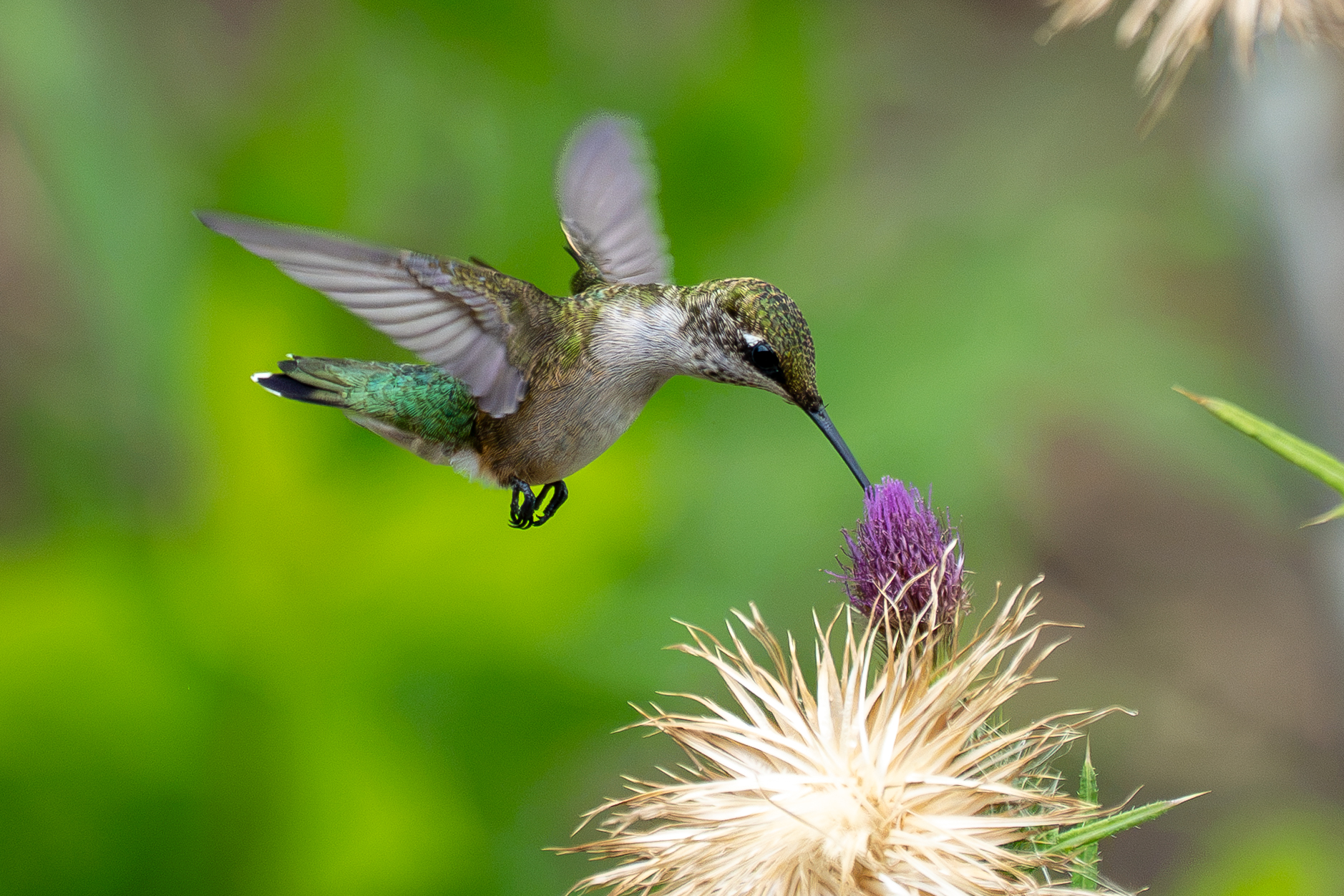
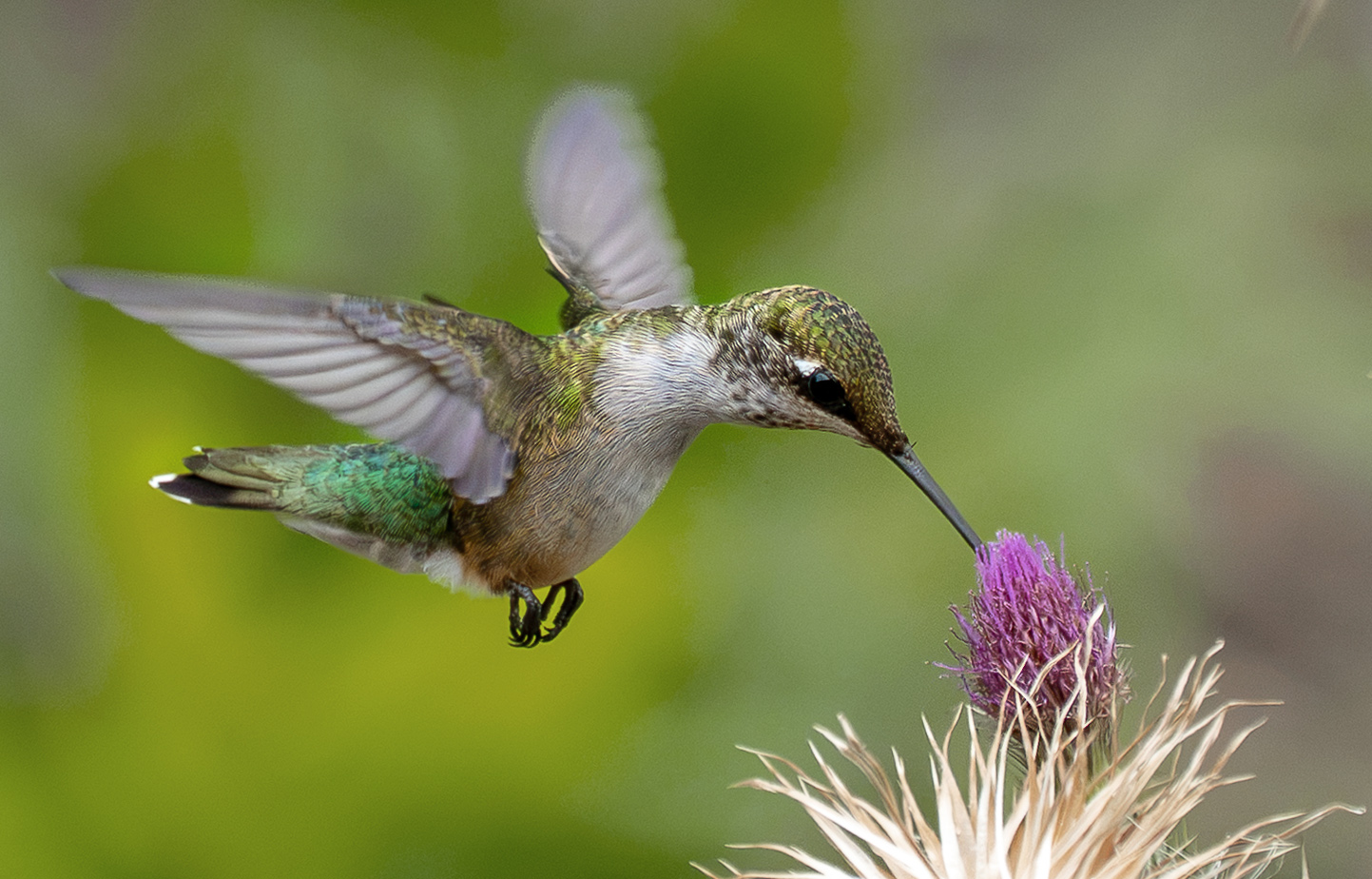
Took a stab at a few things. Been a while since I used PS (i.e. didn't import into Lightroom), so my Photoshop chops are a bit rusty, but hopefully you get the gist. A little of this, a little of that, not too much of any one thing.
OP provided for reference of where it began ... land it where ya like it.
HTH
OP provided for reference of where it began ... land it where ya like it.
HTH
 |
||
 |
||
 |
Aug 20, 2026 at 07:13 PM
p.2 #12Is this as good as it can get or I am missing something?
Imagemaster wrote:
This is an interesting image and depending on the stage of maturity of the bird it is hard to know exactly what the colors really are. There seemed to be plenty of light which will make colors lighter.
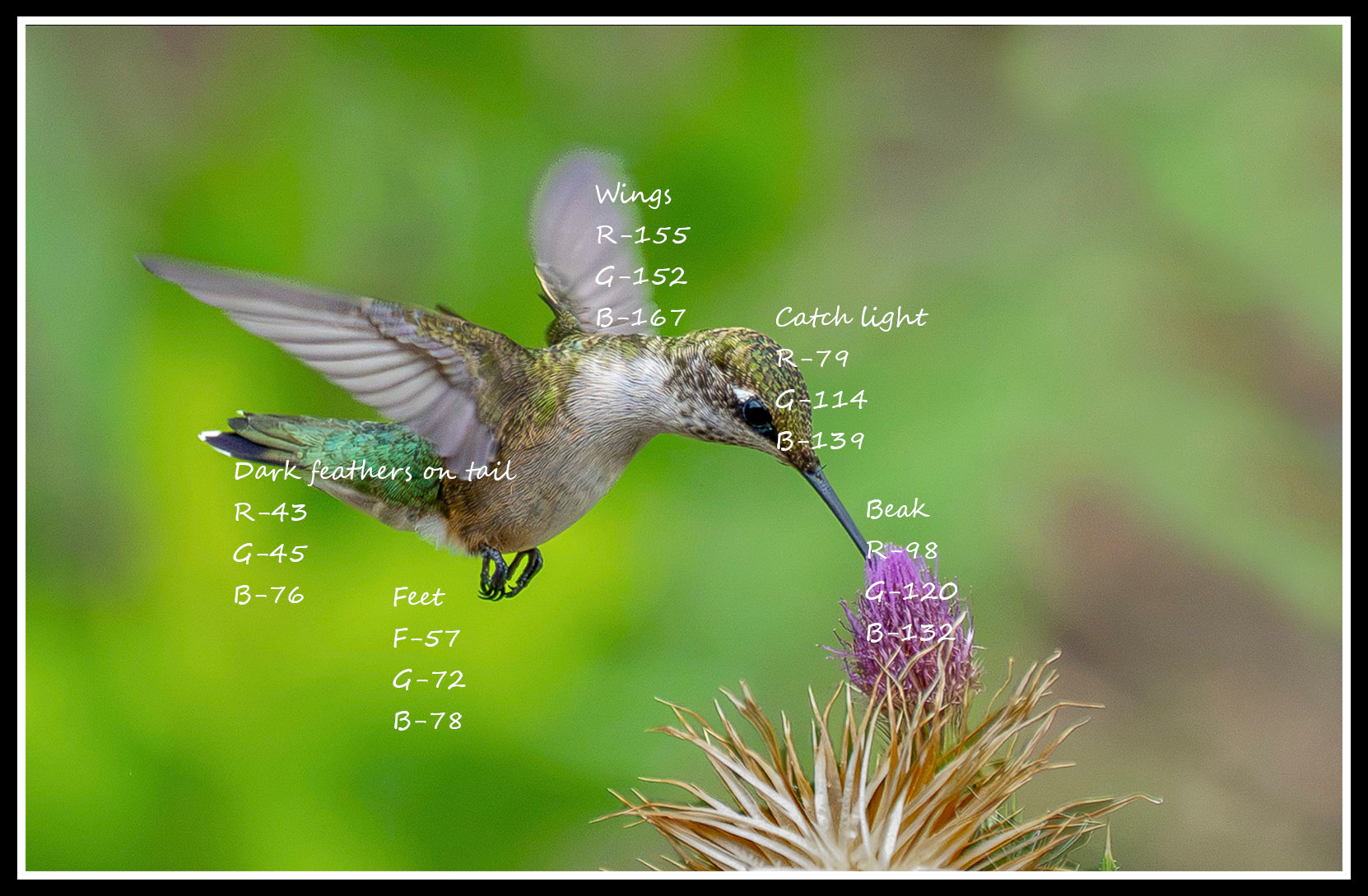
I pulled your image and did a quick check on the colors and the numbers show more blue in all these areas where they should balance. Dark brown wings will look more beige than lavender or blue when in motion. If this is your preference that is fine with me, but it is up to the original poster what they want. I have a personal preference for warmer images, so we are all different in what we like.
Here is your re-worked image with color numbers.
This is an interesting image and depending on the stage of maturity of the bird it is hard to know exactly what the colors really are. There seemed to be plenty of light which will make colors lighter.
I pulled your image and did a quick check on the colors and the numbers show more blue in all these areas where they should balance. Dark brown wings will look more beige than lavender or blue when in motion. If this is your preference that is fine with me, but it is up to the original poster what they want. I have a personal preference for warmer images, so we are all different in what we like.
Here is your re-worked image with color numbers.
Aug 20, 2026 at 07:35 PM
p.2 #13Is this as good as it can get or I am missing something?
Why does everyone want purple or lavender wings? The wings are dark brown and in motion they would be beige.
Aug 20, 2026 at 07:37 PM
p.2 #14Is this as good as it can get or I am missing something?
Malka_1 wrote:
Created a mask just for the beak and shifted the temp a bit to the yellow to get a nice neutral grey. I like the result, that one small change made a difference.
Yeah, you can skin that cat a few diff ways, I "desaturated" the blue / cyan's with local masking for the beak and feet. Also, I will CRANK UP THE SATURATION to 100% ... it will really show you where your colors are (so, you can decide where to mask) skewed or shifted, reflected or cast. And, then you can use that to help understand if it is a LOCAL color issue, or a GLOBAL color issue that you want to adjust / correct for. Of course, then you return your 100% saturation diagnostic tool back to landing it where you want it, but it can be a very good tool for your visualization of those "minor things" that make it "off" by that amount you were speaking to.
Aug 20, 2026 at 07:40 PM
p.2 #15Is this as good as it can get or I am missing something?
grandmas wrote:
Why does everyone want purple or lavender wings? The wings are dark brown and in motion they would be beige.
The wings are at an angle that shares similar AI/AR aspects that it may be picking up the color from a different portion of the sky (or nearby flower, etc.), and thus picking up some color shift ... not unlike the beak / pupil matter, just a different angle. That said, if one wanted to, they could adjust the wing color selectively (vs. global), similar to the selective approach of the shadow / black neutrals.
I suppose the amount of "lavendar" present in the wings isn't a primary concern ... since it is an oof area vs. the focused area of the eye / beak. I just wouldn't base my global WB on the wings. That said, I'm not sure how "brown" the wings are to begin with, but I am pretty sure the beak / pupil / feet aren't blue.
Given the numbers you've indicated, there might be some room for a slight pullback in the blue channel ... would have to give a try and see how much "looks right" to move it more neutral / warm, to see if there is a slight cast overall (but, I'd be cautious to use the blue / lavender in the wing as basis for global WB adjustment)
So, here again ... land it where ya like it.
Aug 20, 2026 at 07:51 PM
p.2 #16Is this as good as it can get or I am missing something?
RustyBug wrote:
That said, I'm not sure how "brown" the wings are to begin with
...but but you are giving color advice
The actual color is DARK BROWN, the color of a pair of men's dark brown suede leather dress shoes. It is easily found info.
I think the OP needs to go on line and look at photos of immature Ruby-throated Hummers and form their own opinion about colors. Also search for what color are the wings of this bird. This gives an idea of how much of a blue cast this image actually has.
grandmas wrote
Why does everyone want purple or lavender wings? The wings are dark brown and in motion they would be beige....but but you are giving color advice
The actual color is DARK BROWN, the color of a pair of men's dark brown suede leather dress shoes. It is easily found info.
I think the OP needs to go on line and look at photos of immature Ruby-throated Hummers and form their own opinion about colors. Also search for what color are the wings of this bird. This gives an idea of how much of a blue cast this image actually has.
Aug 21, 2026 at 10:02 AM
p.2 #17Is this as good as it can get or I am missing something?
grandmas wrote:
That said, I'm not sure how "brown" the wings are to begin with...but but you are giving color advice
The actual color is DARK BROWN, the color of a pair of men's dark brown suede leather dress shoes. It is easily found info.
I think the OP needs to go on line and look at photos of immature Ruby-throated Hummers and form their own opinion about colors. Also search for what color are the wings of this bird. This gives an idea of how much of a blue cast this image actually has.
GM I can understand your persistence on getting the “right colors”. However, I believe that you are missing an important element in that equation. Right colors are not always the best colors in a photo.
Think of the warm colors of a sunset scene. If you color “correct” the deep orange, you would lose the mood and atmosphere of the scene and ruin the original emotion. The “magic” would be gone. IOW correct colors may show the scene, but captured colors show the mood.
This concept is extensively used in movies where color grading is used to generate emotions in the viewer.
So, insisting on getting the “right colors” in a photo can reduce that photo just to data rather then to a storytelling.
Socrate
RustyBug wrote
grandmas wrote
Why does everyone want purple or lavender wings? The wings are dark brown and in motion they would be beige.The actual color is DARK BROWN, the color of a pair of men's dark brown suede leather dress shoes. It is easily found info.
I think the OP needs to go on line and look at photos of immature Ruby-throated Hummers and form their own opinion about colors. Also search for what color are the wings of this bird. This gives an idea of how much of a blue cast this image actually has.
GM I can understand your persistence on getting the “right colors”. However, I believe that you are missing an important element in that equation. Right colors are not always the best colors in a photo.
Think of the warm colors of a sunset scene. If you color “correct” the deep orange, you would lose the mood and atmosphere of the scene and ruin the original emotion. The “magic” would be gone. IOW correct colors may show the scene, but captured colors show the mood.
This concept is extensively used in movies where color grading is used to generate emotions in the viewer.
So, insisting on getting the “right colors” in a photo can reduce that photo just to data rather then to a storytelling.
Socrate
Aug 21, 2026 at 01:25 PM
p.2 #18Is this as good as it can get or I am missing something?
Shasoc wrote:
That said, I'm not sure how "brown" the wings are to begin with...but but you are giving color advice
The actual color is DARK BROWN, the color of a pair of men's dark brown suede leather dress shoes. It is easily found info.
I think the OP needs to go on line and look at photos of immature Ruby-throated Hummers and form their own opinion about colors. Also search for what color are the wings of this bird. This gives an idea of how much of a blue cast this image actually has.GM I can understand your persistence on getting the “right colors”. However, I believe that you are missing an important element in that equation. Right colors are not always the best colors in a photo.
Think of the warm colors of a sunset scene. If you color “correct” the deep orange, you would lose the mood and atmosphere of the scene and ruin the original emotion. The “magic” would be gone. IOW correct colors may show the scene, but captured colors show the mood.
This concept is extensively used in movies where color grading is used to generate emotions in the viewer.
So,...Show more →
I would agree that if you are shooting landscapes you can use colors for mood or whatever. I also agree that flowers do not need to be close. When it comes to wildlife I think the colors should be as close as we can get.
I realize there are many folks who cannot see the blue color cast, but to people like me who can look at an image and see the overall blue cast, it can be very disturbing, which you never bother to think about. I can only point out what I see, but you and others here prefer to look at it from the blue side. If you have a preference for the blue that is fine with me, I don't have a preference for the blue like others and I should not have to defend my choice.
The OP posted for advise. You gave yours and I didn't like it, but I didn't jump on you because of it. Just because you cannot see the blue color cast, does not mean others can't either.
grandmas wrote
RustyBug wrote
grandmas wrote
Why does everyone want purple or lavender wings? The wings are dark brown and in motion they would be beige.The actual color is DARK BROWN, the color of a pair of men's dark brown suede leather dress shoes. It is easily found info.
I think the OP needs to go on line and look at photos of immature Ruby-throated Hummers and form their own opinion about colors. Also search for what color are the wings of this bird. This gives an idea of how much of a blue cast this image actually has.
Think of the warm colors of a sunset scene. If you color “correct” the deep orange, you would lose the mood and atmosphere of the scene and ruin the original emotion. The “magic” would be gone. IOW correct colors may show the scene, but captured colors show the mood.
This concept is extensively used in movies where color grading is used to generate emotions in the viewer.
So,...Show more →
I would agree that if you are shooting landscapes you can use colors for mood or whatever. I also agree that flowers do not need to be close. When it comes to wildlife I think the colors should be as close as we can get.
I realize there are many folks who cannot see the blue color cast, but to people like me who can look at an image and see the overall blue cast, it can be very disturbing, which you never bother to think about. I can only point out what I see, but you and others here prefer to look at it from the blue side. If you have a preference for the blue that is fine with me, I don't have a preference for the blue like others and I should not have to defend my choice.
The OP posted for advise. You gave yours and I didn't like it, but I didn't jump on you because of it. Just because you cannot see the blue color cast, does not mean others can't either.
Aug 21, 2026 at 02:26 PM
p.2 #19Is this as good as it can get or I am missing something?
The photo of the actual hummingbird is quite pleasing in my opinion. Post any image on this forum and it will get picked apart. Some comments will be general, while others will nit-pick an image to death.
The individual colors on the bird are close enough for many people viewing on many different monitors. The exact same species of bird can even have slight color variations between individuals.
The comment that the eye catchlight should be white is nonsense:
Eye catchlights can be blue in a photograph. A catchlight is a reflection of a light source in a subject's eye, so if the light source itself is blue—such as an open blue sky, a blue-tinted LED, a blue gel over a studio flash, or cool open shade outdoors—the reflection in the eye will also appear blue
I have posted images where the highlights in rippled water were blue and some complained that they should have been white. Sorry, that is what blue sky does to reflections.
Aug 21, 2026 at 03:18 PM
p.2 #20Is this as good as it can get or I am missing something?
The OP is satisfied with the revised imaged she posted a couple of days ago!
The only change I made since then was to reduce the blue tint in beak and feet, want to get around to the eye too. It was an overcast day, so blue shouldn't have come from the sky but rather from camera AWB.
Re. wing and other colors - I pulled out my trusty "Field Guide to Birds of North America" from National Geographic and they took an easy way out - the wing color is dark grey. Now, if I were submitting a photograph for the next revision, I'd have to make sure it's factually accurate but as it is it works for me.
It probably goes without saying, but my main goal wasn't to perfect that specific image, but to learn the techniques that would make my photography better. Something wasn't right and I was trying to understand what and why.
I appreciate everyone's input - it's been a great exposure to different schools of thought. It was all worth learning, for this case or a different one in the future.
Aug 21, 2026 at 05:10 PM