p.7 #1 · Could the rumored Leica SL 50 Lux II be M-like in rendering?
1bwana1 wrote:
Well it is digital, it is full frame, and it is mirroless. It is can be used both through the range finder ot TTL with the rear screen. Having an EVF is not integral to the mirrorless definition.
From Wikipedia:
"The first digital rangefinder camera commercially marketed was the Epson R-D1 (released in 2004), followed by the Leica M8 in 2006.[17] They were some of the first digital lens-interchangeable cameras without a reflex mirror, but they are not considered mirrorless cameras because they did not use an electronic viewfinder for live preview, but, rather, an optical viewfinder.
p.7 #3 · Could the rumored Leica SL 50 Lux II be M-like in rendering?
rscheffler wrote:
The FF market is saturated. The APS-C market is practically ignored by Canikony, more or less. Also consider that only with the most recent models does Fuji have cameras that can compete on a fairly even basis against the mainstream FF options with respect to AF performance. Had they started with a FF mirrorless line back when Sony did, but without the benefit Sony had of making their own sensors, Fuji would have basically been like Panasonic was with CDAF competing against more competent DSLR AF systems and the early half-decent PDAF based mirrorless bodies, of which the first good one (for action related AF performance) was the a9 in 2017.
With APS-C Fuji has a niche practically to themselves for those who want and can benefit from a more compact system and could accept some of the AF performance tradeoffs that were necessary until recently.
But if you don't need that level of AF performance, then sure, a Fuji FF body would have been interesting and certainly usable. I just think Fuji wouldn't have been evaluated as kindly by the general market and would have suffered because of it. ...Show more →
In retrospective seen this might be true. But Fuji was in the market with APS-C MLC before Sony came out with FF MLC in 2013. At the time, there would have been plenty of opportunity for Fuji to snack some other part of FF MLC before all the other big brands headed to cropped sensor MLC and much later to FF MLC- Fuji could have been years ahead and sharing with Sony. It remains a mystery why this didn't occur - maybe Fuji was simply complacent and fine with their market cap in cropped sensor tech - but they still took a high risk at the time to not to be quickly overran by FF MLC similar to what occurred already much earlier with DSLRs before when the market moved to FF. I believe that that instead there was an early non-compete arrangement done between both Japanese companies Fuji and Sony - Sony didn't go into further Fuji's APS-C niche and Fuji stayed away from FF but leap-frogged much later later to medium format instead which might not have been part of such early potential agreement.
p.7 #4 · Could the rumored Leica SL 50 Lux II be M-like in rendering?
SlowDriver wrote:
From Wikipedia:
"The first digital rangefinder camera commercially marketed was the Epson R-D1 (released in 2004), followed by the Leica M8 in 2006.[17] They were some of the first digital lens-interchangeable cameras without a reflex mirror, but they are not considered mirrorless cameras because they did not use an electronic viewfinder for live preview, but, rather, an optical viewfinder.
Both of those were APS-C sensor cameras not full frame. If we want to use other sensor formats we may have to go back a long way.
If we want to hang the definition on whether there is an EVF then I think the optional one for the M9 qualifies. But we are all entitled to our own definition.
My point was that it was not that Sony was first to the full frame digital mirrorless market that gave them such a huge success. It is how well they executed once they did enter the market. They changed the whole camera market. An amazing performance.
What is relevant to this thread is that Leica leadership views APS-C based cameras as appropriate for the low end market and is not interested in pursuing that segment.
p.7 #5 · Could the rumored Leica SL 50 Lux II be M-like in rendering?
1bwana1 wrote:
My point was that it was not that Sony was first to the full frame digital mirrorless market that gave them such a huge success. It is how well they executed once they did enter the market. They changed the whole camera market. An amazing performance.
It depends how MLC is defined. If we go strictly by the definition that the mirror present in DSLRs was removed to make a MLC, then yes, the first digital rangefinder cameras would fit here. But if we go by what the majority of users is thinking of when using the full-frame MLC term, the Sony A7 series was the first in line here. I consider myself belonging to the second group - when I mention mirrorless FF cameras, I never really think of digital Leica ones. I group digital Leica M cameras more into the definition as "digital rangefinder camera". In the end it is personal preference how the term is used.
Sony actually executed the marketing for the first gen A7 series pretty poorly. They didn't even have an E-mount lens environment present at the time and relied on early users to adapt their older third party lenses - which took its own momentum which Sony originally likely didn't expect that many users looked back to adapt long forgotten SLR lenses to Sony A7 cameras like Canon FD ones which couldn't be used easily on modern Canon cameras. What helped Sony to its success with their E-mount cameras was novelty - first in the market with this kind of MLC (no rangefinder based to state correctly ) - compactness, and easy adaptability with many AF and MF lenses (with some limitations with wider focal lengths especially with rangefinder lenses). In my eyes, the A7 series was a revolution in photography - I still own and use my A7R which I bought new in early 2014. Great camera IMO.
What is relevant to this thread is that Leica leadership views APS-C based cameras as appropriate for the low end market and is not interested in pursuing that segment.
I am okay with this. For me APS-C was just a stepping stone when digital came up in the early 2000s. I was so happy when I upgraded from my cropped sensor based Canon camera to my 5D MkII in 2009. Since then I am excluding in my photo usage cameras with smaller than FF sensor. Zero interest in any of them.
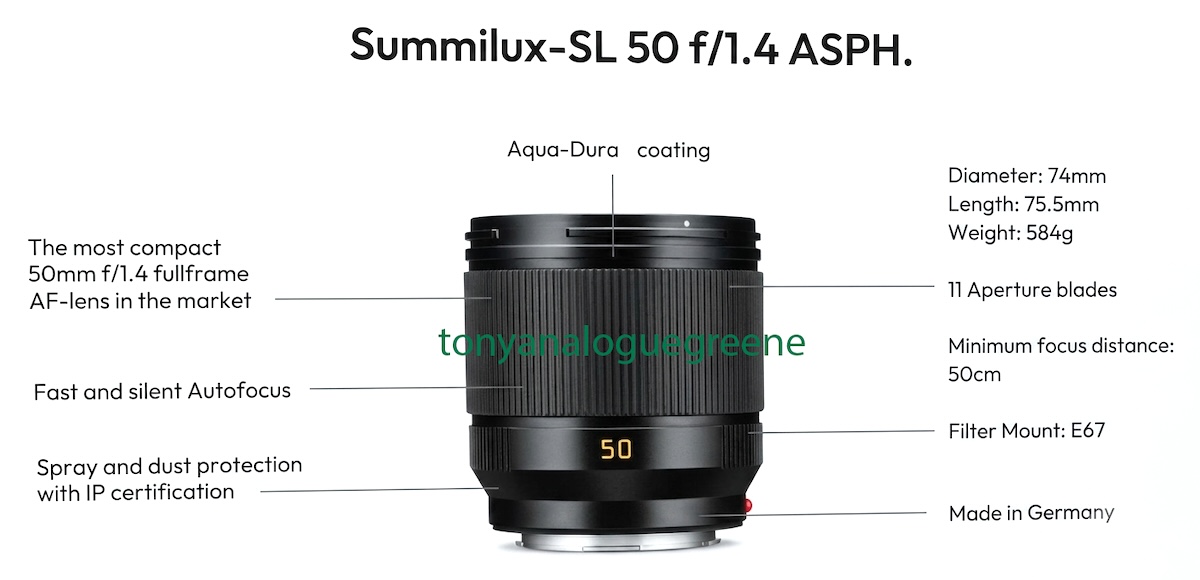
MTF is smoother than 50mm M 1.4 asph II, eg less mid-zone/edge drop, but the graphs look similar... MFD 50cm is a bummer... Even m version mfd is 45cm.
MTF is smoother than 50mm M 1.4 asph II, eg less mid-zone/edge drop, but the graphs look similar... MTF 50cm is a bummer... Even m version mtf is 45cm.
p.7 #12 · Could the rumored Leica SL 50 Lux II be M-like in rendering?
retrofocus wrote:
In retrospective seen this might be true. But Fuji was in the market with APS-C MLC before Sony came out with FF MLC in 2013. At the time, there would have been plenty of opportunity for Fuji to snack some other part of FF MLC before all the other big brands headed to cropped sensor MLC and much later to FF MLC- Fuji could have been years ahead and sharing with Sony. It remains a mystery why this didn't occur - maybe Fuji was simply complacent and fine with their market cap in cropped sensor tech - but they still took a high risk at the time to not to be quickly overran by FF MLC similar to what occurred already much earlier with DSLRs before when the market moved to FF. I believe that that instead there was an early non-compete arrangement done between both Japanese companies Fuji and Sony - Sony didn't go into further Fuji's APS-C niche and Fuji stayed away from FF but leap-frogged much later later to medium format instead which might not have been part of such early potential agreement. ...Show more →
What you're not considering is that at that time DSLRs were still far superior in respect to AF performance than early mirrorless cameras and such a Fuji FF camera would have had to compete with Canon's and Nikon's very established systems. Early mirrorless was for people adapting off-brand/system lenses and those for whom the performance limitations were acceptable. Fuji would have been unfavorably reviewed with respect to AF performance compared to DSLR systems. IMO this is also why Canon and Nikon were perceived as late to the mirrorless movement - because if they would have released FF mirrorless when Sony did in ~2013, those cameras would have performed very unfavorably compared to their own DSLR options and possibly would have harmed their brand reputations more than waiting until ~2018 when they were able to release fairly competitive mirrorless systems.
p.7 #13 · Could the rumored Leica SL 50 Lux II be M-like in rendering?
rscheffler wrote:
What you're not considering is that at that time DSLRs were still far superior in respect to AF performance than early mirrorless cameras and such a Fuji FF camera would have had to compete with Canon's and Nikon's very established systems. Early mirrorless was for people adapting off-brand/system lenses and those for whom the performance limitations were acceptable. Fuji would have been unfavorably reviewed with respect to AF performance compared to DSLR systems. IMO this is also why Canon and Nikon were perceived as late to the mirrorless movement - because if they would have released FF mirrorless when Sony did in ~2013, those cameras would have performed very unfavorably compared to their own DSLR options and possibly would have harmed their brand reputations more than waiting until ~2018 when they were able to release fairly competitive mirrorless systems....Show more →
I politely disagree here. The release of Sony's FF MLC in 2013 was not about AF - even it became much more usable just two years later with the second generation. The focus of these cameras was not on sports at all - and you could well use them for standard AF purposes. Canon and Nikon both were late to the table because they did not anticipate this FF MLC innovation at all - they were all about defending their existing DSLR market. It took both of them multiple years to get even close to where Sony then was already. Canon/Nikon simply didn't have this technology at all and had to play catch up. It took them more than 10 years!
p.7 #14 · Could the rumored Leica SL 50 Lux II be M-like in rendering?
retrofocus wrote:
I politely disagree here. The release of Sony's FF MLC in 2013 was not about AF - even it became much more usable just two years later with the second generation. The focus of these cameras was not on sports at all - and you could well use them for standard AF purposes. Canon and Nikon both were late to the table because they did not anticipate this FF MLC innovation at all - they were all about defending their existing DSLR market. It took both of them multiple years to get even close to where Sony then was already. Canon/Nikon simply didn't have this technology at all and had to play catch up. It took them more than 10 years!...Show more →
In many segments they still haven't managed to catch up. Especially true for Nikon. Sony did a remarkable job of changing the entire industry with technical innovation.


 ) - compactness, and easy adaptability with many AF and MF lenses (with some limitations with wider focal lengths especially with rangefinder lenses). In my eyes, the A7 series was a revolution in photography - I still own and use my A7R which I bought new in early 2014. Great camera IMO.