fredmiranda.com
Login

Moderated by: Fred Miranda
  New fredmiranda.com Mobile Site
  New Feature: SMS Notification alert
  New Feature: Buy & Sell Watchlist
  

FM Forums | Fuji Forum | Join Upload & Sell

1       2       3              6              end
  

DR100% vs 200/400%


ruthenium
Offline
• • • •
Upload & Sell: On
p.7 #1 · DR100% vs 200/400%


Makten wrote:
Interesting! However, the difference from my examples is explained by you using the same ISO for both images, while since I used base ISO (100) for DR100, the camera forced me to use ISO 400 to be able to use DR400. Then C1 obviously applies a different curve. I mean, otherwise there is no point with the DR modes.

Edit: Your second shot is basically shot at ISO 250, but labeled as ISO 500. In my case both the first shot are at ISO 100 while one have a different curve and therefore labeled ISO 400. I think the exact
...Show more

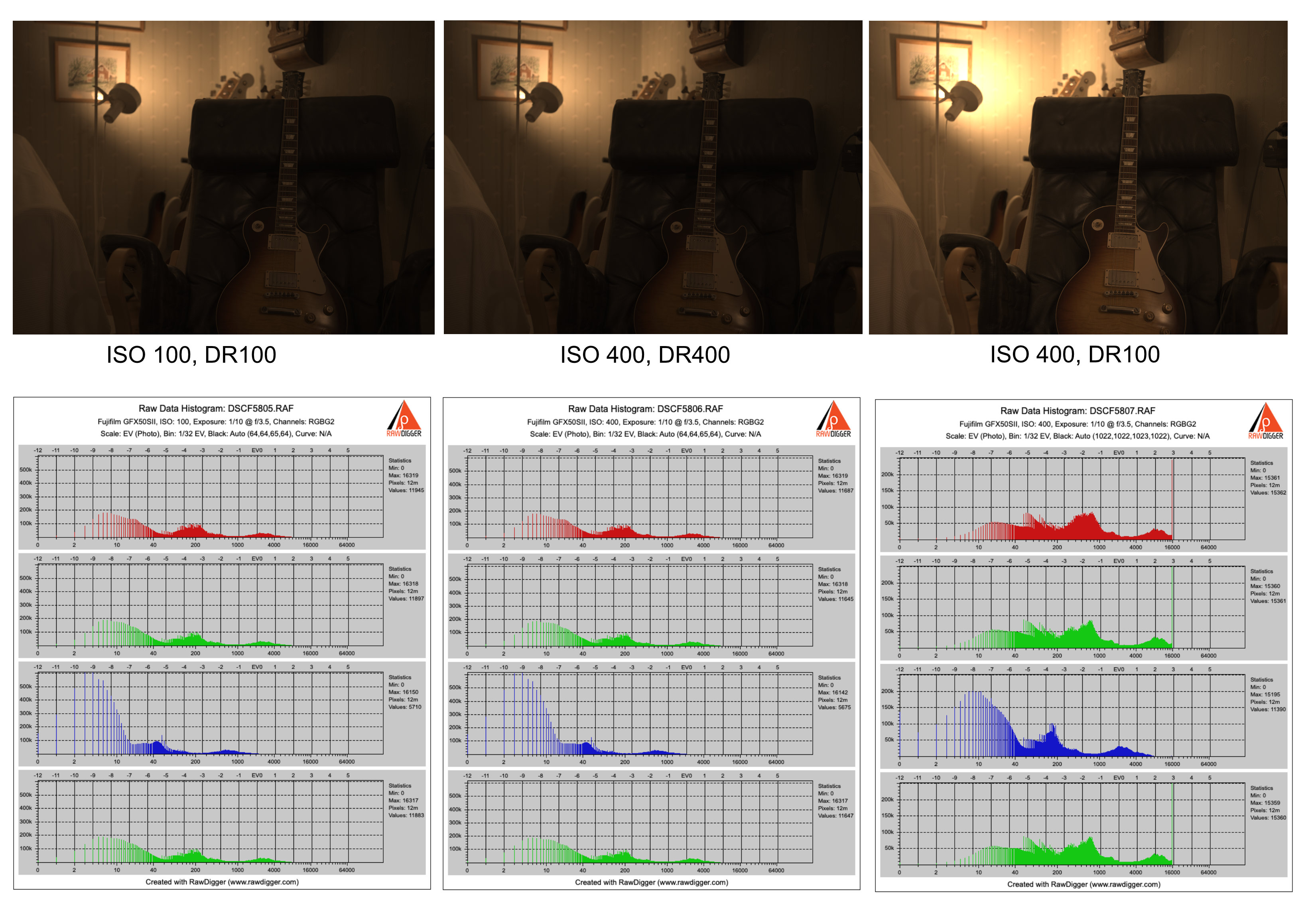
Here are my observations. First, I looked at the three raw files in RawDigger and exported the images as TIFF files. These image and the corresponding raw histograms are compiled in the first upload (see below)
-- The images shot at ISO100&DR100 and ISO400&DR400 display the same brightness, that is the same gain (since the exposure is the same for both).
-- This is explained by Raw Exposure Compensation that I see in the EXIF: -0.5 at ISO100&DR100 and -2.5 at ISO400&DR400. Thus, the 2-stop gain from ISO100 to 400 is negated by the -2 stop "exposure compensation" at ISO400&DR400.
-- The image shot at ISO400&DR100 is naturally brighter than the one at ISO100&DR100 because of the 2-stop gain from ISO100 to 400. No surprise here.
-- The brighter image at ISO400&DR100 displays increased clipping in the highlights, as expected. This clipping is caused by the excessive gain. It is important to note that this clipping happens in the ADC (the technical term for this is "ADC overflow").

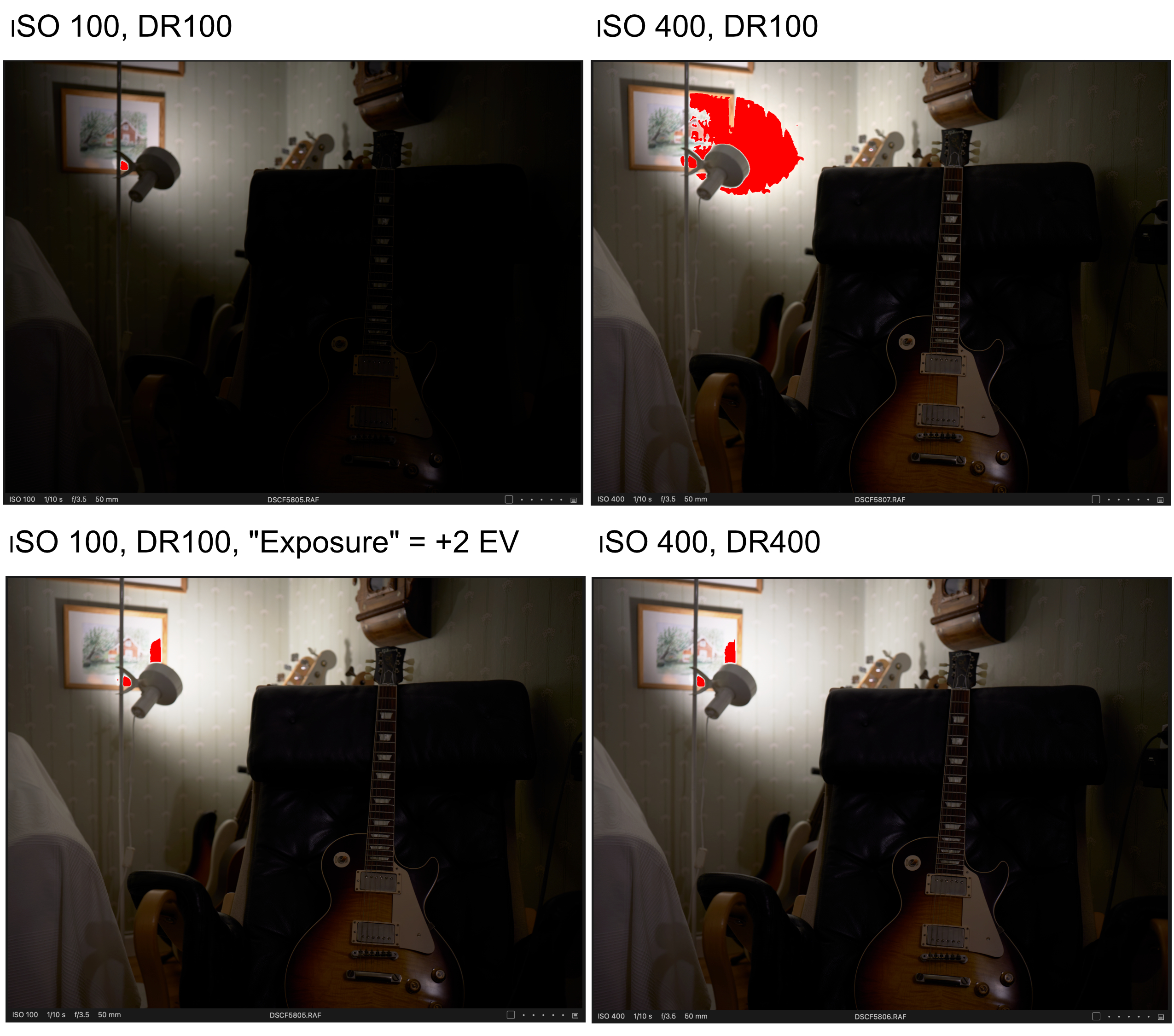
Next, it is instructive to look at the screenshots taken from Capture One, using Curve: Linear Response.
-- The most telling observation is seen when comparing the two images at the bottom. The one on the left was shot at ISO100&DR100 with "Exposure" in Capture One set (by me, manually) to +2 EV. The one on the right is the image shot at ISO400&DR400. For this image, I did not change the Exposure.
-- On the basis of the observations, I conclude that Capture One read the value in Raw Exposure Bias (-2.5) and automatically and silently increased the brightness of the image shot at ISO400&DR400 by 2 stops.
-- It is appropriate to ask, why Capture One acted like it did on the file shot at ISO400&DR400? My understanding is that DR200/DR400 might not be meant to be used in full manual. I believe that DR200/400 settings are meant to be used in either Aperture-priority or Shutter-priority. In these modes, the change from ISO100 to 400 must reduce the actual exposure on the sensor by 2 stops (by either quadrupling the shutter speed, or by closing the aperture by 2 stops). The resulting reduced signal from the sensor is normally increased four-fold with the analogue gain, to be of the normal brightness. However, DR400 effectively cancels this gain in an aggressive effort to prevent any ADC overflow. Thus, the resulting raw file remains dark (darker than it should have been, normally, by 2-stops). Capture One expects this (it is aware of the DR400 in EXIF), and silently increases the brightness by two stops, to make the image look of normal brightness, prior to any post-processing. In this present case, I guess, Capture One assumed the expected behaviour (it apparently wasn't aware that the exposure didn't change in this case from ISO100 to 400), and applied the 2-stop gain that made the image at ISO400&DR400 brighter than that at ISO100&DR100.


Mar 04, 2026 at 05:56 PM
Makten
Offline
• • • • •
Upload & Sell: On
p.7 #2 · DR100% vs 200/400%


ruthenium wrote:
Here are my observations. First, I looked at the three raw files in RawDigger and exported the images as TIFF files. These image and the corresponding raw histograms are compiled in the first upload (see below)
-- The images shot at ISO100&DR100 and ISO400&DR400 display the same brightness, that is the same gain (since the exposure is the same for both).
-- This is explained by Raw Exposure Compensation that I see in the EXIF: -0.5 at ISO100&DR100 and -2.5 at ISO400&DR400. Thus, the 2-stop gain from ISO100 to 400 is negated by the -2 stop "exposure compensation" at ISO400&DR400.
--
...Show more

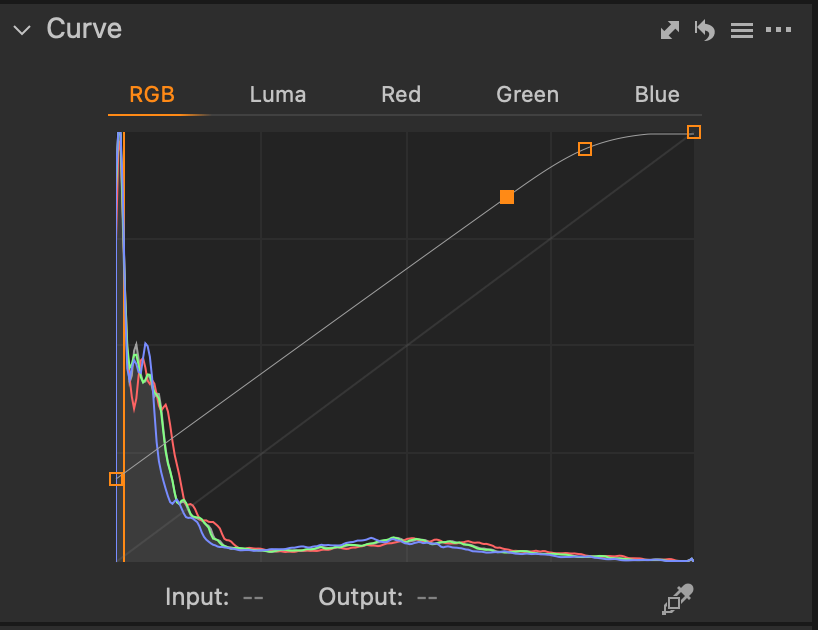
IMO this shows what I wrote earlier: DR400 @ ISO 400 is actually using ISO 100 gain, but a curve is applied (in C1 and for JPG's) that lifts the image 2 stops, except for the highlights that are still at zero (ISO 100). Most of this curve is a linear lift of two stops, but it must "roll off" at the very brightest highlights.

So, if you don't use a raw converter that supports this curve, there is no point in using DR200/400, for other reasons than giving you a better preview of the shadows in the viewfinder.

The curve probably looks something like this, but with the knee even higher up. Only an illustrative example:


Mar 05, 2026 at 03:02 AM
Makten
Offline
• • • • •
Upload & Sell: On
p.7 #3 · DR100% vs 200/400%


What's most interesting I think, is the fact that the camera alters analog gain even for such small steps as between ISO 100 and ISO 400. I would have thought that was done digitally, but apparently not.


Mar 05, 2026 at 03:05 AM


Search in Used Dept. 

ruthenium
Offline
• • • •
Upload & Sell: On
p.7 #4 · DR100% vs 200/400%


"DR400 @ ISO 400 is actually using ISO 100 gain" - I agree.

"but a curve is applied (in C1 and for JPG's) that lifts the image 2 stops, except for the highlights that are still at zero (ISO 100)" - this, I don't know.
My question is: how does the image shot at ISO400&DR400 look to you when compared with the image at ISO100&DR100 where I lifted "exposure" by 2 stops? To me, the two look of nearly indistinguishable brightness/lightness.

We may differently understand the intended application for DR200/400 setting. I understand the intent behind this setting is to protect the highlights by increasing the headroom in the highlights. There are two very different ways of dealing with this:
1) At the base ISO, the sensor is near its full-well capacity. The principal concern is about saturating some of the photodiodes when there's extra bright light in a photographed scene. The only way to deal with this is to reduce exposure by increasing the shutter speed or closing the aperture. This is what working in full manual doesn't allow the camera to do. You note that the blown highlights are the same in the images taken at ISO100&DR100 (with "exposure" lifted by 2 stops) and ISO400&DR400.
2) From ISO = 2 x base ISO and higher, we have less-to-no concern about the sensor being saturated. In this ISO regime, the principal concern is about ADC overflow - clipping in the ADC, caused by too much analog gain on the signal from the sensor. The way to deal with this is by offsetting the gain internally, with Raw Exposure Bias, by 1 stop with DR200 or 2 stops with DR400.

I am presently using my camera with Dynamic Range set to Auto, in Aperture priority. I let the camera decide when to switch from DR100 to DR200. It seems to be acting reasonably so far. This approach suits my shooting style, as most of what I do can be called casual snapshots. When I see something that catches my eye, I stop and take a quick shot, then continue walking/hiking.


Mar 05, 2026 at 08:00 AM
gdanmitchell
Offline
• • • • • • •
Upload & Sell: Off
p.7 #5 · DR100% vs 200/400%


I need to dig into all of these words more carefully at some point, but I think that where you are all heading is that the underlying raw data in the raw file is not changed by the various DR settings.

The settings are about the post-capture application of various programmed interpretations of the underlying raw data. (The fact that you see different things depending on the raw processor supports this idea.)

This also suggests that, for those of us who shoot raw mode exclusively, the DR settings are, at best, a convenience that might allow us to start our post-processing of the raw file with the app’s pre-set interpretation of the data that is designed to mimic what the camera dues automatically (and permanently!) to in-camera raw files.

Further, you could get essentially the same result by exposing to protect the highlights and then lifting the dark tones in post, and by applying raw processing settings tailored to the specifics of each photograph.

Edited on Mar 05, 2026 at 12:12 PM · View previous versions


Mar 05, 2026 at 10:47 AM
ruthenium
Offline
• • • •
Upload & Sell: On
p.7 #6 · DR100% vs 200/400%


gdanmitchell wrote:
I need to dig into all of these words more carefully at some point, but I think that where you are all heading is that the underlying raw data in the raw file is not changed by the various DR settings.

The settings are about the post-capture application of various programmed interpretations of the underlying raw data. (The fact that you see different things depending on the raw processor supports this idea.)

This also suggests that, for those of us who shoot raw mode exclusively, the DR settings are, at best, a convenience that might allow us to start our post-processing
...Show more

I broadly agree with you about DR being a convenience (like AF, or Auto-ISO) for raw shooters who need to minimize the decision-making, e.g., when pursuing fleeting moments, with the following notes:
1) I simply don't know whether converters (e.g., Capture One or ACR) silently and UNIFORMLY apply a hidden "exposure" adjustments on the raw data by +1 or +2 stops with DR200 or DR400, respectively, or if they use a special curve and adjust the brightness non-uniformly. I lean toward the former as being more likely, but this is just how things look to me, and the appearances can be misleading.
2) Note that you don't ALWAYS "get essentially the same result by exposing to protect the highlights." This is correct if the ISO is at the base value. For example, if you shoot at the base ISO and manually reduce the exposure by 1 stop (e.g. with exposure compensation, or by directly changing the SS and/or F number), then the effect is the same as that of switching from DR100 to DR200 without using exposure compensation. This is specifically at the base ISO.

When there is going to be a difference, is when the overall light is lower and the camera (in Auto ISO) wants to increase the ISO. A practical example can be that of shooting after sunset - there are growing shadows all around, yet there is a fairly bright area of sky where the Sun was at the sunset. For an example, let's say the ISO is now at 500, then, using DR200 or 400 shall have no effect on the exposure: you switch from DR100 to DR200 and you retain your SS and aperture unchanged. The same can be achieved in full manual, by manually lowering the ISO gain, from 500 to a lower value. However, when one is shooting in Aperture-priority or Shutter-priority, and would like to use exposure compensation, then that shall reduce the amount of light collected by the sensor. There will be less light and relatively more noise in the shadows, whereas there is no loss of light with DR200 or 400.


Mar 05, 2026 at 11:40 AM
1       2       3              6              end


FM Forums | Fuji Forum | Join Upload & Sell

1       2       3              6              end


Welcome back
Log in to your account