This particular setting DR100% - DR200% - DR400% intrigued me.
I understand the intent, which is relatively straightforward - to aggressively avoid highlights clipping.
However, compressing the dynamic range can be expected to reduce the signal-to-noise in the shadows.
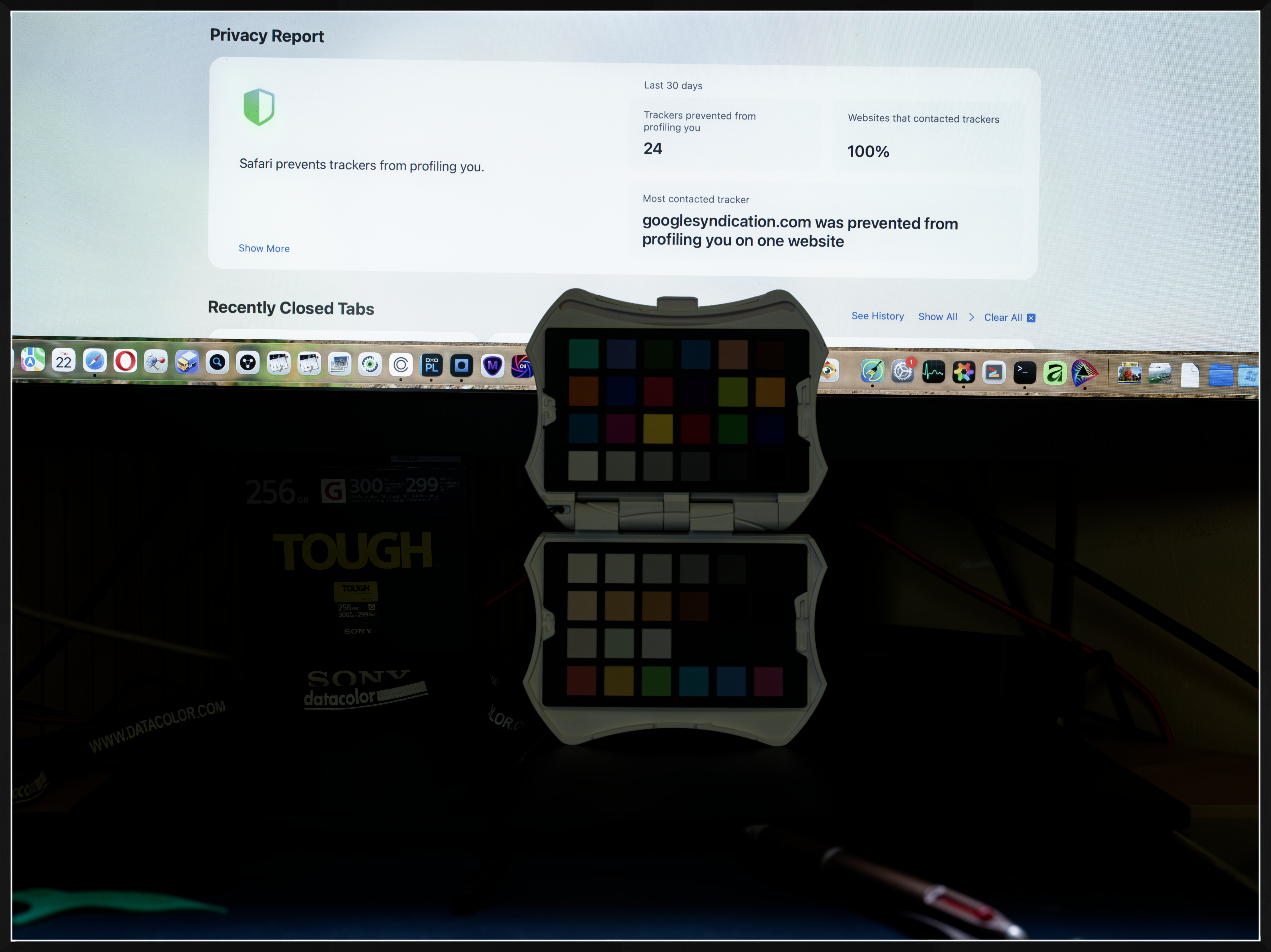
This is what I wanted to visualize and investigate by shooting a high-contrast scene, shown in the first upload.
The camera (GFX100S II & GF55mm F1.7 at F8) was on a tripod.
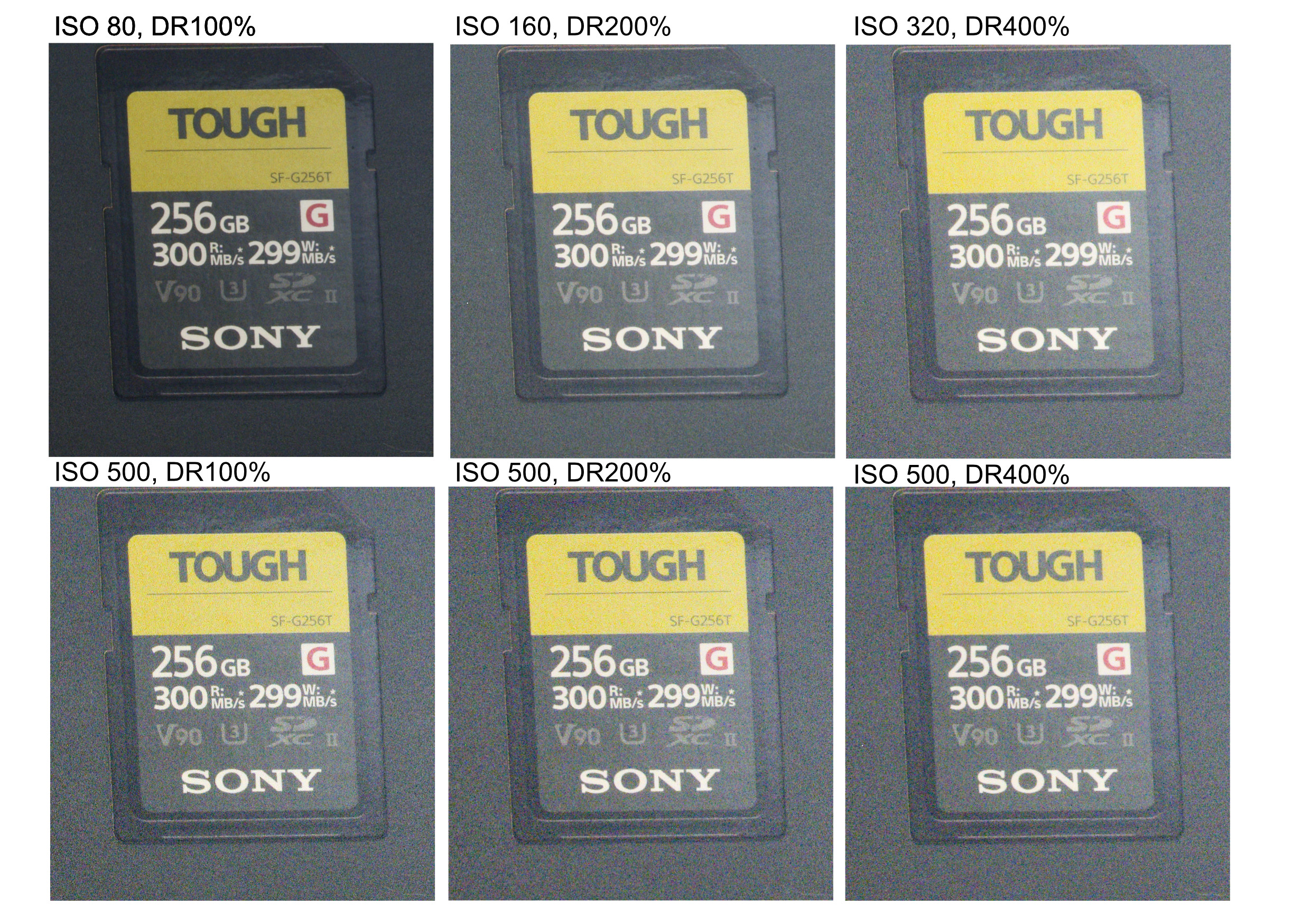
The second upload is a compillation of crops at 100% from the shadow area of the scene, processed without denoising and with the exposure increased by 4 stops to see the noise.
The crops are arranged into two series:
ISO80 DR100% - ISO160 DR200% - ISO320 DR400%
and
ISO500 DR100% - ISO500 DR200% - ISO500 DR400%
The first series displays the expected loss of the signal-to-noise ratio and increase in the visible noise. This is a direct consequence of the reduced amount of light reaching the sensor by 1 stop at ISO160 and by 2 stops at ISO320. Naturally the shutter speed increased from 1.8s to 1/1.1s to 1/2.1s
The second series is somewhat different. The ISO and the shutter speed remained unchanged (ISO500, SS 1/3.2s); thus, it is not immediately clear what the camera did to preserve the highlights. Nevertheless, I can confirm that the effect is there. There is practically no highlights clipping in the raw file at ISO500 and DR400%, while I see some clipping in the image at ISO500 and DR200%, and a fair amount of clipping in the image at ISO500 and DR100%.
The crops in this second series all display visible noise, however, I cannot make any strong claims about the differences. If there are differences in noise, these differences are subtle.
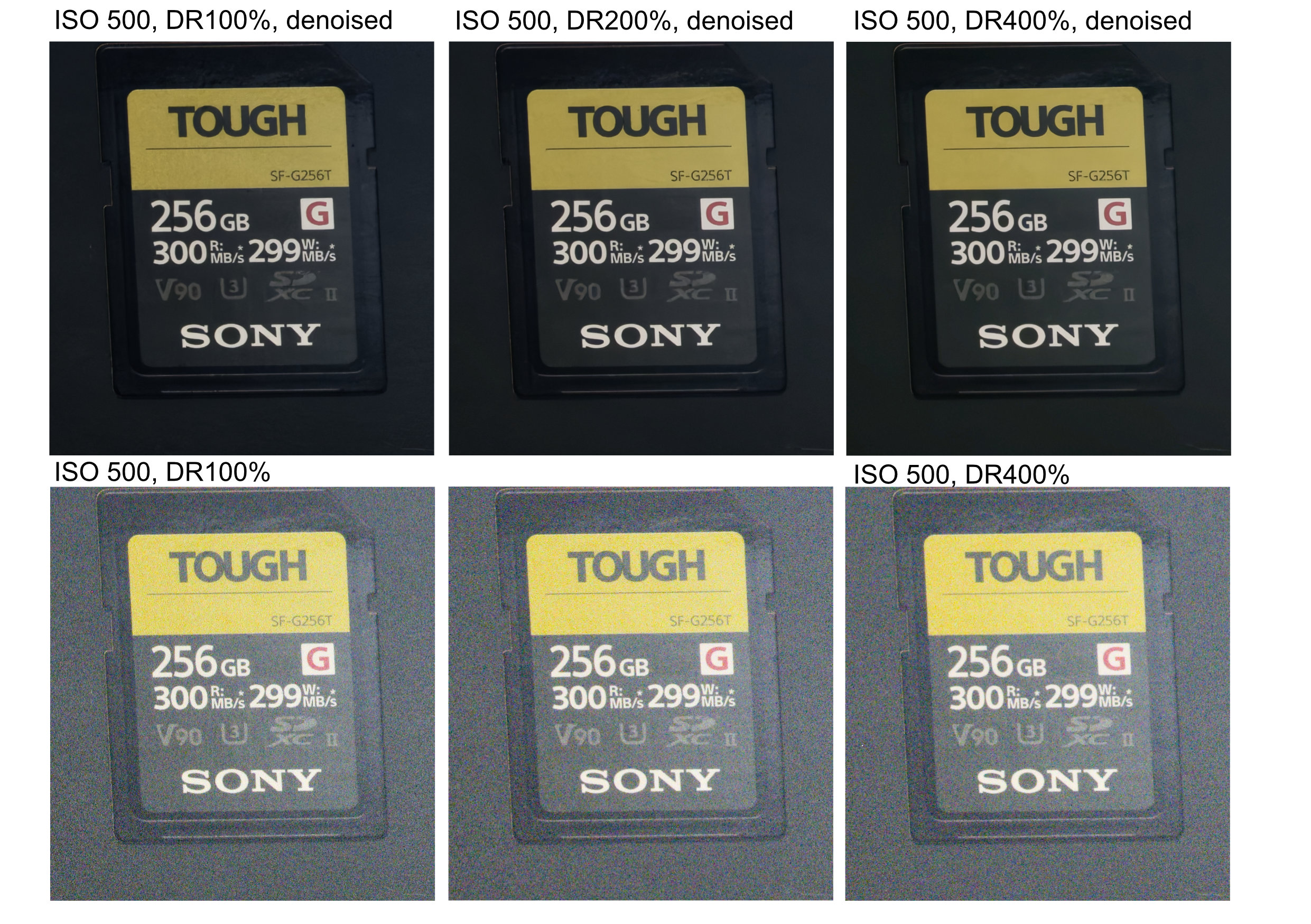
I must add that when denoising is enabled (in DxO Photolab 9), the noise at ISO500 disappears, and the three crops become indistinguishable to my eye.
What I have learned from this exercise is that when one can shoot at the base ISO, then using DR200% and DR400% settings is clearly detrimental to the shadows. Basically, one must know whether the shadows are important or not, and whether the shadow are going to be lifted in post.
When shooting at ISO500, it seems that there is practically no detrimental effect (with denoising enabled) in the shadows, whereas highlights are well preserved at DR200% and even better at DR400%. The third upload (see below) compares the denoised and properly exposed crops with the same before denoising.
I have to wonder if we can get roughly the same outcome by using the 100% setting and exposing to protect the highlights and then recovering shadows in post as necessary, along with applying some addition NR if necessary. (Essentially this means that in extreme DR situations with bright highlights the file may look quite dark.)
That's beeb nt practice for years, and it usually seems to work quite well.
gdanmitchell wrote:
I have to wonder if we can get roughly the same outcome by using the 100% setting and exposing to protect the highlights and then recovering shadows in post as necessary, along with applying some addition NR if necessary. (Essentially this means that in extreme DR situations with bright highlights the file may look quite dark.)
That's beeb nt practice for years, and it usually seems to work quite well.
Mine too, especially as you can do that at base ISO, wheras the 200 and 400 settings force up the ISO.
gdanmitchell wrote:
I have to wonder if we can get roughly the same outcome by using the 100% setting and exposing to protect the highlights and then recovering shadows in post as necessary, along with applying some addition NR if necessary. (Essentially this means that in extreme DR situations with bright highlights the file may look quite dark.)
That's beeb nt practice for years, and it usually seems to work quite well.
The answer depends on the amount of light.
When the light is abundant and ISO < 160, the sensor is at or near its full-well-capacity. Then the highlights are clipped on the sensor, and the only way to avoid this is by reducing the amount of light by closing the aperture or increasing the shutter speed directly. or indirectly via exposure compensation.
In this regime, I would use exposure compensation rather than the DR200% or DR400% settings, because exposure compensation allows fine adjustments of exposure.
With less light on the sensor, when ISO > 320, I believe it is better to use DR200% or DR400% to prevent highlight clipping (that now happens during the analog-to-digital conversion, rather than on sensor). The advantage of this over exposure compensation is that the latter shall reduce the amount of light reaching the sensor. Saving the highlights this way comes at the cost of loosing the dynamic range in the shadows. On contrary, DR200% and DR400% do not affect the exposure. I can imagine that the effect of these settings is via non-linear gain on the signal coming from the sensor (a curve, in a way). That is the weak signal (the shadows) is amplified normally, whereas the strong signal is amplified less than it would have been normally. This amplification happens before the analog-to-digital conversion.
I have no idea why you'd shoot DR modes with a hard coded ISO of 500, which is outside of the ISO invariant range on the 100S II. As you found, you should let it chose the appropriate manipulation of the base ISO where it uses 80, 160, 320.
In general, the DR modes aren't as useful in dark indoor environments like you tested, as you will usually need more ISO than they provide...they are much more useful when you have some actual light, and have high contrast elements in the same scene, bringing the transitions between hard shadows and hard highlights closer together.
I would suggest simply exposing for highlights if shooting RAW. DR is a JPEG feature primarily.
ruthenium wrote:
The answer depends on the amount of light.
When the light is abundant and ISO < 160, the sensor is at or near its full-well-capacity. Then the highlights are clipped on the sensor, and the only way to avoid this is by reducing the amount of light by closing the aperture or increasing the shutter speed directly. or indirectly via exposure compensation.
In this regime, I would use exposure compensation rather than the DR200% or DR400% settings, because exposure compensation allows fine adjustments of exposure.
With less light on the sensor, when ISO > 320, I believe it is better to use DR200% or DR400% to prevent highlight clipping (that now happens during the analog-to-digital conversion, rather than on sensor). The advantage of this over exposure compensation is that the latter shall reduce the amount of light reaching the sensor. Saving the highlights this way comes at the cost of loosing the dynamic range in the shadows. On contrary, DR200% and DR400% do not affect the exposure. I can imagine that the effect of these settings is via non-linear gain on the signal coming from the sensor (a curve, in a way). That is the weak signal (the shadows) is amplified normally, whereas the strong signal is amplified less than it would have been normally. This amplification happens before the analog-to-digital conversion....Show more →
I’m not so sure. I’ve been using my approach at higher ISOs when shooting stuff like indoor subjects and night photography. I can get fine results with very low noise this way, with no more than standard kinds of NR.
My usual method is to make quick (and sometimes intuitive) adjustments to EC while shooting in aperture priority mode and adjusting ISO manually if necessary. Basically this is the long-standing approach of protecting (or exposing for) the highlights and compensating in post. (It is also more or less what we would have done with film.)
(Having said that, I think it is useful to understand how those options on Fujifilm cameras and what they do.)
Here, I shared some observations and my understanding of these particular settings.
I fully appreciate that many photographers rely solely on their experience and their own established empirical practices.
In fact, I fully expect that many photographers are not even interested in the technical aspects of photography. This isn't my concern.
This thread is intended for those few who are interested in the technical details, like the dynamic range, and who may want to optimize the settings to use the best dynamic range available from a camera.
This is more of a matter of principle, and isn't going to be useful every time - only when facing scenes with strong highlights and deep shadows, and when the exposure may need to be lifted in the deep shadows. This isn't a most common photographic scenario. Similarly, we use seatbelts just in case, not because we prepare to experience a collision today.
The key point is that "adjustments to EC while shooting in aperture priority mode and adjusting ISO manually if necessary" work by reducing the amount of light reaching the sensor, whereas the DR200% and DR400% have no effect on the shutter speed or aperture at ISO >320 on my camera, GFX100S II. Should we shoot side-by-side, my camera will collect more light if I employ the DR200% and DR400% settings instead of exposure compensation. Is this going to make my photo better? In principle, theoretically - yes. In practice, it is likely that no one would see a difference in most cases.
ruthenium wrote:
Here, I shared some observations and my understanding of these particular settings.
I fully appreciate that many photographers rely solely on their experience and their own established empirical practices...
I'm not saying the one method is necessarily better than the other, particularly in a universal sense. My main point was probably that it seems that this option on Fujifilm cameras seems to do something that many of us already do manually.
I'm not averse to using camera automation — heck I generally use aV mode and AF for shooting street. But I also think there's room for judgement based on experience... and perhaps an occasional review of the rear screen or even the histogram. Systems like this are often useful in typical situations, but my judgement is often better in more extreme or unusual situations.
If f I'm in the camera-controlled mode and I encounter one of those situations it takes time to disable that setting and then do my manual settings.
Again, it is good and useful to understand how this camera feature works, if for no other reason than to determine its value for your photography.
gaopa wrote:
What about setting it to auto and letting the camera decide?
Fair question, and I can see that it would be a useful setting for some photographers and situations. Here are some things to consider:
1. With the AUTO setting your ISO will be 250 at a minimum, so the lower 125 and 200 values are no longer available to you. If you prefer to use ISO 125 by default, losing that ability is a downside.
2. In some situations we may decide to allow highlights to blow out slightly or shadows to be darker for creative reasons. That choice is no longer yours with the AUTO setting.
You could ameliorate some of this by picking from among he Range Priority settings of AUTO, STRONG, WEAK, but picking one likely means that some scenes would be better with a different setting. (In a sense, once you start considering switching among AUTO and 400% and among AUTO, STRONG, WEAK,and OFF, you can end up needing more manual intervention to manage those choices than would be required if you just used the EC knob and your experience.
I suspect that if you prefer to shoot jpgs rather than raw and prefer not to do post-processing, that using these settings to automatically compensate for challenging situation could be more useful. (I don't shoot jpgs on my Fujifilm camera.)
One more thing to keep in mind. In most real-world photography, exposure is not a precise and absolute thing. If we are honest, in fast moving situations we often don't get a supposedly "perfect" exposure. On average, an automated in-camera process can do better than a photographer who doesn't have a lot of experience dealing with these issues and who prefers to not deal with post processing. On the other hand, a more experienced photographer is more likely to make good choices even in complicated situations, and can even consider their likely post-processing approach as they do.
gaopa wrote:
What about setting it to auto and letting the camera decide?
I leave ISO on auto all the time, it's the 'side' of the exposure triangle that has least effect on image quality. Choose SS to suit subject movement, A for DoF and lens performance. See what ISO that gives, and 'compromise' as or if required. With any experience at all you can pick SS and A that are not going to give outlandish ISO figures.
Use EC dial to sort out uneven lighting, and, usually, to expose so little or no highlight clipping.
Can't remember the last time I moved the ISO dial off A, and there is no reason why you can't get down to base ISO on auto @gdanmitchell?
gyoung143 wrote:
I leave ISO on auto all the time, it's the 'side' of the exposure triangle that has least effect on image quality. Choose to suit subject movement, A for DoF and lens performance. See what ISO that gives, and 'compromise' as or if required. With any experience at all you can pick SS and A that are not going to give outlandish ISO figures.
Use EC dial to sort out uneven lighting, and, usually, to expose so little or no highlight clipping.
Can't remember the last time I moved the ISO dial off A, and there is no reason why you can't get down to base ISO on auto @gdanmitchell@?
ISO changes with light, not the other way around. Thus, one need to keep an eye on the ISO, but the amount of light that reaches the sensor depends exclusively on SS and aperture.
Auto ISO is fine as long as one has access to exposure compensation.
Even then, it is understood that exposure compensation is merely a convenient in practice indirect way to make small changes in the shutter speed or aperture.
My custom set 1 is limited from ISO 80 to 200 and minimum shutter speed of 1s.
Custom set 2 is limited from ISO500 to 12800.
I switch from 1 to 2 when the shutter speed becomes too slow.
Well it sort of is if you want a certain shutter and aperture. You can always limit the high end of auto iso if you are so concerned. Majority of my street is shot with auto iso as shutter and aperture is what affects the visual aspects of an image and iso is just there for the ride.
which, in a roundabout way, confirms my point about it not being irrelevant. ;-)
Except in the most benign and perfectly lit situations either we or the camera still need to come up with the situationally-best combination of ISO, shutter speed, and aperture and we consider subject motion, DOF, noise, and other things to make the choice.
gdanmitchell wrote:
which, in a roundabout way, confirms my point about it not being irrelevant. ;-)
Except in the most benign and perfectly lit situations either we or the camera still need to come up with the situationally-best combination of ISO, shutter speed, and aperture and we consider subject motion, DOF, noise, and other things to make the choice.
With today’s noise reduction…I don’t worry much about iSO. If your shutter is too slow and you get a blurry image…you are toast. If you dof is too narrow and you get a fuzzy background…you are toast. Those are the two things I worry about and just let the iso figure itself out.
gdanmitchell wrote:
which, in a roundabout way, confirms my point about it not being irrelevant. ;-)
Except in the most benign and perfectly lit situations either we or the camera still need to come up with the situationally-best combination of ISO, shutter speed, and aperture and we consider subject motion, DOF, noise, and other things to make the choice.
To the best of my understanding, I suggest a small correction: "we need to come up with the situationally-best combination of shutter speed and aperture, while the camera can be allowed to decide the appropriate analog gain (refered to as ISO) needed to fit the analog signal from the sensor into the digital range of the analog-to-digital converter."
Less light requires more gain post-capture, whereas the amount of light captured by the sensor is determined exclusively by the aperture and the shutter speed (and the lux that is beyond our control).
It seems practical to allow the camera decide the ISO gain because this works acceptably well in most cases. My understanding is that the DR200% and DR400% settings are intended to correct the normal algorithm of deciding the ISO gain by applying less gain to the strong part of the signal coming from the sensor (at ISO 320 and above).
This is just my guess, and it would be interesting to hear more on how DR200% and DR400% really work from the experts. Also, it seem a logical next step to measure the signal to noise ratio in the shadows, to see whether this doesn't change when switching to DR200% and DR400%. Visually, I cannot make a string claim one way or the other. My impression is there's no change, but it is better to have numbers. I can supply the raw files if someone may want to do the measurements.