ruthenium
Online
• • • •
Upload & Sell: On
|
mivadep wrote:
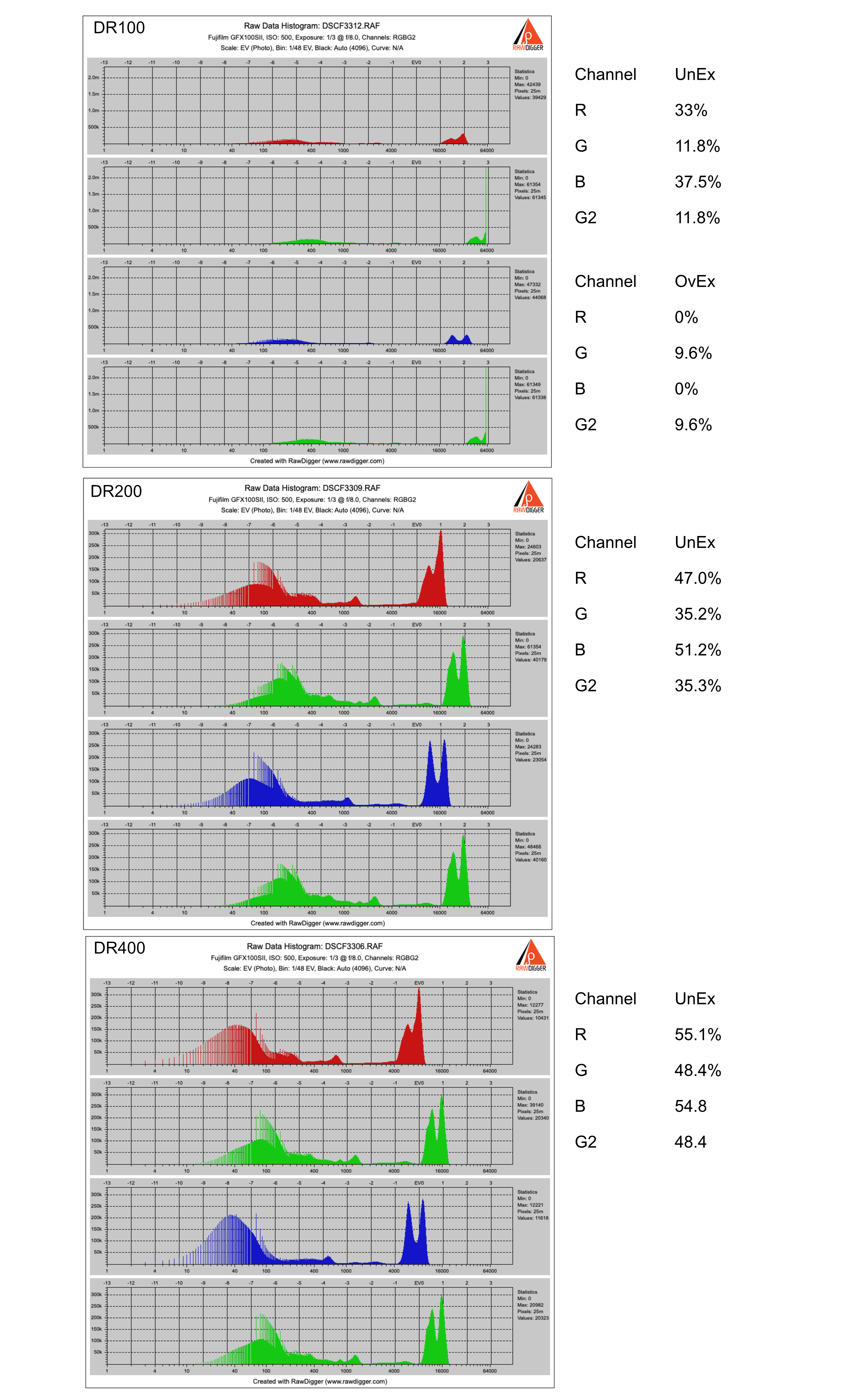
According to pal2tech the DR200/400 settings do something before the data goes to the analog to digital converter:
I'm not sure where he gets this information, but he does show that there is a difference in the raw files.
This is not that straightforward.
The key question is where the highlights are clipped - on the sensor or in the ADC?
There are two distinct scenarios:
1) The light is abundant, the ISO is at the base value, e.g. ISO80 for my camera, the GFX100S II (the base ISO can be different for different cameras). In this scenario, the sensor is near its full-well-capacity (FWC), and there is a risk of the highlights being clipped because of overexposure.
A reasonable strategy to deal with this is to add exposure compensation (-1/3, -2/3, -1, as much as needed according to the histogram). This shall make the camera increase the shutter speed in the A mode, or close the aperture in the S mode.
DR200 and DR400 settings will do exactly the same, but in a more "crude" way: by reducing exposure by -1 and -2 stops, respectively.
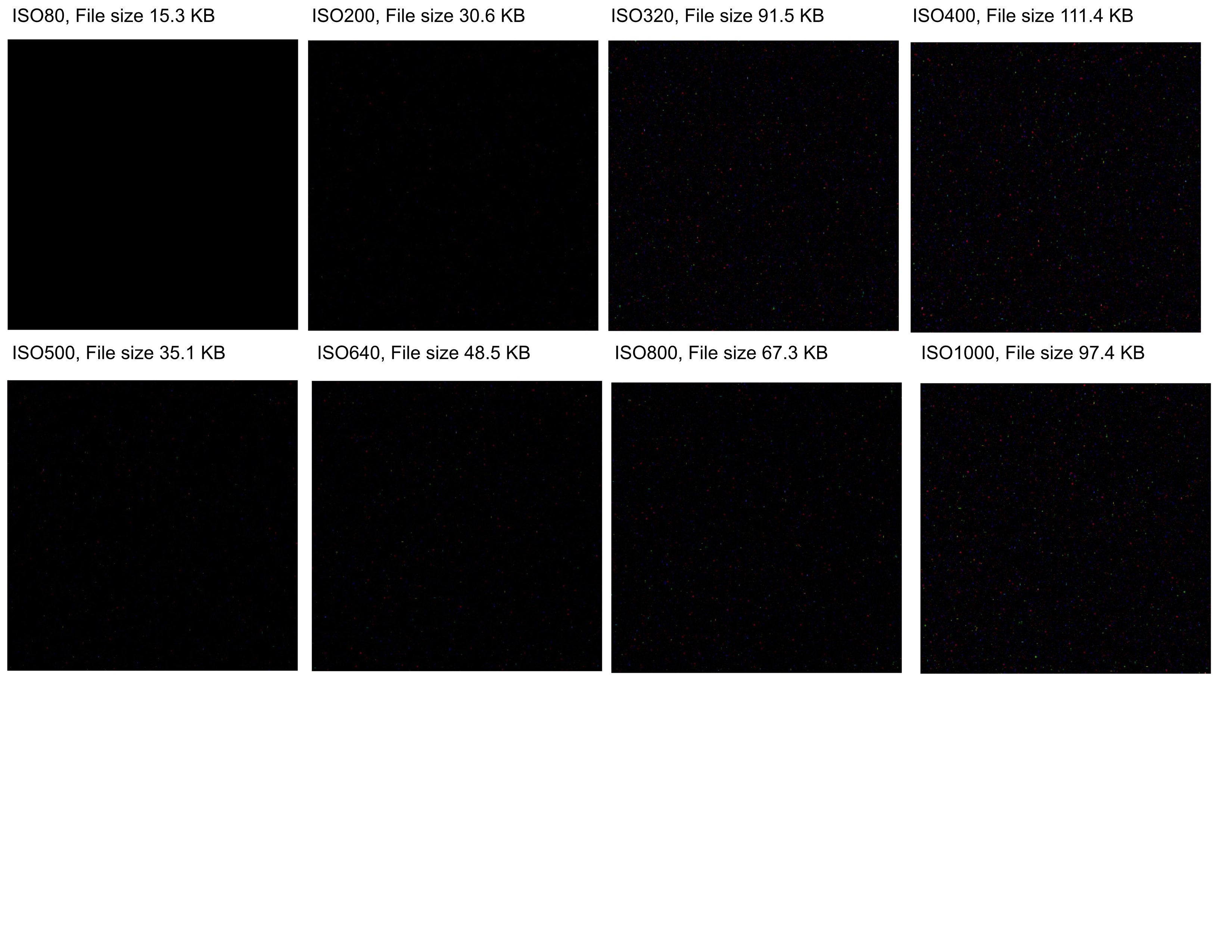
2) In the distinct second scenario, the light is less abundant and the auto-ISO is at or above the value of 2 x base ISO (e.g., at or above ISO320 on my camera GFX100S II). This is when the sensor is not at FWC and isn't overexposed, except in the special case of dealing with moderately lit scenes where there are points of bright light. A trivial example of the latter is a moderately lit Christmas tree with bright lights on it. But this is a special case. Outside of the special cases, when the highlights are clipped, this happens in the analogue-to-digital converter (not on the sensor) if the pre-amplifier happened to apply a stronger analogue gain toward the signal from the sensor.
It is in this distinct scenario, when the problem can be helped by reducing the gain, without changing the exposure.
Cameras like GFX100S II (and the related GFX100 bodies) have the base ISO at 80 and the dual gain at ISO 500. This suggests a practical strategy of using two custom sets: one with the ISO from 80 to 200 for best exposure, and the other from 500 to 12800 (or a lower upper ISO limit if so is desired) for any practical reason when the best exposure cannot be used.
Then, the photographer would switch from custom set 1 to 2 as needed.
It makes sense to have DR at 100% in customer set 1.
I think that custom set 2 may have DR set to 200%. Another option is AUTO, however, I have no idea how smart is the camera, and how it decides when DR should be switched from 100% to 200%. This needs to be tested.
Understandably, my strategy with the two custom sets is for the GFX100S II, and is decided by the knowledge of the base ISO (80) and the ISO when the dual gain is employed by the camera (500). For other cameras, my strategy may not be applicable if there is no dual gain, or when the dual gain is implemented at a higher ISO than 500.
Added: I don't mean to contradict "he does show that there is a difference in the raw files" - this is correct. Indeed, the raw files are affected by the DR settings. This is important for those who shoot raw.
|