p.5 #1 · Small Compact Camera A7C2 vs A7CR vs others
tsdevine wrote:
I don't know, not sure I get hung up so much on the practicality, When conditions are right, I give them a go. When they aren't, I don't.
Here's a portion of a 16 shot pixelshift with an a7R V and GFX100S II. The Sony was shot at 14mm & f/6.3 and the Fuji at 16mm effective & f/8.
Often when I can shoot 4 shot pixelshift, I can also do 16. So I usually do 16, irrespective of how much of a difference it makes.
Is the pronounced difference in colors due to different WB, or due to different color profiles in LR? The light inside the building was probably more or less the same at the time of taking the photos, correct? If I had to make a guess, I would also guess that the crop on the left originated from the Sony camera.
p.5 #2 · Small Compact Camera A7C2 vs A7CR vs others
aCuria wrote:
Jonas, the sample shows that with the 50 mm f/1.4 GM stopped down to f/2.8, you can resolve around 160 lp/mm at very low contrast when using pixel shift.
Using the USAF test chart is roughly equivalent to an MTF-5 or MTF-10 measurement.
That's an odd claim and it is so for at least two reasons.
It's hard to say anything certain about contrast at all when discussing USAF chart tests. The contrast in the images are depending on several factors including the targets paper quality and contrast between the black and white lines, the light, the "development" process which includes the raw converter and all the different settings one can do there and then finally how the image is presented. Are we sure we do the same when considering ACR, all settings straight or neutral, zero sharpening and adjusting the brightness to some standard value measured at a defined place on the chart.
When playing with the USAF test chart you can decide for your setup and your workflow. You will need some energy to describe it and you'll not set any kind of standard.
What we can do is observe the result (according to our own workflow) and compare that to what we get with another lens having everything setup the same. This can be done so it correlates surprisingly well with the IMA-test 50% numbers Lenstip provides us with (this does not mean I find the Lenstip "image quality" test method to be particularly good).
I still have a few doubts, though:
1) MTF 5 is less meaningful for determining how large we can print. For that, we should look at MTF-50, since improvements at MTF-50 correspond most closely to what the human eye perceives as increased sharpness. I suppose we could run additional tests to determine the MTF-50.
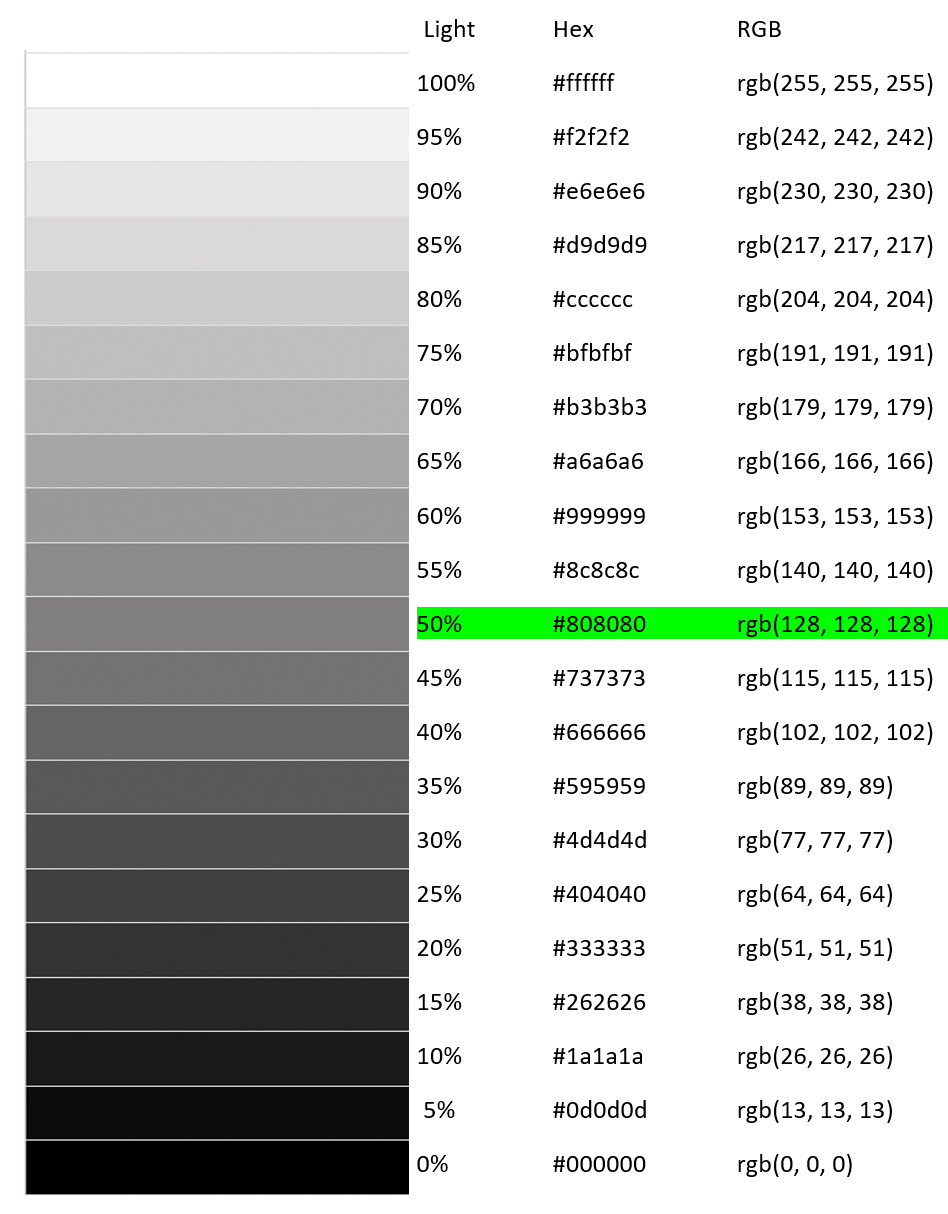
Well, from my discussion above we know it's hard to know what we are looking at. Here is a grey scale:
What is 50% difference here? Is it from 255-->128 (RGB) or is from 204-->77(RGB) or both or none?
It should be possible to agree about a workflow to get comparable results. But is it worthwhile? If it is I'm sure somebody invents a new industrial high contrast standard...
2) It’s not clear to me that the higher resolution seen in pixel shift mode would directly translate to the same results on a higher-MP Bayer sensor. After all, a Bayer sensor effectively discards two-thirds of the incoming light for each color channel, putting it at a relative disadvantage. I do not know how much to discount the results.
It doesn't. A pixelshift 80MP something from an Olympus camera is not as good as a 60MP Sony camera when looking at the finer details. it is approaching the level but it's clearly not there. (It is however way better than the singel exposure.)
3) We should also consider what real-world shooting conditions our tests are meant to represent. For example, when using an f/2.8 zoom, I wouldn’t normally switch to a prime just to shoot at f/2.8 or slower.
Of course. Most of the times I know what I'm interested in. If I want an image that is sharp from the left to the right without dips or fading resolution I may bring the CV50/APO and a tripod. If I'm out and about for some shooting in the streets I may bring the TTA40/2.0 and the 24-50/2.8 only, everything in a satchel bag.
It's the same as always. Sometimes we don't have the right gear.
So if the advantages of a high-MP sensor only become noticeable when using something like the 50 mm f/1.4 GM at f/2.8 or slower, would you then consider today’s lenses already “good enough”?
I don't really consider this good enough
Judging gear like that is kind of extreme and if you are that demanding you should switch to some other brand. Sony cameras and lenses can't deliver what you want.
Yes, in my opinion lenses are sharp enough (in general) and there are other features I would like to see getting improved first. That can, for example, be better flare resistance, less LoCA, less LaCA, more even performance over the image circle. Fix that and then take the next step towards "sharper" images.
Final paragraph:
Your doubts are technically fine. But check Tim's image and the results I showed earlier (both are examples of practical shooting) and say you can't see significant improvements (perhaps not in the Adobe super resolution crop).
p.5 #4 · Small Compact Camera A7C2 vs A7CR vs others
ruthenium wrote:
Is the pronounced difference in colors due to different WB, or due to different color profiles in LR? The light inside the building was probably more or less the same at the time of taking the photos, correct? If I had to make a guess, I would also guess that the crop on the left originated from the Sony camera.
They were shot and processed over a year apart. While there are windows I believe in part of the rotunda, I doubt they would have made any difference in that spot. I may have used different profiles, etc. The lighting there always looks warm, and the Sigma 14-24 runs on the warm side as well. So it could be a combination of things. I processed to taste, not directly comparing them until after I was finished, more out of curiosity.
p.5 #5 · Small Compact Camera A7C2 vs A7CR vs others
tsdevine wrote:
They were shot and processed over a year apart. While there are windows I believe in part of the rotunda, I doubt they would have made any difference in that spot. I may have used different profiles, etc. The lighting there always looks warm, and the Sigma 14-24 runs on the warm side as well. So it could be a combination of things. I processed to taste, not directly comparing them until after I was finished, more out of curiosity.
Sony on the left, Fuji on the right.
Wow, so pixelshift outperforms even a native 100 mpx sensor coupled with a native lens (though I do get a slight diffraction vibe from the Fuji shot, but I might be seeing things) ! And with a "lowly" Sigma lens at that (I'm joking of course, as Sigma is stilll one of the best e-mount UWAs).
I think this further reinforces the point, that good e-mount lenses are more than capable of handling higher res sensors .
p.5 #6 · Small Compact Camera A7C2 vs A7CR vs others
j4nu wrote:
Wow, so pixelshift outperforms even a native 100 mpx sensor coupled with a native lens (though I do get a slight diffraction vibe from the Fuji shot, but I might be seeing things) ! And with a "lowly" Sigma lens at that (I'm joking of course, as Sigma is stilll one of the best e-mount UWAs).
I think this further reinforces the point, that good e-mount lenses are more than capable of handling higher res sensors .
These are both pixelshift.....I didn't post a non-pixelshift shot...
Pixelfshift shots are something you have to learn how to process.....so differences could be more related to my sharpening and postprocessing.
My Sigma 14-24 is very sharp. Although in the shot above, I see certain detail in the Fuji that I struggle to see in the Sony shot. It is very hard to get the shadows and highlights in one shot.....so even exposure can cause differences in detail after processing.
p.5 #7 · Small Compact Camera A7C2 vs A7CR vs others
j4nu wrote:
Wow, so pixelshift outperforms even a native 100 mpx sensor coupled with a native lens (though I do get a slight diffraction vibe from the Fuji shot, but I might be seeing things) ! And with a "lowly" Sigma lens at that (I'm joking of course, as Sigma is stilll one of the best e-mount UWAs).
I think this further reinforces the point, that good e-mount lenses are more than capable of handling higher res sensors .
I'm not sure about outperforming the 100MP Fuji. It may be about the processing and amount of sharpening also. But it doesn't matter: the images are pretty darn close and are of course a demonstration showing pixelshift capabilities.
(One can object and say we haven't seen the whole image though. Make room for another surprise?)
EDIT: Tim posted while I was writing. So it happens.
p.5 #9 · Small Compact Camera A7C2 vs A7CR vs others
tsdevine wrote:
I don't know, not sure I get hung up so much on the practicality, When conditions are right, I give them a go. When they aren't, I don't.
Here's a portion of a 16 shot pixelshift with an a7R V and GFX100S II. The Sony was shot at 14mm & f/6.3 and the Fuji at 16mm effective & f/8.
Often when I can shoot 4 shot pixelshift, I can also do 16. So I usually do 16, irrespective of how much of a difference it makes.
Nice comparison. to me, there is a richness and brilliance in the Fuji shot, derived from tonal gradations, colors, and details, that exceeds that of the A7RV.
p.5 #10 · Small Compact Camera A7C2 vs A7CR vs others
j4nu wrote:
Ah, ok - so I'm even more surprised the Sony shot seems sharper and more contrasty to me.
But as you say, it might come down to processing.
And these were processed a year apart.....and I'm using Topaz Sharpen AI, fiddling with different modes and strengths.....and in theory there is more diffraction in the Fuji shot being at f/8. To me they are both extremely detailed. But it's near impossible to take a 240 MP file and a 400 MP file from two different systems and match the processing. And given I didn't try there, since they were processed a year apart, I can't remember what I did for the Sony (nor the Fuji....although that was in August, so I have more of an inkling). So I would put this more on me and the processing that was done. I'm sure I could tease more contrast and bite out of the Fuji shot if I wanted to. But I can guarantee a lot was done to these files. If you ever see an unsharpened pixelshift file, they look shockingly soft. But they take sharpening extremely well.
I don't think the 14-24 gets enough respect. I know the 12-24 is the "king", but forgetting 14 vs 12, I think my copy would give the 12-24 a run for it's money at 14.
p.5 #11 · Small Compact Camera A7C2 vs A7CR vs others
chiron wrote:
Nice comparison. to me, there is a richness and brilliance in the Fuji shot, derived from tonal gradations, colors, and details, that exceeds that of the A7RV.
Yes, I tend to agree. My processing for the Fuji left me with something rich with more tonality. The Sony shot may have more bite, but then probably loses some of that tonality in the process.
Processing pixelshift files takes some experimentation and I don't have it down to a science. I'm happy with both of those shots though. I wish I had a wider lens for the Fuji.
The Fuji ended up being brighter in general, so you may see less detail in the gold trim. I probably could have done better processing with the Fuji shot, but the lighting is always tricky to handle in the shots taken there.
p.5 #13 · Small Compact Camera A7C2 vs A7CR vs others
Jonas B wrote:
What is 50% difference here? Is it from 255-->128 (RGB) or is from 204-->77(RGB) or both or none?
It should be possible to agree about a workflow to get comparable results. But is it worthwhile? If it is I'm sure somebody invents a new industrial high contrast standard...
Jonas, there is no need to "invent a new industrial high contrast standard" as MTF 50 is sufficient for our use case.
To answer your question "What is 50% difference here" we can look at this definition:
When shooting a test chart like ISO12233 there are these large black areas, this represents low frequency detail. Find the blackest pixel value in the middle of this large black areas there, by blackest i mean a pixel not affected by some kind of reflection.
Assuming 8 bit space (0-255), lets say this black pixel value is 3. Then the reference contrast MTF0 will be:
MTF0=255−3=252
Then the contrast at MTF50 will be
MTF0 * 50%
= 252 * 50%
= 126
Back to the USAF chart, see the big black square? Lets say that black square also has a pixel value of 3. Then if the difference in pixel value between the fine black line and fine white line is less than 126 then that result does not achieve MTF50.
Note that the MTF you are reading off the USAF chart is also in "chart space". This means the lp/mm value you are getting is line pairs per 1 mm "of the physical USAF test chart". This value will vary with distance between the camera and test chart.
However when I say lp/mm I really mean "line pairs per mm of the sensor." This is also what lenstip means by lp/mm.
p.5 #14 · Small Compact Camera A7C2 vs A7CR vs others
Jonas B wrote:
It doesn't. A pixelshift 80MP something from an Olympus camera is not as good as a 60MP Sony camera when looking at the finer details. it is approaching the level but it's clearly not there. (It is however way better than the singel exposure.)
Pixel shift with M43 compared to FF Bayer should have the same blue and red sensor area, but half the green sensor area. From this I would not expect it to be as good as a single frame from FF. Our eyes are extra sensitive to green, having less green sensor area is significant.
Jonas B wrote:
Judging gear like that is kind of extreme and if you are that demanding you should switch to some other brand. Sony cameras and lenses can't deliver what you want. Yes, in my opinion lenses are sharp enough (in general) and there are other features I would like to see getting improved first. That can, for example, be better flare resistance, less LoCA, less LaCA, more even performance over the image circle. Fix that and then take the next step towards "sharper" images.
I try to be maximally pragmatic.
Since I only see ~10% more resolution when shooting a 70-200 @ 2.8 on a 24MP vs 50MP body I’d rather prioritize other factors like low ev autofocus, hit rate, and high frame rates since with that lens I am at 2.8 99% of the time.
Jonas B wrote:
check Tim's image and the results I showed earlier (both are examples of practical shooting) and say you can't see significant improvements
Pixel shift 100% makes a big difference. Its effectively quadrupling the sensor area of both the red and blue channels, and doubling the sensor area of the green channel.
This is roughly equivalent to using a Bayer sensor with 3x bigger surface area than full frame. This is a bigger difference than the gap between APSC and FF.
Increasing the sensor area absolutely makes a big difference.
p.5 #15 · Small Compact Camera A7C2 vs A7CR vs others
aCuria wrote:
Jonas, there is no need to "invent a new industrial high contrast standard" as MTF 50 is sufficient for our use case.
I wasn't clear. I mentioned that as an example of something that will make any kind of try to standardize the use of USAF test charts will fail.
To answer your question "What is 50% difference here" we can look at this definition:
"Spatial frequency where MTF is 50% (nn%) of the low (0) frequency MTF." https://www.imatest.com/imaging/sharpness/
I will break down the meaning of this practically
When shooting a test chart like ISO12233 there are these large black areas, this represents low frequency detail. Find the blackest pixel value in the middle of this large black areas there, by blackest i mean a pixel not affected by some kind of reflection.
Assuming 8 bit space (0-255), lets say this black pixel value is 3. Then the reference contrast MTF0 will be:
MTF0=255−3=252
Then the contrast at MTF50 will be
MTF0 * 50%
= 252 * 50%
= 126
Back to the USAF chart, see the big black square? Lets say that black square also has a pixel value of 3. Then if the difference in pixel value between the fine black line and fine white line is less than 126 then that result does not achieve MTF50....Show more →
Thank you! Great explanation and I appreciate you took the time. I have never really understand how MTF 50 can be translated to what we see on screen. Even if it's a theoretical model only your explanation is of value for me!
Note that the MTF you are reading off the USAF chart is also in "chart space". This means the lp/mm value you are getting is line pairs per 1 mm "of the physical USAF test chart". This value will vary with distance between the camera and test chart.
However when I say lp/mm I really mean "line pairs per mm of the sensor." This is also what lenstip means by lp/mm.
Yes, of course. (100 lp/mm, for example, on the chart wouldn't even be possible.)
That is just a question about math. I have a spreadsheet where I add data as focal length (or really, magnification) and shooting distance. Then I'll in return get a value for lines/mm on the sensor back, one value for each group and pair on the USAF chart.
That's good as I then easily can get valid numbers for different shooting distances.
p.5 #16 · Small Compact Camera A7C2 vs A7CR vs others
Jonas B wrote:
I wasn't clear. I mentioned that as an example of something that will make any kind of try to standardize the use of USAF test charts will fail.
Thank you! Great explanation and I appreciate you took the time. I have never really understand how MTF 50 can be translated to what we see on screen. Even if it's a theoretical model only your explanation is of value for me!
Yes, of course. (100 lp/mm, for example, on the chart wouldn't even be possible.)
That is just a question about math. I have a spreadsheet where I add data as focal length (or really, magnification) and shooting distance. Then I'll in return get a value for lines/mm on the sensor back, one value for each group and pair on the USAF chart.
That's good as I then easily can get valid numbers for different shooting distances....Show more →
It’s greatly simplified if you use the slanted line method, you don’t need to compute the magnification factor
p.5 #17 · Small Compact Camera A7C2 vs A7CR vs others
aCuria wrote:
It’s greatly simplified if you use the slanted line method, you don’t need to compute the magnification factor
I tried slanted line with IMA-test a couple years ago. I didn't like the IMA-test results and found it was better comparing USAF test charts. There are pros and cons as usual.
IMA-test: exact numbers quickly at any desired value of lpmm, strangely high values with lenses showing lateral CA. My impression is that IMA-test simply doesn't work well in those cases.
USAF: Any distance, also very far compared to what IMA-test can do using the standard test charts. The quality of the image is easy and quickly judged - but perhaps only for the person conducting the test (see my discussion on workflow earlier), esults are totally off if trying to compare at a defined level of contrast.
Here is a question. Your advice about finding the contrast number (8-bit system) was to measure the blackest black and then reduce 255 with that figure. That's OK, I get that. At the other end, should one not compensate for the whitest white the same way? Or should one increase the "exposure" eithe in camera or in ACR so to make the white parts 255?
As you see i can't really wrap my head around this. What if I print the target on extra white paper? Or is IMA-test made for use with the targets one can ujy from them only? Whats your take on all this?
p.5 #18 · Small Compact Camera A7C2 vs A7CR vs others
gdanmitchell wrote:
In many (for most photographers, most) cases it will be impossible or nearly so to tell the difference
Then aCuria replied:
It's not so hard to tell the difference. Maybe I will post some samples later.
The full text from which you extracted that excerpt was:
"In many (for most photographers, most) cases it will be impossible or nearly so to tell the difference, while in some cases the difference can be critical.
- - -
In the end apsc, FF and MF have a reason to exist. APSC is cheaper to make than FF, and that is enough to justify its existence. I too use an apsc camera in situations where I dont want the more costly FF camera to get damaged!
They can also be smaller and lighter, and in the case of Fujifilm theirs a full range of maps-c specific lenses available.
Look at the EOS R100, its $559 with a 18-45 lens. Full frame cant easily compete with that. low end FF like the Canon EOS R8 + 24-50 lens is $1599
Canon has long offered some really inexpensive lAPS-C cameras in addition to more capable versions. Those are fine starter cameras and they work pretty well for users who want such a camera to do less intensive things, like family photographs on vacation and similar.
They do tend to be less solidly constructed, and the lenses are, at best, OK, since Canon is usually targeting that "consumer" market with them at these low prices.
p.5 #19 · Small Compact Camera A7C2 vs A7CR vs others
Jonas B wrote:
I tried slanted line with IMA-test a couple years ago. I didn't like the IMA-test results and found it was better comparing USAF test charts. There are pros and cons as usual.
IMA-test: exact numbers quickly at any desired value of lpmm, strangely high values with lenses showing lateral CA. My impression is that IMA-test simply doesn't work well in those cases.
USAF: Any distance, also very far compared to what IMA-test can do using the standard test charts. The quality of the image is easy and quickly judged - but perhaps only for the person conducting the test (see my discussion on workflow earlier), esults are totally off if trying to compare at a defined level of contrast.
Here is a question. Your advice about finding the contrast number (8-bit system) was to measure the blackest black and then reduce 255 with that figure. That's OK, I get that. At the other end, should one not compensate for the whitest white the same way? Or should one increase the "exposure" eithe in camera or in ACR so to make the white parts 255?
As you see i can't really wrap my head around this. What if I print the target on extra white paper? Or is IMA-test made for use with the targets one can ujy from them only? Whats your take on all this?...Show more →
Yes you should compensate white as well.
MTF50 means contrast is 50% of what it “should be”
The difference between the values on the large white area and the values on the large black area is what the contrast “should be” for that lens so we call that 100% contrast
For best results you want the glass chart and not print on paper. The printer resolution isn’t as good
I think the slanted line is easier because we mainly care about line pairs per mm of sensor, and it can give you MTF50 directly (I think it uses Fourier transform to find 50% contrast in the frequency domain)
p.5 #20 · Small Compact Camera A7C2 vs A7CR vs others
aCuria wrote:
Yes you should compensate white as well.
MTF50 means contrast is 50% of what it “should be”
The difference between the values on the large white area and the values on the large black area is what the contrast “should be” for that lens so we call that 100% contrast
For best results you want the glass chart and not print on paper. The printer resolution isn’t as good
I think the slanted line is easier because we mainly care about line pairs per mm of sensor, and it can give you MTF50 directly (I think it uses Fourier transform to find 50% contrast in the frequency domain) ...Show more →
Hey aCuria
Sorry for the slow reply.
I suspected i should compensate for the white difference as well as already done with the blacks. Good to have that confirmed.
There is no problem shooting the ordinary test chart, or a new print from an ordinary office writer printing at 600 dpi. There are several OK printed pairs smaller than the smallest the lenses can resolve also when shooting pretty close (say 1 meter away with a 50mm lens).
For my personal needs the manual method works fine. Thank you again for helping out with the question marks!


 (I'm joking of course, as Sigma is stilll one of the best e-mount UWAs).
 .
.
