Came across a video featuring the Leitz 66 Hugo, a 66mm f2 lens Leitz added to its Hugo range, and thought readers here may have a few minutes to check this one out - I couldn't find reference to it in FM. Quite a lens, and maybe something Leica will consider doing (it has to be them, I feel) at some stage. I could not even find any price for this one. Probably well into 'eek' territory. It scales at 820 grams in full cine form, 92mm filters etc.
'If you have light coming through a lens and everything is corrected, it doesn't have any character, and so what we are looking for is character, to make something come alive.'
..
..
Fred Miranda wrote:
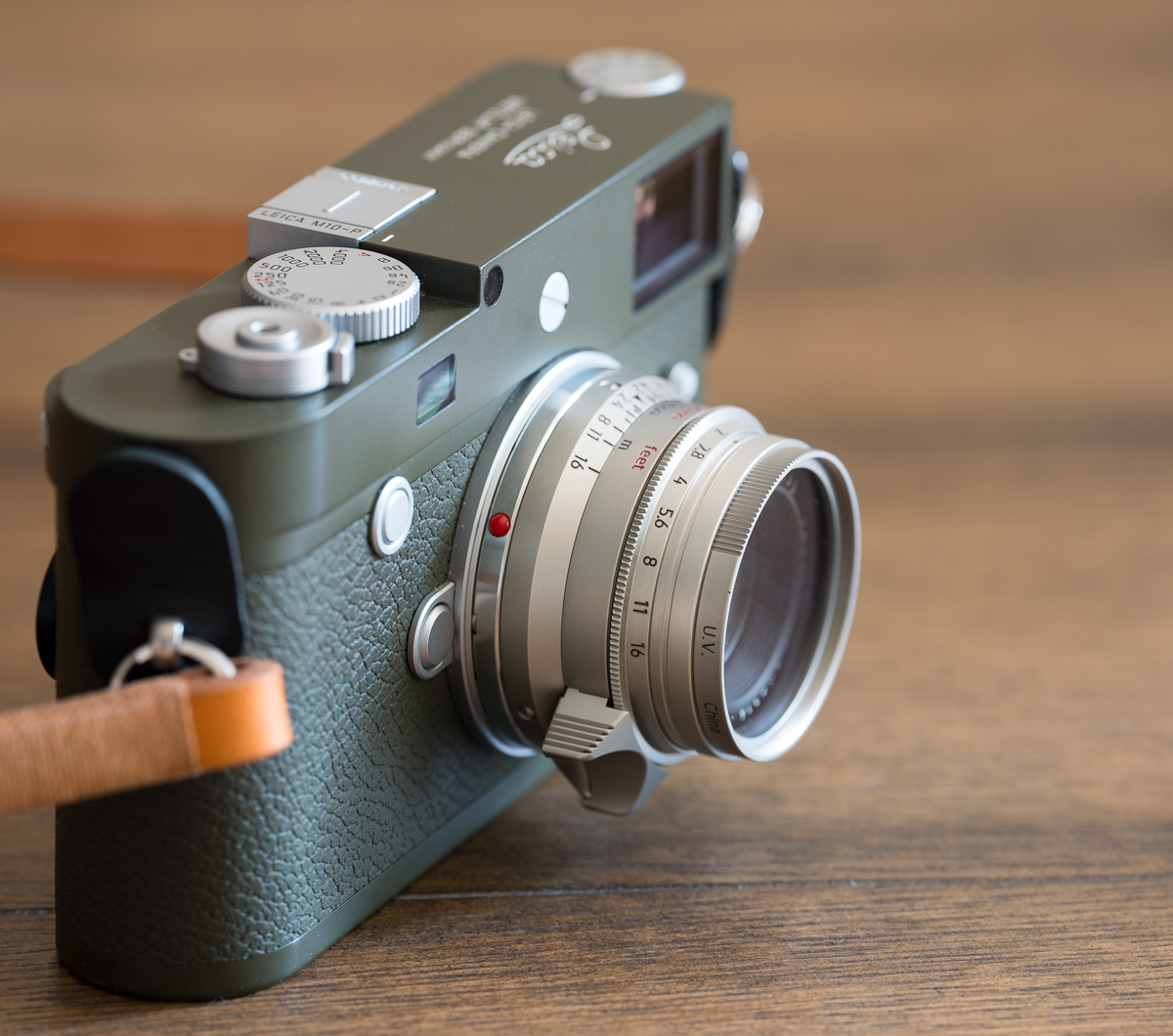
I think the titanium look works great on silver bodies, and it even suits the M10-P and M11-P Safari versions really well.
Here is the LLL 35/2 8-Element Titanium on the Safari.
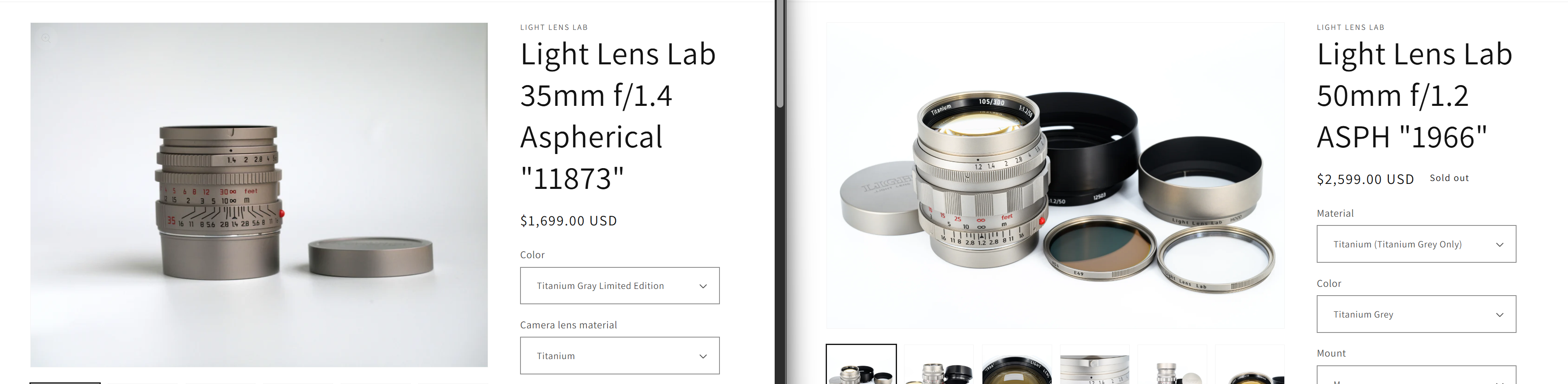
I was interested in the titanium as I have a Safari as well but the titanium in the pics for the AA looks different from the titanium on their other lenses. Not sure if that is just due to prototype/sample pics but I played it safe and bought the silver.
I have the LLL titanium 1966 50mm 1.2 and the color is practically the same to the AA replica pictured. The titanium 50mm 1.2 from your screenshot, while it clearly says titanium on the front looks more like silver. It doesn't look like mine at all. I would expect the titanium AA replica to look very similar to what is pictured.
endergemini wrote:
I was interested in the titanium as I have a Safari as well but the titanium in the pics for the AA looks different from the titanium on their other lenses. Not sure if that is just due to prototype/sample pics but I played it safe and bought the silver.
endergemini wrote:
I was interested in the titanium as I have a Safari as well but the titanium in the pics for the AA looks different from the titanium on their other lenses. Not sure if that is just due to prototype/sample pics but I played it safe and bought the silver.
Whenever I get the Titanium copy for review, I will post a photo of it on the Leica M10-P Safari, so everyone can get a better idea of how it will look.
Fred Miranda wrote:
Whenever I get the Titanium copy for review, I will post a photo of it on the Leica M10-P Safari, so everyone can get a better idea of how it will look.
I don't want to derail the thread but would love to see other pics of the 8 element Titanium on the Safari body to see if maybe I want to change my order before the pre-order window closes for the limited edition.
Fred Miranda wrote:
I think the titanium look works great on silver bodies, and it even suits the M10-P and M11-P Safari versions really well.
Here is the LLL 35/2 8-Element Titanium on the Safari.
The 35/1.4 is going to look great I looked at the photos carefully and I think it is going to mesh very well with the M11P safari perhaps better than my MP .. So I ordered it with Fred’s 5% and decided to get the titanium rather than wait for the black or chrome later, I ordered quickly when I thought there was only 300, but it looks like it will be staple offering now.
The premium of titanium version of ~$300 seems much lower than the other lens models. I changed my order from black to titanium. This will be my first titanium lens.
I don’t know if this link has been referenced in the other LLL thread or not, but it’s not been referenced here. A comparison of the original Leica AA to the FLE.
Might be of interest here if one hasn’t already seen this.
It's probably the most exhaustive and technical resource for the Leica 35mm AA. Lots of interesting things to glean from it.
1. Apparently, the idealized design was to have the aspherical surface be on a concave surface (the way it is on the 11874 and FLE), but the technology of creating aspherical surfaces on concave elements was not well-established, so the work around was to have two convex aspherical surfaces as was used on the AA.
"Watz realized that the aspherical lens needed to perfect this new design required a concave surface, the production of which with the techniques of the time (still based, at Leitz, on precision glass grinding) would have been difficult and, above all, very expensive; since the new design would still have entailed higher production costs (due to the two external doublets), he chose to replace the single concave aspherical lens with two convex lenses, much easier to machine using numerical control, even if the theoretical reduction in production costs was nullified by the doubling of the aspherical surfaces and by the fact that they were mounted in a doublet glued with another spherical lens, an element that requires extremely careful centering during assembly, which is truly critical."
2. The glass types used seem interesting. Of the nine elements, 8 have a high refractive index and of those 8, 5 have a very high refractive index.
"In the optical scheme of the Summilux-M 35mm f/1.4 Aspherical 1st type, the most significant optical glass among those adopted by Herr Watz is present in four lenses, namely the second, third, seventh and eighth of the nine planned; it is a Lanthanum borosilicate glass developed between 1966 and 1970 by two famous chemists from the Wetzlar glassworks, Heinz Broemer and Norbert Meinert; this material is known as 820451 glass and is characterised by a high refractive index, equal to 1.820, and by a decidedly low dispersion, underlined by the Abbe number of 45.1."
3. I'm happy that these geocities-looking pages still exist.
This is just one of the many 'articles' he has looking at the AA vs the FLE. Yes, his film was damaged by x-ray, so the colors are way off, but it gives you a good sense of the rendering. There are a couple photos that show how the AA has a softer (in the plane-of-focus), but also more dimensional draw (don't want to say 3D...there is already too much discourse on that topic).
Thanks so much for this, Jim. This is worth repeating: 'Of the nine elements, 8 have a high refractive index and of those 8, 5 have a very high refractive index.'
In low element count lenses, very important, and this is the direction the Chinese are taking. Leica use HRI for their ultra fast lenses, it is very expensive stuff. And after they relinquished their own glass works, they relied on Schott's catalog or had special glasses developed by them. The better lenses of today are doped with Lanthanum, from my recent reading - from the Greek word "lanthanein," meaning "to lie hidden.
The cine world helps explain Leica's aspherical leanings. "The Leica Summilux-C designers..had a
lens with great optical performance, jammed full of exotic glass, aspherical surfaces, all this great performance, but they now had a lens that was 20% thinner in diameter and 30 to 40% smaller in
circumference."