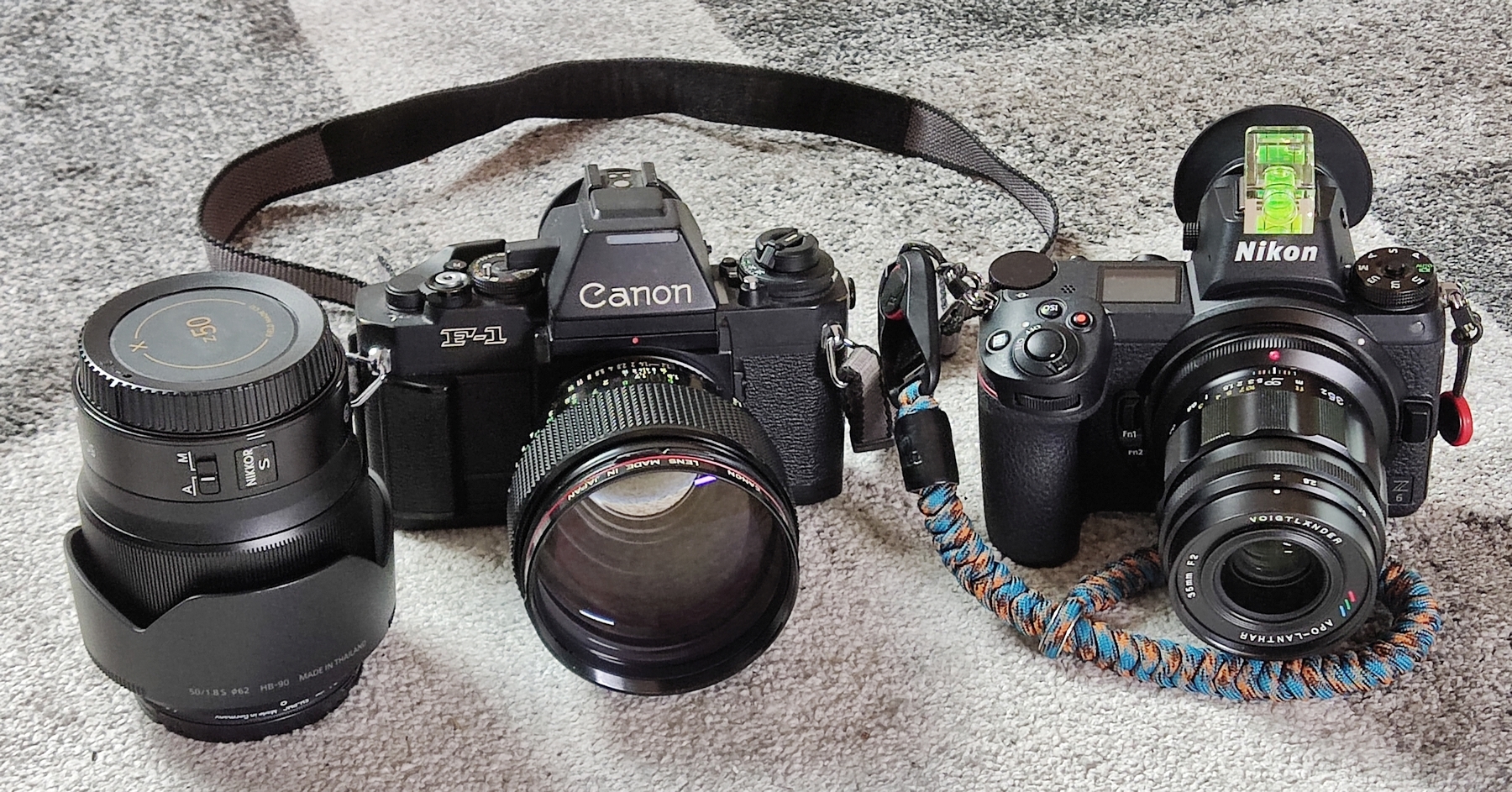
p.5 #1 · Why is the Nikon 35 1.2s and 50 1.2s so large compared to others?
AmbientMike wrote:
Hopefully people finally come to the realization that mirrorless isn't lighter. Sure there's some potential that isnt realized if you put a 2lb or so 50mm on it
Even the Sony 50/1.2 weighs over 2x the excellent 50/1.2 AIS I used to own. None of these are light really
You're not just comparing apples and pears, but rather melons and oranges.
p.5 #2 · Why is the Nikon 35 1.2s and 50 1.2s so large compared to others?
In principle, I would agree with that in the case of Nikon but I think it depends very much on the lenses.
With zoom lenses in particular, you can save quite a bit of weight and size in comparison.
Lenses such as the Z 14-24/2.8 S or the new Z 24-70/2.8 S II are significantly lighter than their F-mount counterparts, which both weigh 1 kg, while the Z-mount counterparts weigh 650 g and 675 g, respectively.
Lenses such as the Z 14-30/4 S also take advantage of the benefits of MILC here.
But this is also achieved by not correcting certain optical aberrations, particularly in the area of distortion, but rather ironing them out via the profile/software.
At 14mm, the Z 14-30 has distortion values that would do a fisheye lens proud.
A considerable amount of weight has also been saved in the super-telephoto solutions.
This is less the case with prime lenses, where the Z 35/1.2 S and the Z 50/1.2 S in particular are enormous in terms of size/weight.
One factor is certainly that Nikon prioritizes optical correction in its high-performance prime lenses, including in the area of focus breathing, where other manufacturers rely much more heavily on software correction.
So the potential is definitely there, but Nikon doesn't seem to prioritize it as much.
However, it's a fine line and a question of philosophy.
In the high-performance sector, I prefer lenses that are optically corrected as optimally as possible without major interventions via software correction.
However, compactness often means more correction via software interventions and compromises in optical correction.
The dimensions of MF lenses are certainly a thing of the past, and you can't expect that from today's AF lenses, especially when they are designed for maximum performance.
My Canon FD 85mm f/1.2 L is thicker, but shorter and more compact than even my Z 50/1.8 S.
However, it is not nearly as well corrected, especially in terms of color aberrations, as modern solutions in this category.
Those days are over.
p.5 #3 · Why is the Nikon 35 1.2s and 50 1.2s so large compared to others?
For what it's worth, and using Sony/Lumix/Nikon with some of the best lenses for each system, I must say I'm both surprised and impressed by the Nikon Z f1.2 lenses.
Surprised because of the size and weight of course, but also by the resolution wide open, to be honest, some of my Sigma, S Pro and GM lenses are much sharper in the center than both my 50mm f1.2 and 35mm f1.2 Z at fast apertures, at least when using ACR.
By exemple my 28-45mm Sigma at 35mm f1.8 is sharper than my 35mmm f1.2 Z at f1.8 (the Sigma is crazy sharp at 35mm). My 50mm S Pro is also sharper than my 50mm f1.2 Z, no matter the aperture I use, it was the same with my 50mm GM f1.2 I sold, the GM was sharper at f1.2.
I know we can't really compare resolution and sharpness between different systems, and it's certainly true because by example I can see that my Sony GM lenses are very slightly sharper on my old A7III than my Z6III with the Megadap Pro+ when I pixel peep (of course I speak about Raw files).
However, I just love the rendering of these Nikon Z f1.2 !
For portrait, the 50mm f1.2 Z has the best rendering I saw from a modern 50mm f1.2 or f1.4 lenses, including the 50mm GM, 50mm S Pro, 50mm Summilux SL and many other. For a bit more cripsness and by exemple when shooting objects, I often prefer the 50mm S Pro or the 50mm GM. But for portrait, I really like the 50mm f1.2Z.
The 35mm f1.2 Z have a similar rendering than the 50mm f1.2 Z but with more contrast, giving more "pop" at the pictures, some people reported it is maybe a tiny bit sharper wide open than the 50mm, this is not my case after pixel peep, but it has an excellent rendering for everything involving people. My 35mm GM and the Viltrox f1.2 I had were both slightly sharper in the center wide open and at f1.4 (at f1.8 my 35mm f1.2Z has a huge resolution boost), but neither the GM nor the Viltrox have the same contrast and overall rendering with some scenes, there is a sort of smooth but high contrast on skin I like a lot, similar to some Leica and Zeiss lenses I have used.
p.5 #4 · Why is the Nikon 35 1.2s and 50 1.2s so large compared to others?
I added it up and the 24/2.8 af, 35/2 af (both D or pre D,) 50/1.2 AIS I used on film are about 30 oz, so all 3 are barely heavier than the Sony 50/1.2 that is supposedly so light.
So I'm not really interested in hearing about how mirrorless is so light
p.5 #5 · Why is the Nikon 35 1.2s and 50 1.2s so large compared to others?
AmbientMike wrote:
I added it up and the 24/2.8 af, 35/2 af (both D or pre D,) 50/1.2 AIS I used on film are about 30 oz, so all 3 are barely heavier than the Sony 50/1.2 that is supposedly so light.
So I'm not really interested in hearing about how mirrorless is so light
Where did anyone say the 1.2 50 GM is light? By itself, it's heavy, very heavy. However, compared to the Z 1.2 50 S, which, unlike any AiS Nikkor, is actually a comparable lens to the GM, it's very light. If you want to compare your AiS, compare it to the CV 1.2 50 Nokton SE. Its size and weight are similar to those of the AiS Nikkor, but it offers a completely different quality at full aperture, not to mention its flare resistance.