fredmiranda.com
Login

Moderated by: Fred Miranda
  New fredmiranda.com Mobile Site
  New Feature: SMS Notification alert
  New Feature: Buy & Sell Watchlist
  

FM Forums | Sony Forum | Join Upload & Sell

1       2       3              12              14              21       22       end
  

After 13 years of all Sony, I'm trying Nikon


aCuria
Offline
• • •
Upload & Sell: Off
p.13 #1 · After 13 years of all Sony, I'm trying Nikon


Steve Spencer wrote:
I would agree and this is a good summary, but would add these corollaries:

In poorer light if there are equivalent lenses, which is a big if, then considering smaller sensor cameras can save money. It isn't just macro photography and group photos, but action photography, including wildlife and sports, that often are shot in poorer light at higher ISOs. The primary advantage of FF for these types of shooting is not the better DR that is available at base ISO, which is rarely available, but instead the availability of lenses for which there are not equivalents for smaller sensor
...Show more

Steve Spencer wrote
The primary advantage of FF for these types of shooting is not the better DR that is available at base ISO, which is rarely available, but instead the availability of lenses for which there are not equivalents for smaller sensor cameras.


I agree with how lens availability is important.

For example, there are plenty of 50mm f/1.2 lenses for full frame, but is it even physically possible to make the equivalent 25 mm f/0.6 for Micro 43? Or a 14-35/f1.0 to match a 28-70/2?

I think for action photography, its "better DR at high ISOs" that matters and not "better DR that is available at base ISO"

Steve Spencer wrote
Base ISO shooting is a primary advantage of FF cameras and if you aren't using that advantage you should consider using it more.


I indeed have a custom hold button set to base ISO to achieve this when the situation calls for it.

Steve Spencer wrote
The lower ISO brings better DR, but the wider aperture that is needed to get a good exposure limits detail as shooting at wider apertures usually means a worse performance of the lens and always means less of the image is in focus.


Physics tells us that in an aberration free lens, the highest resolution is achieved at the brightest aperture. However most camera lenses are not sufficiently aberrations free for this to hold true. Closing the aperture reduces the aberrations which is why we observe resolution improving as we stop down towards the diffraction limit.

Better optics can help with aberrations for example the 50/1.4GM achieves 89 lp/mm at f/2

Another trick in low light is to prefer wider focal lengths, and shoot standing further away from the subject. This results in more DoF at the same aperture.

Steve Spencer wrote
If I am shooting a low light portrait, let's say on the street at night, and I want the depth of field that even an f/2 FF shot would provide, then I can shoot an APS-C system at f/1.4 and get similar DR with the APS-C system.


You will get similar DR but FF will yield more fine detail and overall lp/ph.

I use the APSC DSLR (with cheaper lenses) when shooting in risky scenarios where I don't want a nice camera to get damaged.

When I shot only Canon I shared mostly the same EF lenses on both APSC and FF cameras. Buying separate lenses for APSC is extra cost.

Steve Spencer wrote
The relevant questions then become how often in low light do I want to shoot wide open? My own answer is rarely.


Personally I do shoot wide open fairly often. In the past I have too often set the shutter speed too slow resulting in motion blur in what would have been the best frames.

These days for kid "action" photography regardless of lighting conditions I use ISO auto min ss = 1/500s and an ISO range limit of 12,800. The priority here is capturing the right moment. In good light I use a f/2.8 or f/4 zoom but In low light the aperture will be wide open (f/1.4).

If you rarely use f/1.4 then a 28-70/2 or that Sigma 28-45 f1.8 becomes very attractive instead of a prime.


Sep 25, 2025 at 01:15 AM
aCuria
Offline
• • •
Upload & Sell: Off
p.13 #2 · After 13 years of all Sony, I'm trying Nikon


Immortal wrote:
You can easily print A3 or even A2 format pictures from any stacked sensor Nikon without any problems. Like seriously... you're reaching here.

Done it many times, for many people. Never once i heard that DR was lacking.

You're really taking this "DR hit" to the extremes. 99,9% people really don't notice such a subtle things unless you tell them to do it(and what to look for exactly) and even then it's not obvious for most people.


You can easily print A3 or even A2 format pictures from a 1" prosumer camera without any problems. None of the sheep customers can tell!

Hang on, doesn't the 1" RX10M4 have 24fps burst, 960fps video, fully stacked sensor and a 24-600mm lens?

You only have to give up ~1.4 stop of DR compared to the Z6iii!

The readout speed and fps is faster than the Z6iii + 24-120 + 180-600, for a tiny fraction of the price!

Perhaps we should all buy that since 1 stop of DR "doesn't matter".. right guys? #sarcasm


Sep 25, 2025 at 01:58 AM
j4nu
Offline
• • • • •
Upload & Sell: Off
p.13 #3 · After 13 years of all Sony, I'm trying Nikon


aCuria wrote:
Readout speed is a means to an end, not the end goal.
The real objective is to minimize rolling shutter artifacts and banding.
If the electronic shutter achieves this more effectively, use it.
However if the mechanical shutter performs better, use that instead.


Well, the same can be said about DR.
If the scene does not require it, you can get away with lesser sensor...


Sep 25, 2025 at 03:13 AM
aCuria
Offline
• • •
Upload & Sell: Off
p.13 #4 · After 13 years of all Sony, I'm trying Nikon


j4nu wrote:
Well, the same can be said about DR.
If the scene does not require it, you can get away with lesser sensor...


Dynamic range also affects tonal gradations, I mentioned this in a previous post but lets expand on it

I thought Manny did a good job showing it here:

Nikon Z8 vs X2D

?si=lu46vwWvaid9k6o8&t=372
Canon R5 vs X2D

?si=UsqtZxTNYvWyX0R6&t=432
Sony A7RV? vs X2D

?si=EBKik2M__Caw6tYG&t=449

There are RAW file samples here
https://www.manuelortizphoto.com/free-downloads

I would like to see even better DR on FF sensors, maybe in a decade we will have global shutter FF cameras that can match the DR of the X2D.

As an aside the colors on the Canon came out looking sickly SOOC, whats up with that


Sep 25, 2025 at 05:08 AM
Steve Spencer
Online
• • • • • • •
Upload & Sell: On
p.13 #5 · After 13 years of all Sony, I'm trying Nikon


aCuria wrote:
I agree with how lens availability is important.

For example, there are plenty of 50mm f/1.2 lenses for full frame, but is it even physically possible to make the equivalent 25 mm f/0.6 for Micro 43? Or a 14-35/f1.0 to match a 28-70/2?

I think for action photography, its "better DR at high ISOs" that matters and not "better DR that is available at base ISO"

I indeed have a custom hold button set to base ISO to achieve this when the situation calls for it.

Physics tells us that in an aberration free lens, the highest resolution is achieved at the brightest
...Show more

For action photography it is the availability of bigger lenses with larger entrance pupils that allow faster shutter speeds that is the advantage of full frame systems. As we have reviewed when using lenses with the same depth of field (i.e., that have the same size entrance pupil) smaller sensor cameras can simply turn down the ISO, maintain the same shutter speed and get equivalent DR. There is no advantage of FF sensors for this type of shooting. There is an advantage of more lens availability for FF systems.

In low light situations, whether the FF system will get more detail and lp/ph depends on the lens and the specific sensors. A 40 MP APS-C sensor with a quality lens will get more detail than a 24 MP sensor with an average lens. It is the greater number of pixels of FF systems and the easier design of lenses with slower apertures and equivalent depth of field that often gives a FF system more detail, but whether the FF system actually has an advantage will depend on the exact sensors being compared and the exact lenses. Further for low light portraits, in my shooting, detail is not the most important aspect of picture quality or even in the top 5. For me, APS-C works really well for low light shooting when I use faster lenses (I have 3 f/1.2 APS-C lenses) and because I have good quality fast lenses I don't have to turn the ISO up as high on APS-C and don't see any real world DR advantage for FF. I still shoot FF in these situations often as well but what system I use isn't based on the sensor size and any small advantage of DR for a FF system, but rather based on the lenses I want to use and the look that I want to create.

For me buying lenses is about picking from what is available for the looks I like and the capabilities that they bring. FF systems and Sony in particular has a lot of lenses at this point which is a huge strength, but I still find lenses that bring me something that I can't find on Sony. For example, I have a 23 f/1.2 lens for APS-C that is tiny (weighs just 220g) and is great for travel and yet has a rendering that I really like even shot wide open. It wasn't expensive either. There simply isn't a lens anything like it for Sony and it is a great part of my travel kit. If you recognize that lens availability is the strength of a system, then it follows that one benefit of multiple systems is that multiple systems creates more lens availability. Sure there are cost associated with multiple systems, but greater lens availability is a good thing.

Shooting wider and farther away is not a useful trick for low light photography. Using this "trick," may create more depth of field, but you lose any advantage of the FF system when you crop to the desired framing. I trust you know that cropping your FF camera shots means you are using your FF camera as a smaller sensor camera. In those situations the FF camera is no better or really any different than a crop sensor camera. It is in fact, a cropped sensor camera you are using. I hope you realize it is inconsistent to trumpet the advantages of FF sensor and then talk about how you like to crop and the images turn out great. If cropping works for you, then using a camera with a sensor the same size to which you are cropping will work for you. For me it is the recognition that I can crop and get good images with FF frame with plenty of DR and image quality that tells me that I can effectively use a smaller sensor camera in those same instances. So if you can use a wider lens from further away and crop to get the depth of field and framing that you want, then you can use a smaller sensor camera in that instance as well.

Finally, in my experience using 1/500 for kid photography and I have had 3 kids and the youngest is 13 and I have shot more kid photography than anything else is over kill, and if you are turning up ISO (perhaps by letting auto ISO select a higher ISO) then you are not maximizing image quality. For someone who seems to emphasize getting as high of DR as possible it is surprising to me that you adopt this strategy. In my experience, 1/200 and even 1/125 with a 35mm lens is more than enough shutter speed for shooting kids. If you really care about having as much DR as possible, then I would recommend rethinking this strategy as if you shoot with 1/200 instead of 1/500 that would give you over a stop more DR, which you seem to care a great deal about, unless you are already shooting at base ISO at 1/500. If you are shooting at even ISO 200, there is a stop of DR to be gained by decreasing your shutter speed.

Perhaps you recognize, however, that you still get good shots at that shutter speed even at say ISO 250 and that in your use ISO 100 and ISO 250 aren't that different. If you do recognize that you are seeing in your actual shooting just how small a difference of over 1 stop in DR can be.


Sep 25, 2025 at 05:32 AM
aCuria
Offline
• • •
Upload & Sell: Off
p.13 #6 · After 13 years of all Sony, I'm trying Nikon


Steve Spencer wrote:
For action photography it is the availability of bigger lenses with larger entrance pupils that allow faster shutter speeds that is the advantage of full frame systems. As we have reviewed when using lenses with the same depth of field (i.e., that have the same size entrance pupil) smaller sensor cameras can simply turn down the ISO, maintain the same shutter speed and get equivalent DR. There is no advantage of FF sensors for this type of shooting. There is an advantage of more lens availability for FF systems.

In low light situations, whether the FF system will get
...Show more

Steve Spencer wrote:
In low light situations, whether the FF system will get more detail and lp/ph depends on the lens and the specific sensors. A 40 MP APS-C sensor with a quality lens will get more detail than a 24 MP sensor with an average lens.


It is my experience that if you use the same lens wide open the FF system will get better detail and lp/mm. You can use a 100MP apsc camera and a 24MP FF camera, it wont make a difference. The best primes do 75lp/mm or so at f/1.4, 24MP FF is enough to capture that.

Steve Spencer wrote:
When you crop to the desired framing.


In low light I try to find compositions that work well with the wider framing. I try not to crop at all.

Think about it this way, if you used a 20/1.4 or 24/1.4 in low light you will walk away with very different (wider!) images compared to using a 50/1.4 or 85/1.4. As the focal length gets longer the more you run into DoF issues.

You can pose someone for a full body shot or a half body shot, this is a choice. In low light go for the wider option if you have DoF issues.

Steve Spencer wrote:
1/200 and even 1/125 with a 35mm lens is more than enough shutter speed for shooting kids


I get about blur frames with the kids move at 1/250s, and its those frames I tend to want. Not the ones where they are not moving. It is what it is. Would be nice if Sony had more settings between 1/250 and 1/500 for auto iso min ss.

If they pose for me I will use 1/60 - 1/125

Steve Spencer wrote:
Perhaps you recognize, however, that you still get good shots at that shutter speed even at say ISO 250 and that in your use ISO 100 and ISO 250 aren't that different. If you do recognize that you are seeing in your actual shooting just how small a difference of over 1 stop in DR can be.


In POST I am acutely aware of the image degradation for every stop higher ISO used and every stop the exposure is pushed.

Its the skin tones that bother me more, the exposure latitude is sometimes less important depending on the scene.

I can accept using a higher ISO if I have to, but losing DR at every ISO is a bitter pill to swallow.


Sep 25, 2025 at 05:56 AM
Steve Spencer
Online
• • • • • • •
Upload & Sell: On
p.13 #7 · After 13 years of all Sony, I'm trying Nikon


aCuria wrote:
It is my experience that if you use the same lens wide open the FF system will get better detail and lp/mm. You can use a 100MP apsc camera and a 24MP FF camera, it wont make a difference. The best primes do 75lp/mm or so at f/1.4, 24MP FF is enough to capture that.

In low light I try to find compositions that work well with the wider framing. I try not to crop at all.

Think about it this way, if you used a 20/1.4 or 24/1.4 in low light you will walk away with very different (wider!) images compared
...Show more

One important difference between how we shoot is that as you say you try to find compositions to fit what maximizes IQ. I will never do that. For me composition is king and I try to make it the most important part of every shot. My selection of composition comes first and then I worry about IQ. Never the other way around.

You of course can and perhaps should shoot differently. What we prioritize when there are tradeoffs tells us what matters most to us. It is clear that maximizing image quality matters to you most. To me maximizing my vision for the shot matters most. That starts with composition being compromised as little as I can. It includes selecting lenses for that vision rather than maximum IQ. It includes having lens that allow the expression of my vision. So, yes I will sacrifice DR for my vision--every day of the week and twice on Sunday. I won't look back and regret that decision either. For me a stop of loss in DR is not very consequential if it serves my vision for the shot.


Sep 25, 2025 at 06:21 AM
Ripolini
Online
• • • •
Upload & Sell: Off
p.13 #8 · After 13 years of all Sony, I'm trying Nikon


aCuria wrote:
Nikon Z8 vs X2D

?si=lu46vwWvaid9k6o8&t=372


That guy compares the Z8 with a cheap Tamrikon zoom to the Hasselblad with a 4k$ prime and concludes that better tonal transitions and "color science" come from the sensor ...


Sep 25, 2025 at 06:50 AM
j4nu
Offline
• • • • •
Upload & Sell: Off
p.13 #9 · After 13 years of all Sony, I'm trying Nikon


aCuria wrote:
Dynamic range also affects tonal gradations, I mentioned this in a previous post but lets expand on it

I thought Manny did a good job showing it here:

Nikon Z8 vs X2D

?si=lu46vwWvaid9k6o8&t=372
Canon R5 vs X2D

?si=UsqtZxTNYvWyX0R6&t=432
Sony A7RV? vs X2D

?si=EBKik2M__Caw6tYG&t=449

There are RAW file samples here
https://www.manuelortizphoto.com/free-downloads

I would like to see even better DR on FF sensors, maybe in a decade we will have global shutter FF cameras that can match the DR of the X2D.

As an aside the colors on the Canon came out looking sickly SOOC, whats up with that


I have to say that while I enjoy Manny's reviews from time to time, he's the last person I'd ask about any kind of technicalities of photography .

I don't think I agree with your point about tonal gradiations. After all, DR is the range that the sensor is able to capture. What you're basically saying is that if we take the middle of that range (so no clipping on either end), we will get more "tonal gradiations" on the sensor with higher overall DR...


Sep 25, 2025 at 07:04 AM
Immortal
Offline
• •
Upload & Sell: Off
p.13 #10 · After 13 years of all Sony, I'm trying Nikon


aCuria wrote:
Why would you take any hit at all?

The R6ii sensor is as fast as the z6iii sensor and has up to a stop more dynamic range

The A1 / A1ii sensors are as fast as the Z9 and have up to a stop better DR

I can see no reason to compromise here

Where the compromise kicks in when moving from FF to Hasselblad / GFX medium format. There is no escaping the slow AF and slow sensor readout (for video) with those cameras.


You have a very strong opinions which lets say dont align with any working photographer i ever met.

For me this is the definition of forum nerding, pixel peeping which have very little to do with real world aplications.

You're chasing the last 1%, the "perfection" without any compromise, you just want the the best there is(atm) no matter the cost or anything else. That's not the reality for 99% of photographers or their clients.

There are many reasons why one would'nt want to enter Canon system or pay almost 7000$ for A1 II just to get that last 1% of "perfection".

aCuria wrote:
You can easily print A3 or even A2 format pictures from a 1" prosumer camera without any problems. None of the sheep customers can tell!

Hang on, doesn't the 1" RX10M4 have 24fps burst, 960fps video, fully stacked sensor and a 24-600mm lens?

You only have to give up ~1.4 stop of DR compared to the Z6iii!

The readout speed and fps is faster than the Z6iii + 24-120 + 180-600, for a tiny fraction of the price!

Perhaps we should all buy that since 1 stop of DR "doesn't matter".. right guys? #sarcasm


Again, you have very strong opinion to say the least.

Those "sheep customers" as you call them are the one paying photographers for their work. They don't have to see every little detail that people like you obsess over. One would agrue that the voice of these "sheeps" is way more important for a working photgrapher than some nerd here obsessing over every little thing.

You're just taking nerding to the extreme and it's fine on forums like this but it have very little impact on real world aplications.

Nobody is saying here that there is no DR difference, coz there is. However what most people agree on, even here - that it's inconsequential for most of them and above all it really makes very little to no difference in real world aplications.


Sep 25, 2025 at 08:17 AM


Search in Used Dept. 

ruthenium
Offline
• • • •
Upload & Sell: On
p.13 #11 · After 13 years of all Sony, I'm trying Nikon


Often, in exchanges as the above, most contributors add some valid, useful, or at least entertaining points. Extreme views are perfectly all right (as long as there is no nonsense spilled, that has not been the case here so far), because these reflect the human nature. Some of the photographers are more technically inclined, others pursue the pure art, etc. When we respectfully listen to each other, then I find such discussions enjoyable and educational, even when exposed to extreme views.
My photography is mostly travel snapshots, non-professional. I came to appreciate the importance of the dynamic range, and do care about the DR, for the simple reason that often I must use a camera in less than ideal light when travelling and on hikes. This is when the dynamic range of an average scene can be extreme, too often with blinding highlights and abysmally dark shadows. The very worst in my experience of a non-pro travel photographer is taking pictures of my wife (my permanent model and companion) against some beautifully bright background. I recently switched to processing in Capture One for the main reason that this program seems to excel in recovering the smallest bits of information from the extremes and it has tremendously successful and useful face and skin color correction tools.
The DR can be less important for those who can control the light one way or the other, by using flashes and strobes, or when they have a chance to re-visit a place in a more favourable light. Carrying too much equipment or returning to a place can be impossible when doing a long hike one day in one place, then moving for hiking in a new place.


Sep 25, 2025 at 11:56 AM
j4nu
Offline
• • • • •
Upload & Sell: Off
p.13 #12 · After 13 years of all Sony, I'm trying Nikon


ruthenium wrote:
Often, in exchanges as the above, most contributors add some valid, useful, or at least entertaining points. Extreme views are perfectly all right (as long as there is no nonsense spilled, that has not been the case here so far), because these reflect the human nature. Some of the photographers are more technically inclined, others pursue the pure art, etc. When we respectfully listen to each other, then I find such discussions enjoyable and educational, even when exposed to extreme views.
My photography is mostly travel snapshots, non-professional. I came to appreciate the importance of the dynamic range, and do
...Show more

Yeah, I think it's actually pretty easy to exceed the camera's DR. Well, maybe not if you're shooting indoors / dull light and outdoors / overcast only.
It doesn't mean that 1EV missing will break your photo, but in general better exposed photos look better IMHO ...


Sep 25, 2025 at 04:05 PM
philip_pj
Offline
• • • • • •
Upload & Sell: On
p.13 #13 · After 13 years of all Sony, I'm trying Nikon


The facts often intervene in these discussions, and that is why they make the best friends, if in context and presented fairly. I took a look at the Cined metrics for DR, a fascinating read it was, if you have an open mind that is.

And even in PTP data, the top dozen or so are almost all medium format cameras. Ergo, the better the camera, the higher the dynamic range. Life can be cruel. The better regular cine cameras, if we can call them that, have a stop up their sleeves over the general average of our MILCs. Ronin 4D, V-raptor 8k etc.

Then there is ARRI. Their older (2010!) Alexa Classic has all of 1.5 stops up on MILCs, and the 2022 Alexa 35 (a super35 camera, kind of like APS-C) has all of three stops over the Z8/a7rV, and company at that level. Bear in mind, cine exercises surreal levels of control over light, and they value DR so highly it is almost the raison d'etre of their cameras being chosen.

I'd love that level of DR, and I fully endorse the words of ruthenium here, being a travel photographer. You can recover most images but if you see well, it's easy to see the legacy of recovery in the ensuing images. The camera producers can do much (much) better, so why don't they? (rhetorical question, there are no answers to this one).

I would not be doing this if it was not for Sony, who pushed the DR envelope out in 2012/2013 with the D800/a7r. What people used back then - Canon's 5DIII - were kind of halfway back towards E6, which was virtually unworkable. C41 was always a mess.


Sep 25, 2025 at 05:02 PM
philip_pj
Offline
• • • • • •
Upload & Sell: On
p.13 #14 · After 13 years of all Sony, I'm trying Nikon


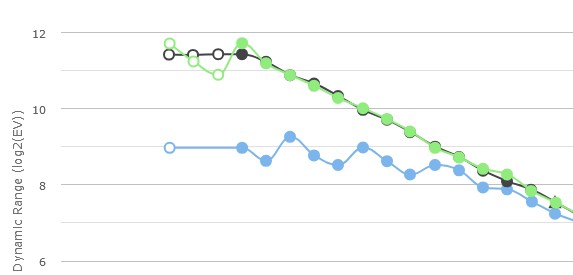
Here is a graph from PTP, showing the Nikon D800, Sony a7r and that dismal establishment player, Canon, and its ghastly 5DIII. 2.75 stops is the differential here. All it took was a competent new entrant to the market.

We gained 30% more DR in an instant. It's still fun looking back at 5D series' images - those blacks are special! And the contrast! It was like arty BW in color. Little wonder why some people are salivating at the prospect of DJI getting into the pool (at the deep end). They won't muck around. Might even save the activity from the phone onslaught. Hope springs eternal..


green: a7r; black: D800; blue (gives you the blues): 5DIII


Sep 25, 2025 at 05:13 PM
aCuria
Offline
• • •
Upload & Sell: Off
p.13 #15 · After 13 years of all Sony, I'm trying Nikon


philip_pj wrote:
Here is a graph from PTP, showing the Nikon D800, Sony a7r and that dismal establishment player, Canon, and its ghastly 5DIII. 2.75 stops is the differential here. All it took was a competent new entrant to the market.

We gained 30% more DR in an instant. It's still fun looking back at 5D series' images - those blacks are special! And the contrast! It was like arty BW in color. Little wonder why some people are salivating at the prospect of DJI getting into the pool (at the deep end). They won't muck around. Might even save the activity
...Show more

You are bringing back some bad memories, this was a tough time to be in the Canon ecosystem

The D750 was so good Canon did not make a more compelling entry FF camera until the R6. The 6Dii and EOS R were failures imo.


Sep 26, 2025 at 01:10 AM
aCuria
Offline
• • •
Upload & Sell: Off
p.13 #16 · After 13 years of all Sony, I'm trying Nikon


j4nu wrote:
I have to say that while I enjoy Manny's reviews from time to time, he's the last person I'd ask about any kind of technicalities of photography .

I don't think I agree with your point about tonal gradiations. After all, DR is the range that the sensor is able to capture. What you're basically saying is that if we take the middle of that range (so no clipping on either end), we will get more "tonal gradiations" on the sensor with higher overall DR...


I think its reasonable to ignore what Manny says and just look at his raw files.

Greg has posted some crops, that's another data point.

Are you claiming here that improving DR does not improve tonal gradations? In that case what affects the gradations?

To me DR seems to affect the tonal gradations, at least as ISO increases DR decreases and tonal gradations get worse.

I could be wrong about this though, if you can explain it better it would be helpful


Sep 26, 2025 at 01:27 AM
Ripolini
Online
• • • •
Upload & Sell: Off
p.13 #17 · After 13 years of all Sony, I'm trying Nikon


aCuria wrote:
The 6Dii and EOS R were failures imo.


What's wrong with the EOS R? At low ISOs the EOS R has 1.5 EV better dynamic range than 6DII. It's even better than the current Z6III.
https://www.photonstophotos.net/Charts/PDR.htm#Canon%20EOS%206D%20Mark%20II,Canon%20EOS%20R,Nikon%20Z%206III


Sep 26, 2025 at 01:42 AM
aCuria
Offline
• • •
Upload & Sell: Off
p.13 #18 · After 13 years of all Sony, I'm trying Nikon


Ripolini wrote:
What's wrong with the EOS R? At low ISOs the EOS R has 1.5 EV better dynamic range than 6DII. It's even better than the current Z6III.
https://www.photonstophotos.net/Charts/PDR.htm#Canon%20EOS%206D%20Mark%20II,Canon%20EOS%20R,Nikon%20Z%206III


This one has less to do with DR.
- EOS R autofocus was not good enough yet, for example there's no eye-AF in AF-C and AF was not very reliable. I tried it and figured it was better to use a DSLR like the D750
- The EOS R competed directly with the A7III, the A7III is a better camera and not by a small margin.


Regarding DR the Z6iii sets a very low bar and did not even exist back then. If you want to compare DR use the D750 as a baseline... It beats the Z6iii by a stop or so


Sep 26, 2025 at 03:45 AM
Steve Spencer
Online
• • • • • • •
Upload & Sell: On
p.13 #19 · After 13 years of all Sony, I'm trying Nikon


aCuria wrote:
I think its reasonable to ignore what Manny says and just look at his raw files.

Greg has posted some crops, that's another data point.

Are you claiming here that improving DR does not improve tonal gradations? In that case what affects the gradations?

To me DR seems to affect the tonal gradations, at least as ISO increases DR decreases and tonal gradations get worse.

I could be wrong about this though, if you can explain it better it would be helpful


What controls tonal gradation is not DR, but color depth as DXO calls it or the maximum number of colors that the camera can distinguish. More light hitting the sensor means more DR, and it means more color depth so letting more light hit your sensor will give you both more DR and more color depth, but DR is not what controls tonal gradations as j4nu suggests. Factors that affect DR do tend to affect color depth, but it isn't a one to one relation and I don't think it is correct to say that DR causes color depth and better tonal gradations. But because there are a number of factors that affect both DR and color depth tracking DR will tend to predict color depth. Said statistically DR and color depth are correlated, but I don't believe that DR causes color depth. One of the first lessons of most basic lectures on scientific enquiry (and all of my lectures on the topic) is that correlation is not causation and this is an example of that principle.


Sep 26, 2025 at 06:00 AM
ruthenium
Offline
• • • •
Upload & Sell: On
p.13 #20 · After 13 years of all Sony, I'm trying Nikon


Steve Spencer wrote:
What controls tonal gradation is not DR, but color depth as DXO calls it or the maximum number of colors that the camera can distinguish. More light hitting the sensor means more DR, and it means more color depth so letting more light hit your sensor will give you both more DR and more color depth, but DR is not what controls tonal gradations as j4nu suggests. Factors that affect DR do tend to affect color depth, but it isn't a one to one relation and I don't think it is correct to say that DR causes color depth
...Show more

Steve, you make a good point here. Thus, the question is "what does the term 'tonal gradations' mean?"
Chat GPT, conveniently supplies the following:
"👉 Tonal gradations refer to the smooth, gradual transitions between different tones — usually shades of light and dark, or subtle differences in color or brightness.
For example:
In a black-and-white photograph, tonal gradations are the smooth changes from pure black through many shades of gray to pure white.
In a painting or digital image, tonal gradations describe how one color blends gradually into another"

The first of the two meanings is what we normally think of as the Dynamic range. A large DR means many numbers in the ADC (analog-to-digital converter) range between black and white. This allows very subtle changes in the tones in-between. In other words, a large DR allows distinguishing very subtle changes in light levels (light intensity).
The second meaning of the "tonal transitions" is about the color depth, and I think this is a closely related idea. Let's recall that all colors result from mixing R-G-B. The jpegs, for example, have an 8-bit color depth, meaning that a certain color is defined by a combination of three numbers, each ranging from zero to 255. For black-grey-white tones:
Pure black: 0,0,0
Dark grey: 50,50,50
Middle grey: 128,128,128
Light grey: 200,200,200
Pure white: 255,255,255

Thus, a camera sensor can only register the intensity of light, not colors. It is the information about which numbers come from under red, green, or blue microlenses that allows the synthesis of the colors.
There are photographers who have much better understanding of DR than mine, but I think the tonal gradations in both senses are indeed directly linked to the DR of a camera sensor.


Sep 26, 2025 at 06:53 AM
1       2       3              12              14              21       22       end


FM Forums | Sony Forum | Join Upload & Sell

1       2       3              12              14              21       22       end


Welcome back
Log in to your account