Steve Spencer wrote:
It can a bit. More detail in the file can lead to a little more file size, but it is also very dependent on the subject and especially the depth of field (i.e., the amount of stuff in focus) of the shot.
Yeah, I know about small fluctuations, but did not know that it can be more than that.
File size depends also on the compression level. For uncompressed files, the amount of detail and/or blurriness is irrelevant: for each photosite you have the same number of bits (2^n, with n the bit depth; e.g., 12- or 14-bit).
Noise too is important: at high ISO, noisy images often produce larger files than clean, smooth images because noise acts as "detail" that compression algorithms tend to maintain.
Ripolini wrote:
I asked DxO support and here is the answer:
"At the moment, the Voigtlander APO-Lanthar 28mm f/2 for Nikon Z does not appear in our list of supported lenses for DxO PureRAW 5, so it is not currently supported as a DxO Optics Module.
We unfortunately can’t confirm if/when a specific lens will be supported in a future update, but you can keep an eye on the supported gear list here (it is updated as new modules are released): DxO Supported Cameras & Lenses".
On E mount so far both of my CV lenses are not on the supported list(Nokton 35 f1.2 SE and APO 28/2). I feel like I write in a request everytime I go to the DxO site...lol
Although I have had my 28 for a few months I have only recently begun to really use and compare with other 28s I have like the nokton, colorskoper, LLL etc... and being a mostly 28/50/90(or 135) kit person which 28 to anchor a M11 kit is a choice. I have decided that the apo lanthar anchors that end of modern M11 (dig) lens kit with its 60 mp, with a 50 apo summicron, and a 90 ultron or 135 apo teleyt leica. If I want a fourth lens for character the new 35 1.4 LLL seems to be my current favorite. Missing of course is a fast noct type but for this kit I am thinking travel and mostly outdoors. Will need something else if I plan a lot of indoors photos. This was first rays of the Sun hitting the plants while the Palo Verde are in bloom, the yellow flowers glow beautifully first rays of light now fading, and make me terribly miserable from the allergy. The 28 apo lanthar as Fred began this thread is quite a lens, I like it.
Great set! The third image stands out to me. It has a beautiful mix of real atmospheric character with a very well corrected lens, and the composition works really well.
Nikon vs Sony Sensor Stack Impact on Image Quality
Voigtlander 28mm f/2 APO-Lanthar sensor stack comparison: Nikon vs Sony, which adapts this lens better?
It's clear from this review that the Voigtlander 28mm f/2 APO-Lanthar is outstanding from center to corners even wide open on the Leica M. When adapted to Sony, however, there is visible degradation, including increased field curvature and astigmatism.
So how does it perform on Nikon sensor?
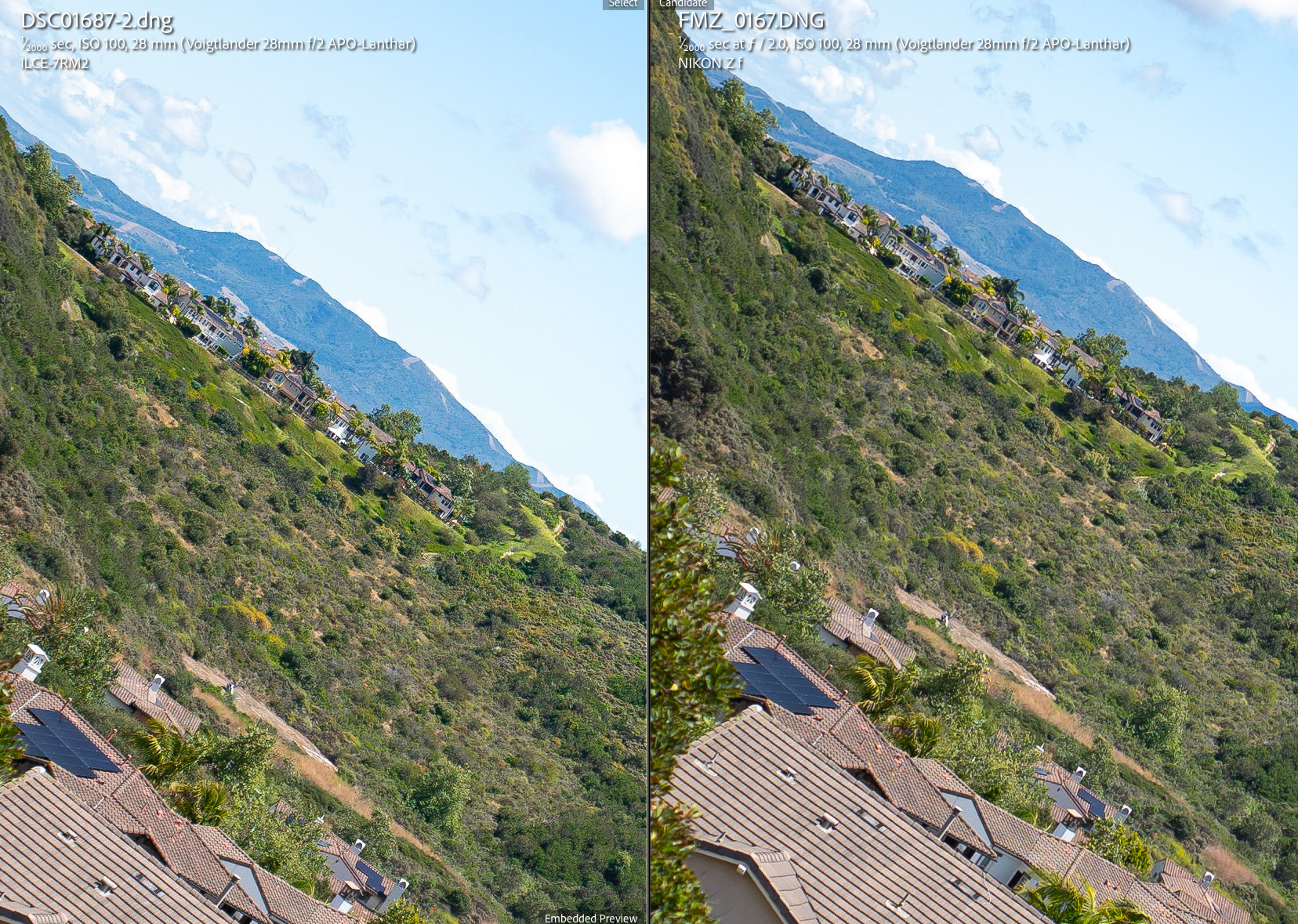
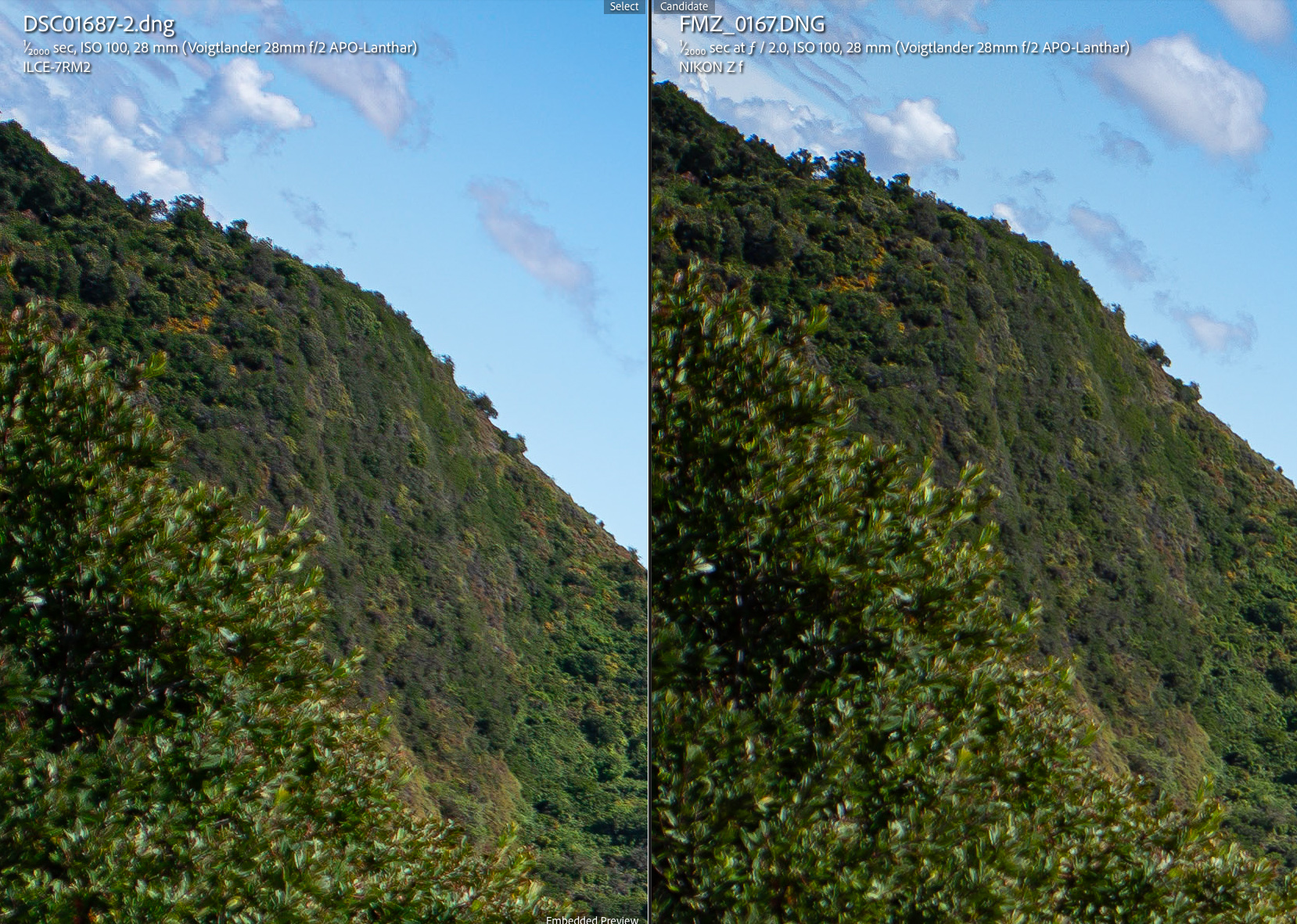
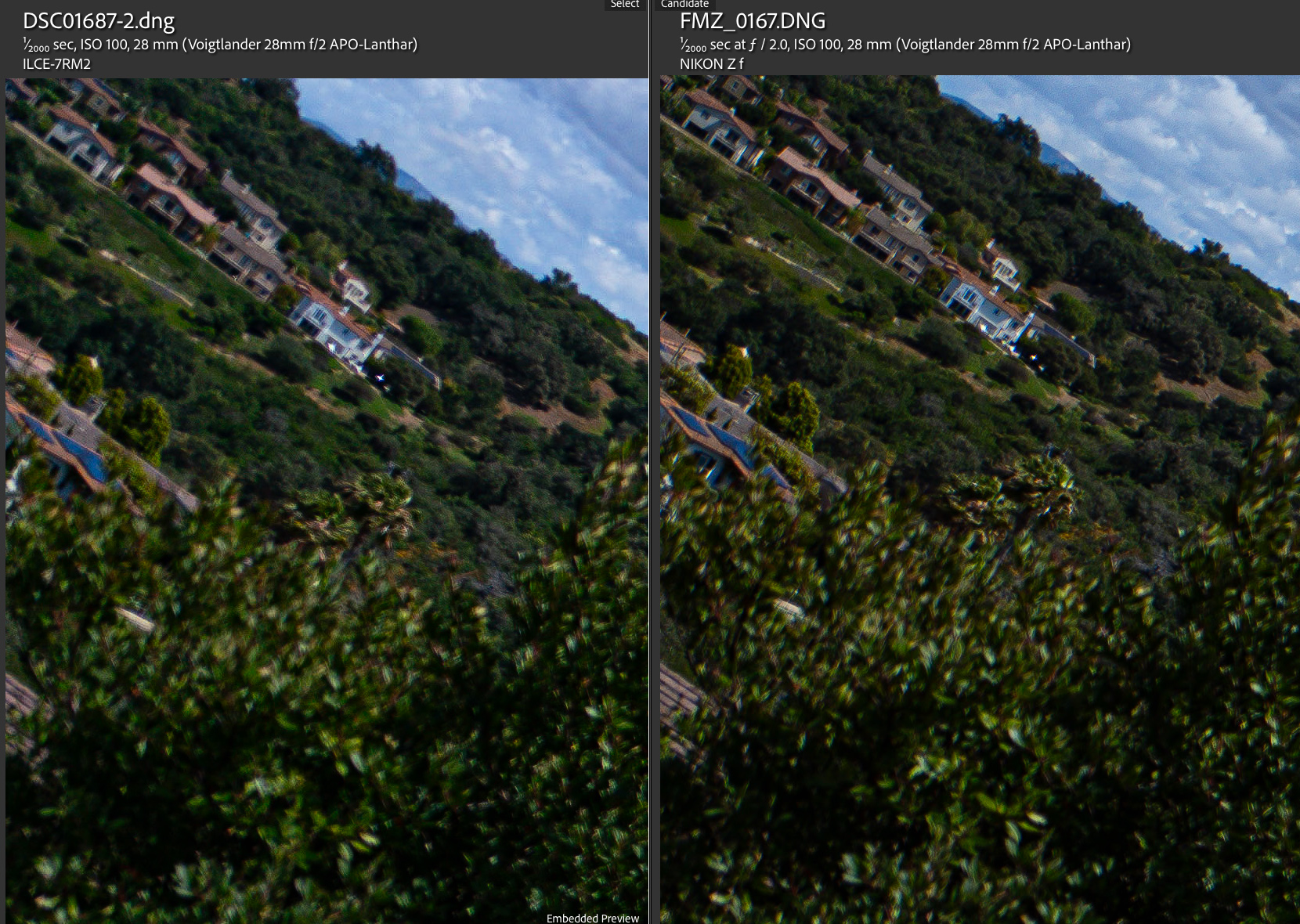
Today I tested the lens on the Nikon Zf, and to my eyes the Nikon sensor handles it noticeably better. As expected, center performance is very similar between systems, and mid-field remains close as well. The main difference shows up in the corners, where Nikon gets much closer to the Leica M performance and flatter field curvature.
At this point, I'd say the Nikon sensor is the better platform for adapting M lenses.
I have noted same with Nikon Z7 and Z8 as I sometimes carry a few M lenses and a Voigtlander close adapter. I dont often use it close in but the adapter works better in my hands than the non adjustable adapter. For reasons I cannot explain I have noted the Z8 is sometimes a better platform than Z7. On the Z7 some lenses fall just short of infinity at hard stop, where it is better on Z8. Closer in it doesn't matter, and I have enjoyed using LLL, ms-optics, voigtlander and leica on the Zs. The Voigtlander noktons and the 21 are particularly nice and as you noted for the 28 apo. The colorskopers also work fine but the fall off is a bit severe for my taste.
May 05, 2026 at 11:35 PM
Steve Spencer Offline • • • • • • • Upload & Sell: On
Fred Miranda wrote: Nikon vs Sony Sensor Stack Impact on Image Quality
Voigtlander 28mm f/2 APO-Lanthar sensor stack comparison: Nikon vs Sony, which adapts this lens better?
It's clear from this review that the Voigtlander 28mm f/2 APO-Lanthar is outstanding from center to corners even wide open on the Leica M. When adapted to Sony, however, there is visible degradation, including increased field curvature and astigmatism.
So how does it perform on Nikon sensor?
Today I tested the lens on the Nikon Zf, and to my eyes the Nikon sensor handles it noticeably better. As expected, center performance is very similar between systems, and mid-field remains close as well. The main difference shows up in the corners, where Nikon gets much closer to the Leica M performance and flatter field curvature.
At this point, I'd say the Nikon sensor is the better platform for adapting M lenses....Show more →
To my eyes there is a very subtle difference in even the midfield with a bit better performance on the Nikon. It seems as you move away from the center the difference in performance on Nikon and Sony gets a little bigger the farther you are from the center, but even in the extreme corners is still pretty small.
In this case, with this lens and its ultra high performance on either of these mounts it would seem that it is worth getting the native mount version to maximize the high performance, for many people at least. With a lesser lens it may well be harder to see the difference between the brands, but I agree that Nikon probably gets you a little better performance. It would take testing to know whether that was visible, even at the pixel level, with any specific lens. Personally, I think the advantage of adapting lenses to Nikon (and Canon) is the focus aids, which I find quite useful, and to me these focus aids make a lot more difference than the slightly better performance, YMMV.
As I suggested for the 35/1.4 Z in that thread, it would be interesting to compare the performance of the Z 28/2 Apo on Zf (or the E 28/2 Apo on Sony) and the VM 28/2 Apo on Leica in order to check how effective is the "tweaking" claimed by the manufacturer.
Ripolini wrote:
As I suggested for the 35/1.4 Z in that thread, it would be interesting to compare the performance of the Z 28/2 Apo on Zf (or the E 28/2 Apo on Sony) and the VM 28/2 Apo on Leica in order to check how effective is the "tweaking" claimed by the manufacturer.
Fred's review of APO-Lanthar 35/2 E-mount and VM showed huge differences in results when using E-mount version on Sony vs. VM version on Sony + the review also covered results of 35/2 APO VM on M10P.
The matching sensor stack + lens combinations (Sony + E-mount 35/2 and Leica + VM 35/2) had excellent corner-to-corner sharpness (including extreme corners) already from f2 in infinity tests, and Sony A7RIV + 35/2 Apo-Lanthar VM reached good extreme corners only by f8. The optical design diagrams of 35/2 Apo-Lanthar VM and E & Z versions look identical, similarly to 28/2 case.
In my experience 28/2 APO-Lanthar E-mount and VM show similar huge differences when both are used on Sony. I traded away my VM as soon as I got the E-mount version though so I can't show any comparison results between those now.
It would be nice if it was demonstrated in the formal review of 28/2 like in the case of 35/2 Apo-Lanthar as well though I guess Fred doesn't have the E-mount or Z-mount versions of the lens currently.
Steve Spencer wrote:
To my eyes there is a very subtle difference in even the midfield with a bit better performance on the Nikon. It seems as you move away from the center the difference in performance on Nikon and Sony gets a little bigger the farther you are from the center, but even in the extreme corners is still pretty small.
In this case, with this lens and its ultra high performance on either of these mounts it would seem that it is worth getting the native mount version to maximize the high performance, for many people at least. With a lesser lens it may well be harder to see the difference between the brands, but I agree that Nikon probably gets you a little better performance. It would take testing to know whether that was visible, even at the pixel level, with any specific lens. Personally, I think the advantage of adapting lenses to Nikon (and Canon) is the focus aids, which I find quite useful, and to me these focus aids make a lot more difference than the slightly better performance, YMMV....Show more →
Yes, I can see a slight advantage in the mid-field even at 24MP. Once this is tested on a 40, 50, or 60MP sensor, the difference should become more noticeable. In some cases the corners may look similar, but the mid-field reveals greater variation since native field curvature plays a major role.
I would say that when using high performing lenses and you need consistency across the frame at wider apertures, going with the native mount makes the most sense. When adapting certain Leica M-lenses, the Nikon sensor generally handles them better than Sony.
I'd also be interested in seeing how E-mount Voigtlander lenses work adapted to Nikon Z (especially given that E-mount has a lot more options than Z does at the moment).
Juha Kannisto wrote:
Fred's review of APO-Lanthar 35/2 E-mount and VM showed huge differences in results when using E-mount version on Sony vs. VM version on Sony + the review also covered results of 35/2 APO VM on M10P.
The matching sensor stack + lens combinations (Sony + E-mount 35/2 and Leica + VM 35/2) had excellent corner-to-corner sharpness (including extreme corners) already from f2 in infinity tests, and Sony A7RIV + 35/2 Apo-Lanthar VM reached good extreme corners only by f8. The optical design diagrams of 35/2 Apo-Lanthar VM and E & Z versions look identical, similarly to 28/2 case.
In my experience 28/2 APO-Lanthar E-mount and VM show similar huge differences when both are used on Sony. I traded away my VM as soon as I got the E-mount version though so I can't show any comparison results between those now.
It would be nice if it was demonstrated in the formal review of 28/2 like in the case of 35/2 Apo-Lanthar as well though I guess Fred doesn't have the E-mount or Z-mount versions of the lens currently.
You should give the Zf a try, Juha. I think it would really suit your style since you mainly shoot manual focus. The focus confirmation alone is a game changer, and the Nikon sensor tends to handle Leica M-mount lenses better. You can also adapt your existing Cosina E mount lenses to Z mount, so there is no need to replace them.