Steve Spencer wrote:
Well, with Sony you either get the rangefinder style body or the high level EVF, but you can't get both. The EV1 provides both a rangefinder style body and a much higher quality EVF than the Sony A7C cameras. You also get the Leica menus, which to me are miles better than Sony menus and personally I would rather have the Leica camera controls than the Sony ones even though the Sony controls have more buttons and more customizability. Personally, I would never pay the price for the Leica EV1, but I do see what I would like about it if I did.
For an EVF camera, however, I don't have Leica, Sony, or Nikon. I am quite happy with the Canon R5 II and its really nice focus aids, fairly small size (very similar to the sony A7r series), quite nice EVF (similar to the EV1) and fast stacked sensor, but that is just me and my preferences....Show more →
I haven't tried the M EV1's EVF yet, but if it delivers a similar experience to the Q3 or SL3 (just with a lower refresh rate) it's in a different league compared to the A7C II or A7CR. The Sony does offer twice the refresh rate, which sounds like an advantage on paper, but in practice it makes little difference for still photography... where it does help is making tracking of moving subjects feel smoother. Beyond that, the A7C II/R also falls a bit short on magnification (0.70x vs 0.76x) and resolution. That said, in my experience, when using magnification as a focus aid, discerning in-focus detail is quite easy even on a smaller, lower-resolution finder.
The day Leica implements focus aids without the need to magnify the image in their EVF cameras, it will get much closer to the rangefinder shooting experience. Canon and Nikon are ahead of the game here.
I've had the M EV1 for a month now, and find the EVF and magnification surprisingly good. The only instance I felt let down was when using a 90mm lens, looking at a magnified view of a flower ; there was a slight breeze, enough for grass and flower to sway side to side; the low refresh rate and lag really hit home in a most dizzying way.
FrozenInTime wrote:
I've had the M EV1 for a month now, and find the EVF and magnification surprisingly good. The only instance I felt let down was when using a 90mm lens, looking at a magnified view of a flower ; there was a slight breeze, enough for grass and flower to sway side to side; the low refresh rate and lag really hit home in a most dizzying way.
I reasonable light I found it easy to achieve accurate focusing even wit fast longish lenses. The hit rate fell off as the light dimmed.
FrozenInTime wrote:
I've had the M EV1 for a month now, and find the EVF and magnification surprisingly good. The only instance I felt let down was when using a 90mm lens, looking at a magnified view of a flower ; there was a slight breeze, enough for grass and flower to sway side to side; the low refresh rate and lag really hit home in a most dizzying way.
In reasonable light I found it easy to achieve accurate focusing even with fast longish lenses. The hit rate fell off as the light dimmed.
Jorge Torralba wrote:
Yes. The sony a7c ii offers exactly what you mention. Similar size to ev1 and offset viewfinder just like the ev1. Just no red dot but same experience. Plus get the right adapter and the Sony will even auto focus those m lenses.
9000.00 vs 2000.00
Lots of new lenses with the leftover 7000.00
There is no justification for the ev1. There really isn't unless it was the only camera that could take the m lenses.
I don't have the a7c ii and have never used it. That said, I currently have the A1 and in the past owned a few other Sony bodies. I have to say that for me, manually focusing a Sony is the most difficult of any camera that I have used, other than older Nikon DSLR bodies. It is so frustrating that I actually sold off all of my manual focus E-mount lenses, although I really loved some of those. I also greatly prefer Leica's menu system.
In the end, people can choose whatever appeals to them for their own reasons, - there is no right or wrong.
Abuttolph wrote:
I currently have the A1 and in the past owned a few other Sony bodies. I have to say that for me, manually focusing a Sony is the most difficult of any camera that I have used, other than older Nikon DSLR bodies. It is so frustrating that I actually sold off all of my manual focus E-mount lenses, although I really loved some of those.
With which EVF cameras (excluding Nikon and Canon models that feature a focus indicator) is manual focusing easier than with your A1, and why?
I have good experience with evf with Thypoch 75mm 1.4... EV1 EVF is much better than Q3 43/SL3-S EVF in low light and I can mf better with EV1+Thypoch 75mm 1.4 in comparison to Q3 43/SL-3S af in same low light... I use the blue color peaking with no magnification per Flash's recommendation... When I read the evf comments online, I was thinking evf was not very good esp for low light... Maybe it is similar to SL2 vs SL3 evf eg worse mf with the newer camera as I don't use them for mf...
1bwana1 wrote:
I reasonable light I found it easy to achieve accurate focusing even wit fast longish lenses. The hit rate fell off as the light dimmed.
EVF usage and its co-factors is one area where it seems fruitless to discuss the matter with your peers, because what your eyes see is (apparently) unlike what anyone else sees. If anyone was to scientifically look into the field, large individual variations would immediately become plain to see.
A related issue came to light reading about lenses with residual SA may not work well on camera focus confirmation systems like Nikon's Zf body.
'Has anyone else noticed that the Nikon Zf focus confirmation seems to be much more reliable with lenses that are well corrected for spherical aberration (SA)? When I adapt lenses with more residual SA, the green focus confirmation still works, but it doesn't seem to be as accurate or consistent.'
You can imagine this finding pushing manufacturers into promoting high levels of 'correction' as a prerequisite for MF focus accuracy. 'Use better lenses!', they can be expected to advise.
What I find on the E EV1 is that for normal view, I don't find the it laggy or slow at all. It's not like you are going to be tracking wildlife with it.
But when you magnify the it does get laggy and slow especially as the light drops. It really is crying out for some kind of focus confirmation, if it had that and a joystick it would be a joy to use. The newer Nikon Z camera really have this manual focus confirmation nailed.
philip_pj wrote:
EVF usage and its co-factors is one area where it seems fruitless to discuss the matter with your peers, because what your eyes see is (apparently) unlike what anyone else sees. If anyone was to scientifically look into the field, large individual variations would immediately become plain to see.
A related issue came to light reading about lenses with residual SA may not work well on camera focus confirmation systems like Nikon's Zf body.
'Has anyone else noticed that the Nikon Zf focus confirmation seems to be much more reliable with lenses that are well corrected for spherical aberration (SA)? When I adapt lenses with more residual SA, the green focus confirmation still works, but it doesn't seem to be as accurate or consistent.'
You can imagine this finding pushing manufacturers into promoting high levels of 'correction' as a prerequisite for MF focus accuracy. 'Use better lenses!', they can be expected to advise. ...Show more →
Yes,
The ZF is probably the best performer when it comes to this. No other camera, even the LS series will do the focus confirmation like nikon does.
However, I left it out of this conversation because it is not a rangefinder style camera but it's actually very similar in size to the ev1 and m11 except for the prism.
Jun 28, 2026 at 06:56 PM
Steve Spencer Offline • • • • • • • Upload & Sell: On
The ZF is probably the best performer when it comes to this. No other camera, even the LS series will do the focus confirmation like nikon does.
However, I left it out of this conversation because it is not a rangefinder style camera but it's actually very similar in size to the ev1 and m11 except for the prism.
Well, actually Canon does focus confirmation at least as well as Nikon, and I actually don't have trouble with the Canon focus aids and my Canon R5 II with my Minolta 58 f/1.2, that has quite a bit of spherical aberration. When focus confirmation missed on the Canon is when it doesn't realize what I want to focus on but about 99 percent of the time it gets it right and eye AF has not missed for me yet.
See this thread for example of the Minolta Rokkor on the Canon R5 II with eye focus manual focus aid:
Steve Spencer wrote:
Well, actually Canon does focus confirmation at least as well as Nikon
Thanks. Can yo elaborate on this? I'm considering a body whose main use will be MF with my old SLR lenses.
I was leaning toward the Z5 II but I would prefer Canon for various reasons.
However, I found a lot of informations on how focusing aids work on the Nikon Zf and others, much less on Canon.
Jun 28, 2026 at 07:59 PM
Steve Spencer Offline • • • • • • • Upload & Sell: On
pmeheut wrote:
Thanks. Can yo elaborate on this? I'm considering a body whose main use will be MF with my old SLR lenses.
I was leaning toward the Z5 II but I would prefer Canon for various reasons.
However, I found a lot of informations on how focusing aids work on the Nikon Zf and others, much less on Canon.
To shoot old SLR lens you need a two adapter solution. An adapter from the SLR mount to Leica M mount and then mount that combination on the Shoten Leica M to Canon RF adapter with electronic contacts. I really like the Shoten adapter. I has a 4mm helicoid to improve close focus capabilities of lenses and it has a simple text file that you can download from the adapter and edit to control the EXIF file and reported focal length to the camera. It allows 10 lenses to be identified in this way. You simply edit the text file and upload it back to the adapter with a chord provided with the adapter and you use the depth of field button to select the particular lens you are using. It all works reasonably well.
Theoretically you could adapt the lens to Canon EF mount and use a chipped adapter and one of the Canon EF to RF adapters, and that ought to work as well but I haven't tried that.
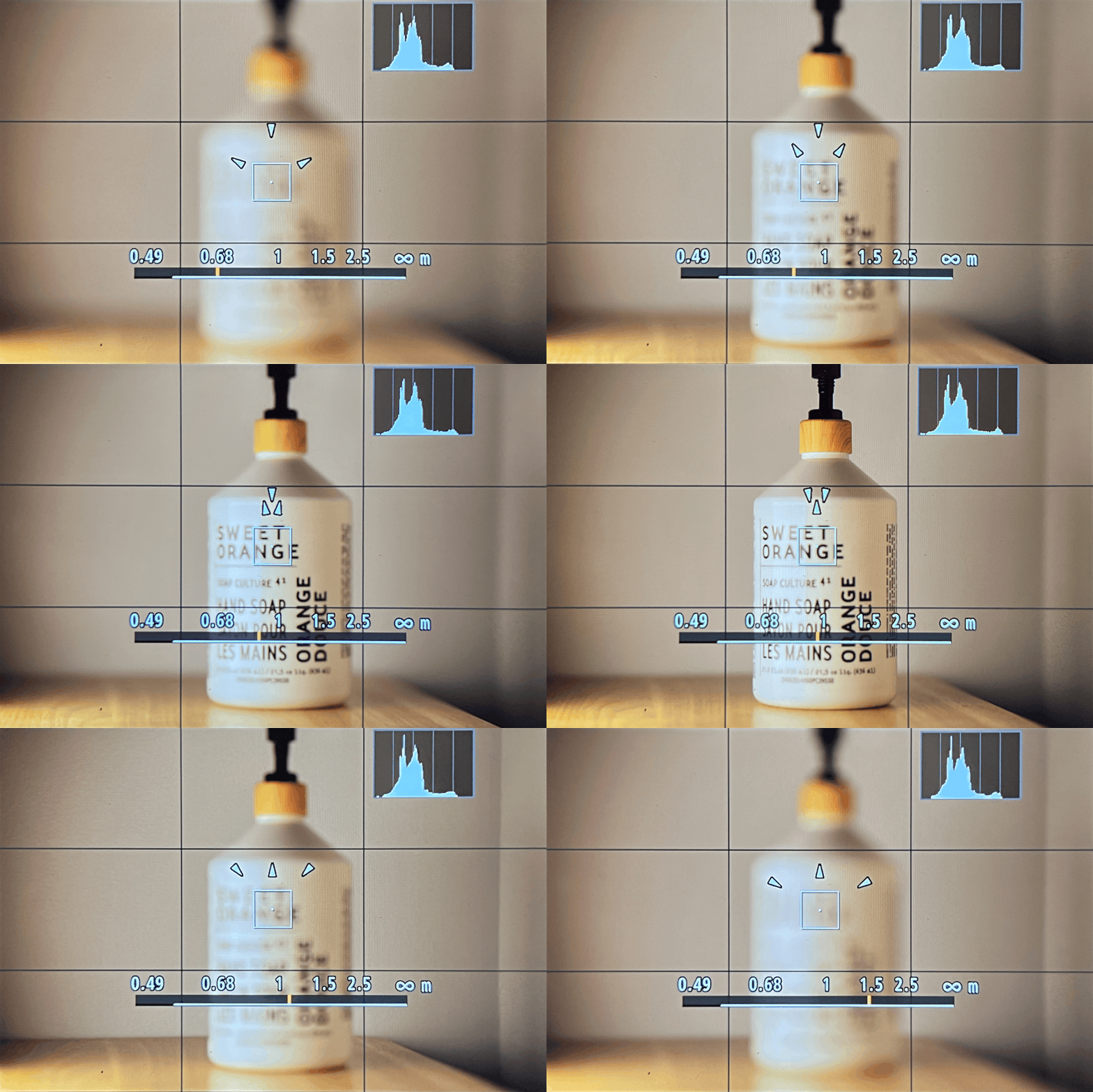
The Canon focus aids are excellent. They show white arrows that tell you the direction of the focus and the arrows converge as you get closer to what the camera judges you want in focus. When the target is judged to be in focus the arrow totally converge and turn green. In addition, if you have AF set to person and eye AF activated the camera will put a green box on the eye of the target if it is in focus and that eye AF is super accurate.
I really like the Canon MF aid and I think it is excellent and as the Canon AF system is excellent it is nice to see it harnessed for manual focus confirmation.
As a Canon user and a Shoten M mount to Canon RF mount chipped adapter user, I agree with Steve. The reason you probably haven't heard much about Canon's manual focus implementation is because most here on FM, and likely also on other platforms, seem to have ignored Canon as a viable system, for various reasons. Yet Canon has very powerful focus capabilities, whether AF or MF.
To refine Steve's description, the arrows are actually three small triangles above the focus point. The center triangle does not move and acts as the point you want the other two triangles to meet for correct focus, similar to old-school match needle metering. When defocus at the point of intended focus is large, the two other triangles are far from the center triangle, one to the left, the other to the right. As defocus decreases and approaches correct focus, the two triangles move closer together until they meet the point of the center triangle and all turn green, along with the focus point/box, as confirmation that correct focus has been achieved. The triangles invert when focus goes past the correct point of focus, which is another visual indicator to help identify whether you are front or back focused. Additionally, there is a focus distance scale below the focus point that indicates focusing distance. When I took the photos in the GIF below, I used a Canon RF lens with full electronic contacts that also reports focusing distance. I'm not sure if the focusing distance scale appears when using an adapted manual focus lens with the Shoten chipped adapter (it has been some time since I have used the adapter and don't remember).
This method of brining the triangles together means it's very easy to see how far focus is from perfect and shares some aspects of the M system's rangefinder patch, in that both will give you a visual representation of how close or far you are from correct focus.
If Leica were to add phase detect pixels to the sensor of the EV2, a variation on Canon's focus assist implementation would be possible and make for a very effective manual focus solution.
Theoretically, adding PD pixels to a future M camera with optical viewfinder would at least allow a basic match needle-like focus confirmation system to be implemented as an alternative focusing solution for those who prefer the OVF experience, but may find the RF patch difficult to see clearly. Yes, for some this would be M system heresy... But I'd welcome it.
Not being a Nikon user, I don't know how similar Nikon's manual focus assist feature is, but given they both use phase detect information off the sensor, both would be very accurate compared to standard focus peaking, which in the past I've found to be too imprecise with exact focus when a lens is stopped down somewhat. The peaking tends to swamp the image and you can't as easily discern where the precise plane of best focus is within the depth of field zone of acceptable focus.
pmeheut wrote:
Thanks. Can yo elaborate on this? I'm considering a body whose main use will be MF with my old SLR lenses.
I was leaning toward the Z5 II but I would prefer Canon for various reasons.
However, I found a lot of informations on how focusing aids work on the Nikon Zf and others, much less on Canon.
Canon's focus confirmation (focus guide) is excellent and was already present on the 2018 Canon EOS R.
Just to be clear though, it normally only works for electronically coupled lenses, in the case of the M to RF Shoten adapter it is the adapter itself that features electronic contacts.
I am not sure whether Shoten adapters for other mounts do the same. I don't believe so, but perhaps somebody can confirm.
I've been running around with one of these for the last few days. I've been trying to evaluate whether I'm going to take one with me to Europe alongside my MP.
Again, I love the weight and form factor, but I found it easier to manually focus M lenses adapted on my Hasselblad than I do here. Peaking function on here is not where it needs to be and the FPS drop on higher magnification is nauseating at some focal lengths.
I think the focus distance scale part will not be present / can't show the actual focus distance with most manual focus lenses on Canon RF and Nikon Z. Cosina Voigtländer and also Zeiss Otus ML RF-mount lenses and Z-mount lenses don't have distance encoders, and same was also true of the older F-mount and EF-mount lenses made by Cosina that include electronic contacts. Zeiss Loxia lenses (probably not made by Cosina) for E-mount also don't include distance encoders.
Cosina includes distance encoders on their E-mount and X-mount lenses, and those are also included in E-mount Zeiss Otus ML lenses. Those will show focus distance info and can support 5-Axis IBIS on cameras that support it.
Electronic adapters would also not be able to support any actual focus distance information if the adapted lenses don't have electronic contacts & provide such info.
Anyhow, I think phase detection based focus aids don't really need focus distance information to work properly.
It would be nice if Sony (I'm primarily a Sony user, secondarily Fuji and Sigma fp) also added support for something like the Canon focus triangles, but focus peaking also has some advantages. For example, no need to have a focusing box anywhere in the frame or to move it to desired position, since peaking can be seen anywhere in the frame all at once, and it's usually not too intrusive (in my opinion) at wider apertures. I usually use selective magnification in addition to peaking only when shooting at relatively stopped down apertures, city scenery or landscapes.
Juha Kannisto wrote:
I think the focus distance scale part will not be present / can't show the actual focus distance with most manual focus lenses on Canon RF and Nikon Z. Cosina Voigtländer and also Zeiss Otus ML RF-mount lenses and Z-mount lenses don't have distance encoders, and same was also true of the older F-mount and EF-mount lenses made by Cosina that include electronic contacts. Zeiss Loxia lenses (probably not made by Cosina) for E-mount also don't include distance encoders.
Cosina includes distance encoders on their E-mount and X-mount lenses, and those are also included in E-mount Zeiss Otus ML lenses. Those will show focus distance info and can support 5-Axis IBIS on cameras that support it.
Electronic adapters would also not be able to support any actual focus distance information if the adapted lenses don't have electronic contacts & provide such info.
Anyhow, I think phase detection based focus aids don't really need focus distance information to work properly.
It would be nice if Sony (I'm primarily a Sony user, secondarily Fuji and Sigma fp) also added support for something like the Canon focus triangles, but focus peaking also has some advantages. For example, no need to have a focusing box anywhere in the frame or to move it to desired position, since peaking can be seen anywhere in the frame all at once, and it's usually not too intrusive (in my opinion) at wider apertures. I usually use selective magnification in addition to peaking only when shooting at relatively stopped down apertures, city scenery or landscapes....Show more →
The focus scale part of the manual aids on the Zf do not work with my TTartisan 6bit encoder since the big Zf firmware update, I think that’s why it’s discontinued, TTartisan don’t want to bother with the updates I believe. I would have to try the new Shoten ones.
But following that, since I was annoyed by that I went back focusing with magnification and peaking and don’t care much now for the Nikon aids.
I still wish Nikon would have made the Zf a true stills camera, with everything you find on a old manual one, a choice of simulated split focusing screens, arrows, the green box and whatever, even the needle if need be, anything that comes to mind, and a sensor with no AA filter, the camera could really be an alternative to any Leica if it were what it looks like.
Nikon made a bold choice at the time, coming up with a retro camera when nobody was asking for it, they were a little scared and made something in between, I wish they had gone all the way.
Regarding Sony, it’s true that the manual experience is bare, I own a Fx2 now and it’s the most enjoyable camera I have owned for that even though, it’s close in fun to my M9. I think it’s marketed in all the wrong ways.
Still I wouldn’t mind they implemented some things more fancy for the manual experience in the firmware.
And I’m a bit annoyed that all the new cool adapters that come to the market have no Sony E versions.


 But I'd welcome it.