Diopter adjustable EVF
IBIS
Dual Cards
Punch in Zoom (without mounting Visoflex) for critical focus
A few things that can make it a nice combo. Yes, it is a bit larger than my M10R. But, it isn't as "odd" as it might seem at first blush. I do have longer glass (500/5.6) in L mount. But, I've got my M 135/3.4 APO and M 75/2.4 (as well as other M lenses) mounted on my SL2-S far more often than on my M10R. Lenses known for their focus shift, play well on the SL, too.
It also makes a companion carry to go with the M or Q and have one body set up for wide / normal and one for longer without a need to change lenses. Granted, I "can" do that with the M, but longer M glass on the SL is (imo) easier to work with sometimes, than on the M ... less effort, of sorts.
I know more than one photographer that primarily uses their SL bodies with M lenses. It works for them.
My primary camera is M lenses on my M11 body using the RF as the main compositional and focus interface. I enjoy it and get results I like.
My most used secondary system is my SL3 with APO-SL primes. It is my primary system for a number of use cases. This gives me the highest image quality of any system I have ever used.
However, not infrequently I find myself blending the systems by adapting M lenses to the SL3 body. When I want a wider point of view than my 28mm APO-SL I use my 21mm SEM. When I want the character of my Summilux lenses but can benefit from IBIS or focus peaking, or the flip screen, the SL3/M combo works extremely well, providing a wonderful experience, solving for situation, and producing excellent results.
I recently did a three day trip to the Barolo are of Italy with my Wife and her Mother. It was Peak Fall colors time. Normally, I would use the Sl3/APO-SL system for this. But this was a family trip primarily so I took only my M11 system to keep things light and small. Still, great results.
While in Bologna recently to preview the M11-EV1 it rained heavily one day. On that day I went street shooting with an SL/28-70 zoom. Absolutely no concerns about the rain damaging the equipment. Rain is such a fantastic street photography opportunity. It provides many special images unavailable in good weather. Again great experience, great results.
The point is that it is nice to have options. The SL and M systems blend so well together that the sum is much better than the parts. About the only use case that this combo doesn't excellent at is flying birds, and fast moving sports.
More than a few have bought Leica SL, SL2, SL3 cameras to use exclusively with their Leica M lenses. Not unusual. There are potential advantages. I suspect some of the same will now consider the traditional rangefinder form factor with built in EVF, the new M EV1 too.
"Leica SL3 with M-mount Lenses: A Review
The Leica SL3 is a full-frame mirrorless camera designed to work seamlessly with Leica’s native L-mount lenses. However, one of its standout features is the ability to adapt Leica M-mount lenses, opening up a world of possibilities for photographers seeking the iconic Leica “look.”
Here’s a review of the SL3, focusing specifically on its performance with M-mount lenses:
-Image Quality: The SL3’s 60-megapixel BSI CMOS sensor delivers exceptional image quality, especially when paired with high-quality M-mount lenses. Sharpness, detail, and color rendition are outstanding, showcasing the true potential of these legendary optics.
-Manual Focus Assist: The SL3 is not just about exceptional image quality; it’s also about empowering photographers. It offers excellent features like focus peaking and magnification, making it a breeze with manual-focus M-mount lenses. The camera’s high-resolution EVF provides a clear view of the subject, aiding precise focusing and giving you complete control over your shots.
-High ISO Performance: One of the SL3’s key advantages is its high ISO performance. This feature allows you to use M-mount lenses even in the most challenging lighting conditions without compromising image quality. It’s a game-changer for photographers who often shoot in low-light environments.
-Build Quality: The SL3 is not just a camera; it’s a reliable companion. Its outstanding build quality, with a robust magnesium alloy body, ensures it can withstand the rigors of everyday use. Its weather sealing provides peace of mind, allowing you to focus on your photography even in inclement weather.
-Ergonomics: The SL3’s ergonomic design makes it comfortable to hold and operate, even with larger M-mount lenses. The controls are well-placed and intuitive, providing quick access to essential settings.
-Fast Aperture Advantage: One of the most compelling features when pairing fast M-mount lenses (e.g., Noctilux or Summilux) with the SL3 is the ability to shoot at incredibly high shutter speeds (up to 1/16000s) even in bright daylight without the need for an ND filter. Shooting at high shutter speeds creates creative possibilities, like using wide apertures for shallow depth-of-field effects in any lighting condition.
-Image Stabilization: The Leica SL3’s robust in-body image stabilization (IBIS) system, capable of compensating for up to 5.5 stops of camera shake, is particularly beneficial when using M-mount lenses. As these lenses traditionally lack stabilization, the SL3’s IBIS enables photographers to capture sharper handheld images in low-light conditions or with slower shutter speeds." – https://www.lpworkshops.com/leica-sl3-m-mount-lenses-review/...Show more →
philip_pj wrote:
One thing (among several) Leica got right was the size and weight differential - at 850 grams the SL3 fades as a harmonious complement to the svelte and light M lenses.
EV1 scales at 495 grams, so the SL3 forces you to carry an impost of 355 grams, or a full 72% more, just for the camera weight budget. That hurts. A vast array of M lenses weigh less that that.
And add 70 grams for a Leica adapter ($480), and your carry delta goes up to 425 grams, not far off a doubling. It might defeat the purpose for small camera/travel users. And it's weight you cannot remove, like a heavy lens after a session. Best to know these things.
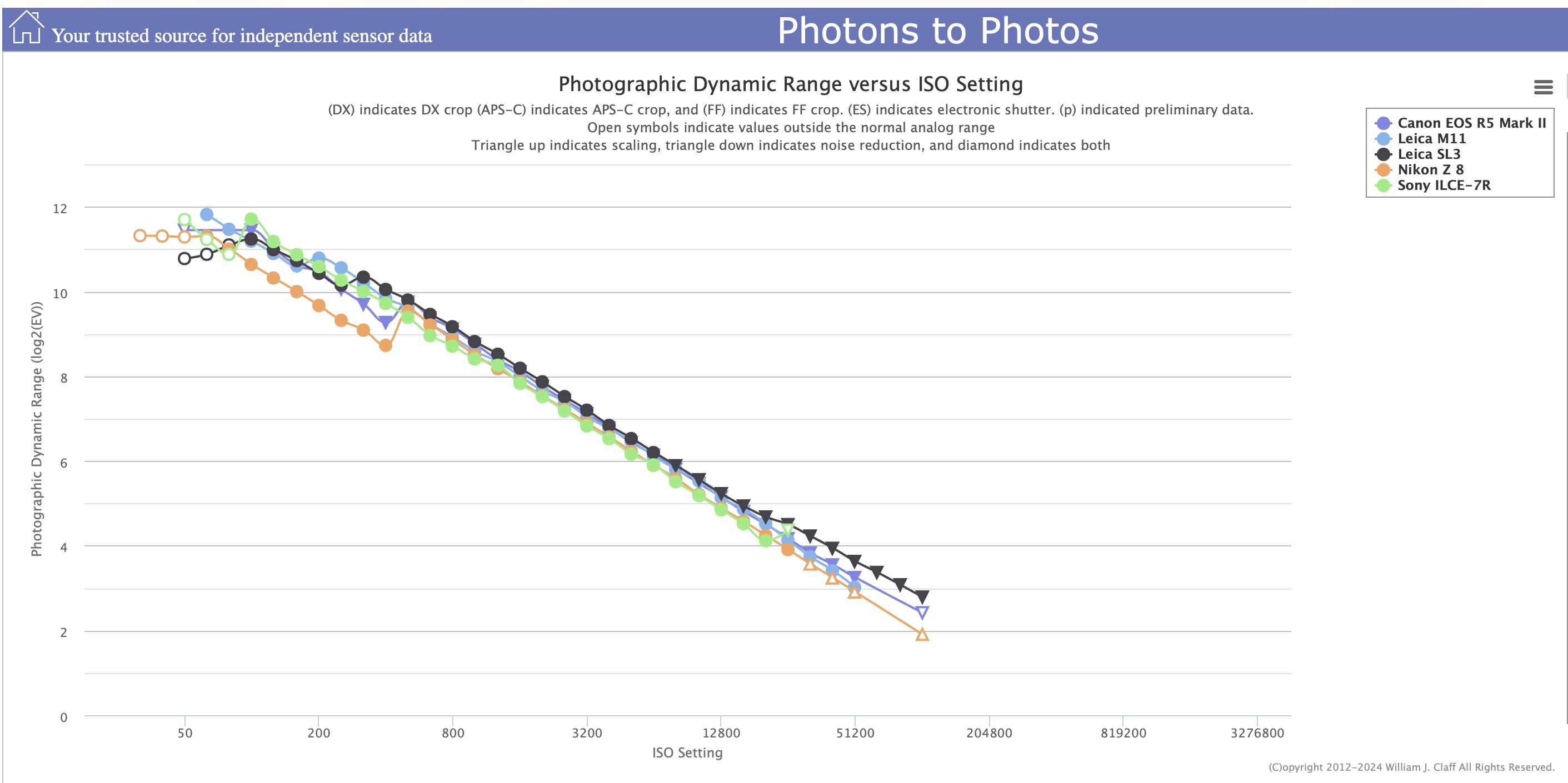
A digital aeon ago, the first Sony a7r has a full half stop of dynamic range over the SL3 (surprised me too) at base ISO, while giving up a measly 0.3 stops at ISO 6400. Body size is also a huge issue for what many of us do. The practicalities matter.
This construction 'is not just about' is a sure tell of AI generated text, which helps explain the flowery prose that follows....Show more →
You wrote: "A digital aeon ago, the first Sony a7r has a full half stop of dynamic range over the SL3 (surprised me too) at base ISO, while giving up a measly 0.3 stops at ISO 6400."
I've filled an HDD or two with A7r photos.
Yes. The original ( 2013) A7r's dynamic range does appear to hold up well compared to many of the newer Sony, Canon, Nikon, Leica FF cameras.
LBJ2 wrote:
"Why did you get the SL3 if you only use M mount lenses?"
Apologies, maybe I didn't understand the question correctly. Also, no idea if the article I posted was AI generated or not. But as an SL owner I felt the points he listed in that article salient even if there were some errors.
No apologies needed! I think it’s just a misunderstanding. I was hoping to hear from the OP as to what his reasons were.
LBJ2 wrote:
You wrote: "A digital aeon ago, the first Sony a7r has a full half stop of dynamic range over the SL3 (surprised me too) at base ISO, while giving up a measly 0.3 stops at ISO 6400."
I've filled an HDD or two with A7r photos.
Yes. The original ( 2013) A7r's dynamic range does appear to hold up well compared to many of the newer Sony, Canon, Nikon, Leica FF cameras.
That was the camera that finally pulled me away from Canon. Back then, the only bodies with that kind of impressive dynamic range were the Nikon D800 and the Sony A7R, since they shared the same sensor.
Fred Miranda wrote:
That was the camera that finally pulled me away from Canon. Back then, the only bodies with that kind of impressive dynamic range were the Nikon D800 and the Sony A7R, since they shared the same sensor.
Same here. In 2014, I left Canon for the Sony A7R. I am still using this camera - it has a fantastic FF sensor. Sony continued developing the A7 series successfully to date - I still like the first gen of these cameras for my usage predominantly with adapted manual focus and some EF lenses. Its EVF is outdated by modern standard, but it still works well enough.
retrofocus wrote:
Same here. In 2014, I left Canon for the Sony A7R. I am still using this camera - it has a fantastic FF sensor. Sony continued developing the A7 series successfully to date - I still like the first gen of these cameras for my usage predominantly with adapted manual focus and some EF lenses. Its EVF is outdated by modern standard, but it still works well enough.
What blows my mind is that the OG A7R was truly ahead of its time. More than ten years of sensor development later, the improvements feel small compared to the leap it represented back then.
I remember comparing the Nikon D800, which used the same sensor as the A7R, against the Canon 5D Mark II. The difference was so dramatic that it honestly shocked me. I chose the A7R over Nikon because I loved Canon glass, especially their TS-E lenses. Canon lenses were easy to adapt to the mirrorless A7R, and I wanted to continue using them. The A7R II was really close to the peak, even by today's sensor standards, and it fixed all the quirks of the original A7R.
Fred Miranda wrote:
What blows my mind is that the OG A7R was truly ahead of its time. More than ten years of sensor development later, the improvements feel small compared to the leap it represented back then.
I remember comparing the Nikon D800, which used the same sensor as the A7R, against the Canon 5D Mark II. The difference was so dramatic that it honestly shocked me. I chose the A7R over Nikon because I loved Canon glass, especially their TS-E lenses. Canon lenses were easy to adapt to the mirrorless A7R, and I wanted to continue using them. The A7R II was really close to the peak, even by today's sensor standards, and it fixed all the quirks of the original A7R.
+1. Same here! The A7R II fixed a few minor issues the original A7R suffered from like shutter lag. But using the appropriate not too long exposure time in some situations avoided it also on the A7R. I personally didn't like the more bulky handgrip added to the A7R II which made me shine away to upgrade. My opinion about the ergonomics between both versions hasn't changed since.
Sony made a sudden quantum leap with the first FF-based MLC system in 2013 and caused shockwaves at other camera brands. Canon lost some camera sales because of it for sure - and it forced Canon to finally get first the 5DsR out (much too late for the market unfortunately) followed by their first FF MLC attempts.
It was also the reason why I used for many years M-lenses only attached to my A7R before even getting my first digital Leica M camera in 2019. I am one of the more rare Leica users which didn't find the entry to Leica through the camera but via M lenses first. Maybe this is the reason why I am not so fixated on the rangefinder itself even I like it for manual focusing
Sony envisioned a Leica style camera in the - 465 grams! - a7r, complete with top panel shutter release, and spare design. Mine is my main camera, and after 13 years (I bought in real early) l want another one, but unabused low shot count ones will be hard to find.
The shutter never bothered me, it appears very strong and the report lets subjects know when you have taken the shot. It's old-fashioned! Sony made a mistake by not repurposing the sensor which had just a little AF on it. That sensor (D800 too) was the fulcrum upon which the mass market shifted its axis. Remember all the 'what lenses will work on 36mp' questions?
'The original Sony a7R has an electronic viewfinder (EVF) with a resolution of 2.4 million dots, a magnification of 0.71x, and 100% field coverage.'
'The Sony a7CR's Electronic Viewfinder (EVF) has a resolution of 2.36 million dots, a 0.70x magnification, and 100% frame coverage.'
'Sony Alpha a7CR is 32% (15.2 mm) thicker than Sony A7R.
Sony Alpha a7CR [515 g] weights 11% (50 grams) more than Sony A7R [465 g]' (plus ca change)
An interesting point is that the sensor (made by Sony) made its debut in the D800 well before its use in the A7R. (March 2012 for the D800 vs Oct 2013 for the A7R)
And yes the D800 made a huge impact. Everyone was doing those tests with lifting the shadows to show the impressive DR.
I think Sony saw with the D800 that there was a large market for that sensor, and so they released the A7R.
I do agree that since then, sensor tech has kind of plateaued, at least in terms of IQ. All else has been iterative improvement. There is nothing wrong with that, and in fact, it's more the norm and is also important. A lot of iterative improvements adds up.
In biology there is a term called punctuated equilibrium, which means that things kind of go along in an equilibrium state for a while, with smaller improvements, that are then periodically punctuated by some big changes. Tech tends to work the same way IMHO.
There was the stacked sensor in the A9 that I believe was the next big breakthrough for sensors.
quantumloop wrote:
An interesting point is that the sensor (made by Sony) made its debut in the D800 well before its use in the A7R. (March 2012 for the D800 vs Oct 2013 for the A7R)
And yes the D800 made a huge impact. Everyone was doing those tests with lifting the shadows to show the impressive DR.
I think Sony saw with the D800 that there was a large market for that sensor, and so they released the A7R.
I do agree that since then, sensor tech has kind of plateaued, at least in terms of IQ. All else has been iterative improvement. There is nothing wrong with that, and in fact, it's more the norm and is also important. A lot of iterative improvements adds up.
In biology there is a term called punctuated equilibrium, which means that things kind of go along in an equilibrium state for a while, with smaller improvements, that are then periodically punctuated by some big changes. Tech tends to work the same way IMHO.
There was the stacked sensor in the A9 that I believe was the next big breakthrough for sensors.
+1. I thought for a while that the next big thing regarding sensors is the one in FF where depth-of-field information is recorded and the focus can be adjusted later in PP throughout the image. The technology existed on small cellphone sensors and was developed by a small startup named LinX Imaging which was later purchased by Apple. Unfortunately, this technology never made it into professional cameras and larger sensors to date. We only see it known as portrait mode on Apple Smartphones.
philip_pj wrote:
Sony envisioned a Leica style camera in the - 465 grams! - a7r, complete with top panel shutter release, and spare design. Mine is my main camera, and after 13 years (I bought in real early) l want another one, but unabused low shot count ones will be hard to find.
The shutter never bothered me, it appears very strong and the report lets subjects know when you have taken the shot. It's old-fashioned! Sony made a mistake by not repurposing the sensor which had just a little AF on it. That sensor (D800 too) was the fulcrum upon which the mass market shifted its axis. Remember all the 'what lenses will work on 36mp' questions?
'The original Sony a7R has an electronic viewfinder (EVF) with a resolution of 2.4 million dots, a magnification of 0.71x, and 100% field coverage.'
'The Sony a7CR's Electronic Viewfinder (EVF) has a resolution of 2.36 million dots, a 0.70x magnification, and 100% frame coverage.'
'Sony Alpha a7CR is 32% (15.2 mm) thicker than Sony A7R.
Sony Alpha a7CR [515 g] weights 11% (50 grams) more than Sony A7R [465 g]' (plus ca change)...Show more →
Thanks for comparing this - I was unaware that my old A7R EVF is still comparable with more modern A7 based cameras!
Sony targeted especially Canon at the time to move customers. This was another smart Sony move, because they knew that many vested Canon EF users were stuck with limited Canon FF sensor resolution and DR at the time and jealously looked at the D850. But switching from one lens environment to another was costly and tedious. Sony saw the niche and offered a solution with the A7R using this higher resolving sensor with much more DR and allowing Canon users to use their EF lenses with adapter which worked flawlessly if AF wasn't as important (in this case Canon offered the 5D MkIII anyway for better AF performance). Sony pushed this openly by even adding a free Metabones EF/E-mount adapter to their A7 cameras in Australia (unfortunately they never did this in the US).
I also remember reading in 2013 that after the A7 series release Leica had emergency meetings in Wetzlar because they also felt threatened first by this innovative and capable camera series. IMO what saved Leica's camera sales were two things: different and unique rangefinder focusing system plus that wider M lenses caused issues in the corners with the thicker Sony sensor cover glass. If Sony really wanted to go after Leica - likely the M-lens market was too small of a niche for Sony to really consider - they would have made a thinner cover glass. But Sony's focus was and remained on adapting (D)SLR glass especially before Sony/Zeiss lenses hit the market with quite some delay in a larger variety followed by other E-mount lens makers.
Leica stayed its course as we know and added the mirrorless SL series a couple years later, but other established camera brands also changed gears after 2013 and put resources in to develop their own FF-based MLC systems which have replaced now their DSLR lines. Without Sony and its A7 series push, this development would have taken much longer for sure - probably > 10 years.
Always to my big surprise the main potential biggest competitor with Sony in the FF MLC market stayed away from even trying to get in there - Fuji. They theoretically had all ready to go since they were already in cropped sensor MLC systems. It still remains a mystery why they let Sony covering this whole FF MLC niche for many years - maybe they didn't see it as such a big success in the beginning and underestimated it until it was too late to compete. Another theory is that Fuji had an agreement with Sony to split the market between them in FF and cropped MLCs, but this is unproven.
RustyRus wrote:
I can't even pretend to be excited- Hard Pass
At least try one so you understand the current baseline. I will not be surprised if for a time the M EV(x) line iterates faster than other Leica bodies and we see some new features in it first. Of all current Leica offerings it has the most potential to bring new users to Leica.
stgrove wrote:
So who will order an EV1 sold in the US come Monday?
To me this is pretty interesting camera (at least in theory) that could replace my Kolari-modded Sony. Of course it is significantly more expensive, but that is a bit like the GFX vs Hasselblad debate.
I just have a hard time accepting that it would cost more than an SL3.
retrofocus wrote:
+1. I thought for a while that the next big thing regarding sensors is the one in FF where depth-of-field information is recorded and the focus can be adjusted later in PP throughout the image. The technology existed on small cellphone sensors and was developed by a small startup named LinX Imaging which was later purchased by Apple. Unfortunately, this technology never made it into professional cameras and larger sensors to date. We only see it known as portrait mode on Apple Smartphones.
Yes - this is the one I wanted to refer to but didn't come up with its name. They marketed the Lytro for a very short time, and the cool idea behind it never made it into larger sensor formats unfortunately. Google purchased this one!