Cosina might be moving to a new business model, where they intend to increase their off-brand production more quickly as the expand their portfolios in those directions, 'off-brand' meaning non M-mount lenses in this context. Other things point that way, like the very different livery - lens casings, rings, dimensions.
They might prefer to keep the lens performance across mounts more separate as well, to encourage custom buying rather than portability across systems. We don't know the extent to which any compromises were built into their lens designs to make their lenses more functional on non M-mount cameras.
They would see what we are seeing here. The 90AA works as it should into the very far left-top region above - the Sony crop might even beat the M crop a little. It conforms to the time-honored rule of thumb that - over 50mm - M-mount lenses should be acceptable on E-mounts cameras enough to satisfy the modal Sony user interested in such lenses. thanks again for this work, really valuable.
Can't help but think that doing without aspherical element surfacing might cost them an extent of telecentricity in outer frames, which shows up differentially in 'problem' sensors that are more demanding in this respect.
Canon, Sony and others are moving ahead quickly with light-bending (as well as mind-bending) shapes in (particularly) rear element groups, to match their mount idiosyncracies (widths and FFDs).
What percentage of lens sales volumes and profit do Cosina make from VM lenses, and how much from other full-frame mount lenses? It might be 90/10, but that might be changing too.
Jan 23, 2025 at 05:54 PM
Steve Spencer Offline • • • • • • • Upload & Sell: Off
Fred Miranda wrote:
I found the result puzzling, though not too disappointing, considering the lens was designed for a different sensor stack. Fortunately, the performance degradation on the Sony sensor is confined to the extreme corners. In the center and mid-field (where it matters for most shooting) the performance is very similar.
The result isn't influenced by the adapter used, as long as it’s an optimal one. I used my reliable Voigtlander M to E adapter (v2) for this test.
Although I would definitely prefer the lens' performance extended into the corners on a Sony sensor, personally I wouldn't be too worried about having to stop down to f/5.6 for infinity landscapes shots. I rarely shoot landscape at wider apertures and I rarely have anything I care about in the extreme corners so it is really rare to have both of. these rare events happen at the same time. I also often shoot my 90mm lens in my MF kit in APS-C crop to get a bit more reach and this lens will have zero issues cropped to APS-C as well. You put those things together and I think the lens could be quite useful even on a camera with a Sony sensor. I actually worry about the field curvature affecting shorter focus distance shots like portraits a lot more. One of the virtues of the lens on Leica M is how flat field it is. That doesn't appear to be so on Sony. Fred is there any chance you could shoot one of your field curvature GIFs of this lens on Sony? I wonder what the field curvature will be like at different focus distances.
philip_pj wrote:
...
What percentage of lens sales volumes and profit do Cosina make from VM lenses, and how much from other full-frame mount lenses? It might be 90/10, but that might be changing too.
I think their mirrorless system lenses are selling decently at least in Japan and put together are probably exceeding VM sales. To get some numbers, I looked at Japanese price ranking site kakaku.com's listings. I checked how many lenses by Cosina Voigtländer were in top 500 popularity rankings among all lenses, how those were distributed between different mounts and what the average prices were for each mount. These are the results based on today's data:
VM: 17 lenses in top 500. Average price: 74605 JPY.
Sony E: 8 lenses in top 500. Average price: 100236 JPY.
Nikon Z FF: 7 lenses in top 500. Average price: 123443 JPY.
Fuji X APS-C: 7 lenses in top 500. Average price: 66413 JPY.
Nikon F FF: 6 lenses in top 500. Average price: 51206 JPY.
Canon RF: 1 lens in top 500. Average price: 96600 JPY.
Nikon Z APS-C: 1 lens in top 500. Average price: 62170 JPY.
Micro 4/3: 0 lenses in top 500.
I think higher average prices would have some correlation with higher profit per lens. Overall I think the non-VM FF lenses could exceed the VM lenses in totals especially if Nikon F is counted in too.
Fred Miranda wrote:
I found the result puzzling, though not too disappointing, considering the lens was designed for a different sensor stack. Fortunately, the performance degradation on the Sony sensor is confined to the extreme corners. In the center and mid-field (where it matters for most shooting) the performance is very similar.
It will be interesting to test a future E-mount version on the same body (A7R II) in order to understand the effectiveness of Cosina claims ("optical design optimized for Sony E-mount sensors").
philip_pj wrote:
moving ahead quickly with light-bending (as well as mind-bending) shapes in (particularly) rear element groups, to match their mount idiosyncracies (widths and FFDs).
Distortion inducing ... then computationally "corrected"
Steve Spencer wrote:
Although I would definitely prefer the lens' performance extended into the corners on a Sony sensor, personally I wouldn't be too worried about having to stop down to f/5.6 for infinity landscapes shots. I rarely shoot landscape at wider apertures and I rarely have anything I care about in the extreme corners so it is really rare to have both of. these rare events happen at the same time. I also often shoot my 90mm lens in my MF kit in APS-C crop to get a bit more reach and this lens will have zero issues cropped to APS-C as well. You put those things together and I think the lens could be quite useful even on a camera with a Sony sensor. I actually worry about the field curvature affecting shorter focus distance shots like portraits a lot more. One of the virtues of the lens on Leica M is how flat field it is. That doesn't appear to be so on Sony. Fred is there any chance you could shoot one of your field curvature GIFs of this lens on Sony? I wonder what the field curvature will be like at different focus distances....Show more →
But f/5.6 on the Sony sensor in the corners looked pretty bad to me. Even f/8 didn't look optimal.
@Fred_Miranda, if you still have your SL2, it might be interesting to see if it does any better.
highdesertmesa wrote:
But f/5.6 on the Sony sensor in the corners looked pretty bad to me. Even f/8 didn't look optimal.
@Fred_Miranda, if you still have your SL2, it might be interesting to see if it does any better.
---------------------------------------------
RustyBug wrote:
I would expect to see the SL2 to be very close (if not identical) to the M in terms of optics.
Sensor / processing might be different, etc. but optically they shouldn't be different (imo) by anything of significance.
Unfortunately, I no longer shoot with the SL2, so I can't test this at the moment. However, I've tested multiple Leica and Voigtlander M lenses on the SL2 in the past, comparing them to their performance on the M. Most of the time, the lenses performed very well on the SL2's sensor (way better than they did on Sony's), but they never fully matched the optimal performance seen on the Leica M sensor ... so the results weren't identical.
The exceptions were lenses that also perform well on Sony bodies, like telephoto lenses such as the Leica 90/2 AA and slower lenses. Based on my previous experience, I'd guess the Voigtlander 90mm f/2 APO-Ultron will perform better on the SL2 than on Sony, but not as perfectly as it does on the M.
For those curious, the Voigtlander 90mm f/2 APO-Ultron performs just as well on my Sony A7CR UT as it does on the Leica M, delivering very sharp corners even wide open. This applies to any Sony "UT" modded camera, but so far, I've only used an A7CR UT, which offers sensor stack compatibility comparable to the M11.
Just as I remembered from testing years ago, the Leica APO-Summicron 90mm f/2 ASPH has no issues with the Sony sensor stack. I tested it again just now, and here are 100% (pixel-level) comparisons of the extreme corners on both Leica and Sony sensors. I'd say the Leica performs beautifully on the Sony sensor stack wide open without any noticeable penalty.
PS: Don’t worry too much about color, temperature, or tint...these are different sensors. I could have matched the colors exactly, but that wasn’t the focus here.
Thanks for this comparison, Fred.
I notice that the tagging (in the top of the images) says it's the Apo-Ultron in both frames, but these images are (supposed to be) with the Apo-Summicron-M. If possible, I suggest correcting the tags.
I notice that the tagging (in the top of the images) says it's the Apo-Ultron in both frames, but these images are (supposed to be) with the Apo-Summicron-M. If possible, I suggest correcting the tags.
Thanks! Well, that's a mistake on my part. I used Lenstagger to clarify things, but it actually ended up being more confusing.
Jan 24, 2025 at 01:13 PM
Steve Spencer Offline • • • • • • • Upload & Sell: Off
highdesertmesa wrote:
But f/5.6 on the Sony sensor in the corners looked pretty bad to me. Even f/8 didn't look optimal.
@Fred_Miranda, if you still have your SL2, it might be interesting to see if it does any better.
Three things, first it only looks bad compared to the better performance of the lens on Leica M. IMO, it does not look bad in an absolute sense and it is quite good compared to some other lenses I have used and liked for landscapes (e.g., the CV E-mount 40 f/1.2 or Leica M 50 lux Asph).
Second, corners, IMO, need to be kept in context. Personally I almost always crop to a 4 X 3 aspect ratio. In fact, my default file with my Sony A7r V is 4 X 3, which makes this small area in the far corners in which I almost never put anything meaningful even smaller. Further if I really need the corners to be great, it is a pretty minimal crop to get rid of the small area with the reduced performance. All I am saying is there are multiple ways that the weaker performance that Fred notes won't matter much or can be mitigated. If there is nothing meaningful in the corners as is typical for my landscape then it mostly won't matter. Stopping down mitigates the worst of it. Cropping to 4 X 3 mitigates most of it. Cropping just a bit more probably to something like a 105mm perspective which will still leave 40 MP on my A7r V will probably not only mitigate the weakness in corner sharpness but totally eliminate it. Yeah, it is ugly but for my use of the lens I am pretty sure I could work around it 99% of the time.
Third, given the pattern of field curvature if you really did care about the corners then you might be able to balance the center performance and corners a bit by focussing more for the corners. The lens is so good in the center and mid frame that if you lost just a tiny bit of sharpness there to improve the corners the images would probably still be excellent (as opposed to phenomenal) in the center and mid frame and a bit better in the corners when shot at f/5.6.
Doesn't mean that it isn't still disappointing and it also doesn't mean that the issue causing it (astigmatism and field curvature won't matter for other types of shooting). Fred's tests actually have me a lot more worried about the lens for portraits than they do about the lens for landscapes. Personally, weakness in the corners is not a central concern for me with landscapes. I worry much more about weakness in the mid frame and even resistance to flare than corners that are just ok at f/5.6.
None of that means I don't want the lens in Sony E-mount to avoid that field curvature and astigmatism. I do and definitely hope Cosina creates a version designed to be unaffected by the thicker Sony cover glass.
Steve Spencer wrote:
Three things, first it only looks bad compared to the better performance of the lens on Leica M. IMO, it does not look bad in an absolute sense and it is quite good compared to some other lenses I have used and liked for landscapes (e.g., the CV E-mount 40 f/1.2 or Leica M 50 lux Asph).
Second, corners, IMO, need to be kept in context. Personally I almost always crop to a 4 X 3 aspect ratio. In fact, my default file with my Sony A7r V is 4 X 3, which makes this small area in the far corners in which I almost never put anything meaningful even smaller. Further if I really need the corners to be great, it is a pretty minimal crop to get rid of the small area with the reduced performance. All I am saying is there are multiple ways that the weaker performance that Fred notes won't matter much or can be mitigated. If there is nothing meaningful in the corners as is typical for my landscape then it mostly won't matter. Stopping down mitigates the worst of it. Cropping to 4 X 3 mitigates most of it. Cropping just a bit more probably to something like a 105mm perspective which will still leave 40 MP on my A7r V will probably not only mitigate the weakness in corner sharpness but totally eliminate it. Yeah, it is ugly but for my use of the lens I am pretty sure I could work around it 99% of the time.
Third, given the pattern of field curvature if you really did care about the corners then you might be able to balance the center performance and corners a bit by focussing more for the corners. The lens is so good in the center and mid frame that if you lost just a tiny bit of sharpness there to improve the corners the images would probably still be excellent (as opposed to phenomenal) in the center and mid frame and a bit better in the corners when shot at f/5.6.
Doesn't mean that it isn't still disappointing and it also doesn't mean that the issue causing it (astigmatism and field curvature won't matter for other types of shooting). Fred's tests actually have me a lot more worried about the lens for portraits than they do about the lens for landscapes. Personally, weakness in the corners is not a central concern for me with landscapes. I worry much more about weakness in the mid frame and even resistance to flare than corners that are just ok at f/5.6.
None of that means I don't want the lens in Sony E-mount to avoid that field curvature and astigmatism. I do and definitely hope Cosina creates a version designed to be unaffected by the thicker Sony cover glass....Show more →
Cropping to 4:3 helps even on an M body with a lot of M lenses. There are a few M lenses I’ve had that perform poorly enough in the corners at infinity (uncropped 3:2) that they almost cover like an APS-C lens.
Agree with Steve here. Other factors enter the picture, like multi-mount use and exactly what you use this one for, future plans etc. It looks this way because the middle is very solid. It's pretty decent even at f2 in the midfield, and fade character will be pretty good for full images where it is likely to be used (subject, focus distance, aperture, detail lost in vignette).
'90mm f/2 APO-Ultron performs just as well on my Sony A7CR UT as it does on the Leica M'
Frankly, I'm very surprised how great the Sony sensors work with the UT conversion, so thank you again.
philip_pj wrote:
Agree with Steve here. Other factors enter the picture, like multi-mount use and exactly what you use this one for, future plans etc. It looks this way because the middle is very solid. It's pretty decent even at f2 in the midfield, and fade character will be pretty good for full images where it is likely to be used (subject, focus distance, aperture, detail lost in vignette).
'90mm f/2 APO-Ultron performs just as well on my Sony A7CR UT as it does on the Leica M'
Frankly, I'm very surprised how great the Sony sensors work with the UT conversion, so thank you again. ...Show more →
The same applies to my Nikon Z6 converted with Ultra-Thin sensor glass by Kolari Vision.
The Voigtlander 90mm f/2 APO-Ultron features a relatively narrow exit pupil diameter, which contributes to increased optical vignetting depending on its position within the optical path. This occurs because the narrower exit pupil restricts off-axis light rays, causing them to strike the sensor at steeper angles..
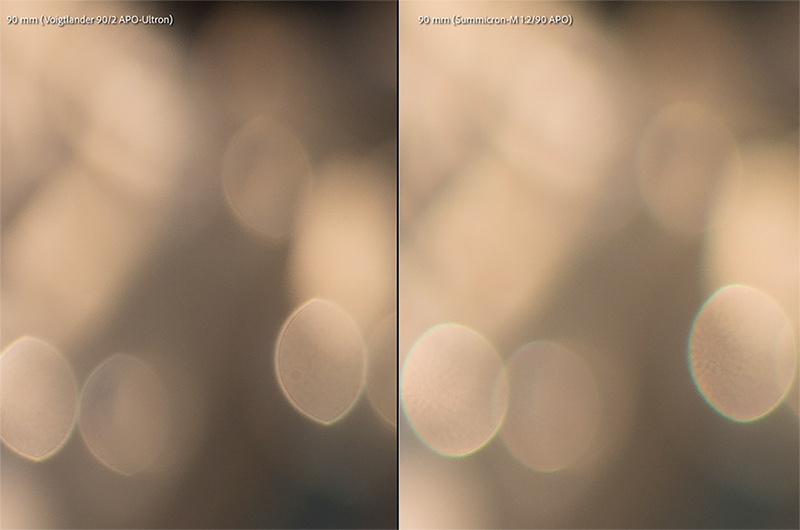
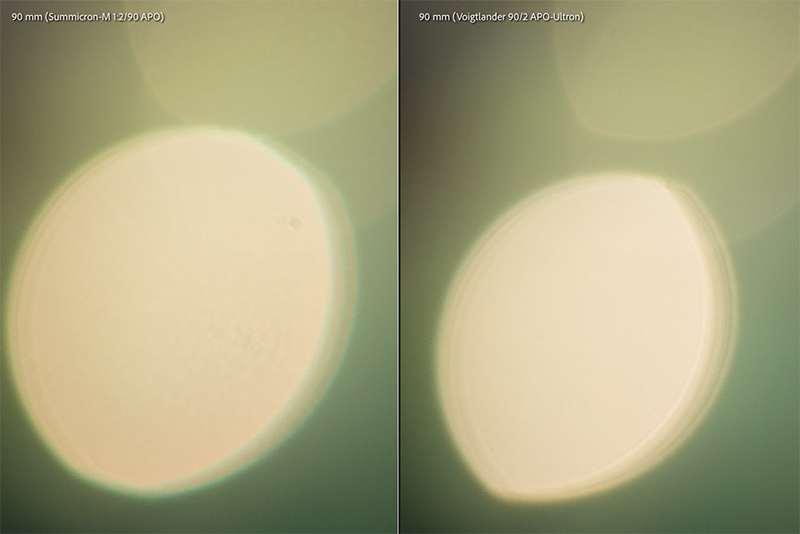
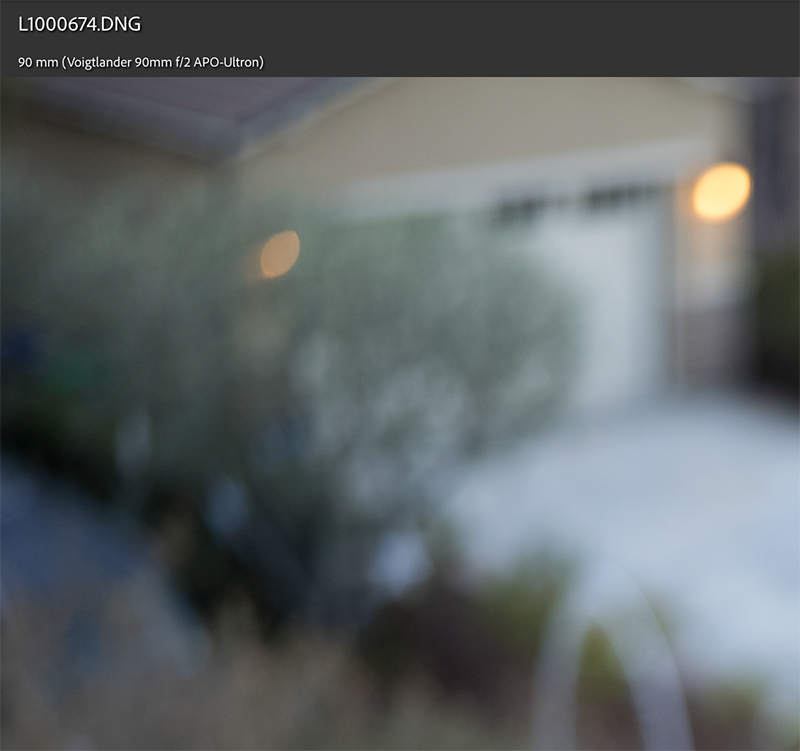
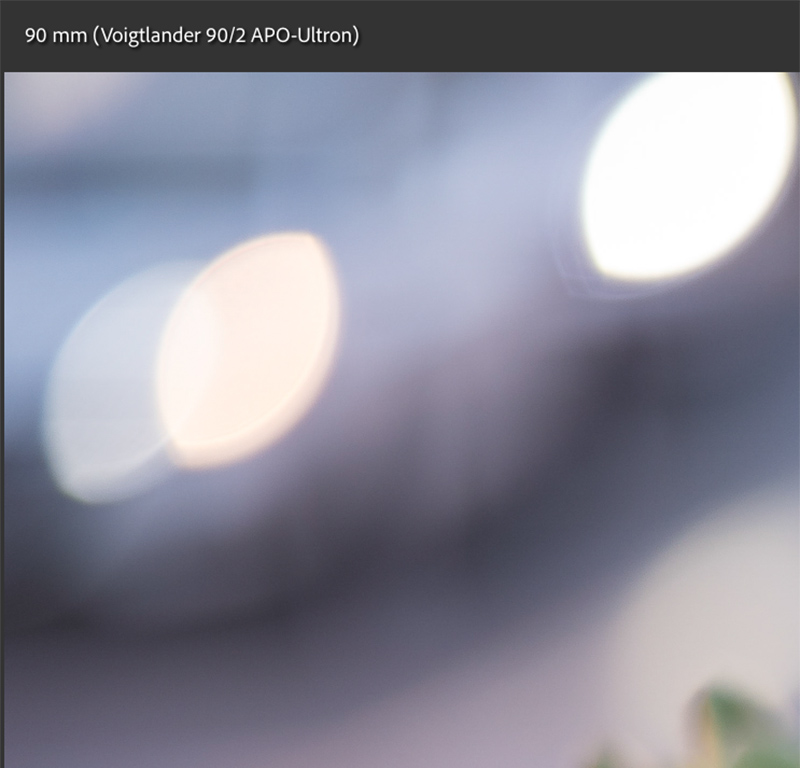
Higher optical vignetting not only results in darker corners with slight less blur off-axis but also produces cat’s-eye-shaped specular highlights, where the bokeh balls becomes elongated toward the corners. Depending on the subject distance, this can increase the likelihood of a swirling effect in the background.
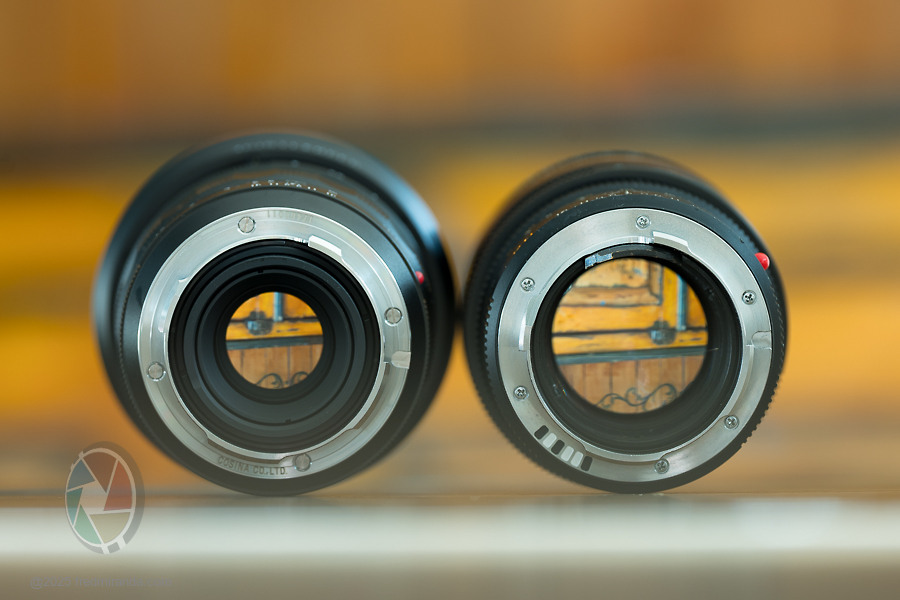
This comparison image shows the exit pupils of the Leica 90mm f/2 APO and the Voigtlander 90mm f/2 APO. The Leica’s wider exit pupil significantly reduces optical vignetting, as evident in the rendering tests shared in this review.
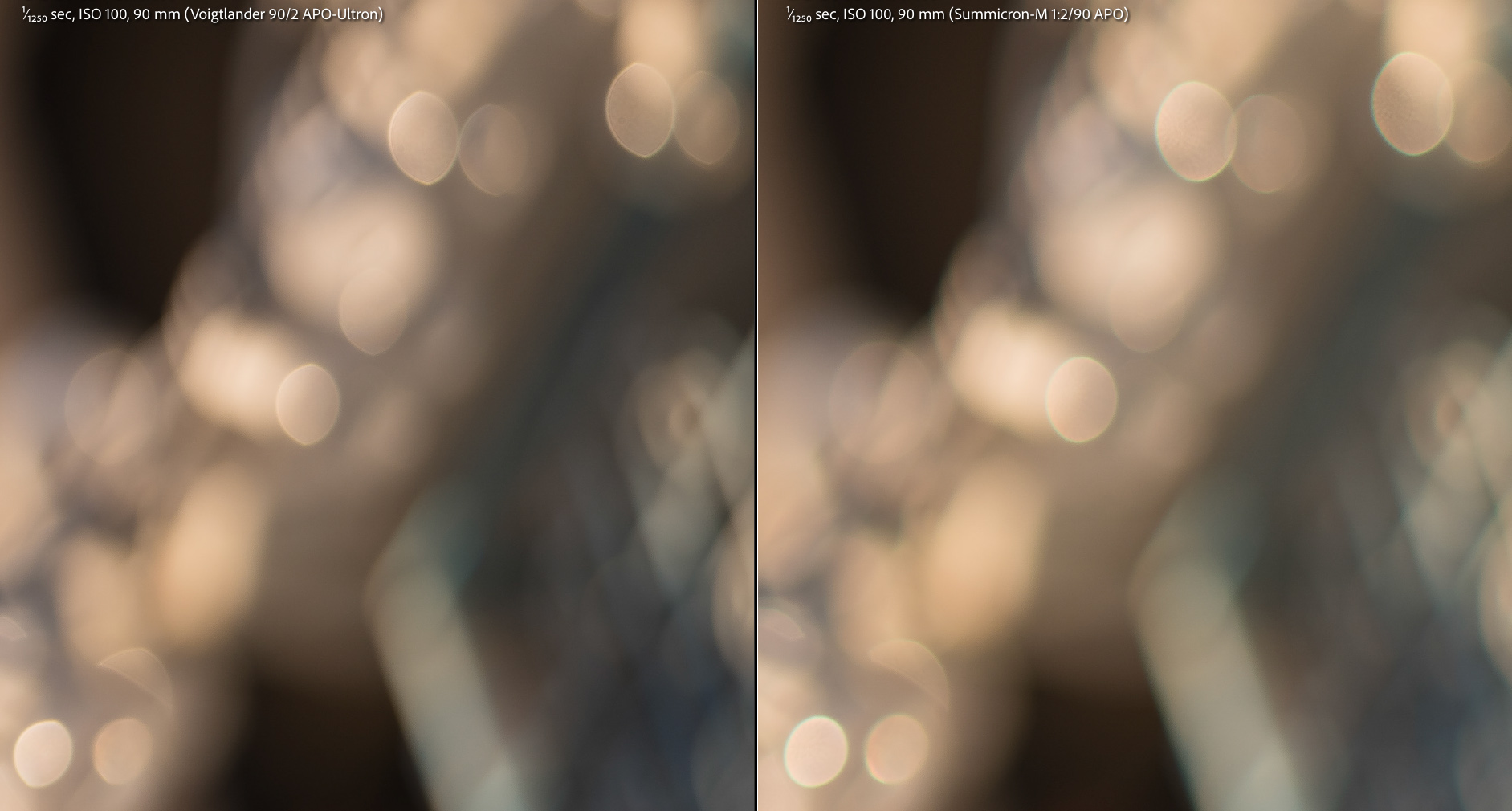
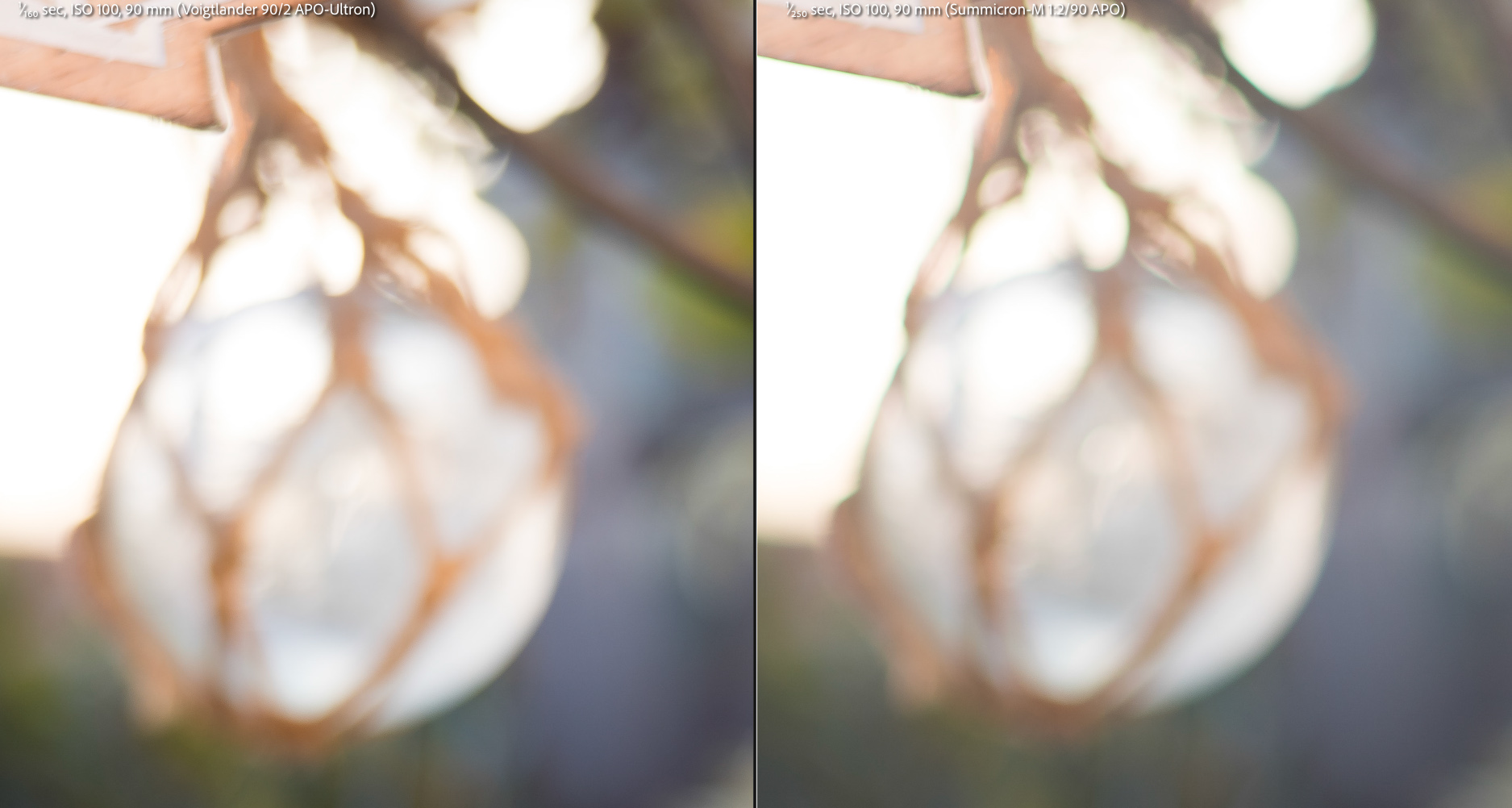
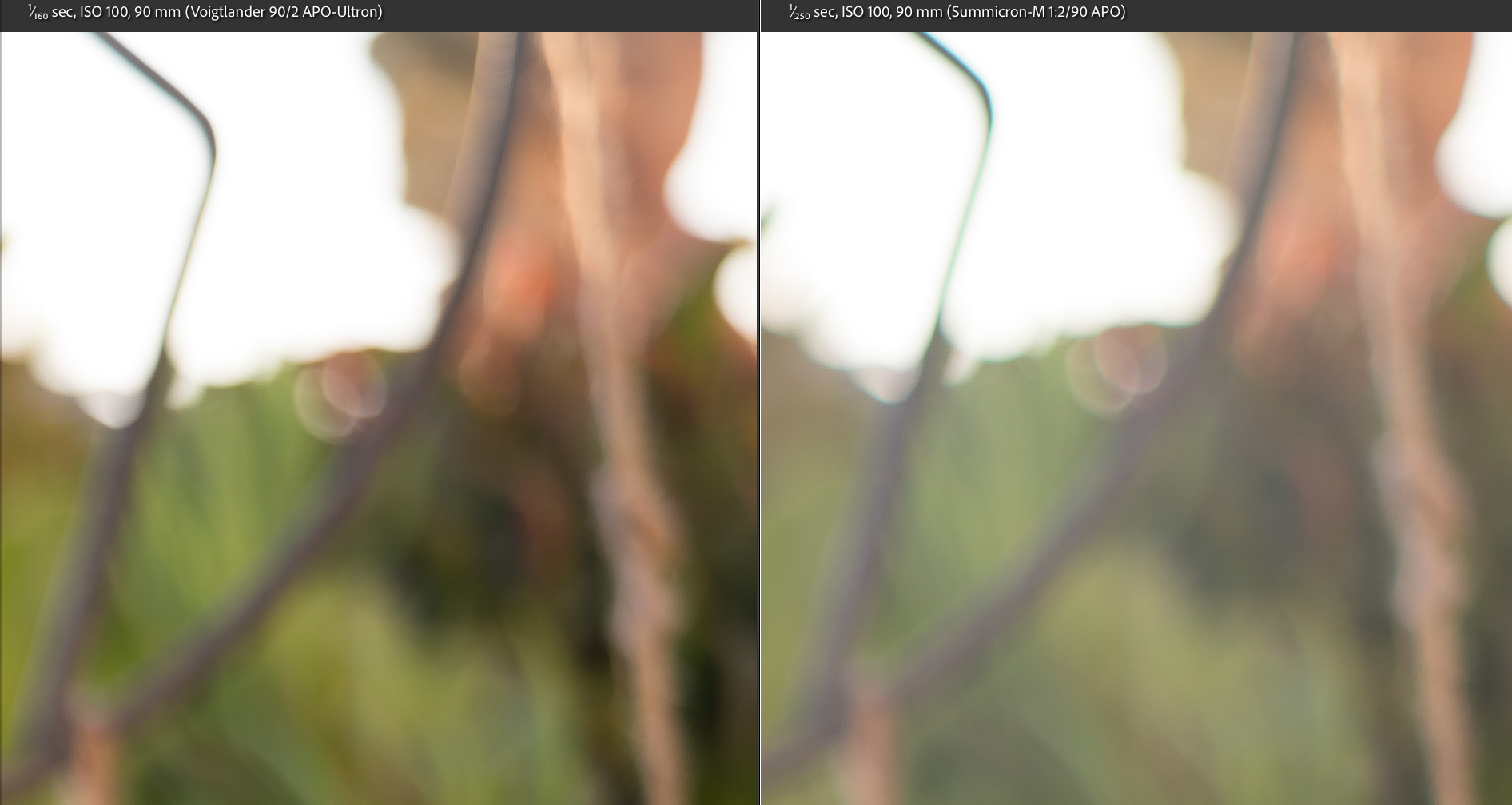
As an apochromatic lens, the Leica APO-Summicron 90mm f/2 ASPH. is highly regarded for its excellent correction of axial chromatic aberration. Axial CA, which appears as purple fringing on the focus plane and magenta/green fringing off-axis, typically becomes noticeable only in extreme high-contrast scenarios. However, in my experience, this lens exhibits more fringing than expected. While the correction is impressive, I feel it falls short of the standard set by some of the best modern APO lenses.
A great example is the new Voigtlander 90mm f/2 APO-Ultron, which features six ADP elements and effectively eliminates axial color errors. I have tested this lens in extreme contrast conditions and found no noticeable fringing. If any exists, it is negligible, offering a clear advantage over the Leica for photographers who prioritize thorough aberration correction.
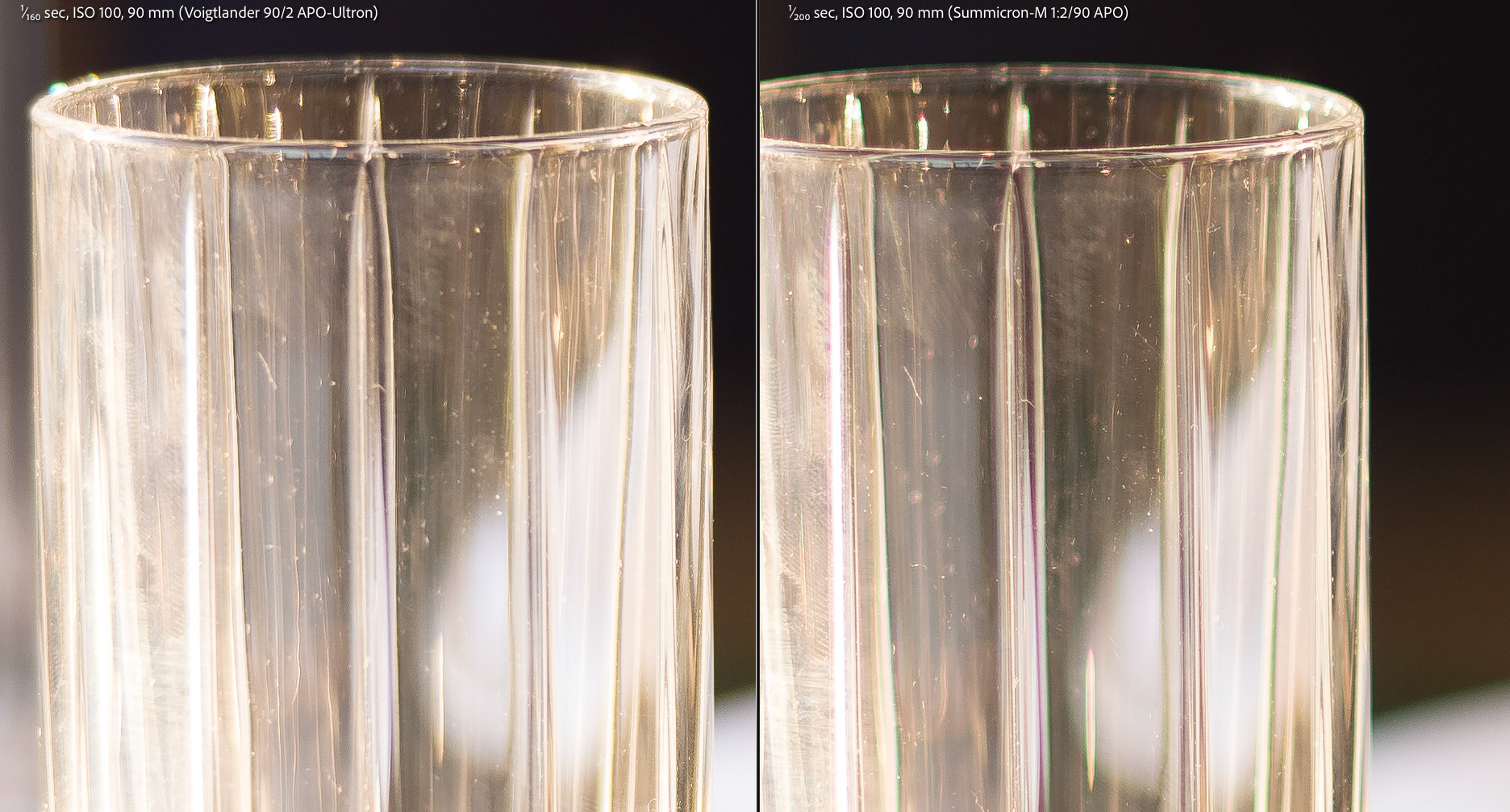
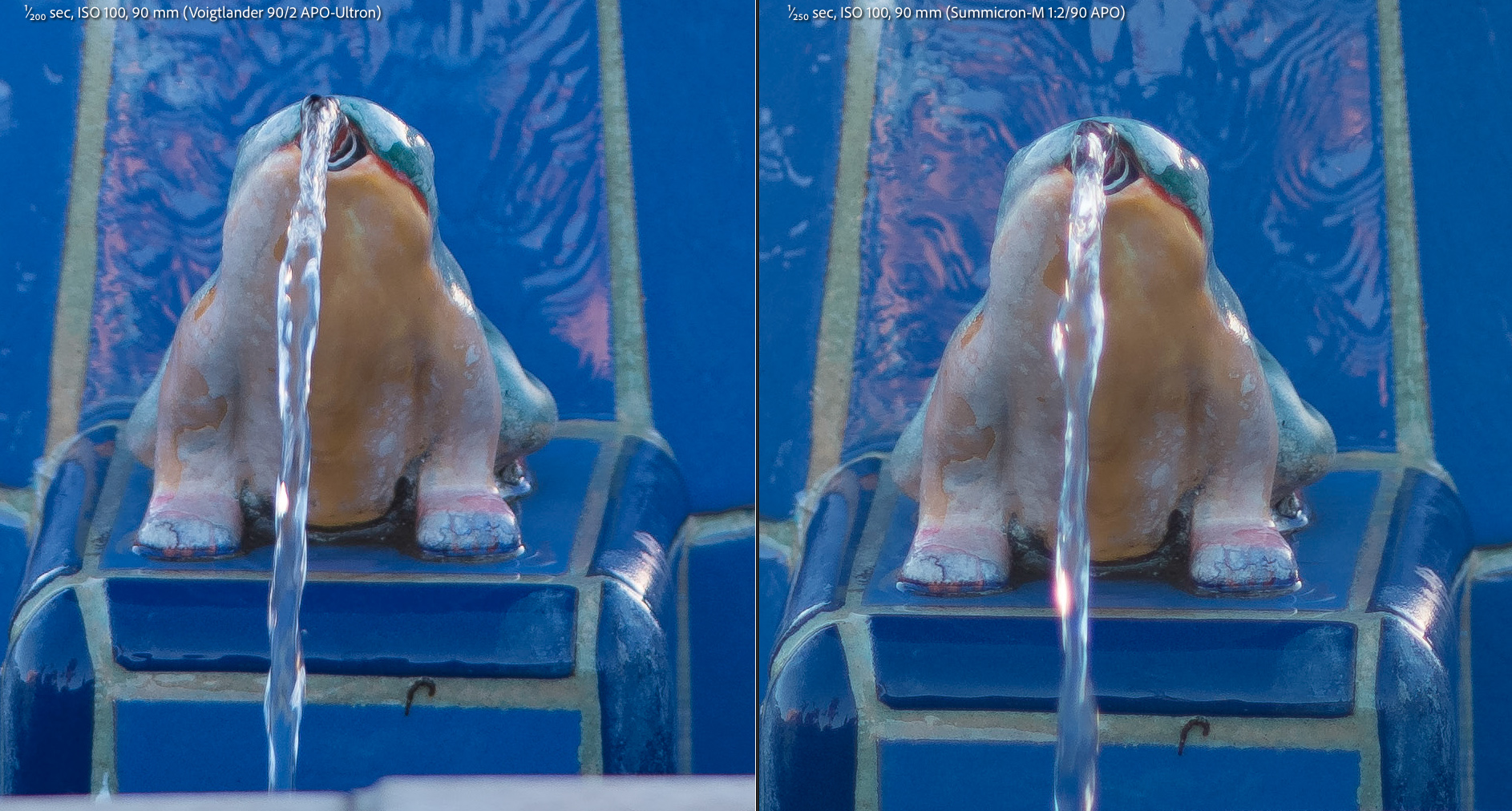
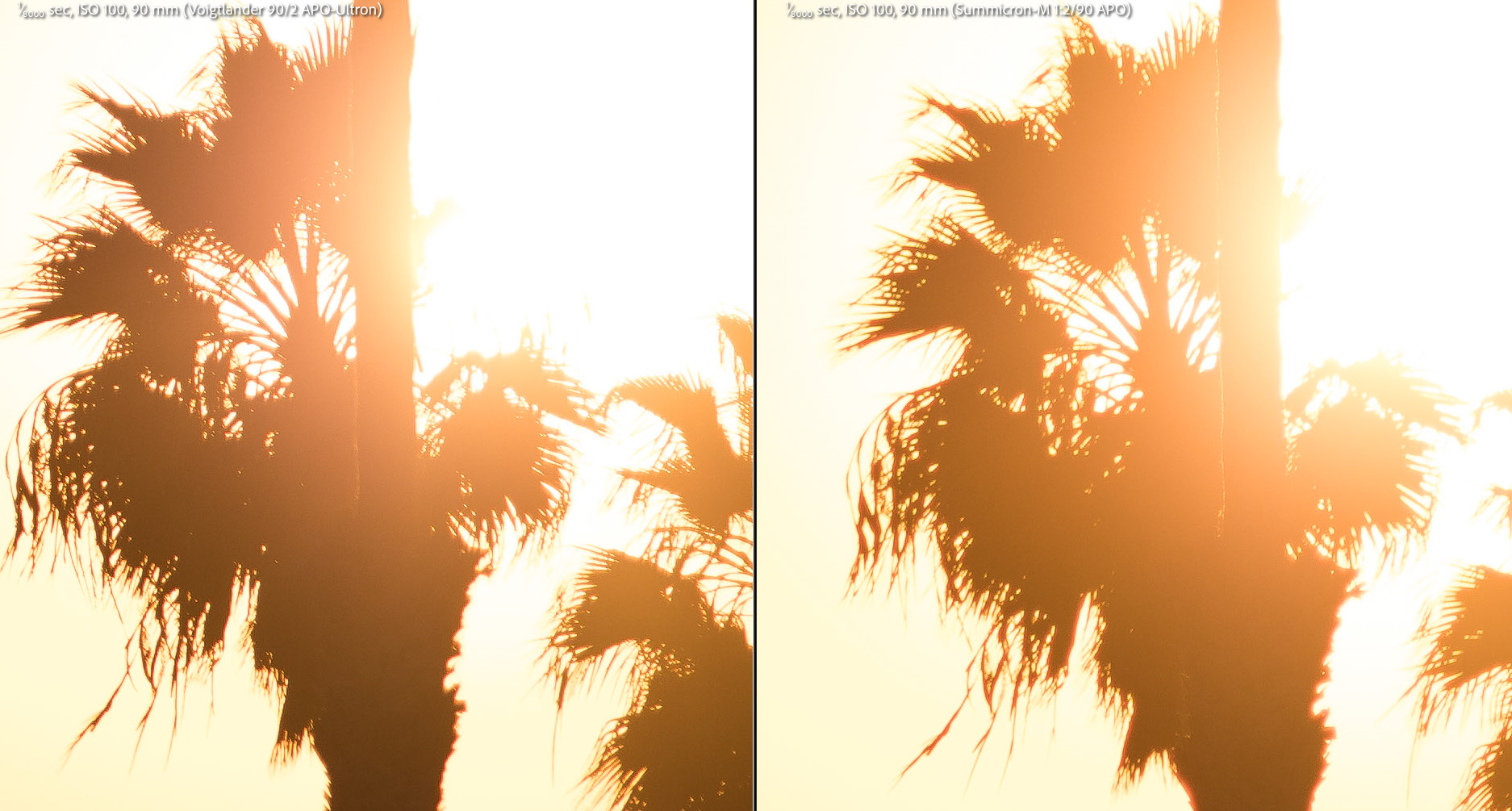
Here are a few samples comparing the Voigtlander and the Leica in terms of axial chromatic aberration (magenta/green) in the out-of-focus areas and purple fringing in the focused areas.
Purple/red fringing in the focused area on the Leica.
Green fringing on the background specular highlights in the Leica.
Green fringing on the background specular highlights in the Leica.
Green fringing on the background specular highlights in the Leica.
Purple/red fringing visible in the focused area of the Leica.
Magenta fringing visible in the Leica crop.
Purple/red fringing visible in the focused area of the Leica.
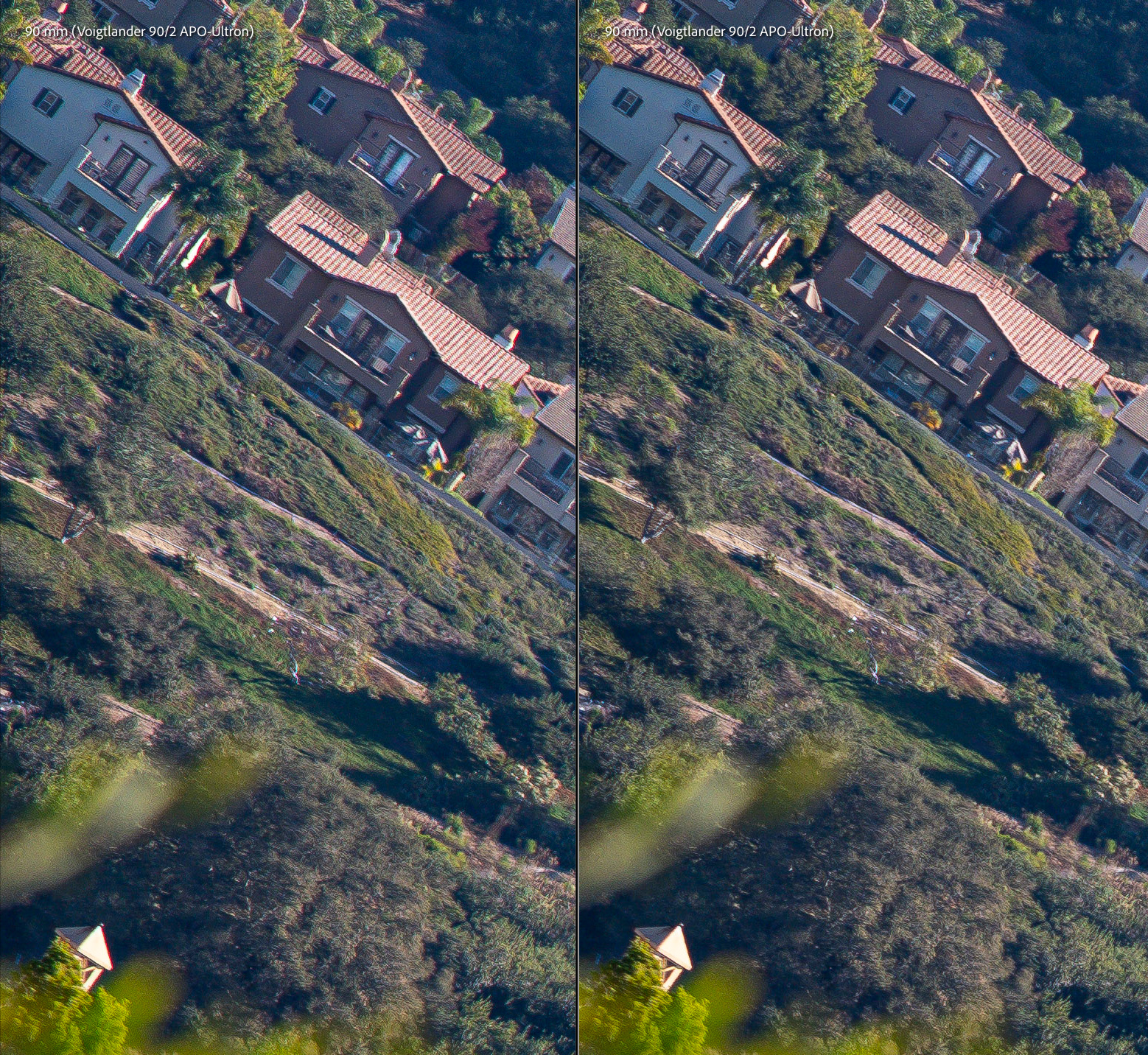
The Voigtlander 90mm f/2 APO-Ultron demonstrates excellent correction for lateral chromatic aberration, which typically appears toward the corners of the frame at any aperture. However, it is not entirely perfect, as some fringing is noticeable at the pixel level.
When using Lightroom’s automatic chromatic aberration correction, this issue is effectively resolved without any visible impact on image quality.
LEFT: Pixel-level crop showing the corners of the image at f/2.8. If you look closely, you can spot some fringing.
RIGHT: Same image with Lightroom’s correction for lateral chromatic aberration applied.