Desmolicious wrote:
It's a bummer that the type 1 does not collapse, as the new Thypoch 50mm Eureka does collapse, is meant to be really solid feeling, and is only $580.
Well, just check the video in the link below, at around 09min15sec mark. After seeing this I remembered what Fred was saying, at some point, about tight tolerances needed for a "precision" lens like this APO (and the aparent/possible reason Voigtlander has opted for a non-collapsible version). This very "wobbling" I saw in this video combined with the clickless aperture has set this lens aside from my interest as a small(est) 50mm lens to adapt to my Sony A7Cr.
catacore wrote:
Well, just check the video in the link below, at around 09min15sec mark. After seeing this I remembered what Fred was saying, at some point, about tight tolerances needed for a "precision" lens like this APO (and the aparent/possible reason Voigtlander has opted for a non-collapsible version). This very "wobbling" I saw in this video combined with the clickless aperture has set this lens aside from my interest in a small(est) 50mm lens to adapt to my Sony A7Cr.
&ab_channel=AnalogInsights
What killed it for me with this lens is the clickless aperture settings, and the focus shift. As a film shooter both are serious buzz kills.
catacore wrote:
Well, just check the video in the link below, at around 09min15sec mark. After seeing this I remembered what Fred was saying, at some point, about tight tolerances needed for a "precision" lens like this APO (and the aparent/possible reason Voigtlander has opted for a non-collapsible version). This very "wobbling" I saw in this video combined with the clickless aperture has set this lens aside from my interest as a small(est) 50mm lens to adapt to my Sony A7Cr.
Indeed! Slightly wobbly collapsible lenses worked fine with film but may not withstand the scrutiny of 60+ MP sensors when testing resolution at the pixel level. I think initially, Cosina made the design collapsible but decided against it when they couldn't achieve acceptable tolerances during production. It doesn't function like a collapsible lens but "looks" like one. Personally, I thought this would bother me, but after testing one, I changed my mind. The Type I is a beautifully crafted lens and looks very nice in person.
Fred Miranda wrote:
Youtube reviewer (Jimmy) - I usually don't watch these, but here are my thoughts:
- He doesn't test if the lens is free of distortion and misses that it can focus closer (0.35m) than any other 50mm M-mount lenses, including those he compared it with.
- His main focus is on questioning the usefulness of an f/3.5 lens, arguing that only fast lenses have character. He doesn't consider applications like street photography, where you might stop down to f/5.6 or f/8.
- He overlooks that the field curvature is flat compared to other lenses, which is beneficial for landscapes and architecture.
- He critiques the focusing ring being connected to the aperture, which is valid, but for street photography using zone focusing, this shouldn't be an issue since the aperture would hardly change.
- He bought the lens to review it but didn't research the weight, mistakenly stating that the Type II silver brass weighs 150 grams, which is inaccurate.
He also believes that all modern 50mm lenses perform similarly to this APO at f/3.5, which isn't the case. While it's true that faster lenses get reduced aberrations when stopped down, side-by-side comparisons show that both the CV 50/2 and 50/3.5 APO lenses perform exceptionally well and stand out from the crowd.
I appreciate Jimmy's review and welcome any critique on mine. It's always valuable to have different perspectives.
We agree on several points, such as the fact that the Type I model is not collapsible despite what the design might suggest. Also, the f/3.5 aperture doesn’t offer much blur and may be too slow for low-light shooting conditions. We also concur that the Type II model combines aperture and focus control on the same ring, which may be inconvenient. However the Type I version has separate focus/aperture rings.
I enjoyed watching many of Jimmy's other reviews, so here's my contribution to support his channel:
Too much personality and opinion presented in a monotonous manner, not enough meat to be interesting. At least the guys at Dear Susan are eloquent when they're telling you about the pointlessness of a lens that has your interest.
You and the guys at PR need to keep doing what you're doing. You keep your opinions brief and always have evidence to back them up. And you keep your testing, sampling, and post processing similar enough that it's easy to make lens comparisons from your individual reviews. In my opinion, you're among the best out there for single copy testing.
Fred Miranda wrote:
Youtube reviewer (Jimmy) - I usually don't watch these, but here are my thoughts:
- He doesn't test if the lens is free of distortion and misses that it can focus closer (0.35m) than any other 50mm M-mount lenses, including those he compared it with.
- His main focus is on questioning the usefulness of an f/3.5 lens, arguing that only fast lenses have character. He doesn't consider applications like street photography, where you might stop down to f/5.6 or f/8.
- He overlooks that the field curvature is flat compared to other lenses, which is beneficial for landscapes and architecture.
- He critiques the focusing ring being connected to the aperture, which is valid, but for street photography using zone focusing, this shouldn't be an issue since the aperture would hardly change.
- He bought the lens to review it but didn't research the weight, mistakenly stating that the Type II silver brass weighs 150 grams, which is inaccurate.
He also believes that all modern 50mm lenses perform similarly to this APO at f/3.5, which isn't the case. While it's true that faster lenses get reduced aberrations when stopped down, side-by-side comparisons show that both the CV 50/2 and 50/3.5 APO lenses perform exceptionally well and stand out from the crowd.
I appreciate Jimmy's review and welcome any critique on mine. It's always valuable to have different perspectives.
We agree on several points, such as the fact that the Type I model is not collapsible despite what the design might suggest. Also, the f/3.5 aperture doesn’t offer much blur and may be too slow for low-light shooting conditions. We also concur that the Type II model combines aperture and focus control on the same ring, which may be inconvenient. However the Type I version has separate focus/aperture rings.
I enjoyed watching many of Jimmy's other reviews, so here's my contribution to support his channel:
I've managed to get the two APO 50/3.5 and the Skopar 50/2.2 returned and refunded. Only the import duties that I can't claim back
It was however, an utterly odd experience having three duff Voigtlander lenses in a row. Both APO lenses front focused to varying degrees, and both had different degrees of tilt and swing. The Skopar had quite a bit of asymmetry from top left to bottom right of the frame. The left mid-zone had astigmatism while the symmetrically opposite side was excellent.
Had the Silver APO Type II 50/3.5 been perfect, then I would been ok with its odd design, because I liked how it looked and felt. But in all honesty neither APO lenses wowed me at all. If anything I would consider trying the Skopar 50/2.2 again, but that vignetting was just too much for my liking.
I've managed to get the two APO 50/3.5 and the Skopar 50/2.2 returned and refunded. Only the import duties that I can't claim back
It was however, an utterly odd experience having three duff Voigtlander lenses in a row. Both APO lenses front focused to varying degrees, and both had different degrees of tilt and swing. The Skopar had quite a bit of asymmetry from top left to bottom right of the frame. The left mid-zone had astigmatism while the symmetrically opposite side was excellent.
Had the Silver APO Type II 50/3.5 been perfect, then I would been ok with its odd design, because I liked how it looked and felt. But in all honesty neither APO lenses wowed me at all. If anything I would consider trying the Skopar 50/2.2 again, but that vignetting was just too much for my liking.
Ironic that they made the “collapsible” non-collapsible to keep it APO, yet they can’t seem to consistently manufacture lenses with aligned elements.
I was having trouble with a lens front focusing by several feet over the weekend, but I stumbled across some advice on Leica Forum to always mount M lenses with the focus ring at minimum distance and not infinity. Never had read that before, but it worked (LLL 8-Element).
highdesertmesa wrote:
Ironic that they made the “collapsible” non-collapsible to keep it APO, yet they can’t seem to consistently manufacture lenses with aligned elements.
I was having trouble with a lens front focusing by several feet over the weekend, but I stumbled across some advice on Leica Forum to always mount M lenses with the focus ring at minimum distance and not infinity. Never had read that before, but it worked (LLL 8-Element).
Ironic for sure. My confidence in Voigtlander has certainly suffered by this.
Mounting with the lens at infinity engages the camera focus lever sooner, and is therefore more prone to being damaged during sloppy lens changes. But it's not a rule that Iv'e ever heard of.
What does make a lens back focus relative to normal focusing, is to rack the focus from close focus to the subject rather than from infinity. The mechanical hysteresis in the lens's helicoid system, and perhaps to a small degree in the camera too, causes this focus inconsistency.
It annoys me tremendously on the Nokton 75/1.5 but never experienced it on the Nokton 50/1.5 ASPH II. Not every lens is the same.
Mounting with the lens at infinity engages the camera focus lever sooner, and is therefore more prone to being damaged during sloppy lens changes.
...
Infinity hard stop vs. Minimum hard stop with the cam hitting the roller sooner when racked in to Infinity, the possibility of throwing the rangefinder roller off is greater, or at least that has been put forward as one drawback to hard lens changes.
There are some who experience consistent rangefinder alignment issues and other lens mounting issues, so you have to wonder how they handle their gear. It is a mechanical connection, with a roller adjusted by a screw, on a metal spring slammed up against a dead weight cam of different configurations and perhaps tolerances on different lenses.
hmzimelka wrote:
Ironic for sure. My confidence in Voigtlander has certainly suffered by this.
Mounting with the lens at infinity engages the camera focus lever sooner, and is therefore more prone to being damaged during sloppy lens changes. But it's not a rule that Iv'e ever heard of.
What does make a lens back focus relative to normal focusing, is to rack the focus from close focus to the subject rather than from infinity. The mechanical hysteresis in the lens's helicoid system, and perhaps to a small degree in the camera too, causes this focus inconsistency.
It annoys me tremendously on the Nokton 75/1.5 but never experienced it on the Nokton 50/1.5 ASPH II. Not every lens is the same. ...Show more →
---------------------------------------------
mapgraphs wrote:
Infinity hard stop vs. Minimum hard stop with the cam hitting the roller sooner when racked in to Infinity, the possibility of throwing the rangefinder roller off is greater, or at least that has been put forward as one drawback to hard lens changes.
There are some who experience consistent rangefinder alignment issues and other lens mounting issues, so you have to wonder how they handle their gear. It is a mechanical connection, with a roller adjusted by a screw, on a metal spring slammed up against a dead weight cam of different configurations and perhaps tolerances on different lenses.
What I experienced with the 35 8-Element from LLL:
Mounted to the camera with the lens infinity-locked (carefully, no slamming): I experienced consistent front focus by about a meter when the rangefinder was focused at about 6 meters.
Re-mounted with lens at minimum focus distance: focus with the rangefinder is perfect.
I'm not going to try to confirm this by re-mounting at infinity given the delicate nature of the mechanics involved.
highdesertmesa wrote:
I was having trouble with a lens front focusing by several feet over the weekend, but I stumbled across some advice on Leica Forum to always mount M lenses with the focus ring at minimum distance and not infinity. Never had read that before, but it worked (LLL 8-Element).
Interesting, I have one lens that front focuses and noticed sometimes it’s fine. I feared my rangefinder alignment was drifting but then other lenses are always spot-on. I will try this mounting technique to see if that fixes the problem!
I've managed to get the two APO 50/3.5 and the Skopar 50/2.2 returned and refunded. Only the import duties that I can't claim back
It was however, an utterly odd experience having three duff Voigtlander lenses in a row. Both APO lenses front focused to varying degrees, and both had different degrees of tilt and swing. The Skopar had quite a bit of asymmetry from top left to bottom right of the frame. The left mid-zone had astigmatism while the symmetrically opposite side was excellent.
Had the Silver APO Type II 50/3.5 been perfect, then I would been ok with its odd design, because I liked how it looked and felt. But in all honesty neither APO lenses wowed me at all. If anything I would consider trying the Skopar 50/2.2 again, but that vignetting was just too much for my liking.
...Show more → highdesertmesa wrote:
Ironic that they made the “collapsible” non-collapsible to keep it APO, yet they can’t seem to consistently manufacture lenses with aligned elements.
I was having trouble with a lens front focusing by several feet over the weekend, but I stumbled across some advice on Leica Forum to always mount M lenses with the focus ring at minimum distance and not infinity. Never had read that before, but it worked (LLL 8-Element).
hmzimelka wrote:
Ironic for sure. My confidence in Voigtlander has certainly suffered by this.
Mounting with the lens at infinity engages the camera focus lever sooner, and is therefore more prone to being damaged during sloppy lens changes. But it's not a rule that Iv'e ever heard of.
What does make a lens back focus relative to normal focusing, is to rack the focus from close focus to the subject rather than from infinity. The mechanical hysteresis in the lens's helicoid system, and perhaps to a small degree in the camera too, causes this focus inconsistency.
It annoys me tremendously on the Nokton 75/1.5 but never experienced it on the Nokton 50/1.5 ASPH II. Not every lens is the same. ...Show more →
One of the 'joys' of using Leica M. It's a simple system but not one where you can turn off your brain because of the various 'quirks' that need to be kept in check. Pretty much all of my M lenses have unique focusing traits that I need to keep in mind while shooting. Some of those traits may also be related to the camera's RF calibration, which might no longer be correct.
As for Cosina VM build consistency, all I can say is the VM28/2 v2 I have does not perform as well as indicated in Fred's tests at wider apertures. But it's very good stopped down where I mostly use it, so have 'lived with it,' like many of the other lens quirks in my M collection. If pursuing calibration perfection I think I would have become very frustrated with the system. Instead I have 'calibrated' myself for each lens to offset focusing errors during use.
Fred Miranda's lens reviews are currently one of, if not the best on the web that I have seen, and the review on new apo is no exception.
I was wondering if he has tried out the Q3 43 and has any thoughts about the camera and it's lens when compared to this 50apo. Having seen reviews of the Q43 all mention glowing praise of it, which means the reviewer is biased and or not critical enough to give a balanced review like Fred
Thankyou for your dedication and time in giving us balanced well thought out reviews
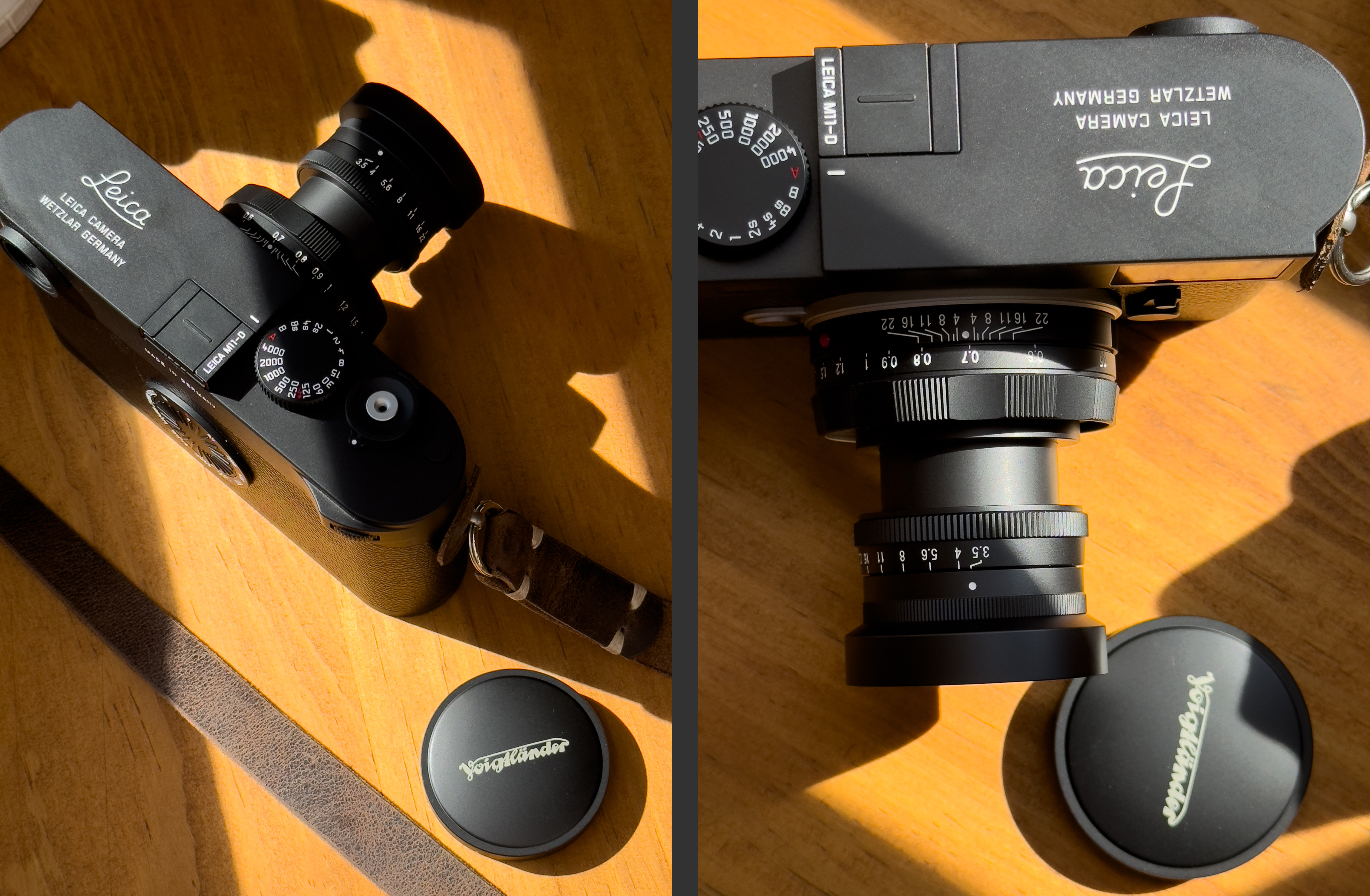
I just ordered the Type I (Pirate's Peg Leg Edition) in matte black to use with my M11-D. Should be here tomorrow. If it is a good copy, I may get the Visoflex 2 to use with it sometimes for focusing closer than 0.7m. I just can't get used to the Type II (Cannibal's Shrunken Head Edition) external design even though I prefer its MFD. But – if I really like the matte black variant, I may get the silver Type II. The silver and brass makes sense, but I can't make sense of gloss black paint on the aluminum barrel of the black Type II.
mboy wrote:
Fred Miranda's lens reviews are currently one of, if not the best on the web that I have seen, and the review on new apo is no exception.
I was wondering if he has tried out the Q3 43 and has any thoughts about the camera and it's lens when compared to this 50apo. Having seen reviews of the Q43 all mention glowing praise of it, which means the reviewer is biased and or not critical enough to give a balanced review like Fred
Thankyou for your dedication and time in giving us balanced well thought out reviews
Turn on subtitles if needed but some interesting thoughts on the Type I matte black version. Also interesting how some of his phrases used to describe tonal range and shadow detail translate into English.
– The copy I received is perfectly centered and calibrated to the rangefinder.
– IQ at f/3.5 at all distances is outstanding.
– Extremely high microcontrast from wide open. The f/2 APO I remember being just as sharp, but I feel like highest contrast with the f/3.5 APO happens at even smaller detail frequencies (anecdotally, I no longer have the f/2 to compare).
– Astonishingly light. Featherweight. Like no lens is on the camera at all.
– The haptics of the detent at just under 0.7m is sublime.
– Aperture ring clicks are positive but nicely dampened. Its aperture ring sounds and feels exactly like the shutter speed dial on the M11 as opposed to the more metallic click of many M lenses.
– Focusing ring is extremely smooth and even throughout the focusing range. It moves as smoothly as the nicest brass lenses I've used such as the 50 Lux Black Chrome.
– Focus throw is pleasing, and I'm glad there is no focus tab since they rotate too far around when close focusing (Leica 50 Lux close focus for example, which has no textured focusing ring, only the tab, which gets awkward at MFD)
– Tolerance to the M mount when attaching the lens is tight. I need to use one hand's thumb to push the lens release button and the other hand to turn the base of the lens to unmount it. Tight but not scary tight if that makes sense.
– Matte black paint is a good match to the M11/P/D paint.
– White lens markings match the M11-P/D white script and other lettering nicely.
I will for sure be getting the Visoflex 2 to make use of the close MFD of this lens with the M11-D.
I don't think this lens will be coming off my camera for a very long time.
highdesertmesa wrote:
Initial thoughts after some quick tests:
– The copy I received is perfectly centered and calibrated to the rangefinder.
– IQ at f/3.5 at all distances is outstanding.
– Extremely high microcontrast from wide open. The f/2 APO I remember being just as sharp, but I feel like highest contrast with the f/3.5 APO happens at even smaller detail frequencies (anecdotally, I no longer have the f/2 to compare).
– Astonishingly light. Featherweight. Like no lens is on the camera at all.
– The haptics of the detent at just under 0.7m is sublime.
– Aperture ring clicks are positive but nicely dampened. Its aperture ring sounds and feels exactly like the shutter speed dial on the M11 as opposed to the more metallic click of many M lenses.
– Focusing ring is extremely smooth and even throughout the focusing range. It moves as smoothly as the nicest brass lenses I've used such as the 50 Lux Black Chrome.
– Focus throw is pleasing, and I'm glad there is no focus tab since they rotate too far around when close focusing (Leica 50 Lux close focus for example, which has no textured focusing ring, only the tab, which gets awkward at MFD)
– Tolerance to the M mount when attaching the lens is tight. I need to use one hand's thumb to push the lens release button and the other hand to turn the base of the lens to unmount it. Tight but not scary tight if that makes sense.
– Matte black paint is a good match to the M11/P/D paint.
– White lens markings match the M11-P/D white script and other lettering nicely.
I will for sure be getting the Visoflex 2 to make use of the close MFD of this lens with the M11-D.
I don't think this lens will be coming off my camera for a very long time....Show more →
I’m glad you got a good copy! I’ve tried three versions, and they were all excellent as well. The matte black Type I looks absolutely stunning on the M11-D!