This topic is in the 2024 archive. You can read it and like its posts here. It is read only.
Archive 2024Dynamic Range R5ii vs R5
p.1 #1Dynamic Range R5ii vs R5
There is a discussion on dpreview about dynamic range:
https://www.dpreview.com/forums/thread/4769704?page=2
I need to read it more slowing but I think the conclusion was the R5 mechanical has higher dynamic range than r5ii electronic 14bit. [maybe because of longer pixel reads]
It's seems early on this front but it is an area of great interest to me. 2/3 of my shooting is at iso 100 on the tripod - landscape.
If I understand it, the comparison might still have to be best mechanical vs mechanical (EFCS). But I was hoping for AEB/electronic with highest dynamic range because 30fps would stop lots of motion.
Interested in your thoughts on this and any reliable data.
Scott
Aug 04, 2024 at 11:01 AM
AmbientMike
Offline
Activity
[X]
Details
p.1 #2Dynamic Range R5ii vs R5
ES doesn't have the DR, vs MS, in general. You can probably see this most easily on the table on Bill Claff's site looking at Maximum PDR.
Doesn't look like Bill Claff has tested R5II DR yet didn't see it on DxO easily could have missed it though.
Doesn't look like Bill Claff has tested R5II DR yet didn't see it on DxO easily could have missed it though.
Aug 04, 2024 at 11:47 AM
p.1 #3Dynamic Range R5ii vs R5
AmbientMike wrote:
ES doesn't have the DR, vs MS, in general. You can probably see this most easily on the table on Bill Claff's site looking at Maximum PDR.
Doesn't look like Bill Claff has tested R5II DR yet didn't see it on DxO easily could have missed it though.
I thought lower dr of electronic was the 12 bit. Whic should have improved with r5 ii 14 bit. But maybe there is something else going on. Maybe stacked sensor has impact.
Aug 04, 2024 at 11:51 AM
AmbientMike
Offline
Activity
[X]
Details
p.1 #4Dynamic Range R5ii vs R5
Looked again some do pretty well using ES, in the table below the graphs. R6 II does well using EFCS, not sure if that's faster.
Some of the stacked sensors do fine on DR , some don't. The R5 probably tough to beat because it's high to begin with
https://www.photonstophotos.net/Charts/PDR.htm
Some of the stacked sensors do fine on DR , some don't. The R5 probably tough to beat because it's high to begin with
https://www.photonstophotos.net/Charts/PDR.htm
Aug 04, 2024 at 12:07 PM
p.1 #5Dynamic Range R5ii vs R5
I don't think anybody's going to know until full production bodies are in the wild, and Bill Claff and others are able to run the usual tests. The rumours of a triple base ISO design are promising for DR at low ISO.
AmbientMike wrote:
Looked again some do pretty well using ES, in the table below the graphs.
This is correct - for instance the Sony 100MP sensor in the GFX 100 (original, II, s, sII) has an excruciatingly slow readout speed but you don't lose any dynamic range. It's so slow that you can get "rolling shutter" artifacts from wind vibrations on a tripod (and yes I have experienced this the hard way).
My guess is that the R5 IIs dynamic range will be a compromise between higher readout speeds leading to greater noise (but benefiting action shooters, especially since they spend much of their time at higher ISOs anyway) and sufficient low ISO range and shadow recoverability for the landscapers.
Aug 04, 2024 at 12:31 PM
p.1 #6Dynamic Range R5ii vs R5
Scott Stoness wrote:
There is a discussion on dpreview about dynamic range:
https://www.dpreview.com/forums/thread/4769704?page=2
I need to read it more slowing but I think the conclusion was the R5 mechanical has higher dynamic range than r5ii electronic 14bit. [maybe because of longer pixel reads]
It's seems early on this front but it is an area of great interest to me. 2/3 of my shooting is at iso 100 on the tripod - landscape.
If I understand it, the comparison might still have to be best mechanical vs mechanical (EFCS). But I was hoping for AEB/electronic with highest dynamic range because 30fps would stop lots of motion.
Interested in...Show more →
R5II 14-bits e-shutter should still have higher DR than R5 12-bits e-shutter. For your needs it will still be an improvement, though it's possible it might not quite match or exceed R5 14-bits mechanical. But of course, it's still TBD.
It would be interesting if Canon provided an option to slow down sensor read speed if it allowed higher bit depth and/or higher DR, for those who don't require fast readout for their applications.
Aug 04, 2024 at 02:08 PM
p.1 #7Dynamic Range R5ii vs R5
In general, a stacked sensor will have more read noise compared to a similar non-stacked sensor though the R5II's DR has yet to be determined. Modern cameras offer such great DR that it is likely that the R5II's Canon sensor will fall in line. For comparison, look at the R5 versus the R3 (stacked sensor) and the DR differences are relatively small. Then look at the Z8 which is a high MP stacked sensor, ES only, and compare it against the existing R5. It isn't something to be overly concerned about IMHO.
Aug 04, 2024 at 02:14 PM
p.1 #8Dynamic Range R5ii vs R5
I was going to mention the Nikon Z6 and Z6II vs. the Z6III's semi-stacked sensor, which does result in a slight DR penalty at lower ISOs...
Again I think this is all going to boil down to individual needs and preferences. As someone primarily photographing people at various types of events, including sports, I'll take slightly worse low ISO DR in exchange for the clear benefits of lower rolling shutter that stacked allows. But Scott's needs are not the same as mine and if there is a DR tradeoff, likely would affect him more than me. And I understand why for him, the R5II's specs are not a clear improvement over the R5, yet for me, they are.
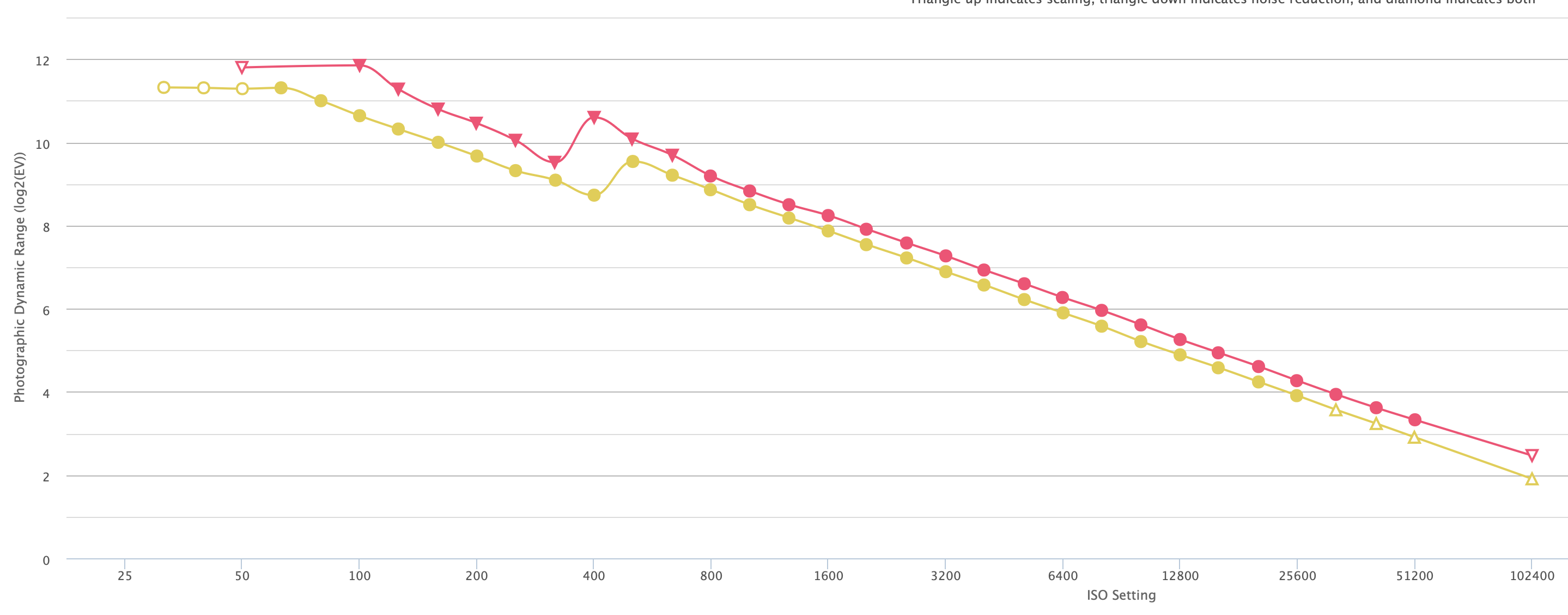
Here's the PtP DR chart of the three Z6 generations also compared against the R6II in mechanical and e-shutter. I elected to compare the R6II because it's also 24MP and should be a more apples to apples comparison.
Aug 04, 2024 at 02:40 PM
p.1 #9Dynamic Range R5ii vs R5
R5 = red
Z8 = Yellow
I do not expect the R5II to be better than the R5 but we'll see. And isn't this where people say Canon cheats on their RAW files which means this isn't an apples to apples caparison anyway?
Z8 = Yellow
I do not expect the R5II to be better than the R5 but we'll see. And isn't this where people say Canon cheats on their RAW files which means this isn't an apples to apples caparison anyway?
Aug 04, 2024 at 04:16 PM
p.1 #10Dynamic Range R5ii vs R5
artsupreme wrote:
R5 = red
Z8 = Yellow
I do not expect the R5II to be better than the R5 but we'll see. And isn't this where people say Canon cheats on their RAW files which means this isn't an apples to apples caparison anyway?
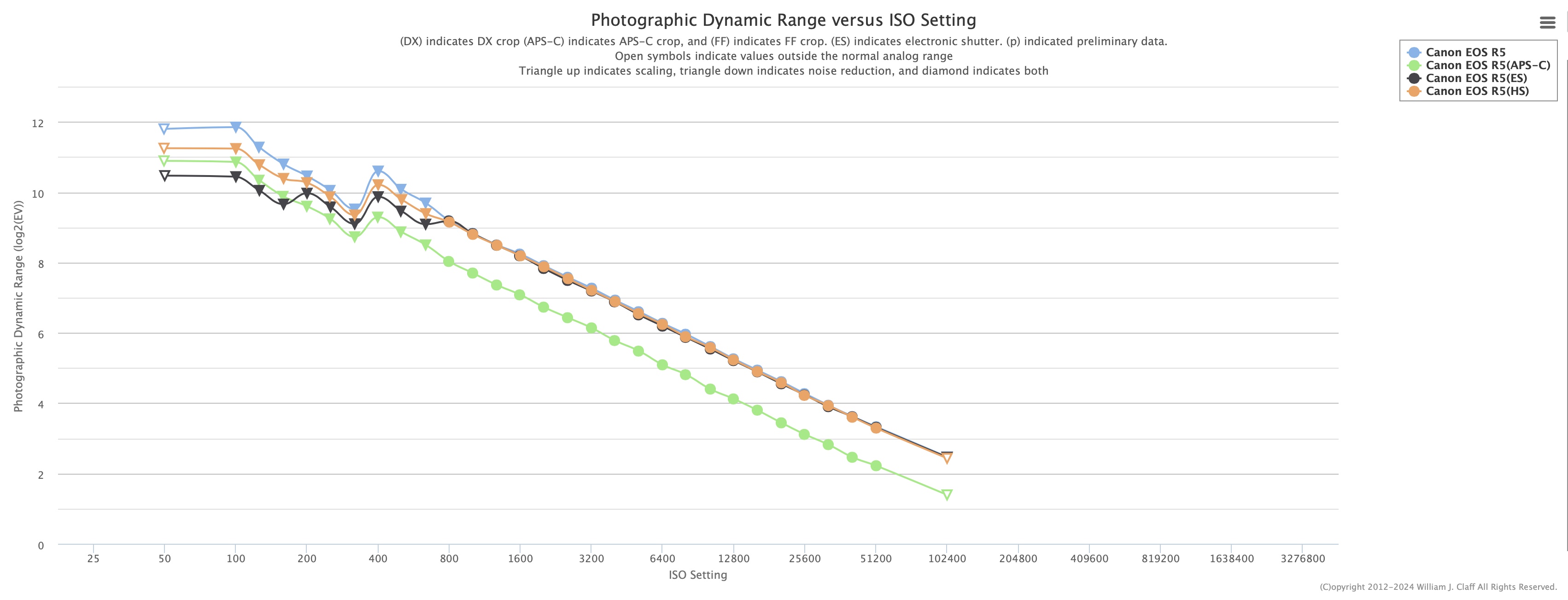
There are measures for ES - electronic shutter, R5, HS, and APSC. I presume the HS is high speed (12fps efts)?
If so the 14 bit at 15fps might be improved by 1/3 stop at low iso's?
Does anyone know what HS means vs r5 [no HS] ?
It suggests ES is same a mechanical at iso 800, and same as HS at 200.
R5 = red
Z8 = Yellow
I do not expect the R5II to be better than the R5 but we'll see. And isn't this where people say Canon cheats on their RAW files which means this isn't an apples to apples caparison anyway?
There are measures for ES - electronic shutter, R5, HS, and APSC. I presume the HS is high speed (12fps efts)?
If so the 14 bit at 15fps might be improved by 1/3 stop at low iso's?
Does anyone know what HS means vs r5 [no HS] ?
It suggests ES is same a mechanical at iso 800, and same as HS at 200.
Aug 05, 2024 at 03:59 PM
p.1 #11Dynamic Range R5ii vs R5
Does even DR relate to the bit depth of raw files? There's this well depth of the sensels, and then there is color depth of the raw files or other formats. I would expect that within the process of the digitalization, the well depth is transformed into the bit depth of the image format, sort of like 10+bits of raw are mapped to 8 bits of jpeg or vice versa (e.g. jpeg converted to 16bit PNG), depending, which one is bigger, or perhaps they relate 1:1. Is there any info on this?
Aug 05, 2024 at 04:22 PM
p.1 #12Dynamic Range R5ii vs R5
artsupreme wrote:
R5 = red
Z8 = Yellow
I do not expect the R5II to be better than the R5 but we'll see. And isn't this where people say Canon cheats on their RAW files which means this isn't an apples to apples caparison anyway?
If the R5II's DR is equivalent to the R5, slightly better, or equivalent to the Z8, it doesn't really translate into significant, real world differences. If the DR is the issue, buy a medium format.
Aug 05, 2024 at 05:32 PM
p.1 #13Dynamic Range R5ii vs R5
14 bit compared to 12 is a fool's game...dithering noise is its hallmark card. Nice to have but pretty indistinguishable in actual photos.
Aug 05, 2024 at 05:55 PM
p.1 #14Dynamic Range R5ii vs R5
Check out DPReview
Canon EOS R5II Studio scene shows expected speed/DR tradeoff
in those test R5II seems alot worse than R5
Similar trade-offs as Nikon Z6III
Canon EOS R5II Studio scene shows expected speed/DR tradeoff
in those test R5II seems alot worse than R5
Similar trade-offs as Nikon Z6III
Aug 06, 2024 at 09:36 AM
p.1 #15Dynamic Range R5ii vs R5
From what I can see the new camera has a bit more noise, and a bit more sharpness and detail. Maybe Canon stopped putting noise reduction into the raw files.
Aug 06, 2024 at 02:02 PM
p.1 #16Dynamic Range R5ii vs R5
WRT in-camera RAW NR, we'll probably have a better idea once Bill Claff has been able to evaluate the R5II's files. I'd be surprised if there was a sudden reversal by Canon. But who knows, it could happen... 
Aug 06, 2024 at 02:32 PM
p.1 #17Dynamic Range R5ii vs R5
rscheffler wrote:
WRT in-camera RAW NR, we'll probably have a better idea once Bill Claff has been able to evaluate the R5II's files. I'd be surprised if there was a sudden reversal by Canon. But who knows, it could happen...
I would guess the reason for a sudden reversal could be to save power and reduce heating.
The camera is officially not available yet?
Aug 06, 2024 at 02:36 PM
p.1 #18Dynamic Range R5ii vs R5
alundeb wrote:
I would guess the reason for a sudden reversal could be to save power and reduce heating.
The camera is officially not available yet?
Those are two very good reasons to get rid of the in-camera NR
rscheffler wrote
WRT in-camera RAW NR, we'll probably have a better idea once Bill Claff has been able to evaluate the R5II's files. I'd be surprised if there was a sudden reversal by Canon. But who knows, it could happen...The camera is officially not available yet?
Those are two very good reasons to get rid of the in-camera NR
Aug 06, 2024 at 03:00 PM
p.1 #19Dynamic Range R5ii vs R5
alundeb wrote:
I would guess the reason for a sudden reversal could be to save power and reduce heating.
The camera is officially not available yet?
@aludenb, while the camera is not "officially" out yet, there have been a few members have managed to get their hands on the cameras early.
rscheffler wrote
WRT in-camera RAW NR, we'll probably have a better idea once Bill Claff has been able to evaluate the R5II's files. I'd be surprised if there was a sudden reversal by Canon. But who knows, it could happen...The camera is officially not available yet?
@aludenb, while the camera is not "officially" out yet, there have been a few members have managed to get their hands on the cameras early.
Aug 06, 2024 at 03:13 PM
p.1 #20Dynamic Range R5ii vs R5
Sashi wrote:
I would guess the reason for a sudden reversal could be to save power and reduce heating.
The camera is officially not available yet?@aludenb, while the camera is not "officially" out yet, there have been a few members have managed to get their hands on the cameras early.
One of mine will be here tomorrow and I might be willing to dump it for a discount. PM me if anyone is interested, especially with a local sale in SoCal.
alundeb wrote
rscheffler wrote
WRT in-camera RAW NR, we'll probably have a better idea once Bill Claff has been able to evaluate the R5II's files. I'd be surprised if there was a sudden reversal by Canon. But who knows, it could happen...The camera is officially not available yet?
One of mine will be here tomorrow and I might be willing to dump it for a discount. PM me if anyone is interested, especially with a local sale in SoCal.
Aug 06, 2024 at 03:21 PM