bernardl wrote:
I don’t know what’s so hard to understand. Global shutter is a unique capability for which I am ok to compromise on other aspects.
The R1 doesn’t have a global shutter so it’s not an alternative to the a9III.
What is the relevance of global shutter to bird photography in particular? I have no experience with hummingbirds, so maybe their wings are faster, but with all the birds I have encountered, it would be of no relevance.
I also don’t see the availability of budget lenses on RF as being at all relevant to the OP. He’s doing this professionally and has a big budget. He probably just needs one or two lenses, not a wide range like many hobbyist general photographers, so can direct his already larger budget to those lenses.
This thread is deteriorating into another "which system is best”, the correct answer to which is “for what?”, and the OP already laid out exactly what. Bird photography. Not sports.
bernardl wrote:
I don’t know what’s so hard to understand. Global shutter is a unique capability for which I am ok to compromise on other aspects.
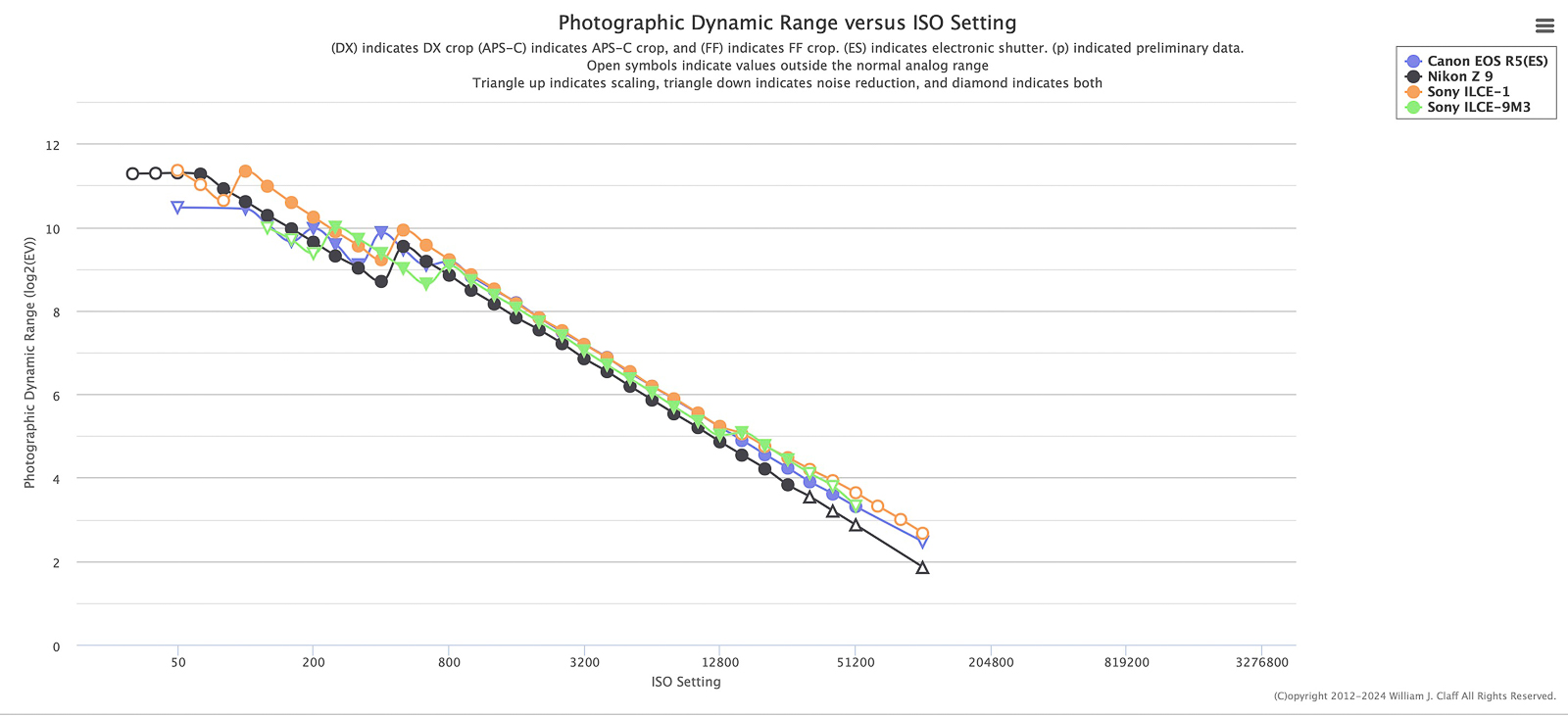
The R1 doesn’t have a global shutter so it’s not an alternative to the a9III. So its base ISO DR, fake as it is since Canon is the only company applying DR to their raw files at base ISO, is just irrelevant.
I also shoot with a Phaseone IQ-150 that has the best DR on the market by far, it would not have come to my mind to bring it up in the discussion since it doesn’t have a GS shutter either.
To be 100% clear, Canon and Nikon have nothing coming close to the a9III for the niche use cases when a GS is needed. As a Nikon Shooter I can benefit from these capabilities at limited cost because I can use my Sony lenses on my Nikon bodies with excellent AF. The a9III also has fabulous AF, a deep pré-capture raw buffer, the ability to shoot 120 fps at full res raw with AF and exposure,… it’s overall head and shoulder above the R1 as a sports camera. Your insistence on DR demonstrates that you understand that a global comparison of both cameras would reveal of the extent of the gap.
I can benefit from these advantages at minimal cost while keeping the benefits of my Nikons. This would be more difficult had I committed to the RF mount.
Btw, how good is the AF through these adapters? So good that a Sony shooter using his FE 600mm f4 on the Z8 was complaining in a FB group a few hours ago that the AF of the Z8 is not 100% as good as that of the a1 on humming birds in flight…
Yes, I realize the A9 III spits out low DR, lower quality photos at a high rate.
Where were you to defend DSLR'S that supposedly aren't any good because of the DR? Nothing else considered, for the most part. So if you apply the same standard to the A9III, it is no good, apparently, since it has poor DR vs even older DSLR'S
melcat wrote:
This thread is deteriorating into another "which system is best”, the correct answer to which is “for what?”, and the OP already laid out exactly what. Bird photography. Not sports.
What else could we expect? Given the OP already knows the answer to his question, this thread is really just fodder for a good old flamewar that brings back nostalgia for the days when the Canon board was much busier.
The way you pushed Sony on the Canon board. Did you ever push a balanced attitude on DSLR'S? What a stupid post
Yes, for a landscape camera, dynamic range is very important…but the A93 is not a landscape camera and for shooting sports, there are many other attributes of the camera well ahead of dynamic range.
Calling something stupid is a very childish response when they have no real rebuttal.
rscheffler wrote:
Bernard, many of your replies are stated as absolutes supporting your opinions and suggest there is no gray area. Clearly you're passionate about raw-level NR applied in-camera, whereas for me, I'd only care if it resulted in noticeable image quality degradation. So, whatever Canon is applying in-camera thus far has been a non-factor for me and my apparently much less critical imaging criteria.
And the Z6 can be "safely forgotten" because it's no longer relevant for you, but Debord was 'stuck' with one, unsatisfied with its performance and apparently unwilling or unable to justify an upgrade to the Z8 before finding another solution before the Z6III arrived...
Adapting has been a long-time solution across many systems and it so happened that until recently, Canon's EF flange distance was the best suited to adapting lenses from other brands. Therefore some could pick and choose off-brand options if it best suited their needs. But with RF Canon has reversed that by making it longer than Sony and Nikon, probably to eliminate the possibility, after so many EF lenses were used on Sony cameras back when Sony had a very limited lens selection. How many Nikon Z users are now adapting Sony FE lenses? Why is that? Because those are superior to Nikon options (or lack thereof)? Or maybe the reality is some just like to have options (and now Nikon Z is arguably the best system for adapting lenses). It's easy to pull isolated examples out of history, like I can ask why anyone bothered to shoot Nikon with obsolete screw-drive lenses compared to Canon's USM back in the 90s? How long did it take for Nikon to release AF-S 'USM' super-teles after Canon already had it in their 300/2.8 way back in 1987? The Nikon stop-gap AF-I model was released in 1992 and AF-S didn't appear until a whopping 9 years after the Canon in 1996. No wonder so many abandoned Nikon! (I sold many Canon systems to switchers back then) Or for something more relevant, to me: Canon released the 200-400/4 TC lens in 2013 and Nikon didn't respond with their 180-400 until 2018! That 200-400 is a prime reason I was and still am with Canon (a lens notably and surprisingly absent from Sony, at least for now), along with excellent CPS support and various other factors that are difficult to tease out of spec sheets on paper....Show more →
A couple of answers:
- my point about in camera raw NR is that it prevents any comparison of sensors DR
- the Z6 can be forgotten in the sense that it’s AF is absolutely not representative of Nikon’s current AF performance. The Canon R was overall way more of a disaster if you insist on looking at initial mirrorless offerings,
- fully agreed that Nikon was very late with AF-S, you can add FF sensors to the list until 2007. And that very much backs up my view that Canon was the most innovative camera company until 2006, they have mostly been sleeping on their laurels since then, I know I am over simplifying a bit, there are always some exceptions. The R5/R6 were remarkable efforts compared to the 5Dmk n,
- you appear to have a selective memory about 200-400mm f4, Nikon released their first AF-S VR one 10 years before the first similar Canon (it was announced in 2003), the very first Nikon 200-400mm f4 dates back 1984. Agreed their were late to add a built-in TC to theirs
- glad to see you appreciate the value of built-in TCs. Let’s hope that the rumored RF 200-500mm f4 comes with one.
Agreed this isn’t relevant for bird photography. Apologies, I’ll stop here.
rscheffler wrote:
What else could we expect? Given the OP already knows the answer to his question, this thread is really just fodder for a good old flamewar that brings back nostalgia for the days when the Canon board was much busier.
Could be. Canon’s releases offer a lot of fodder and there is enough blame on all of the fanboys. Some of the Canon users refuse to acknowledge the shortcomings and likewise many Nikon and Sony owners are unable to concede the same.
I’ll have another steaming helping of tu quoque please…
Meanwhile on the subject of NR in raw files, a few things:
1. I was under the impression that Canon is not the only one doing this, and that cameras are generally taking steps to handle noise from the sensors internally these days.
2. Imagine that we get the same image quality and the same noise levels from three cameras. One supposedly applies no internal NR. One applies a little bit. Another applies more. But in the end, all three files look great. Why should be care which approach is used?
chez wrote:
Yes, for a landscape camera, dynamic range is very important…but the A93 is not a landscape camera and for shooting sports, there are many other attributes of the camera well ahead of dynamic range.
Calling something stupid is a very childish response when they have no real rebuttal.
But your last 2 post are massively stupid
As much trouble as you have caused on the Canon board pushing your stupid Sony, and as much of that involved running down DSLR'S for having low DR, you have no business whatsoever taking up for a low DR $6k Sony, having older DSLR level DR, on the Canon board.
Talking up for GDan may have been a waste of time, but you still acted like an 11 year old at recess. So you have no business whatsoever telling me I'm childish
gdanmitchell wrote:
I’ll have another steaming helping of tu quoque please…
Meanwhile on the subject of NR in raw files, a few things:
1. I was under the impression that Canon is not the only one doing this, and that cameras are generally taking steps to handle noise from the sensors internally these days.
2. Imagine that we get the same image quality and the same noise levels from three cameras. One supposedly applies no internal NR. One applies a little bit. Another applies more. But in the end, all three files look great. Why should be care which approach is used?
Only Canon applies NR to their raw files at low ISOs.
There are 2 reasons why I prefer cameras not to apply NR:
1. GPU are tens of times more powerful meaning that better NR algorithms can be used (in your 3 use cases #1 will always offer better shadow quality)
2. It enables me to assess the image quality potential of the sensor.
A raw file should be a raw file. Otherwise I would shoot jpg. I guess that many photographers in this very forum consider it a half insult to be asked if they shoot jpg. Well… 🤣
Why does Canon do it? To display artificially flattering DR numbers. And it works, some photographers are genuinely convinced that Canon recent cameras have the best DR on the market. In my view it’s close to false advertisement. The legality of this may be borderline questionable considering the misleading nature of this trick vs the base expectation of most photographers about what a raw file is.
In many countries it’s illegal to add sugar to desert wines…why so? To protect consumers.
What? It is literally because of the noise reduction algorithm Sony applied to their raw files that was eating up the stars lol but whatever.
But hey in all seriousness don't let me stop you guys from keep arguing over which brand is 5% better than the other and how it's obviously preventing you getting your world class leading photos, have fun!
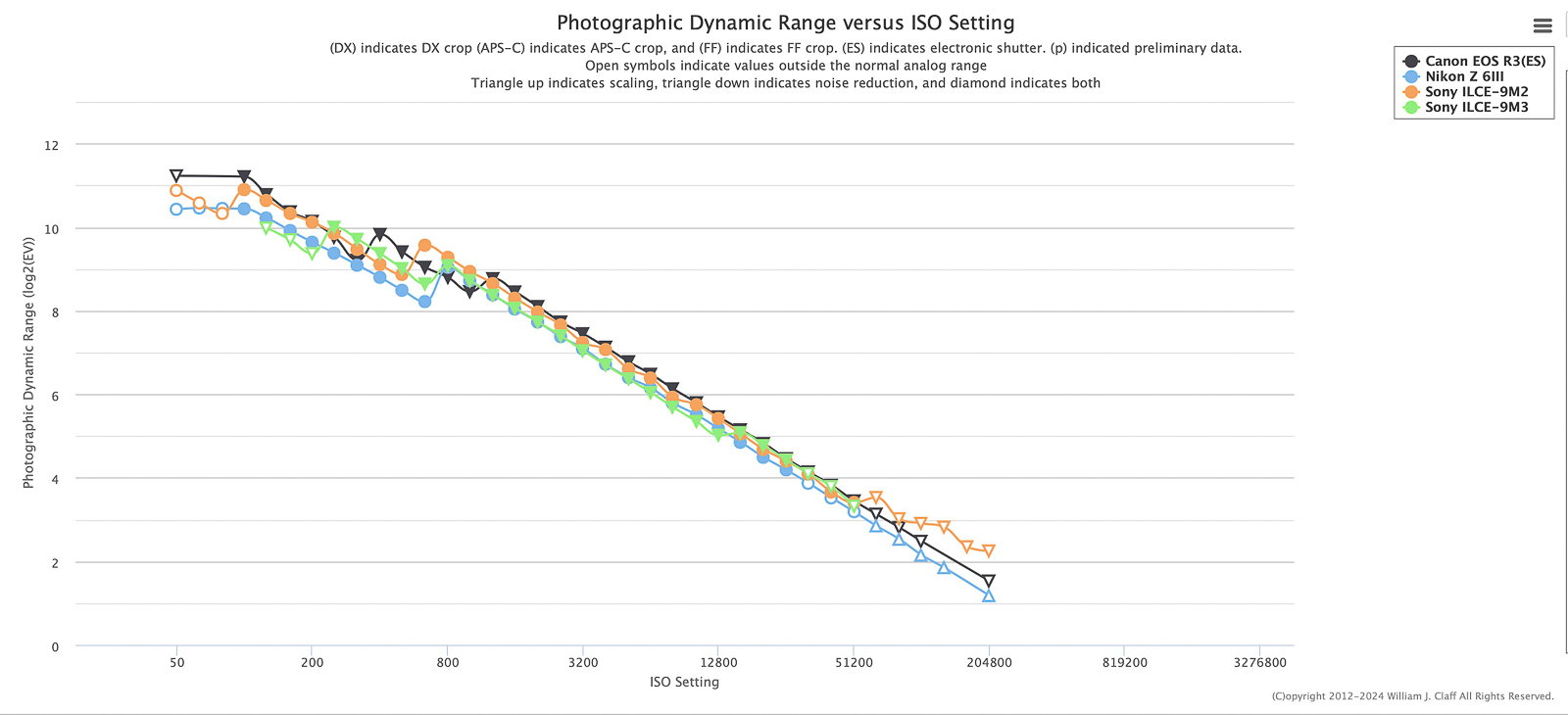
The limited photography dynamic range at low ISO of the A9III is caused by the limited full well capacity, evident in the base ISO of 250. It basically has the PDR of an APS-C camera. For me, that negates the most important reason to use a large sensor in the first place. The noise reduction algorithms, be it the Canon read noise NR or the Sony Star eater, are completely irrelevant when it comes to the fact that the global shutter does indeed sacrifice a lot of PDR at base ISO.
That being said, Bill Claff at photonstophotos does indicate NR detected for the A9III PDR measurements, if that makes anyone sleep better.
alundeb wrote:
That being said, Bill Claff at photonstophotos does indicate NR detected for the A9III PDR measurements, if that makes anyone sleep better.
If so I stand corrected, I was not aware of this. Nikon remains the only guardian of the temple it would seem then. 🤣
alundeb wrote:
The limited photography dynamic range at low ISO of the A9III is caused by the limited full well capacity, evident in the base ISO of 250. It basically has the PDR of an APS-C camera. For me, that negates the most important reason to use a large sensor in the first place. The noise reduction algorithms, be it the Canon read noise NR or the Sony Star eater, are completely irrelevant when it comes to the fact that the global shutter does indeed sacrifice a lot of PDR at base ISO.
That being said, Bill Claff at photonstophotos does indicate NR detected for the A9III PDR measurements, if that makes anyone sleep better....Show more →
The saving grace for the A9III in regards to DR is that 99% of the target market never get the luxury of shooting anywhere remotely close to base ISO 250, let alone if it actually had ISO 100.
When we evaluated the A9III's DR in the range where most sports and wildlife shooters live at it is competitive with all the other cameras (R1/R5II remain to be seen).
Storm in a tea cup.
Well, if you are comparing to 1DXIII. The old DSLR D6 not looking so good.
So why not be honest? You lose ISO values below 250.
Compared to 1DXIII there is a small PDR hit, at low ISO, but it's better than D6.
Compare to 1DXII and it's an even smaller difference.
As Arbitrage mentioned, loss of ISOs below 250 is barely a loss for this camera.
Stupid to keep harping on about it as if it's a big deal.
Wait until someone else releases a global shutter camera and compare then.
I’m in a very similar situation as Dorian, I’ve been shooting with Canon now for about a decade and I’ve often toyed with the idea of switching but they’ve always offered enough to keep me in the ecosystem. I’ve owned an a9 and a9 II and bought 200-600’s twice and it just wasn’t enough to get me to jump ship. The thing I want most these days is a faster body that I can use at same speeds 90% of the time and then for niche scenarios like swallows in flight I can bump it up to 60fps or more. For swallows, 30fps is more than enough if all you’re concerned with is getting a nice photo of a bird in flight. At this point I have hundreds if not thousands of those photos that I’ve been able to capture with little effort with the R3 (the resolution is low but if you practice enough getting them at close range is not that hard). The issue comes down to when you start pushing past the basic stuff and start thinking about something different and unique.
The a9 III’s release is the first body I’ve seen that truly offers something that none of the competition remotely has in its insane burst speeds (along with killer AF that I assume is at least on-par with the R3). With all the rumors that the R1 was going to be a lower res body I was ready to accept it given that it had speed to at least stack up against the a9 III. I would have been completely content with the R1/R5 II combo had the R1 shot at least 60fps but what they gave us offers such a little improvement over the R3 in terms of burst rate that it became a non-starter for me as soon as it was announced. It feels like the culmination of Canon resting on its laurels while Nikon and Sony push the boundaries with their gear lineup.
At this point I’m just going to pare down my kit to the bare essentials (probably just my R3, RF 400, TC’s, and maybe the 100-500) and go from there. If the R5 II ends up being a huge improvement somehow over the R3 in terms of AF then maybe I’ll bite. The only thing really keeping me from pulling the trigger on the a9 III and doing a complete switch is buffer depth, at 120fps you’re only getting like a second and a half of shooting which may or may not be enough. I need to do more research on that to see if it’s more useable at 60fps which should be more than fast enough for most cases. I am curious to see if the rumors of a high speed option from Nikon come to fruition too, if they could provide a 24MP body that shoots 120fps but with the buffer depth of the Z9 that would be it for me, I could live with that and a Z9/Z8 for years to come.
Tony5787 wrote:
I’m in a very similar situation as Dorian, I’ve been shooting with Canon now for about a decade and I’ve often toyed with the idea of switching but they’ve always offered enough to keep me in the ecosystem. I’ve owned an a9 and a9 II and bought 200-600’s twice and it just wasn’t enough to get me to jump ship. The thing I want most these days is a faster body that I can use at same speeds 90% of the time and then for niche scenarios like swallows in flight I can bump it up to 60fps or more. For swallows, 30fps is more than enough if all you’re concerned with is getting a nice photo of a bird in flight. At this point I have hundreds if not thousands of those photos that I’ve been able to capture with little effort with the R3 (the resolution is low but if you practice enough getting them at close range is not that hard). The issue comes down to when you start pushing past the basic stuff and start thinking about something different and unique.
The a9 III’s release is the first body I’ve seen that truly offers something that none of the competition remotely has in its insane burst speeds (along with killer AF that I assume is at least on-par with the R3). With all the rumors that the R1 was going to be a lower res body I was ready to accept it given that it had speed to at least stack up against the a9 III. I would have been completely content with the R1/R5 II combo had the R1 shot at least 60fps but what they gave us offers such a little improvement over the R3 in terms of burst rate that it became a non-starter for me as soon as it was announced. It feels like the culmination of Canon resting on its laurels while Nikon and Sony push the boundaries with their gear lineup.
At this point I’m just going to pare down my kit to the bare essentials (probably just my R3, RF 400, TC’s, and maybe the 100-500) and go from there. If the R5 II ends up being a huge improvement somehow over the R3 in terms of AF then maybe I’ll bite. The only thing really keeping me from pulling the trigger on the a9 III and doing a complete switch is buffer depth, at 120fps you’re only getting like a second and a half of shooting which may or may not be enough. I need to do more research on that to see if it’s more useable at 60fps which should be more than fast enough for most cases. I am curious to see if the rumors of a high speed option from Nikon come to fruition too, if they could provide a 24MP body that shoots 120fps but with the buffer depth of the Z9 that would be it for me, I could live with that and a Z9/Z8 for years to come....Show more →
You have me wondering what that “something different and unique” could possibly be.


 (I sold many Canon systems to switchers back then) Or for something more relevant, to me: Canon released the 200-400/4 TC lens in 2013 and Nikon didn't respond with their 180-400 until 2018! That 200-400 is a prime reason I was and still am with Canon (a lens notably and surprisingly absent from Sony, at least for now), along with excellent CPS support and various other factors that are difficult to tease out of spec sheets on paper.